India’s Industrial Growth Hits a 2-Year High: IIP Jumps 6.7% in Nov 2025 — Explained
In November 2025, India’s industrial sector delivered one of its strongest performances in recent years. The country’s Index of Industrial Production (IIP) rose by 6.7% year-on-year, marking the highest industrial growth in nearly two years. This jump was led mainly by manufacturing and mining, while electricity output remained weak.

At first glance, this looks like a strong positive signal for the economy. But to truly understand what this number means, we need to go deeper—into which sectors grew, what kind of demand is driving production, how this compares with recent months, and whether this momentum can sustain.
This article explains the latest IIP data in simple words, uses real numbers, and adds historical and global context, so readers can clearly understand what is happening in India’s real economy.
What Is the Index of Industrial Production (IIP) and Why It Matters
The Index of Industrial Production (IIP) is a monthly indicator that measures how much physical output India’s industries produce compared to the same month last year. It is released by the Ministry of Statistics and Programme Implementation (MoSPI).
IIP covers three major sectors:
Manufacturing
Mining
Electricity
Unlike GDP, which is released quarterly and includes services, IIP focuses purely on industrial activity. It tells us whether factories are producing more goods, whether mines are extracting more raw materials, and whether electricity generation is rising or falling.
When IIP growth is strong, it usually means:
Factories are busier
Job creation improves
Business confidence rises
Government tax collections strengthen
That is why a sharp rise in IIP often attracts attention from policymakers, investors, and economists.
November 2025 IIP: The Headline Numbers
The latest data released at the end of December 2025 shows a clear rebound in industrial activity.
📊 Data Box: IIP Growth — November 2025 (YoY)
| Indicator | Growth |
|---|---|
| Overall IIP | +6.7% |
| Manufacturing | ~8.0% |
| Mining | ~5.4% |
| Electricity | –1.5% |
Source: MoSPI, Government of India
The key takeaway is simple: manufacturing and mining pulled industrial growth higher, while electricity output declined.
Why This 6.7% Growth Is Important
This number matters not just because it is high, but because of when and how it happened.
First, this is the strongest IIP growth in nearly two years, showing that industrial momentum has improved after a phase of uneven performance.
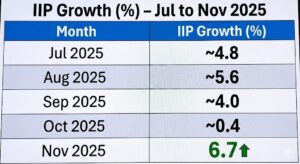
Second, the jump comes after a very weak October 2025, when industrial growth was close to flat. This suggests November was not a gradual rise, but a sharp rebound.
Third, the growth is broad-based within manufacturing, instead of being driven by just one small segment.
In short, November 2025 looks like a turning point month for industrial activity.
How Industrial Growth Has Moved in Recent Months
To understand the November surge better, it is useful to look at how IIP behaved over the previous few months.
📊 Data Box: IIP Trend — July to November 2025
| Month | IIP Growth (%) |
|---|---|
| July 2025 | ~4.8 |
| August 2025 | ~5.6 |
| September 2025 | ~4.0 |
| October 2025 | ~0.4 |
| November 2025 | 6.7 |
This table shows three important things:
Industrial growth was moderate but stable between July and September
October saw a sharp slowdown, partly due to festivals and fewer working days
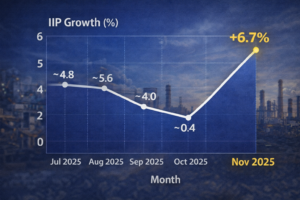
November saw a strong bounce-back, more than compensating for October’s weakness
This pattern suggests that the slowdown in October was temporary, not structural.
Manufacturing: The Real Engine Behind the Growth
Manufacturing is the largest component of IIP, accounting for over three-fourths of the index. When manufacturing performs well, overall industrial growth rises sharply.
In November 2025, manufacturing output grew by around 8%, making it the single biggest contributor to the IIP jump.
Several key manufacturing industries showed strong growth:
Basic metals (steel, aluminium)
Motor vehicles and transport equipment
Pharmaceuticals
Fabricated metal products
These are core industries, closely linked to infrastructure, construction, exports, and consumer demand. Their strong performance indicates that production growth was not limited to luxury or seasonal goods, but spread across essential sectors.
Mining Output: Supporting the Industrial Recovery
Mining output grew by about 5.4% in November 2025.
Mining often slows during the monsoon season due to weather-related disruptions. A rebound in November suggests:
Normalisation of supply chains
Improved availability of raw materials for factories
Better support for construction and infrastructure projects
While mining is smaller than manufacturing in the IIP basket, its recovery plays a supporting role in sustaining industrial momentum.
Electricity Output: A Weak Spot in the Data
One area that stands out in the November data is electricity.
Electricity generation contracted by around 1.5% year-on-year, even as factories and mines expanded output.
This divergence matters because electricity demand reflects:
Household consumption
Small business activity
Services sector energy use
Weak electricity growth suggests that consumption recovery is uneven, especially outside large industrial units. It tells us that while factories are doing better, overall demand in the economy is not yet fully broad-based.
Sector-Wise Growth Snapshot

📊 Data Box: Sector-Wise IIP Growth (Nov 2025)
| Sector | Growth (%) |
|---|---|
| Manufacturing | ~8.0 |
| Mining | ~5.4 |
| Electricity | –1.5 |
This clearly shows that industrial growth is factory-led, not consumption-led.
The Most Important Insight: Use-Based Industry Growth
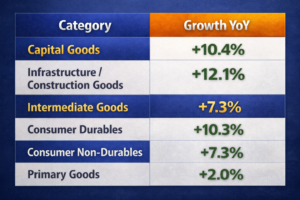
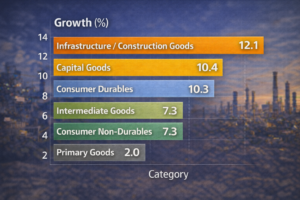
The most revealing part of the IIP data is the use-based classification, which shows what kind of goods are being produced.
📊 Data Box: Use-Based Industry Growth (Nov 2025)
| Category | Growth (%) |
|---|---|
| Infrastructure / Construction Goods | 12.1 |
| Capital Goods | 10.4 |
| Consumer Durables | 10.3 |
| Intermediate Goods | 7.3 |
| Consumer Non-Durables | 7.3 |
| Primary Goods | 2.0 |
This table tells a powerful story.
What the Use-Based Data Really Means
When capital goods grow strongly, it means companies are buying machines and equipment. This usually happens when businesses expect future demand to rise.
When infrastructure and construction goods grow even faster, it signals:
Active government infrastructure spending
Ongoing construction of roads, railways, housing, and industrial corridors
Together, these two categories suggest that India’s industrial growth in November 2025 was investment-led, not just driven by short-term consumption.
Consumer durables growth shows that middle-class demand exists, but it is not the sole driver. Primary goods growing slowly indicates there is no overheating in raw material demand.
How This Fits into India’s Broader Economic Strategy
Over the past few years, India has focused heavily on:
Infrastructure investment
Manufacturing incentives
Supply-chain diversification
The November IIP data aligns well with this strategy. It supports the idea that public and private investment is beginning to translate into real factory output.
This also complements the policy stance of the Reserve Bank of India, which has emphasised maintaining growth momentum while keeping inflation under control.
Lessons from the Past: Why One Month Is Not Enough
History offers an important warning.
India has seen several episodes where industrial growth spiked for a month or two, only to slow down later. Sustained industrial cycles usually require:
Consistent demand
Credit availability
Export stability
Energy price stability
The current data is encouraging, but December 2025 and early-2026 numbers will be crucial in confirming whether this is a lasting trend or a temporary rebound.
What This Means for Jobs and Ordinary Indians
Industrial growth eventually affects people’s lives in real ways.
If the current trend continues:
More factory shifts mean more employment
Infrastructure growth creates local jobs
Capital goods demand supports skilled manufacturing roles
However, weak electricity growth reminds us that small businesses and rural consumption still need support. The recovery is progressing, but unevenly.
Risks That Could Slow Industrial Momentum
Despite the strong November data, several risks remain:
Global economic slowdown affecting exports
Energy price volatility
Trade and tariff uncertainties
Tight financial conditions
Policymakers will need to carefully balance growth support with stability.
Final Verdict: A Strong Signal, But Not the Final Answer
India’s 6.7% IIP growth in November 2025 is one of the clearest signs in recent months that industrial momentum is improving. Manufacturing and investment-linked sectors are leading the recovery, which is exactly what long-term growth needs.
However, true industrial revival is confirmed only when:
Growth remains strong across multiple months
Consumption and electricity demand catch up
Job creation broadens
For now, November 2025 stands as a strong and credible turning point, but the next few data releases will decide whether this momentum becomes a full-fledged industrial cycle.
Editorial Note
IIP data is provisional and subject to revision as more information becomes available. All figures are based on the latest official release by MoSPI, Government of India.
📌 Frequently Asked Questions (FAQ)
1. What is IIP in India?
IIP stands for Index of Industrial Production. It measures the monthly change in the volume of production in manufacturing, mining, and electricity sectors in India. It is released by the Ministry of Statistics and Programme Implementation (MoSPI) and is used to track the health of the industrial economy.
2. Why did India’s IIP grow by 6.7% in November 2025?
India’s IIP rose 6.7% in November 2025 mainly because of strong manufacturing output (~8%) and a recovery in mining (~5.4%). Factory production increased as infrastructure projects, capital spending, and vehicle manufacturing picked up after a weak October.
3. Which sector contributed the most to IIP growth in November 2025?
The manufacturing sector contributed the most to IIP growth. It forms more than 75% of the IIP index, and its strong performance in November was the biggest reason for the overall rise in industrial production.
4. Why did electricity production fall despite strong industrial growth?
Electricity output declined by about 1.5% because household and small business demand remained uneven. While large factories increased output, overall power consumption did not rise at the same pace, showing that recovery is still uneven across the economy.
5. What does strong capital goods growth indicate?
Capital goods growth of 10.4% indicates that companies are investing in machines, equipment, and factories. This usually signals future production expansion, job creation, and a more sustainable economic recovery.
6. Why is infrastructure and construction goods growth important?
Infrastructure and construction goods grew by 12.1%, the highest among all categories. This shows that government and private infrastructure projects—such as roads, railways, housing, and industrial parks—are actively driving industrial demand.
7. Is India’s industrial growth sustainable after November 2025?
One strong month is encouraging, but sustainability depends on whether growth continues in December 2025 and early 2026. For a lasting industrial cycle, India needs consistent demand, stable energy prices, strong credit growth, and export support.
8. How does IIP growth affect jobs and income?
Higher industrial production often leads to:
More factory shifts
Increased hiring in manufacturing and construction
Better income stability in industrial regions
If the current trend continues, it can positively impact employment and wages, especially in manufacturing hubs.
9. How is IIP different from GDP growth?
IIP measures only industrial output and is released monthly. GDP measures the entire economy—including services and agriculture—and is released quarterly. IIP is often used as an early indicator of economic momentum.
10. Why do policymakers and investors track IIP closely?
IIP helps policymakers decide on interest rates, spending, and reforms, while investors use it to assess economic strength, corporate earnings potential, and market trends. A rising IIP usually boosts confidence in economic growth.
11. Can IIP data be revised later?
Yes. IIP data is provisional and may be revised as more production data becomes available. Final figures are usually released in later months.
12. What should readers watch next after this IIP data?
Readers should track:
December 2025 IIP data
Manufacturing PMI trends
Electricity demand
Capital expenditure announcements
Export performance
Together, these will show whether India’s industrial rebound is temporary or long-lasting.
Central Statistics Office (CSO)
🔍 People Also Ask (PAA)
What is the current IIP growth rate in India?
As per the latest official data, India’s IIP grew by 6.7% in November 2025, which is the highest level in nearly two years. The growth was mainly driven by manufacturing and mining sectors.
Is 6.7% IIP growth good for the Indian economy?
Yes, a 6.7% IIP growth is considered strong because it signals higher factory output, improved investment activity, and better job prospects. However, sustained growth over several months is needed to confirm a long-term recovery.
Which sector is driving India’s industrial growth in 2025?
The manufacturing sector is the biggest driver of industrial growth in 2025. It contributes more than three-fourths of the IIP index and recorded strong growth in November 2025.
What does capital goods growth mean in IIP data?
Capital goods growth means companies are buying machinery and equipment. In November 2025, capital goods grew by 10.4%, indicating rising business confidence and future production expansion.
Why is infrastructure goods growth important for India?
Infrastructure and construction goods grew by 12.1%, showing strong activity in roads, railways, housing, and public projects. This type of growth supports long-term economic development and job creation.
Why did electricity production fall in November 2025?
Electricity output declined by 1.5% because overall power demand from households and small businesses remained weak. This suggests that consumption recovery is still uneven despite strong factory output.
Does high IIP growth guarantee GDP growth?
Not always. IIP reflects only industrial activity, while GDP includes services and agriculture. However, sustained IIP growth usually supports higher GDP growth over time.
How often is IIP data released in India?
IIP data is released monthly, usually with a lag of about six weeks. It is first released as provisional data and later revised.
Can IIP growth impact inflation?
Yes. Strong industrial growth can increase demand for raw materials and labour, which may put upward pressure on prices if supply does not keep pace. This is why the RBI monitors IIP closely.
What should investors watch along with IIP data?
Investors should track:
Manufacturing PMI
Capital goods growth
Electricity demand
Credit growth
Export performance
Together, these indicators show whether industrial growth is sustainable.
Is India entering a new industrial growth cycle?
November 2025 data is a positive signal, but a new industrial cycle can only be confirmed if strong growth continues for several months with broad-based demand and stable global conditions.
U.S. Dollar vs Rupee Explained: IMF Data, Oil Imports & India’s Real Risk