1. Introduction: Replacing the Outdated Ruler
Imagine trying to measure a modern smartphone using a wooden ruler designed fifteen years ago. The phone has changed, but the ruler has not. This is exactly the situation India’s economy is facing today. India in 2026 is digital, fast-moving, service-driven, and deeply connected to global markets. Yet, many of the tools used to measure its progress were designed more than a decade ago.
In February 2026, India will take a major step to fix this problem. The Ministry of Statistics and Programme Implementation (MoSPI) will retire the old data series and launch a new Consumer Price Index (CPI) and a new GDP series. This is not just a technical update. It is a reset of how India understands its own economy.
The reason is simple. Economies change over time. What people buy, how they earn, how they pay, and what they value has changed massively since the last base year revision in 2015. Without updating the measurement system, policymakers risk making decisions using outdated information. The 2026 reboot is about seeing India’s real economy more clearly.
2. The Logic: Why Now?
The strongest reason for change lies in what economists call the “basket problem.” The CPI basket decides how inflation is measured. Today’s basket still gives heavy weight to items that no longer reflect how people actually live. Some categories are outdated, while many modern expenses are underrepresented.
For example, digital spending has exploded. Mobile data plans, OTT subscriptions, online education, food delivery apps, and e-commerce shopping are now part of daily life for millions of Indians. Yet, these “digital life” expenses get very little weight in the current inflation calculation. As a result, the CPI often fails to reflect real household spending pressure.
There is also a global rule of thumb. Most countries revise their base year every five years. India’s current CPI base is 2012, and the GDP base is 2011–12. That means India is over a decade late. In that time, GST was introduced, digital payments grew exponentially, the gig economy emerged, and services overtook manufacturing as the main growth engine.
There is also an international credibility angle. The International Monetary Fund (IMF) recently gave India’s national accounts a “C grade” in data practices, mainly due to outdated base years and limited real-time integration. The 2026 revision is a direct effort to regain global statistical credibility and align India with best global practices.
3. Real-Time Data and the New “Yardsticks”
The 2026 reset will not change just one indicator. It will update multiple economic yardsticks at once, making India’s data system more consistent and modern.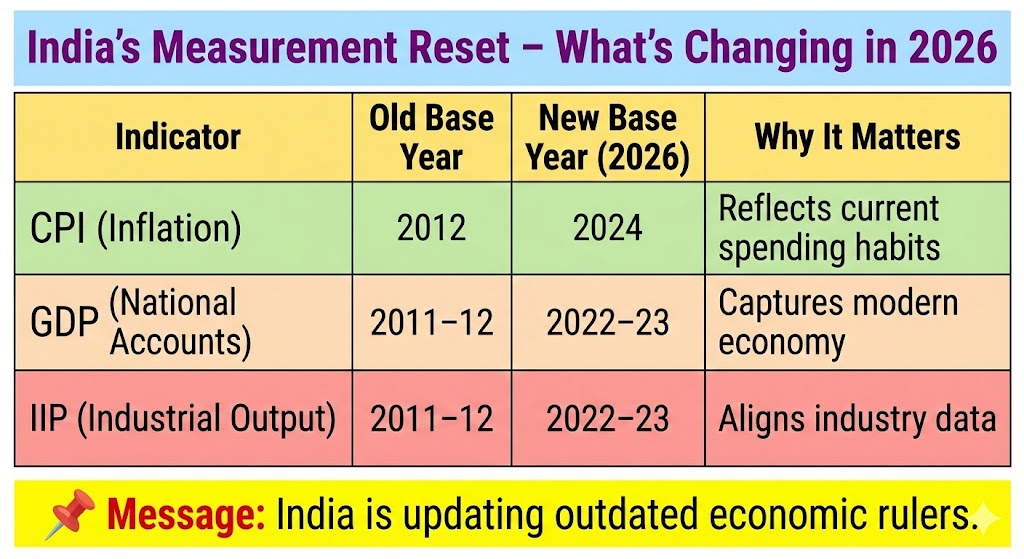
Here is what is changing:
Retail Inflation (CPI) will move from a 2012 base year to a 2024 base year
GDP (National Accounts) will shift from 2011–12 to 2022–23
Industrial Production (IIP) will also adopt 2022–23 as its new base
The rollout is already planned. The new CPI series will be released on February 12, 2026, and the new GDP series will follow on February 27, 2026. This phased approach allows markets and policymakers to adjust gradually.
The key idea is simple: newer base years mean data that reflects today’s economy, not yesterday’s reality.
4. What Is Actually Changing “Under the Hood”?
One of the most important technical upgrades is the move toward double deflation. This sounds complex, but the idea is straightforward. Earlier, GDP calculations adjusted only for final product prices. Under double deflation, price changes in inputs (raw materials) and outputs (final goods and services) are both considered.
Why does this matter? Suppose global commodity prices fall sharply. Under the old method, GDP growth could look higher than it really is because lower input costs artificially boost value added. Double deflation corrects this distortion and gives a more accurate picture of real growth.
Another major change is real-time data integration. The new system will directly use digital data from GST filings, e-Vahan vehicle registrations, and PFMS (Public Financial Management System). This reduces delays, improves accuracy, and limits manual adjustments. In simple terms, the data becomes harder to manipulate and easier to verify.
India will also formally include satellite accounts for sectors like the digital economy, tourism, and culture. Earlier, many service activities were poorly captured. Now, platform work, app-based services, and online content creation will finally be counted properly.
5. When the Ruler Changed Before: Lessons from History
India has seen this before. In 2015, when the GDP base year shifted from 2004–05 to 2011–12, growth numbers changed sharply. The GDP growth rate for FY14 was revised from 4.7% to 6.9%. This surprised many observers and triggered global debate.
However, nothing magical happened to the economy overnight. The new series simply captured sectors that the old method missed, especially services, modern manufacturing, and corporate activity. The old ruler was too short; the new one could finally measure the full length.
This practice is not unique to India. China, the United States, and the European Union regularly revise their base years. These revisions help maintain realistic debt-to-GDP ratios, improve investor trust, and keep economic policy grounded in reality.
6. What Does This Mean for the Common Man?
For ordinary citizens, the most immediate impact will be felt through inflation and interest rates. If the new CPI shows that real inflation is lower than what the old series indicated, the Reserve Bank of India (RBI) may have more room to cut interest rates over time.
Lower repo rates can translate into cheaper home loans, car loans, and business loans. Even small changes in inflation measurement can influence RBI’s policy stance, which directly affects monthly EMIs.
Better data also improves policy targeting. If services and gig work are shown to be larger than earlier estimates, the government may introduce new welfare schemes, tax benefits, or social security measures for these workers. In short, better measurement leads to smarter decisions.
7. Why Investors Are Watching Closely
Foreign investors care deeply about data transparency. When GDP and inflation numbers are based on outdated systems, investors demand a higher risk premium. This raises borrowing costs for the country.
A modern, transparent measurement system improves confidence. It tells investors that India is serious about global standards and long-term stability. This can support stronger foreign inflows, a stable currency, and deeper capital markets.
For equity markets, revised GDP numbers may change sector weightings and earnings expectations. Some sectors may look larger, others smaller, but the overall benefit is clarity.
8. The Temporary Risks and Challenges
Every major data revision comes with short-term confusion. For a few months, analysts will need to back-cast old data to compare it with the new series. This creates noise, mixed headlines, and sometimes panic reactions in markets.
Another concern is the urban–rural gap. If the new CPI relies too heavily on online prices and digital transactions, it may miss real inflation faced by rural households. Nearly 60% of India’s population still lives outside major cities, where consumption patterns differ sharply.
MoSPI will need to ensure balanced sampling so that rural India is not statistically invisible in a digital-heavy framework.
9. The Bigger Picture: Why This Matters Beyond Numbers
This change is not about making growth look higher or lower. It is about measuring reality honestly. Without accurate measurement, even the best policies fail because they target the wrong problems.
India is aiming to become a $5 trillion economy, a global manufacturing hub, and a digital leader. These goals require modern statistical tools. Old rulers cannot measure new ambitions.
The 2026 reboot is India saying it is ready to be judged by 21st-century standards, not legacy systems.
10. Conclusion: Seeing the Economy Clearly at Last
There is a simple truth in economics: we cannot manage what we cannot measure. The February 2026 shift is not a cosmetic change. It is a declaration of transparency, confidence, and maturity.
Readers should not panic if GDP growth or inflation numbers suddenly change in early 2026. The economy will not have changed overnight. Only our ability to see it clearly will have improved.
In the long run, better measurement leads to better policy, better investment decisions, and better outcomes for citizens. India’s new ruler may look unfamiliar at first—but it will finally fit the economy it is trying to measure.
Official portal of India’s Ministry of Finance:
Frequently Asked Questions (FAQ)
1. Why is India changing its GDP and inflation measurement in 2026?
India is updating its GDP and inflation measurement because the current base years are outdated. The economy has changed significantly due to digital payments, GST, services growth, and new spending patterns. Updating the base year helps reflect today’s real economy more accurately.
2. What is the new base year for GDP and CPI?
India will shift:
GDP base year from 2011–12 to 2022–23
CPI (inflation) base year from 2012 to 2024
This update will take effect from February 2026.
3. Does a new GDP series mean the economy has suddenly grown or slowed?
No. The economy does not change overnight. Only the method of measurement changes. Numbers may look higher or lower because newer sectors like services and digital activity are better captured.
4. When will the new CPI and GDP data be released?
New CPI series: February 12, 2026
New GDP series: February 27, 2026
These dates are important because markets and policies may react to the new numbers.
5. How will the new CPI affect inflation figures?
The new CPI will better reflect what people actually spend money on today, such as digital services, data plans, online shopping, and modern consumption habits. This may change how inflation is calculated and perceived.
6. Will this impact home loans and interest rates?
Yes, indirectly. Inflation data influences the Reserve Bank of India’s interest rate decisions. If the new CPI shows lower real inflation, RBI may get more room to reduce interest rates, which can lower EMIs over time.
7. Why is the IMF linked to India’s data revision?
The International Monetary Fund (IMF) has pointed out that India’s data systems rely on old base years. Updating GDP and CPI improves global credibility and aligns India with international best practices.
8. What is “double deflation” and why does it matter?
Double deflation adjusts for price changes in both inputs (raw materials) and outputs (final goods). This prevents growth from being overstated when commodity prices fall and gives a more accurate picture of real economic growth.
9. Will past GDP numbers be changed?
Yes, past data may be recalculated using the new base year. This is called back-casting. It helps analysts compare old and new data but can create short-term confusion.
10. Is this revision risky for markets?
In the short term, markets may react to sudden changes in headline numbers. However, in the long run, better data improves transparency, investor confidence, and policy accuracy.
11. How does this help common people?
Better measurement leads to better policy decisions. Government spending, welfare schemes, and tax planning become more targeted. Over time, this can improve job creation, price stability, and economic planning.
12. Will rural inflation be accurately captured?
This is a key concern. The government must ensure that rural prices and offline consumption are properly included, so inflation faced by rural households is not ignored.
13. Do other countries also change base years?
Yes. Countries like the United States, China, and EU nations regularly update base years, usually every five years. India is aligning itself with global norms.
14. Should readers worry about sudden changes in numbers in 2026?
No. Readers should remember that the economy is not changing suddenly — only the measurement system is. The revision helps everyone see the economy more clearly.
15. What is the biggest takeaway from India’s economic reset?
The biggest takeaway is simple: better measurement leads to better decisions. India’s 2026 reset is about transparency, accuracy, and readiness for a modern economy.
National Sample Survey Office (NSSO) – Official Webpage
People Also Ask (PAA)
Why will India’s GDP and inflation numbers change in 2026?
India is updating the base years used to calculate GDP and inflation. The economy has changed a lot since the last revision, especially due to digital payments, GST, and services growth. When the base year changes, numbers may look different even though the real economy has not changed overnight.
What is the new base year for India’s GDP?
India will move the GDP base year from 2011–12 to 2022–23. This helps capture newer sectors like digital services, platform work, and modern manufacturing more accurately.
What is the new base year for CPI inflation?
The Consumer Price Index (CPI) base year will change from 2012 to 2024. This allows inflation to reflect current spending habits such as data plans, online shopping, and modern consumption patterns.
When will the new GDP and CPI series be released?
New CPI series: February 12, 2026
New GDP series: February 27, 2026
These releases may lead to short-term market reactions as people adjust to the new numbers.
Does a higher GDP number mean India suddenly grew faster?
No. A higher or lower GDP number after rebasing does not mean the economy suddenly changed. It simply means the new method measures economic activity more accurately than before.
How will this affect interest rates and EMIs?
Inflation data plays a big role in interest rate decisions by the Reserve Bank of India. If the new CPI shows lower real inflation, there may be more room for rate cuts over time, which can reduce loan EMIs.
Why did the IMF criticise India’s data system earlier?
The International Monetary Fund (IMF) pointed out that India was using very old base years, which reduced international confidence in its economic data. Updating GDP and CPI helps improve global credibility.
What is “double deflation” in GDP calculation?
Double deflation adjusts GDP for price changes in both inputs (like raw materials) and outputs (final goods). This prevents growth from being overstated when input prices fall and gives a more realistic growth figure.
Will past GDP and inflation data be revised?
Yes. Past data may be recalculated using the new base year through a process called back-casting. This helps compare old and new data but may cause temporary confusion.
Can this data change confuse markets?
In the short term, yes. Sudden changes in headline numbers can confuse markets. But in the long term, accurate data improves investor confidence and policy decisions.
How does this change benefit common people?
Better data helps the government design better policies. Welfare schemes, subsidies, and tax planning become more targeted, which can improve price stability and job creation.
Will rural inflation be properly reflected?
This is an important concern. Authorities must ensure that rural prices and offline markets are included so that rural households’ inflation experience is not ignored.
Do other countries also change base years?
Yes. Countries like the US, China, and EU members regularly update base years, usually every five years. India is aligning with global best practices.
Should people panic when numbers change in 2026?
No. People should remember that only the measurement is changing, not the economy itself. The revision simply provides a clearer picture.
What is the main takeaway from India’s economic reset?
The main takeaway is simple: modern economies need modern measurement tools. India’s 2026 reset is about accuracy, transparency, and better decision-making.
📊 Infographic 1: India’s Measurement Reset — What’s Changing in 2026
| Indicator | Old Base Year | New Base Year (2026) | Why It Matters |
|---|---|---|---|
| CPI (Inflation) | 2012 | 2024 | Reflects current spending habits |
| GDP (National Accounts) | 2011–12 | 2022–23 | Captures modern economy |
| IIP (Industrial Output) | 2011–12 | 2022–23 | Aligns industry data |
📌 Message: India is updating outdated economic rulers.
🧺 Infographic 2: CPI Basket — Old vs New Reality
| Category | Old CPI Weight (2012) | New CPI Focus (2024) |
|---|---|---|
| Food | Very High | Still Important |
| Clothing | Traditional Focus | Modern Apparel |
| Digital Services | Minimal | Major Addition |
| Online Education | Ignored | Included |
| OTT & Subscriptions | Ignored | Included |
| E-commerce Prices | Underweighted | Captured |
📌 Message: Inflation will now reflect real life spending.
📅 Infographic 3: Why India Is Revising Now
| Reason | Explanation |
|---|---|
| 10+ Years Delay | Base year overdue |
| Economic Shift | Services > Manufacturing |
| Digital Payments Boom | Old data missed it |
| IMF Rating Pressure | Global credibility |
| Policy Accuracy | Better decisions |
📌 Message: Revision is overdue, not optional.
⚙️ Infographic 4: What Changes “Under the Hood”
| Upgrade | What It Means |
|---|---|
| Double Deflation | Input + Output prices |
| GST Data Use | Real-time tax data |
| e-Vahan | Vehicle registrations |
| PFMS | Govt spending tracking |
| Satellite Accounts | Digital, tourism, culture |
📌 Message: Faster, cleaner, harder-to-manipulate data.
📈 Infographic 5: When Base Year Changed Before (2015)
| Indicator | Old Series | New Series |
|---|---|---|
| GDP Growth FY14 | 4.7% | 6.9% |
| Reason | Limited capture | Services + Manufacturing |
| Impact | Confusion | Long-term clarity |
📌 Message: Growth didn’t change — measurement did.
🌍 Infographic 6: Global Practice — India Is Catching Up
| Country | Base Year Update Cycle |
|---|---|
| USA | Every 5 Years |
| China | Every 5 Years |
| EU | Regular Updates |
| India (Earlier) | 10–12 Years |
| India (Now) | Modern Standard |
📌 Message: India aligns with global norms.
🏦 Infographic 7: What It Means for You
| Group | Impact |
|---|---|
| Common People | Better inflation tracking |
| Borrowers | Potential lower EMIs |
| RBI | Accurate policy signals |
| Govt | Better spending targeting |
| Investors | Higher confidence |
📌 Message: Better data = better outcomes.
⚠️ Infographic 8: Short-Term Risks to Watch
| Risk | Why It Matters |
|---|---|
| Back-casting Confusion | Old vs new comparison |
| Market Volatility | Headline shock |
| Rural Price Gap | Offline inflation |
| Media Misreading | Panic headlines |
📌 Message: Short pain, long gain.
🧠 Infographic 9: Key Dates to Remember
| Event | Date |
|---|---|
| New CPI Release | 12 Feb 2026 |
| New GDP Series | 27 Feb 2026 |
| Transition Phase | Feb–Mar 2026 |
📌 Message: Expect data changes, not economic shock.
Geopolitics of Trade: How China & India are Shaping Bangladesh Ports