Core Sector Output Growth at 1.8% in November — A Sign of Industrial Recovery in India
In December 2025, India’s industrial engines roared back to life after months of uneven performance. According to official data released by the Government of India, the combined output of the eight core sectors grew by 1.8% in November 2025 compared to the same month last year. These eight core industries together make up 40.27% of the country’s Index of Industrial Production (IIP) — a key gauge of how well the industrial economy is performing.
This growth marks a modest but important turning point, especially after the sector had contracted in October 2025. The improvement, driven mainly by higher output in cement, steel, fertilizer and coal, suggests that India’s industrial revival is gaining traction — even as challenges remain in energy and fuel-related segments.
Understanding the Core Sectors — What They Are and Why They Matter

Before we delve deeper into the data, let’s understand what these core sectors actually are — and why their growth matters for the whole economy.
India’s Index of Eight Core Industries (ICI) measures the combined output of:
Coal
Crude Oil
Natural Gas
Petroleum Refinery Products
Fertilisers
Steel
Cement
Electricity
Together, these industries account for more than 40% of the Index of Industrial Production (IIP), which itself is closely watched by economists to assess the health of industry, manufacturing and infrastructure development.
Think of these as the foundation stones of economic activity — if the core sectors grow, we usually see construction, manufacturing, jobs, and investments follow. If they lag, it often signals deeper industrial distress.
November 2025: What the Data Tells Us
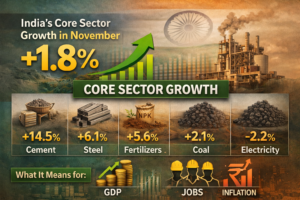
Here’s a snapshot of the November 2025 performance:
Overall core sector output grew by 1.8% year-on-year.
Cement production soared by 14.5%, one of the strongest individual gains among the industries.
Steel output rose by 6.1%, another key contributor.
Fertiliser output increased by 5.6%, reflecting stronger agricultural inputs.
Coal production grew by 2.1%, sustaining energy raw materials.
However, crude oil production declined by 3.2%, and natural gas fell by 2.5% — showing ongoing challenges in the energy sector.
Electricity generation also eased by 2.2% in November.
This mixed data suggests that while the backbone of India’s construction and industrial infrastructure is strengthening, certain energy-linked segments have yet to fully recover.
A Temporary Rebound or Long-Term Revival? Context from Recent Months
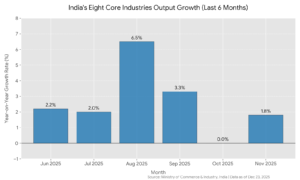
To understand why this 1.8% figure matters, we need historical context. In October 2025, the core sector index had actually contracted by 0.1% compared to the previous year — signalling a slowdown.
Before that, in early 2025, growth in these sectors had been uneven:
In August 2025, core sector growth was a healthy 6.3%, driven by strong performance in manufacturing-linked sectors.
By September, growth slowed to 3%, reflecting uneven demand across sectors.
This volatility shows that while India’s industrial base can grow robustly, short-term fluctuations driven by global price shifts, weather patterns, and policy changes can impact output month to month.
A good historical parallel is the period after the 2008 global financial crisis, when India’s industrial output fluctuated widely before settling into steady growth in the early 2010s. Back then, policymakers used targeted reforms and fiscal support to stabilize growth — a lesson relevant again today.
Sector-Wise Story: Who Is Driving Growth — And Who Isn’t
Winners in November 2025
Cement: A 14.5% jump shows strong demand for construction — potentially tied to government infrastructure projects and private housing.
Steel: At 6.1% growth, the sector reflects manufacturing and urban development activity.
Fertilisers: A 5.6% increase indicates activity in agriculture, possibly linked to inventory stocking ahead of the rabi season.
Coal: A 2.1% rise, though modest, supports industrial energy needs.
Lagging Components
Crude Oil: A 3.2% contraction likely reflects global pricing pressures and cost structures that make domestic production harder.
Natural Gas: Down by 2.5%, often tied to slower domestic demand and import priorities.
Electricity: A 2.2% dip could mean either lower demand or issues in supply, particularly during earlier winter months.
Why Core Sector Growth Signals a Broader Industrial Revival
Because these industries are so foundational, even small increases like 1.8% can be the first signs of recovery pulling other sectors along. For example:
Cement and steel drive construction, which in turn creates jobs and demand for other goods.
Fertiliser growth supports agriculture — a sector linked to rural demand and consumption of goods.
Even a modest coal increase ensures continuity in electricity and heavy manufacturing.
In practical terms, when construction materials grow fast, it often means roads, bridges, and homes are being built, which boosts economic activity at multiple levels — from industrial workers to truck drivers and equipment manufacturers.
This is similar to how in the early 2000s, a jump in automobile production signalled a larger industrial shift well before GDP numbers captured the trend.
Industrial Output and the Real Economy: GDP, Jobs and Prices
Core sectors are a leading indicator for overall industrial performance and GDP. When they grow, it usually means factories are awake, workers are employed, and production lines are rolling.
Analysts note that this uptick in core growth suggests India’s wider industrial output may have expanded around 2.5%-3% in November, though final data from the IIP will confirm this later.
This, in turn, can affect:
Jobs: More output can lead to hiring in factories, transport and services.
Consumer prices: A healthy production base can ease inflationary pressure as supply meets demand.
Investment Decisions: Companies often look at core sector trends before expanding plants or ordering new machinery.
Government Policies and Industry Support
India’s industrial revival is partly due to supportive government policies, like the Production Linked Incentive (PLI) schemes introduced over recent years. These schemes provide performance-based incentives to companies in key sectors like electronics, automotive components and pharmaceuticals.
For example, under PLI schemes, electronics production has surged from about ₹2.13 lakh crore in FY2021 to ₹5.25 lakh crore in FY2025, showing how targeted policy can trigger real growth.
This kind of support is helping India transition from being a big consumer of industrial goods to a competitive producer on the global stage.
What This Means for Ordinary Indians
For everyday citizens, this 1.8% growth isn’t just a number:
Job seekers may see more openings in manufacturing sites and construction projects.
Small businesses that supply materials or services to big factories may get more orders.
Real estate buyers may benefit from better infrastructure and stable prices.
Consumers may see relatively stable prices for goods as supply tightens.
It’s like a large engine warming up after a cold start — once it gets going, everything connected to it begins to move faster.
A Word of Caution: Slower Than Last Year — But Still a Rebound
Although 1.8% growth is positive compared with October’s contraction, it’s still lower than the 5.8% growth recorded in November 2024, showing that full industrial momentum is not yet restored.
Also, the cumulative core sector growth from April to November 2025–26 was 2.4%, compared to 4.4% a year earlier, showing overall moderation over the year.
This means India’s industrial revival is real but gradual — much like the slow but steady recovery after past slowdowns, such as the post-2012 global slowdown.
Conclusion — A Steady Revival With a Clear Signal
India’s 1.8% core sector growth in November 2025 might seem modest, but it’s the direction that matters. After earlier contractions and uneven performance, this rebound suggests industrial activity is stabilizing. Growth led by cement, steel, fertilisers and coal indicates underlying strength in construction and infrastructure — the building blocks of economic expansion.
This trend, supported by policy incentives and improving demand, suggests that India’s industrial base is waking up again — and this may translate into stronger GDP growth, job creation, investment and consumer confidence in the months ahead.
India’s core engine is warming up once more — and that’s good news for the economy and everyday people alike.
To visit the official website of Ministry of Commerce and Industry click here
Frequently Asked Questions (FAQ)
1️⃣ What is India’s core sector output?
India’s core sector output measures the production of eight key industries—coal, crude oil, natural gas, refinery products, fertilisers, steel, cement and electricity. These sectors together account for over 40% of the Index of Industrial Production (IIP), making them a strong indicator of overall industrial and economic health.
2️⃣ Why did India’s core sector grow 1.8% in November?
The growth was mainly driven by strong output in cement (+14.5%), steel (+6.1%), fertilisers (+5.6%) and coal (+2.1%). Higher infrastructure activity, steady construction demand and better agricultural input supply helped push growth despite weakness in energy-related sectors.
3️⃣ Is 1.8% core sector growth considered good or weak?
On its own, 1.8% growth is modest. However, it is important because it marks a recovery after contraction in October. Historically, even small positive growth after a slowdown often signals the beginning of an industrial turnaround rather than a one-month spike.
4️⃣ Which core sectors performed the best in November?
The top performers were:
Cement (+14.5%) – showing strong construction and infrastructure activity
Steel (+6.1%) – indicating manufacturing demand
Fertilisers (+5.6%) – reflecting agricultural preparation
These sectors usually lead broader industrial growth cycles.
5️⃣ Which sectors dragged down overall core sector growth?
Output declined in crude oil (-3.2%), natural gas (-2.5%), and electricity (-2.2%). This reflects ongoing challenges in domestic energy production and lower power demand during early winter months.
6️⃣ How does core sector growth impact GDP?
Core sector growth is a leading indicator of GDP growth. When core industries expand, they support manufacturing, construction, transport and services. A steady rise in core output often leads to stronger GDP numbers in subsequent quarters.
7️⃣ Does core sector growth affect job creation?
Yes. Higher production in cement, steel and coal directly supports jobs in factories, construction sites, logistics and infrastructure projects. Indirectly, it boosts employment in services linked to these industries.
8️⃣ How does core sector growth impact inflation?
When production rises, supply improves. This can help control inflation, especially in construction materials, fertilisers and energy. However, weakness in crude oil and gas can still create inflationary pressure through imports.
9️⃣ How does November 2025 growth compare with last year?
Core sector growth in November 2024 was higher, indicating that the pace of recovery in 2025 is slower. However, the direction has turned positive, which is more important during periods of industrial stabilisation.
🔟 What should investors and businesses watch next?
Key indicators to monitor include:
December core sector data
IIP and manufacturing PMI
Infrastructure spending in the Union Budget
Oil and gas production trends
Sustained growth over multiple months will confirm whether the recovery is durable.
1️⃣1️⃣ Is India’s industrial slowdown over?
Not fully. The data suggests early signs of revival, not a complete recovery. Consistent growth across energy, manufacturing and infrastructure sectors over the next few months will be crucial.
1️⃣2️⃣ Why does core sector data matter to common people?
Because it affects jobs, prices, economic stability and growth opportunities. Strong core sector output often leads to better employment prospects, stable inflation and higher overall economic confidence.
To visit official website of NSSO click here
People Also Ask (PAA)
What is core sector output in India?
Core sector output measures production in eight key industries—coal, crude oil, natural gas, refinery products, fertilisers, steel, cement and electricity—which together form over 40% of India’s industrial activity.
Why is core sector growth important for India’s economy?
Because it acts as an early signal for GDP growth, job creation and investment trends. When core industries grow, manufacturing, construction and services usually follow.
Is 1.8% core sector growth a sign of economic recovery?
Yes, it signals early recovery, especially after contraction in the previous month. However, sustained growth over several months is needed to confirm a full industrial revival.
Which sectors drove core sector growth in November?
Cement and steel led growth, supported by fertilisers and coal. These sectors usually rise when infrastructure and construction activity picks up.
Why did crude oil and natural gas output decline?
Domestic production challenges, maintenance shutdowns and lower demand reduced output. India still relies heavily on imports for oil and gas.
How does core sector growth affect GDP growth?
Core sector expansion improves industrial output, boosts employment and raises demand, which directly supports higher GDP growth in subsequent quarters.
Does core sector growth help control inflation?
Yes. Higher production improves supply of key materials like cement and steel, which can help contain price pressures, especially in construction and infrastructure.
How is core sector growth linked to job creation?
Growth in cement, steel and coal creates jobs in factories, transport, construction sites and supporting services, benefiting both skilled and unskilled workers.
How does India’s core sector growth compare with last year?
Growth is lower than last year’s levels but has turned positive again, indicating stabilisation rather than a slowdown.
What should investors watch after core sector data?
Investors should track IIP data, manufacturing PMI, infrastructure spending, energy output trends and upcoming GDP numbers.
Can core sector growth influence stock markets?
Yes. Strong data often supports stocks in infrastructure, cement, steel, capital goods, logistics and energy-related sectors.
What does core sector growth mean for common people?
It impacts job opportunities, price stability, housing costs, infrastructure quality and overall economic confidence.