
India 2026 Strategy Decoded: US Trade War, China Engagement & Domestic Security Push
I. The “NAVI” World Order
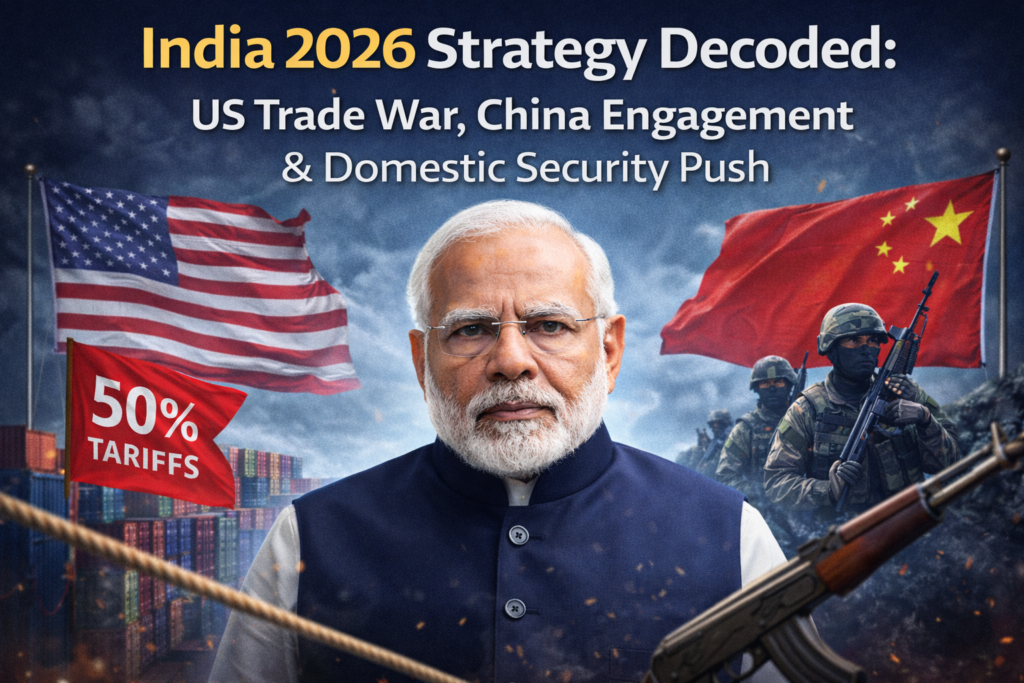
The year 2026 is shaping up to be unlike any other. The global system is no longer stable or predictable. Economists and strategists are increasingly using a new word to describe this reality: NAVI — Non-linear, Accelerated, Volatile, and Interconnected. In this world, decisions taken in Washington or Beijing can impact jobs, prices, and security thousands of kilometres away in India within weeks.
India enters this NAVI world with a strange paradox. On one hand, it is the world’s fastest-growing major economy, with GDP growth forecast at around 7.3% for FY26 by multilateral agencies. India has also become the world’s fourth-largest economy, overtaking Japan in nominal GDP terms. On the other hand, India is facing pressure on three fronts at the same time.
First, there is a trade shock from the West, triggered by new U.S. tariffs. Second, there is a tactical thaw with China, where economic logic is pushing both sides toward limited cooperation despite unresolved border tensions. Third, there is a hard internal security deadline at home — the government’s promise to end Left-Wing Extremism by March 31, 2026.
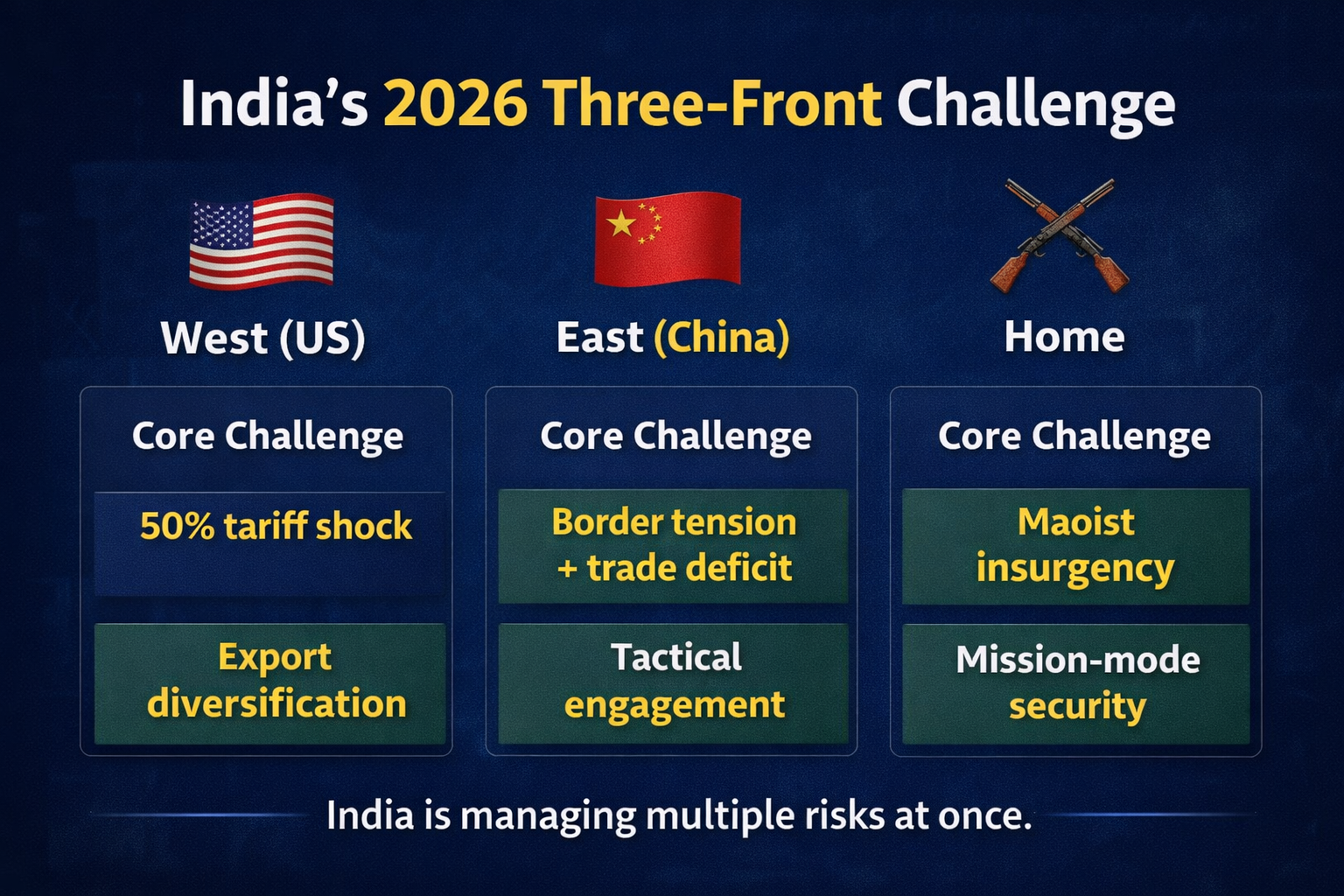
This is not a year for idealism. It is a year of tightrope walking, where India must balance growth, security, and sovereignty in a world of weaponised interdependence.
1️⃣ Ministry of Finance, Government of India
II. The US Tariff Shock & India’s Economic De-Risking
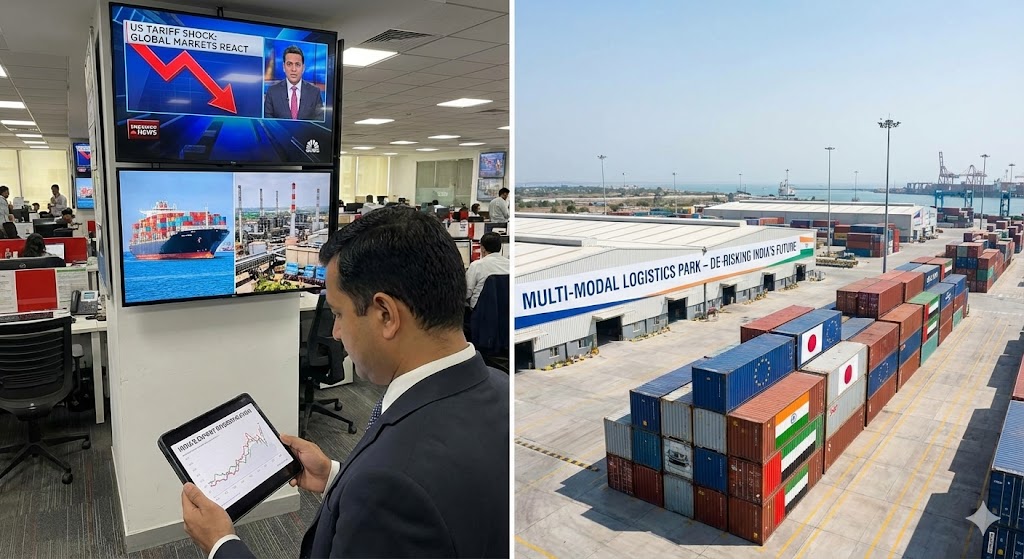
In late 2025, the return of Donald Trump to the White House brought an abrupt shift in U.S. trade policy. Citing national security concerns and India’s continued purchases of Russian crude oil, the U.S. imposed tariffs of up to 50% on select Indian exports. Sectors such as engineering goods, chemicals, and certain consumer products were hit hardest.
At first glance, this looked like a major setback. The United States remains one of India’s largest export destinations. But New Delhi did not panic. The response was measured and strategic, not emotional.
One key buffer has been the managed depreciation of the Indian rupee, which has moved into the ₹87–₹90 per dollar range. While a weaker currency raises import costs, it also makes Indian exports more competitive in global markets. For exporters, this depreciation acts as a natural shock absorber against tariffs.
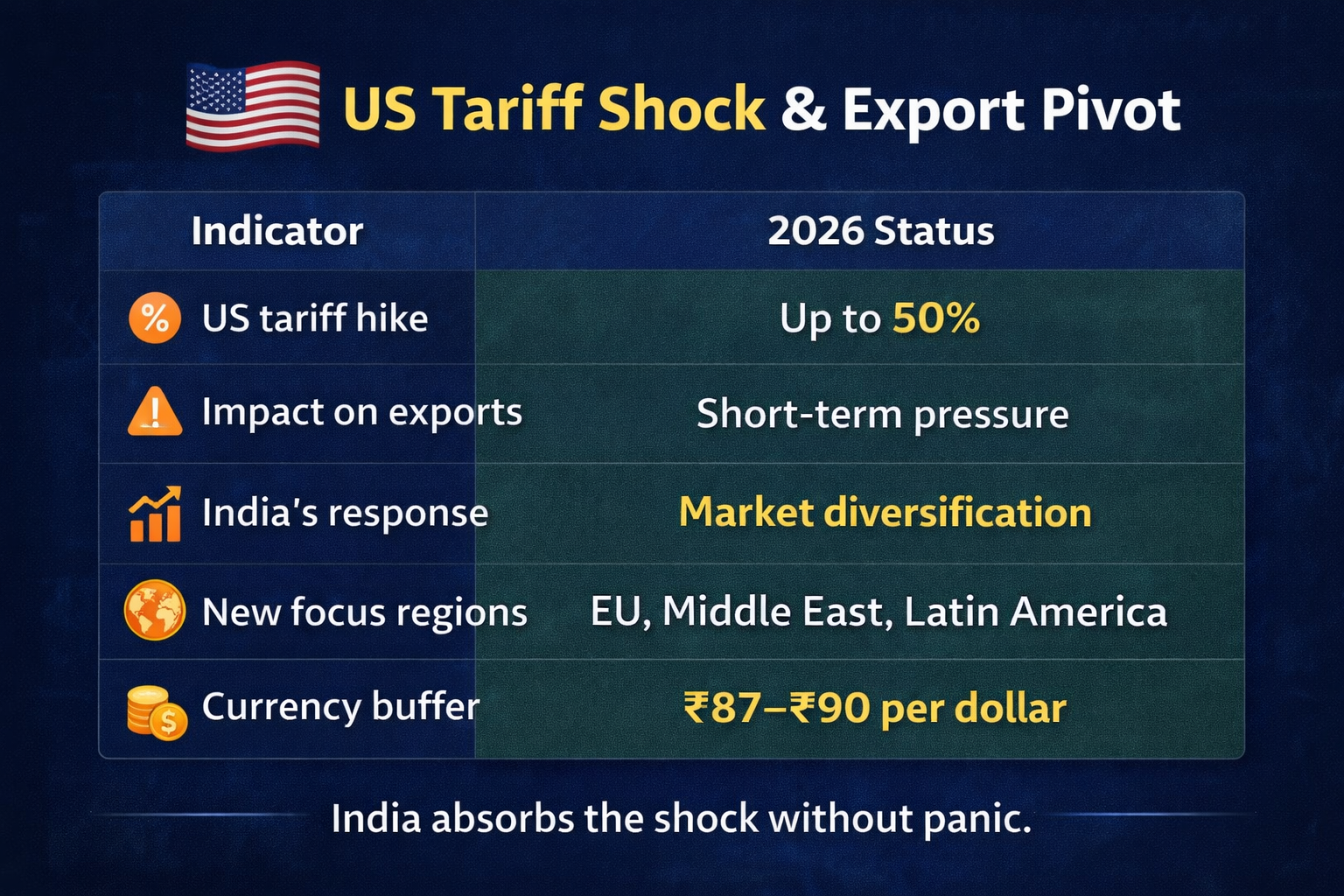
India has also quietly shifted its mindset from cost-efficiency to geopolitical resilience. The export target for FY26 remains ambitious at $840–$850 billion, but the route to that target has changed. Instead of relying heavily on the U.S. market, India is accelerating trade ties with the Middle East, the European Union, and Latin America.
Free Trade Agreement talks with the EU have gained momentum, while Comprehensive Economic Partnership Agreements with Gulf countries are already showing results. This diversification reduces the risk of any one country using trade as a pressure tool against India.
In short, the tariff shock has forced India to de-risk its trade strategy, not retreat from globalisation.
2️⃣ Ministry of Commerce & Industry (Exports, Tariffs, FTAs)
III. The China ‘Thaw’ — Tactical Peace or Strategic Trap?
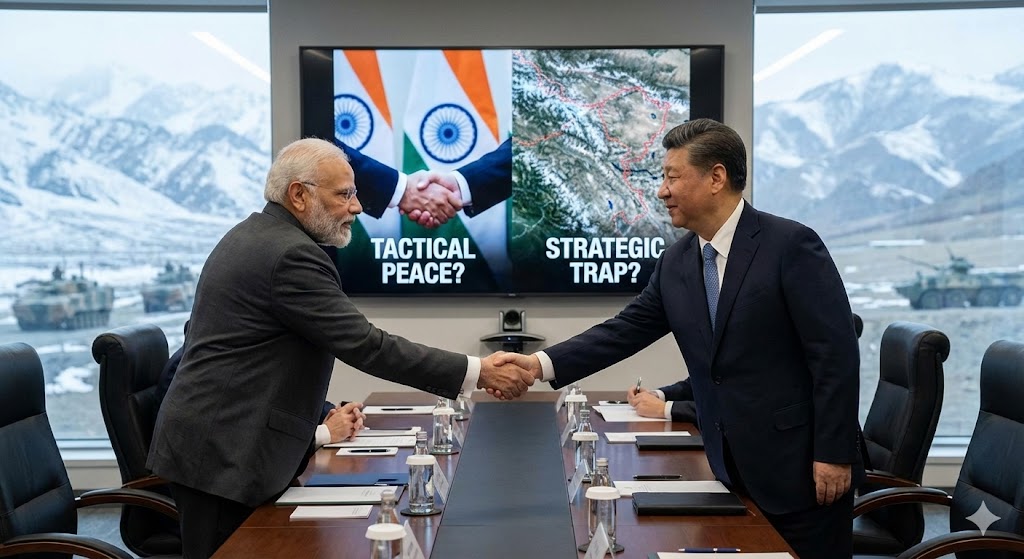
One of the most surprising developments of late 2025 was the gradual warming of ties between India and China. After nearly five years of freeze following the Galwan clash, direct flights between Delhi and Beijing resumed, and border trade passes such as Nathu La and Shipki La were reopened.
Why now? The answer lies in economic reality.
India’s trade deficit with China touched an uncomfortable $106 billion in 2025. Despite years of talk about decoupling, Indian manufacturing and electronics supply chains remain deeply dependent on Chinese inputs. Complete separation proved costly and impractical.
For China, the timing is also strategic. Beijing is facing slower growth, pressure from Western sanctions, and rising tensions in the South China Sea. A permanently hostile India would push New Delhi closer into a full-fledged military and economic alliance with the U.S., Japan, and Australia. That is something China wants to avoid.
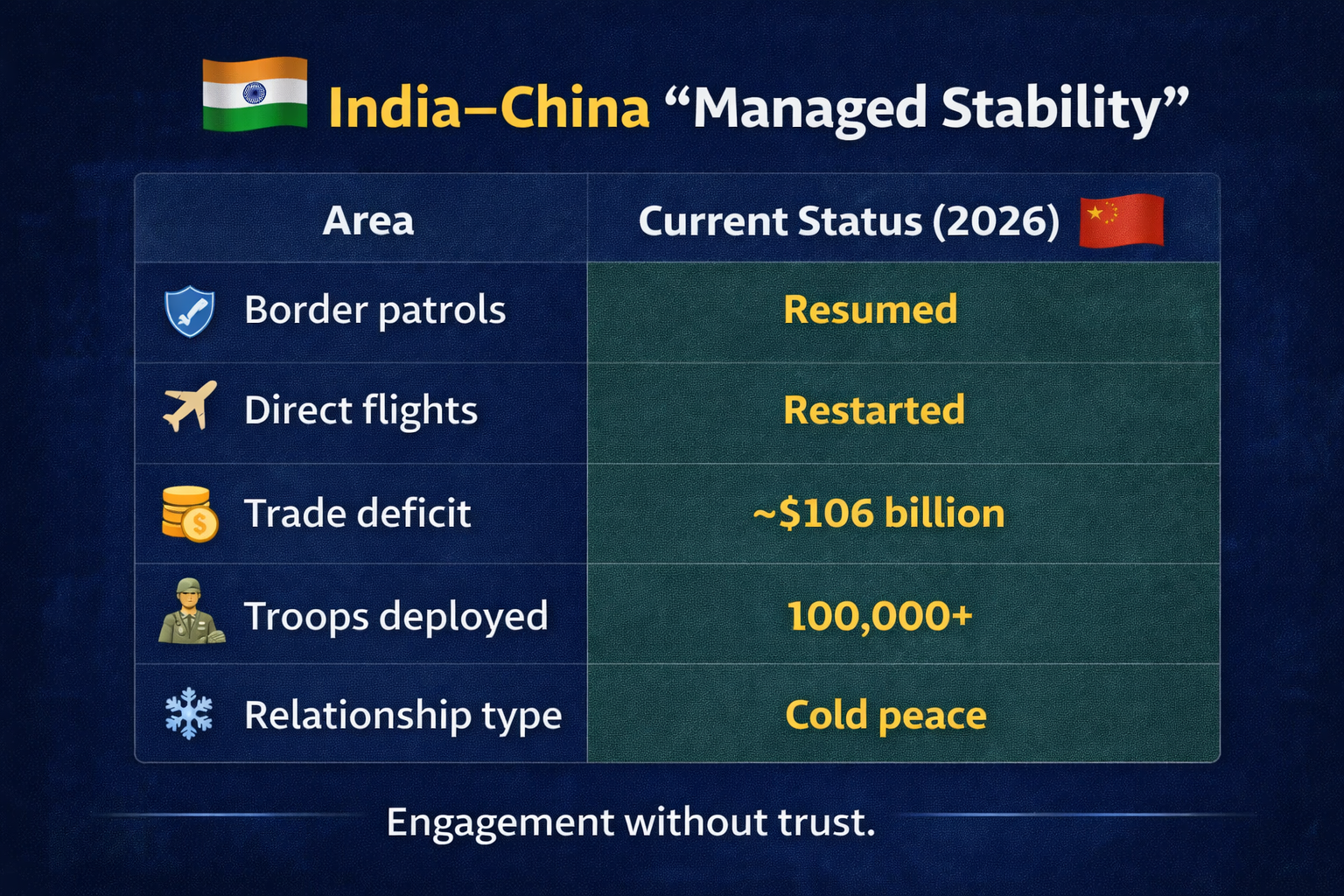
Thus, both sides have arrived at a position best described as “managed stability.” Trade channels are reopening, talks are resuming, but trust remains low. Over 100,000 troops are still stationed on both sides of the Line of Actual Control. Patrols have resumed, but disengagement is limited.
This is not peace. It is a cold peace, driven by economic compulsion rather than political goodwill. India is using this breathing space to strengthen its PLI-backed domestic supply chains, while China is trying to prevent strategic encirclement.
The danger, however, is complacency. History shows that tactical calm with China can quickly reverse. India’s challenge in 2026 is to use time wisely, not assume permanent stability.
4️⃣ Ministry of External Affairs (India–China Engagement)
IV. Internal Security and the March 31 Deadline

While global headlines focus on tariffs and China, India’s most decisive battle in 2026 may be at home. Amit Shah has set a firm deadline: India will be Maoist-free by March 31, 2026.
This is not just rhetoric. The numbers show real progress.
In 2013, 126 districts across India were affected by Left-Wing Extremism. By early 2026, this has been reduced to just three core districts in Chhattisgarh — Bijapur, Sukma, and Narayanpur. Security forces have steadily dismantled Maoist networks, cut off funding routes, and regained territorial control.
In 2025 alone, 312 LWE cadres were neutralised, and more than 800 surrendered under the revised rehabilitation policy, which focuses on skills, livelihoods, and reintegration rather than punishment.
But this campaign is not just about guns and boots. It is deeply geoeconomic. Maoist-affected regions sit on rich mineral reserves and strategic land corridors. Ending insurgency unlocks infrastructure projects, mining investments, and ₹30 crore per district per year in targeted development funding.
Roads, telecom towers, schools, and healthcare centres are already reaching areas that were once inaccessible. For India’s long-term growth, securing the “Red Corridor” is as important as securing borders.
5️⃣ Ministry of Home Affairs (Maoist Deadline & Internal Security)
V. Conclusion: India as the Stabilising Bridge
When all three pillars are viewed together, a clear pattern emerges. India in 2026 is no longer choosing sides. It is choosing interests.
With the United States, India is standing firm without confrontation. With China, it is engaging without surrender. At home, it is finishing a decades-old internal security challenge with administrative focus and political will.
If India succeeds in meeting the Maoist-free deadline and maintaining border stability, it can gradually shift billions of rupees from emergency security spending to Digital Public Infrastructure and AI-driven productivity. That is where long-term power now lies.
The real test of 2026 is not about grand speeches or global applause. It is about discipline. As one senior policymaker put it, the choice is between the allure of fantasy and the discipline of reality.
India appears to be choosing reality — carefully, quietly, and with eyes wide open.
6️⃣ NITI Aayog (Long-Term Strategy & Growth Outlook)
Final Takeaway for Readers
2026 will not be remembered as a year of dramatic victories. It will be remembered as the year India held its balance — economically, geopolitically, and internally — in a world that no longer offers easy choices.
That, in today’s NAVI world, is real strength.
❓ Frequently Asked Questions (FAQ)
1. Why is 2026 considered a critical year for India?
2026 is important because India is dealing with multiple challenges at the same time. These include higher US tariffs, a fragile improvement in relations with China, and a firm deadline to end Maoist violence internally. At the same time, India is growing fast economically, which makes managing these risks even more crucial.
2. How will US tariffs affect India’s economy in 2026?
Higher US tariffs can hurt Indian exports in the short term, especially in sectors like textiles, gems, and engineering goods. However, India is reducing its dependence on the US by expanding trade with Europe, the Middle East, Latin America, and Africa. A weaker rupee also helps exporters stay competitive.
3. What does “India’s economic de-risking” mean?
Economic de-risking means reducing dependence on any one country or market. India is spreading its trade, investment, and supply chains across multiple regions so that policy changes by one country do not severely damage the economy.
4. Is India really improving relations with China in 2026?
India and China are not becoming close allies. What we are seeing is a tactical thaw, not full trust. Border patrols and talks have resumed, but both sides still keep large troop deployments. The goal is stability, not friendship.
5. Why hasn’t India completely cut trade ties with China?
China is still a major supplier of electronics, machinery, and industrial inputs. Completely cutting ties would raise costs for Indian manufacturers. Instead, India is following a strategy of “managed engagement” while building alternative supply chains through Production Linked Incentive (PLI) schemes.
6. What is the March 31 internal security deadline about?
The government has set March 31, 2026, as a target to eliminate Maoist insurgency from remaining core districts. This deadline focuses on both security operations and development measures such as roads, mobile connectivity, schools, and jobs.
7. How does internal security affect India’s economic growth?
Better internal security allows infrastructure projects, mining, and industries to operate smoothly. Maoist-affected areas are resource-rich but underdeveloped. Clearing these regions helps attract investment, create jobs, and boost state revenues.
8. Is India still the fastest-growing major economy in 2026?
Yes. India is projected to grow around 7–7.5% in 2026, making it the fastest-growing large economy globally. Strong domestic demand, digital infrastructure, and public investment are key drivers of this growth.
9. What does “choosing interests over alliances” mean for India?
It means India avoids taking rigid sides in global power blocs. Instead, it works with different countries based on national interest—trade with one, security coordination with another, and diplomacy with all.
10. How does this strategy help ordinary Indians?
A stable economy, controlled borders, diversified trade, and better internal security help protect jobs, keep inflation under control, and attract investment. Over time, this supports higher incomes and better public services.
11. Is India moving away from globalization?
No. India is not rejecting globalization; it is reshaping how it participates. The focus is now on secure supply chains, trusted partners, and domestic capacity rather than unchecked dependence.
12. What should investors and businesses watch in 2026?
Key areas to watch include export diversification, India–China border developments, internal security progress, currency movement, and government support for manufacturing, AI, and infrastructure.
🔍 People Also Ask (PAA)
What is India’s strategy for 2026?
India’s 2026 strategy focuses on managing global risks while sustaining growth. It includes reducing dependence on the US market, maintaining tactical stability with China, and completing internal security operations against Maoist insurgency, all while protecting economic momentum.
How are US tariffs impacting India in 2026?
US tariffs have created short-term pressure on Indian exports, especially in labour-intensive sectors. However, India is responding by diversifying export markets, supporting exporters through policy incentives, and allowing currency flexibility to absorb shocks.
Why is India engaging with China again despite border tensions?
India is engaging with China for economic stability, not trust. Trade with China remains important for key industrial inputs. The engagement aims to prevent escalation while India strengthens domestic manufacturing and alternative supply chains.
What does “China thaw” mean in the India-China context?
The “China thaw” refers to limited normalization steps such as resuming flights and border trade. It does not mean a full resolution of disputes. Military deployments remain high, making it a tactical pause rather than lasting peace.
What is the March 31, 2026 deadline in internal security?
March 31, 2026, is the government’s target date to eliminate Maoist insurgency from remaining core districts. The focus is on security operations combined with development and rehabilitation to ensure long-term stability.
How does internal security affect India’s economy?
Improved internal security allows infrastructure projects, mining, and industries to operate freely. It also helps bring development funds and private investment into previously affected regions, supporting jobs and regional growth.
Is India still the fastest-growing major economy in 2026?
Yes. India is expected to remain the fastest-growing large economy in 2026, with GDP growth projected around 7–7.5%, supported by domestic demand, public investment, and digital infrastructure.
What is India’s approach to global alliances in 2026?
India follows a flexible, interest-based approach. Instead of aligning permanently with one power bloc, it works with multiple countries depending on trade, security, and strategic needs.
How is India reducing economic risks from global trade wars?
India is reducing risk by signing new trade agreements, strengthening domestic manufacturing, diversifying export destinations, and investing in digital and physical infrastructure to stay competitive.
What should businesses and investors watch in India in 2026?
Key areas include export policy changes, currency movement, India-China relations, progress in internal security, government spending priorities, and reforms linked to manufacturing, AI, and infrastructure.
Does India’s 2026 strategy signal a shift away from globalization?
No. India is not rejecting globalization. It is adapting to a more fragmented global system by prioritizing secure trade, resilient supply chains, and national interest.
Why is 2026 seen as a turning point for India?
2026 is viewed as a turning point because India is balancing external pressures with internal consolidation. Success this year could allow India to redirect resources from security and crisis management toward long-term growth drivers like technology and infrastructure.







1 thought on “India 2026 Strategy Decoded: US Trade War, China Engagement & Domestic Security Push”