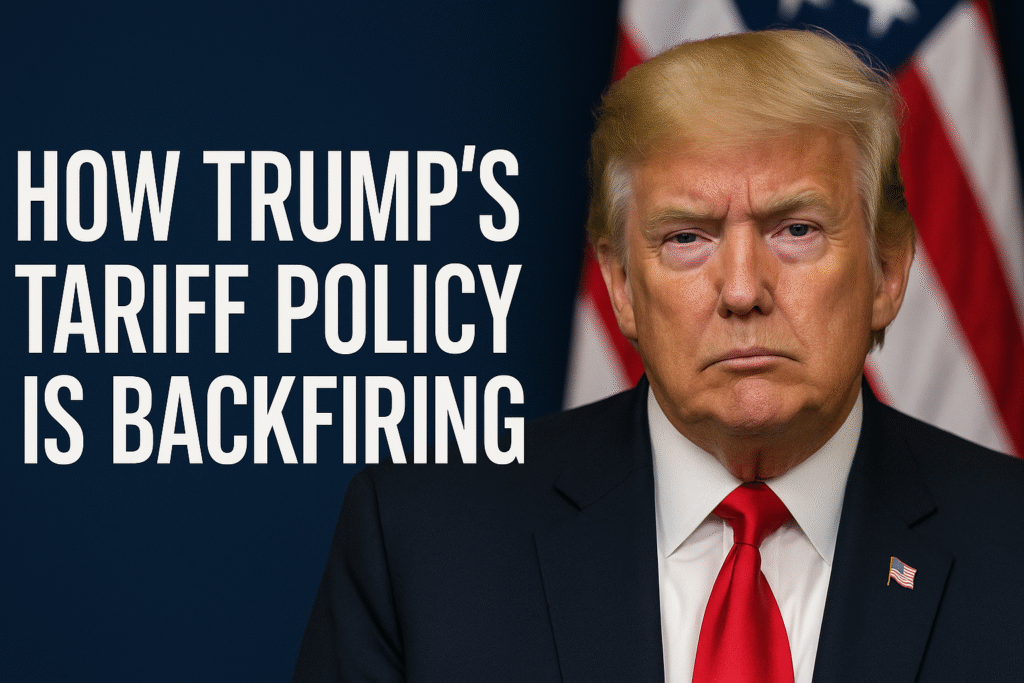
How Trump’s Tariff Policy Is Backfiring: Rising Prices, Global Pushback, and Why Even MAGA Supporters Must Rethink Their Economic Ideology
In recent years, former U.S. President Donald Trump’s tariff-heavy approach has become one of the most controversial economic strategies in global trade history. Although Trump introduced tariffs claiming they would “punish foreign countries” and “protect American workers,” the core reality of international economics works differently. Tariffs do not raise revenue from foreign governments—they act as a hidden tax on American consumers. This was repeatedly explained by economists from Harvard, MIT, the American Enterprise Institute, and even former Republican advisers. Yet Trump ignored all professional warnings and instead treated every major trading partner—China, India, Canada, Mexico, and even European allies—with the same aggressive stick. Today, the consequences of those decisions are becoming visible not only in the global trade system but also in the daily lives of Americans, including Trump’s most loyal voter base.
The clearest sign of this policy failure is the sharp rise in food prices across the United States. The tariff war initially targeted manufactured goods, electronics, and machinery, but it quickly expanded to include hundreds of food items. As a result, the cost of importing essential ingredients—from fruits and nuts to packaged foods and seafood—rose dramatically. Studies from the U.S. International Trade Commission and the Peterson Institute show that tariffs introduced between 2018 and 2023 added up to $1,300 per year in additional costs for the average American household. This number is not political speculation; it comes from official federal and independent economic research. Food inflation became so intense that Trump was eventually forced to roll back or reduce tariffs on nearly 200 essential food items, not because he suddenly accepted economic logic, but because rising grocery prices were angering his core vote bank in swing states.
The pattern is simple: importers pay the tariffs → wholesalers increase prices → retailers adjust margins → consumers pay more. Despite Trump’s repeated claims that “China is paying the tariffs,” data from the Congressional Budget Office clearly shows that more than 98% of tariff expenses were paid by American companies and people, not by China. This misunderstanding—or refusal to understand—of how tariffs work has pushed American families into a cost-of-living crisis. Items such as olive oil, seafood, nuts, cheese, bakery ingredients, and even basic sauces became 15% to 40% more expensive purely because of tariff side-effects. Many MAGA supporters, particularly those from working-class communities who struggle with rising expenses, are now indirectly paying for a policy they once believed would help them.
Beyond domestic inflation, Trump’s tariff war also triggered an international backlash that weakened America’s global standing. By treating every country—friend or rival—with equal hostility, Trump created a world in which nations began exploring alternatives to the U.S.-led trade system. During his first term, China and Russia accelerated non-dollar trade settlements. India negotiated energy payments with Russia in rupees, bypassing the dollar. Brazil openly discussed shifting to Chinese settlement systems. The European Union started strengthening its independent payment corridors. Even Saudi Arabia, America’s long-time oil ally, engaged in talks with China about selling oil in yuan. These developments were unheard of before Trump’s tariff era. His policies unintentionally gave momentum to a global movement known as de-dollarisation—the process where countries reduce their dependency on the U.S. dollar for international trade.
This is not a small issue. America’s superpower status rests heavily on the dollar’s dominance. Roughly 88% of global trade uses the dollar, and about 58% of the world’s reserves are held in dollars. If the world gradually shifts away from using the U.S. currency, the United States will lose its greatest economic weapon: the ability to borrow cheaply, sanction nations easily, and control global finance. Every tariff imposed without strategic thinking encourages more countries to seek alternatives, which ultimately weakens America far more than it hurts China or Russia. Ironically, Trump’s supporters—who believe tariffs make America stronger—may be unintentionally supporting a policy that risks America’s long-term economic influence.
Domestically, the damage has already been visible in American agriculture and small businesses. When Trump placed tariffs on China, Beijing retaliated by slashing U.S. soybean and wheat imports. As a result, American farmers lost billions in export revenue. The Trump administration was forced to pay $28 billion in bailouts to farmers to prevent mass bankruptcies. In effect, taxpayers ended up paying farmers to compensate for losses caused by the government’s own tariff war. Meanwhile, small import-dependent businesses—furniture stores, hardware retailers, electronics shops, clothing wholesalers—faced a 20% to 35% rise in operating costs because they suddenly had to pay tariff-inflated prices for goods. Many of these small businesses struggled to survive, with a significant number shutting down or laying off workers. The very communities that Trump promised to protect were the first to bear the economic pain.
Even today, Trump continues to receive advice from political loyalists rather than qualified economists. One of the greatest concerns raised by academics and financial experts is that Trump surrounds himself not with independent thinkers but with advisors who simply echo his beliefs. He has dismissed research-based economic warnings as “fake” or “globalist propaganda,” turning economic strategy into political theatre. But the global economy does not bend to political slogans. Markets respond to data, policy consistency, and economic logic, not to campaign rhetoric. For America to remain stable and strong in the global trade ecosystem, its leaders must rely on informed decision-making rather than ideological impulses.
If Trump continues imposing tariffs without discrimination or strategic planning, the consequences will only intensify. American families will continue paying higher prices for groceries, home goods, cars, and essentials. Farmers will remain vulnerable to foreign retaliation. Small businesses will face rising competition from countries trading outside U.S. influence. Most dangerously, the world may continue accelerating its shift away from the dollar, slowly eroding America’s economic dominance.
For MAGA supporters and ordinary American citizens, this is the moment to reflect. The country’s economic stability matters more than political slogans. Tariffs do not make America great—they make America expensive. They do not strengthen U.S. global influence—they push countries away from the dollar system. And they do not protect American workers—they increase the financial burden on families, farmers, and small businesses. If America wants to preserve its global leadership, its citizens—especially Trump’s core supporters—must demand better economic policies, better advisors, and better decision-making rooted in real-world financial understanding.
Ultimately, Trump still has time to correct course. But to do so, he must step away from the sycophants and yes-men around him and start listening to credible economic experts who understand global trade dynamics. If he continues ignoring economic realities, the burden of his tariff mistakes will fall squarely on the American people and, ironically, on the MAGA community he claims to represent. America’s future strength depends not on aggressive rhetoric but on smart, informed economic governance. The sooner voters recognise this, the better positioned the country will be to avoid damaging consequences that could last for decades.