US Sanctions Waiver on Russian Oil: How the 2026 Hormuz Crisis Is Shaping India’s Energy Security

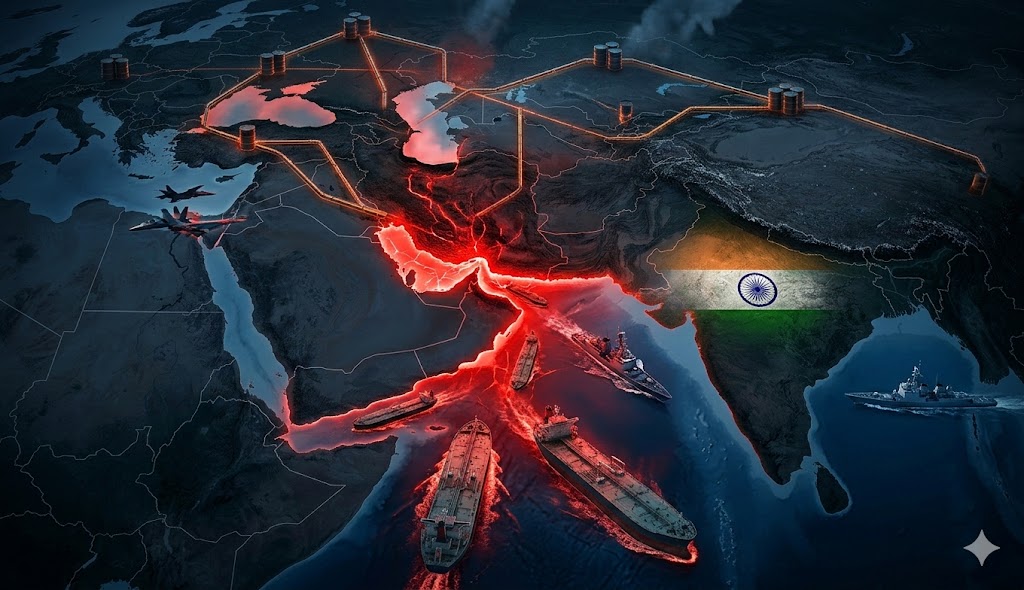
Introduction: The Oil Crisis
On March 9, 2026, global energy markets were once again shaken by geopolitical tensions in West Asia. Oil prices surged close to $115 per barrel, shipping routes in the Persian Gulf became uncertain, and the strategic importance of the Strait of Hormuz returned to the center of global politics. In the middle of this crisis, the United States announced a 30-day sanctions waiver allowing India to purchase certain shipments of Russian oil that were already in transit. At first glance, this decision appeared generous. However, many analysts in India began asking a deeper question: is this waiver actually a lifeline for India’s energy security, or is it a temporary leash that increases dependence on US geopolitical decisions?
The crisis highlights a larger debate about global energy politics. Countries like India must constantly balance their economic growth with external geopolitical pressures. India is the world’s third-largest oil consumer and imports nearly 85% of its crude oil needs. Any disruption in global supply chains immediately affects inflation, foreign exchange reserves, and the broader economy. Therefore, decisions made in Washington or the Persian Gulf can have direct consequences for millions of Indian households.
In recent years, India has pursued a pragmatic energy strategy. It has purchased discounted Russian crude, expanded ties with Middle Eastern suppliers, and invested in infrastructure projects that bypass traditional shipping chokepoints. But the current crisis shows how fragile this balance can be. When sanctions, conflicts, and maritime risks combine, energy trade becomes not just an economic issue but a strategic one.
This situation has led some analysts to use a provocative phrase: “Energy Colonialism.” The argument is that powerful countries can manipulate sanctions and waivers to control the economic choices of emerging economies. Whether one agrees with that view or not, the March 2026 crisis clearly demonstrates how energy flows, financial systems, and geopolitics are deeply interconnected.
Global Oil Price Data
The Hormuz Choke: A Manufactured Vulnerability?
The Strait of Hormuz is one of the most important maritime passages in the world. Nearly 20% of global oil shipments pass through this narrow waterway between the Persian Gulf and the Arabian Sea. When tensions rise in this region, the entire global energy market reacts immediately.
Recent military escalations involving Israel and Iran have increased the risk of disruptions in the region. Even rumors of attacks or blockades can cause shipping companies and insurance providers to raise their risk assessments. Tanker operators become cautious, and shipping costs increase rapidly.
For India, the stakes are particularly high. A large portion of India’s crude oil imports come from Gulf producers such as Saudi Arabia, Iraq, and the United Arab Emirates. Any instability in the Strait of Hormuz directly affects India’s supply chains.
At the same time, India has tried to diversify its geopolitical partnerships in the region. One of the most important projects in this strategy is the development of the Chabahar Port in Iran, supported by India as a gateway to Central Asia. The project has been strategically important for India because it allows trade routes that bypass Pakistan and connect to Afghanistan and Central Asia.
However, sanctions on Iran have repeatedly complicated India’s plans. When geopolitical pressure increases, projects like Chabahar become vulnerable to external decisions. India must constantly negotiate exemptions and waivers to keep such projects operational.
Critics argue that this situation creates a structural vulnerability for India. When global energy routes become politicized, countries that depend heavily on imports may find themselves navigating between competing geopolitical interests. The Strait of Hormuz crisis therefore raises a broader question: is the vulnerability purely geographic, or is it also a result of geopolitical power dynamics?
Strait of Hormuz Oil Transit Statistics
Decoding the 30-Day Russian Oil Waiver
The recent waiver issued by the United States Department of the Treasury allows India to purchase certain shipments of Russian crude oil that were loaded before March 5 and are currently at sea. The waiver lasts for only 30 days, meaning that transactions must be completed within this short window.
This condition is important. The waiver does not allow India to freely continue buying Russian oil indefinitely. Instead, it merely provides temporary flexibility for shipments that were already in transit before the latest sanctions escalation.
Russia has become one of India’s largest oil suppliers since 2022, particularly after Western sanctions created discounts on Russian crude. Indian refiners benefited from these price differences, which helped reduce fuel inflation at home.
The short-term waiver therefore prevents immediate disruption in Indian refineries that were expecting these shipments. But the limited duration also creates uncertainty for future contracts. Energy markets prefer stability and predictable supply chains. Temporary waivers do not provide that stability.
Some analysts argue that the United States may have another motivation for offering the waiver. If India and other major buyers suddenly stopped purchasing Russian oil, global prices could rise sharply. That price spike would affect not only developing economies but also Western consumers.
Therefore, the waiver may serve a dual purpose: stabilizing global oil markets while maintaining pressure on Russia through sanctions.
The “China Mistake” Debate at Raisina Dialogue 2026
During the 2026 edition of the Raisina Dialogue, global policymakers discussed the shifting balance of power in Asia. One controversial moment occurred when US Deputy Secretary Christopher Landau remarked that the United States would not repeat the “China mistake” when engaging economically with India.
The phrase sparked debate among analysts and policymakers. Some interpreted the comment as a signal that the United States intends to carefully manage economic cooperation with India while avoiding overdependence similar to the US-China trade relationship of previous decades.
However, critics in India saw the statement differently. They argued that such rhetoric suggests a conditional partnership. In this view, India is welcomed as a strategic partner when it aligns with Western geopolitical goals, but faces pressure when it pursues independent economic policies.
Trade tensions have occasionally reinforced this perception. For example, discussions about reciprocal tariffs and market access continue to shape the US-India economic relationship.
Despite these debates, India and the United States still share strong economic ties. Bilateral trade between the two countries has grown significantly in recent years, making the United States one of India’s largest trading partners.
The Raisina Dialogue discussion therefore highlights a complex reality. Strategic partnerships in the modern world often involve both cooperation and competition at the same time.
Financial Impact: The Cost of Strategic Alignment
Energy shocks rarely remain limited to oil markets. They quickly spread into financial markets, currency valuations, and investment flows.
In recent weeks, volatility in global energy prices has influenced investor sentiment across emerging markets. Foreign institutional investors (FIIs) often respond to geopolitical uncertainty by moving capital toward safer assets.
For India, this can create pressure on both equity markets and the currency. Rising oil prices also increase India’s import bill, which affects the current account deficit and can influence inflation levels.
Another major financial consequence involves maritime risk. When shipping routes become dangerous, insurance costs rise dramatically. Companies providing maritime war risk insurance reassess their premiums, and tanker operators must pay higher coverage costs.
These costs are eventually reflected in oil prices and shipping contracts. Financial institutions that provide trade finance solutions for energy transactions must also adjust their risk models. Banks and insurers carefully monitor geopolitical developments because they affect the stability of global supply chains.
Currency arrangements also play an important role. Some analysts have suggested that alternative payment systems, including rupee-based settlements or bilateral currency agreements, could help reduce dependence on traditional international financial networks.
Such mechanisms, however, require strong financial infrastructure and trust between trading partners.
Global Maritime Shipping Risk
Conclusion: Atmanirbhar Bharat and the Future of Energy Security
The March 2026 crisis has once again highlighted the complex relationship between geopolitics and energy markets. For a country like India, which depends heavily on imported oil, strategic autonomy in energy policy is essential.
India has already taken several steps toward strengthening its energy resilience. Investments in renewable energy, diversification of oil suppliers, and strategic petroleum reserves all contribute to long-term stability.
Another important development is the exploration of digital financial infrastructure. The Reserve Bank of India has been experimenting with a central bank digital currency known as the e-Rupee. Some analysts believe that such systems could eventually play a role in international trade settlements.
India is also expanding connectivity projects such as the International North-South Transport Corridor (INSTC), which aims to link India with Russia and Central Asia through alternative trade routes. These initiatives are designed to reduce dependence on traditional maritime chokepoints.
Ultimately, the goal is not to choose between different geopolitical blocs but to maintain flexibility. A stable and diversified energy strategy allows India to pursue economic growth while navigating an increasingly complex global environment.
The March 2026 waiver may be temporary, but it has sparked an important conversation about the future of India’s energy independence.
As global power dynamics evolve, the central question remains: should India prioritize short-term geopolitical alignment, or should it focus on building long-term strategic autonomy in energy and trade?
The answer to that question will shape India’s economic trajectory for decades to come.
FAQ: Hormuz Oil Crisis and India’s Energy Security
1. What is the Strait of Hormuz and why is it important for global oil trade?
The Strait of Hormuz is a narrow maritime passage connecting the Persian Gulf to the Arabian Sea. Nearly 20% of the world’s crude oil supply passes through this route every day, making it one of the most strategically important shipping lanes for global energy markets. When geopolitical tensions increase in this region, oil prices often rise because traders fear disruptions in supply chains. Countries that depend heavily on imported oil, such as India, are especially sensitive to developments in this area.
2. Why did the United States grant India a waiver to buy Russian oil in 2026?
The United States Department of the Treasury granted a temporary waiver allowing India to purchase certain shipments of Russian oil that were already loaded before new sanctions took effect. The waiver was intended to prevent sudden disruptions in global oil supply and avoid a rapid spike in international crude prices. Since India is one of the largest oil consumers in the world, sudden supply interruptions could have destabilized both regional and global energy markets.
3. How does the Hormuz crisis affect India’s economy?
India imports nearly 85% of its crude oil requirements, which means fluctuations in global oil prices directly impact the country’s economy. Higher oil prices increase transportation costs, fuel prices, and inflation. They can also widen India’s current account deficit and weaken the national currency. According to data from the Petroleum Planning and Analysis Cell, energy imports are one of the largest components of India’s total import bill.
4. What role does maritime insurance play during geopolitical conflicts?
When geopolitical tensions rise in major shipping routes like the Persian Gulf, insurance companies increase premiums for oil tankers traveling through those areas. This is known as maritime war risk insurance. Higher insurance costs raise the overall cost of transporting crude oil and energy commodities. Shipping companies, refiners, and traders must factor these costs into global energy pricing, which can influence fuel prices worldwide.
5. Why is Russia an important oil supplier for India?
Since 2022, Russia has become one of India’s major crude oil suppliers because Russian crude has often been available at discounted prices compared to other global benchmarks. Indian refiners have benefited from these price advantages, helping stabilize domestic fuel costs. Purchasing diversified energy supplies also helps India reduce dependence on a single region for oil imports.
6. What is the significance of Chabahar Port for India’s strategic trade routes?
The Chabahar Port project in Iran is strategically important for India because it provides direct access to Central Asia and Afghanistan without passing through Pakistan. The port is part of India’s broader effort to develop alternative trade corridors that strengthen regional connectivity. This infrastructure also plays a role in India’s long-term energy and trade strategy in the region.
7. Could digital currencies like the e-Rupee change global energy trade?
Some experts believe that central bank digital currencies may eventually play a role in international trade settlements. The Reserve Bank of India has already launched pilot projects for the digital rupee, also known as the e-Rupee. In the future, such digital payment systems could help countries settle trade transactions more efficiently and reduce reliance on traditional financial networks.
8. How does the Hormuz crisis influence global oil prices?
Oil prices respond quickly to geopolitical tensions because traders anticipate supply disruptions. If shipping routes become unsafe or blocked, oil supplies may decline, pushing prices higher. Market data from institutions such as the International Energy Agency shows that even rumors of disruptions in the Strait of Hormuz can cause immediate volatility in global energy markets.
9. What is India doing to strengthen its energy security?
India is pursuing multiple strategies to improve long-term energy security. These include diversifying crude oil suppliers, expanding strategic petroleum reserves, investing in renewable energy, and building alternative trade routes such as the International North-South Transport Corridor (INSTC). These efforts aim to reduce vulnerability to geopolitical disruptions in global energy markets.
10. Why is energy security considered a geopolitical issue?
Energy security is closely connected to geopolitics because access to oil, gas, and other resources influences economic growth and national security. Countries often use energy trade, sanctions, and strategic partnerships as tools of foreign policy. As a result, global energy markets are shaped not only by supply and demand but also by diplomatic relations, conflicts, and international alliances.

Anant Jha
Anant Jha is the Editor-in-Chief of SRVISHWA.com, where he writes on geopolitics, geoeconomics, and global financial trends. As a geopolitical and geoeconomic analyst (and continuous learner), he focuses on decoding global power shifts, currency dynamics, and economic strategies shaping the modern world.He is also a stock market fundamental analyst and learner, exploring how macroeconomic events influence businesses and long-term investment opportunities. Through his work, he aims to simplify complex global issues and connect them with real-world economic impact for readers.
View all posts →