

As a political–economic strategist who has closely observed the evolution of India’s technology sector for more than three decades, I see the Q3 FY26 results of HCL Technologies, released on January 12, 2026, as a clear example of operational agility in a changing global economy.
At first glance, the headline number—a year-on-year decline in net profit—created discomfort in the market. But just like many past cycles, this reaction focused more on accounting optics than on business reality. When the numbers are read in full context, HCL Tech’s performance reflects not weakness, but strategic resilience, policy alignment, and a powerful shift toward high-value engineering and R&D services.
From a geoeconomic lens, HCL Tech is no longer just an Indian software exporter. It is becoming a strategic node in global technology supply chains, supported by its expanding engineering portfolio, deep partnerships with global hardware and AI leaders, and carefully timed acquisitions.
1. The Opening Narrative: Beyond the Statutory Noise
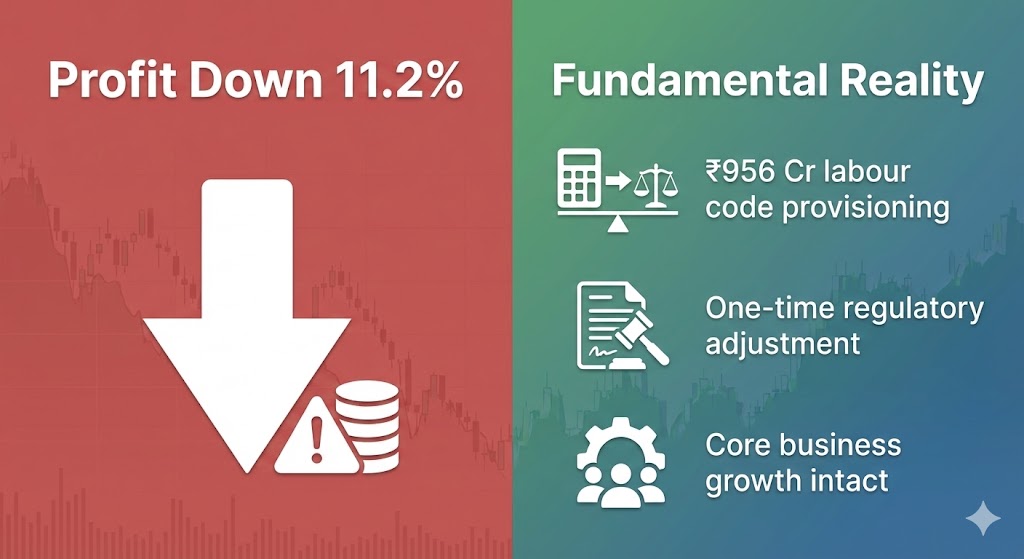
The first number that drew attention in Q3 FY26 was the 11.2% year-on-year decline in net profit. For many investors, this immediately raised questions about demand slowdown or margin pressure. However, this conclusion misses the most important detail behind the number.
HCL Tech took a one-time provisioning of ₹956 crore related to compliance with India’s new labour codes. These reforms are designed to formalise employment, strengthen social security, and standardise workforce practices across industries. This provisioning is not linked to falling demand or operational inefficiency.
From an expert’s perspective, this move reflects institutional maturity. Companies that proactively align with regulatory reforms reduce long-term legal and compliance risks. In contrast, firms that delay such adjustments often face sudden shocks later. By absorbing this cost early, HCL Tech has effectively “cleaned its balance sheet” for the future.
There is also a geopolitical dimension here. HCL Tech is the only large Indian IT company with a well-balanced mix of services and software products. This dual structure makes it less vulnerable to discretionary IT spending cuts in the US and Europe, where pure-play services firms are facing sharper volatility.
HCL Technologies – Official Q3 FY26 Results
2. Q3 FY26 Financial Scorecard: Breaking the $15 Billion Barrier
One of the most important achievements in this quarter was HCL Tech crossing $15 billion in annualised revenue, a milestone that places it firmly among the world’s large-scale technology service providers.
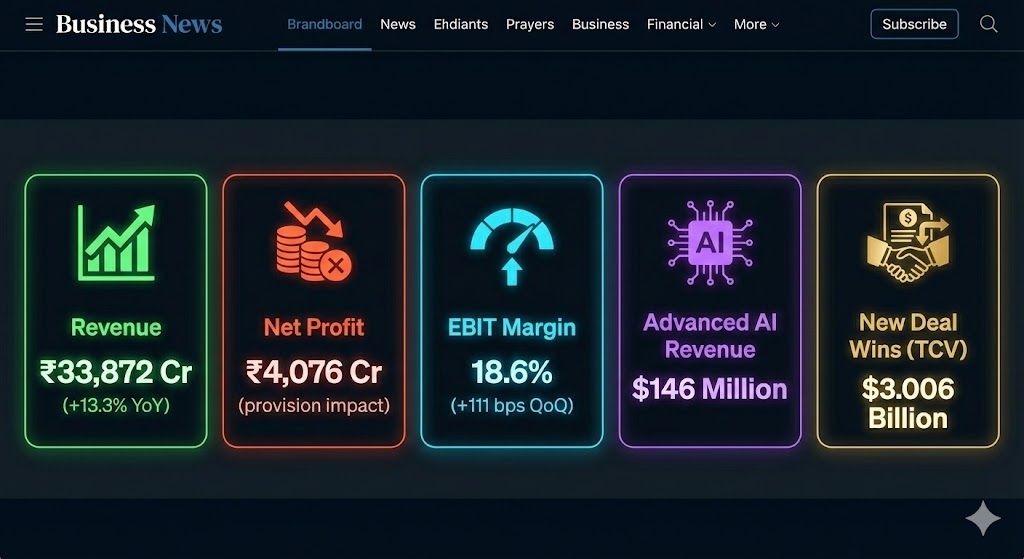
For Q3 FY26, HCL Tech reported consolidated revenue of ₹33,872 crore, representing a 13.3% year-on-year growth and a 6% quarter-on-quarter increase. This performance significantly exceeded analyst expectations, which were closer to 2–3% growth for the quarter.
This is not incremental growth—it is a clear breakout.
Despite wage hikes, restructuring costs, and global uncertainty, HCL Tech managed to expand its adjusted EBIT margin to 18.6%, improving by 111 basis points quarter-on-quarter. Margin expansion during a period of cost pressure is a strong indicator of operational efficiency and pricing discipline.
The company also announced an interim dividend of ₹12 per share, marking the 92nd consecutive quarter of dividend payouts. Such consistency is rare and signals stable cash flows and strong capital allocation discipline.
Q3 FY26 Performance Matrix
| Key Metric | Q3 FY26 Data | Growth / Status |
|---|---|---|
| Consolidated Revenue | ₹33,872 Cr | +13.3% YoY (Strong Beat) |
| Net Profit (PAT) | ₹4,076 Cr | -11.2% YoY (Provision Impact) |
| New Deal Wins (TCV) | $3.006 Billion | +43.5% YoY (Record High) |
| Advanced AI Revenue | $146 Million | +19.9% QoQ (Accelerating) |
| Interim Dividend | ₹12 per share | 92nd consecutive quarter |
3. Fundamental Deep-Dive: The ER&D Edge
The real strength of HCL Tech lies in its Engineering and R&D (ER&D) services, which grew 10.8% year-on-year during the quarter. At a time when generic IT services are slowing globally, specialised engineering work is expanding rapidly.
Industries such as automotive, aerospace, semiconductors, telecom equipment, and industrial automation are investing heavily in product engineering and embedded software. These are not discretionary projects—they are essential for competitiveness in a world moving toward electrification, automation, and AI-driven systems.
HCL Tech has emerged as a global leader in ER&D, especially in areas where software meets hardware. This positioning explains why its growth remains strong even when traditional IT spending weakens.
A major validation of this capability came at CES 2026, where NVIDIA’s CEO publicly mentioned HCL Tech as a key partner in “Physical AI”—AI systems that interact with the real world through machines, sensors, and robotics. This is not just corporate praise; it is geopolitical recognition of Indian engineering talent in next-generation technologies.
NASSCOM – Indian IT Industry Performance
4. The Policy & Macro Angle: New Spending Pockets
The ₹956 crore labour code provisioning is best understood as a one-time adjustment, not a recurring burden. Management has indicated that the ongoing impact of labour reforms is likely to be just 10–20 basis points, which is negligible from FY27 onward.
This clears uncertainty and improves earnings visibility.
Another important macro driver is the growing role of Digital Public Infrastructure (DPI). India’s success with platforms like Aadhaar, UPI, and digital governance tools is now being exported globally. HCL Tech has seen rising demand in its public services vertical, particularly in digital identity, e-governance, and citizen service platforms.
Management’s confidence was evident in its decision to raise FY26 revenue guidance to 4.0%–4.5%. In a global economy aiming for a “soft landing,” such guidance upgrades are a bullish signal, especially when many peers are cutting forecasts.
HCL Tech Investor Presentation / Financial Highlights
5. Geoeconomic Expansion: M&A and Global Foothold
HCL Tech’s $160 million acquisition of HPE’s Telco business is strategically significant. Telecom networks are at the heart of modern geopolitics—supporting 5G today and 6G tomorrow, along with cloud, edge computing, and defence communications.
This acquisition places HCL Tech directly inside the architecture of global telecom networks, rather than just on the software services layer. It strengthens relationships with telecom operators and equipment vendors across North America, Europe, and Asia.
At the same time, HCL Tech’s Advanced AI revenue reached $146 million, growing nearly 20% quarter-on-quarter. This growth is being driven by platforms such as Agentic AI Force 2.0, which enable automation and decision-making without proportionate increases in headcount.
This is how non-linear growth is achieved—higher revenue without matching increases in costs.
6. Workforce Dynamics: Quality Over Quantity
One of the quieter but most important trends in Q3 FY26 was workforce optimisation. HCL Tech reported a net headcount reduction of 261 employees, while simultaneously adding 2,852 freshers.
This may seem contradictory, but it reveals a deliberate strategy. The company is rebuilding its workforce pyramid from the base—hiring fresh talent while controlling mid-level cost inflation.
The results are already visible. Last-twelve-month attrition declined to 12.4%, down from 13.2%. Lower attrition reduces hiring and training costs, improves project continuity, and protects margins.
This fresher-led pyramid model is one of the key reasons HCL Tech has been able to sustain 18%+ margins while continuing to grow.
7. Conclusion: The “Buy on Dips” Thesis
For a long-term fundamental analyst, the Q3 FY26 profit “miss” is not a red flag—it is an opportunity. The underlying story is far stronger than the headline suggests.
The record $3.006 billion in new deal wins ensures revenue visibility for the next three to five years. The ER&D leadership, telecom expansion, and AI platforms position HCL Tech in the highest-growth segments of global technology spending.
The expert’s closing view is clear: HCL Tech is transitioning from a traditional IT service provider into a technology product and engineering powerhouse. This transition aligns perfectly with India’s Aatmanirbhar Bharat vision of moving up the global value chain—from cost-based services to capability-based leadership.
In a volatile market, companies that combine policy alignment, operational discipline, and strategic foresight are rare. HCL Tech is proving that it belongs in that category.
❓ FAQs (For Bottom of Article – Schema Ready)
Q1. Why did HCL Tech profit fall in Q3 FY26?
HCL Tech’s profit declined mainly due to a one-time ₹956 crore provisioning linked to India’s new labour codes. Core business growth remained strong.
Q2. How did HCL Tech perform on revenue in Q3 FY26?
HCL Tech reported ₹33,872 crore in revenue, growing 13.3% year-on-year and 6% quarter-on-quarter, significantly beating market expectations.
Q3. What is HCL Tech’s strength in ER&D services?
HCL Tech is a global leader in Engineering and R&D services, with strong exposure to automotive, semiconductors, telecom, and physical AI.
Q4. How important is AI for HCL Tech’s future growth?
AI is a fast-growing revenue driver, with advanced AI revenue at $146 million, supported by platforms like Agentic AI Force 2.0.
Q5. What is the significance of HCL Tech’s new deal wins?
HCL Tech reported record new deal wins worth $3.006 billion, providing revenue visibility for the next 3–5 years.
🔍 PEOPLE ALSO ASK (PAA) – USE AS H2 / H3
(These improve featured snippet chances)
Is HCL Tech facing a slowdown in 2026?
No. While global IT spending is cautious, HCL Tech continues to grow due to its ER&D leadership and strong deal pipeline.
What makes HCL Tech different from other IT companies?
HCL Tech has a unique services + software products mix and a dominant position in high-value engineering services.
How does the labour code impact affect HCL Tech long term?
The impact is largely one-time, with future costs expected to be minimal and manageable.
Why is ER&D important for India’s IT sector?
ER&D moves Indian IT up the value chain, reducing dependence on low-margin services and increasing global strategic relevance.
Is HCL Tech aligned with India’s Aatmanirbhar Bharat vision?
Yes. Its focus on engineering, telecom, semiconductors, and AI supports India’s push toward higher-value technology leadership.





1 thought on “HCL Tech Q3 FY26 Results Explained: ER&D Growth, AI Push & Profit Dip Decoded”