1. The Executive Summary (The Macro Hook)
Hindustan Aeronautics Limited (HAL) has delivered a strong and confident performance in Q3 FY26, sending a clear message to the market. The company reported a consolidated net profit of ₹1,867 crore, which is nearly 30% higher than ₹1,440 crore recorded in Q3 FY25. This is a significant jump for a heavy manufacturing defence company. Revenue from operations grew 11% year-on-year to ₹7,699 crore compared to ₹6,957 crore last year. Many investors were worried that delays in GE F404 engine supplies would slow down Tejas Mk1A deliveries and impact revenue, but the numbers prove that production activity remained stable. The board also declared a first interim dividend of ₹35 per share, which reflects strong cash flow and management confidence. Most importantly, profit growth is much higher than revenue growth, which shows better operational efficiency and stronger margins. This quarter can clearly be described as a quality beat.
Hindustan Aeronautics Limited official website
2. Financial Dashboard: Q3 FY26 Real-Time Data
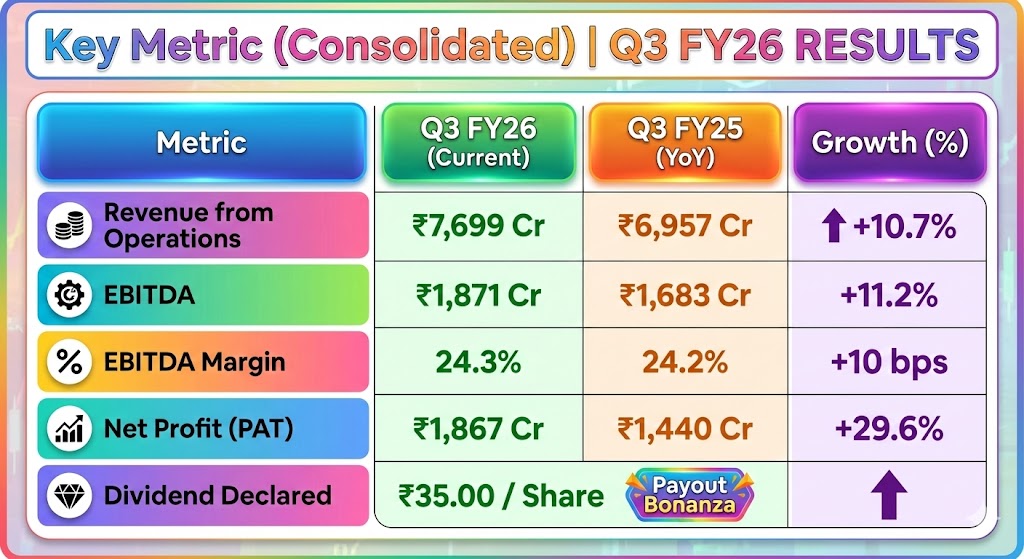
The financial data of Q3 FY26 shows stable growth with improving profitability. Revenue increased to ₹7,699 crore, registering a growth of 10.7% year-on-year. EBITDA rose to ₹1,871 crore, up 11.2% from ₹1,683 crore in Q3 FY25. EBITDA margin stood at 24.3%, slightly higher than 24.2% last year, showing margin stability despite supply challenges. Net profit jumped sharply to ₹1,867 crore, marking a 29.6% increase. In capital-intensive industries like aerospace manufacturing, maintaining margins above 24% is impressive. Many capital goods companies operate with lower margins between 15% and 20%. The ₹35 per share interim dividend also indicates strong financial discipline. The key takeaway from this data is that HAL is not only growing revenue but also improving profitability at a faster pace.
HAL investor presentation Q3 FY26
3. Fundamental Breakdown: The Engine of Growth
From a fundamental perspective, HAL’s performance is supported by strong execution and business visibility. Investors always look for clarity in future earnings, and HAL currently has that advantage. The company’s order book stands at over ₹90,000 crore, and when including the expected additional 97 Tejas Mk1A aircraft, the overall pipeline visibility reaches around ₹2.3 lakh crore. This gives revenue visibility for the next seven to eight years, which is rare in manufacturing. Strong long-term contracts reduce uncertainty and allow better financial planning. The combination of manufacturing, services, and defence policy support is driving HAL’s stable growth path.
A. The GE Engine Bottleneck: Cleared?
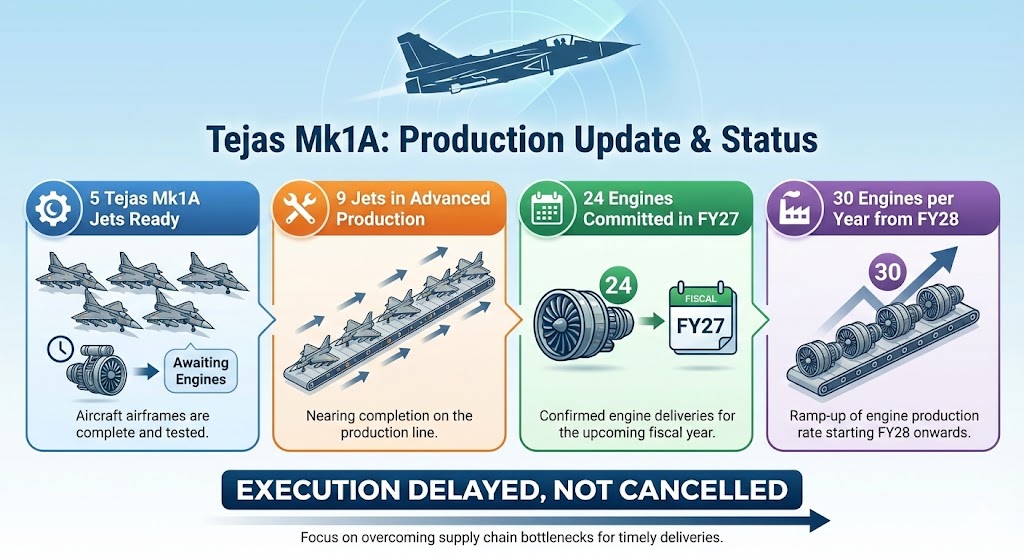
One of the biggest concerns in recent quarters was the delay in GE F404 engine deliveries required for the Tejas Mk1A fighter jets. Without engines, aircraft cannot be delivered, and revenue recognition gets postponed. However, management clarified that five Tejas Mk1A jets are fully ready except for engines, and nine more are in advanced production stages. This means that once engines are supplied, deliveries can happen quickly. GE has reportedly committed to delivering 24 engines in FY27 and 30 engines per year from FY28. This commitment provides a clear production roadmap for the next two years. The situation appears manageable rather than alarming, and this clarity reduces investor fear significantly.
GE Aerospace
B. The MRO Cash Cow
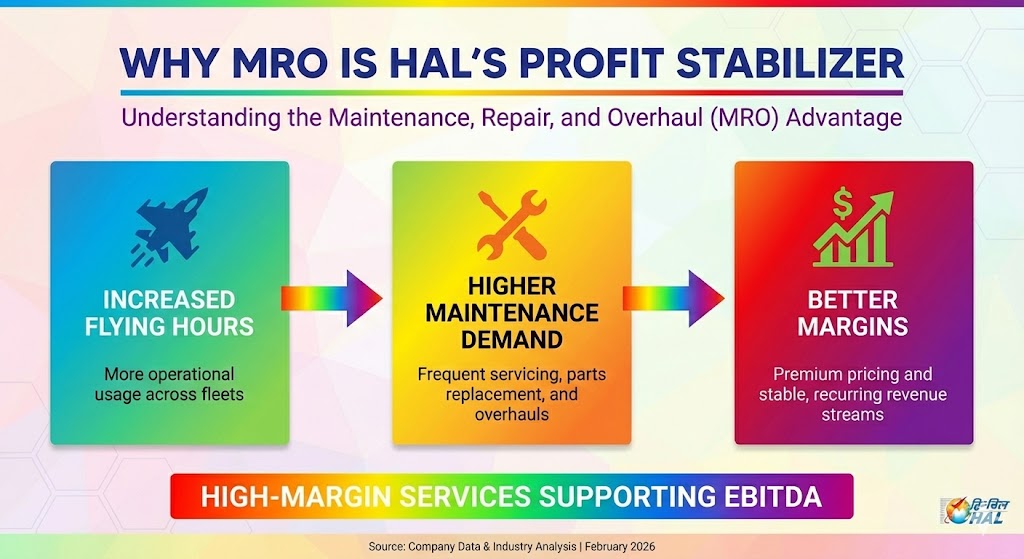
While public focus remains on new aircraft manufacturing, the Maintenance, Repair and Overhaul (MRO) business plays a critical role in supporting profits. The Indian Air Force continues to operate its aircraft actively, especially due to ongoing security requirements along the borders. Increased flying hours result in higher maintenance demand. Service and MRO activities typically carry better margins because infrastructure and expertise are already established. This high-margin segment helps stabilize earnings even when manufacturing deliveries face temporary challenges. The stable EBITDA margin of 24.3% reflects the strong contribution from the services segment.
C. Order Book: The 2032 Visibility
HAL’s order book strength is one of its biggest advantages. With confirmed orders exceeding ₹90,000 crore and potential pipeline visibility touching ₹2.3 lakh crore, the company has predictable revenue streams for several years. Very few Indian manufacturing companies have such long-term clarity. This visibility reduces business risk and allows steady capacity utilization. It also supports research and development spending for future platforms like Tejas Mk2 and other advanced aircraft programs. Long-term government contracts provide stability that private manufacturing firms often lack.
SIPRI military expenditure database
4. Geopolitics & Policy: The Atmanirbhar Moat
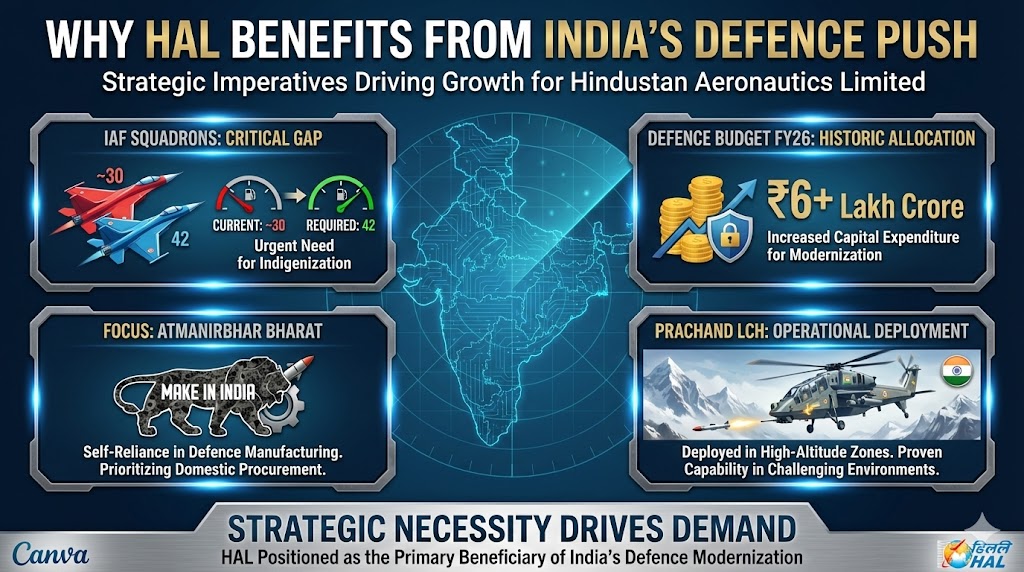
India’s geopolitical environment directly supports HAL’s growth. The Indian Air Force currently operates around 30 fighter squadrons against a sanctioned strength of 42 squadrons. This gap highlights urgent procurement needs. Under the “Atmanirbhar Bharat” initiative, the government is prioritizing domestic defence production over imports. Foreign aircraft procurement takes time and involves high costs and strategic dependence. HAL’s Tejas Mk1A is positioned as the primary solution to strengthen squadron strength. Additionally, the Prachand Light Combat Helicopter has been deployed in high-altitude regions like Ladakh, demonstrating India’s indigenous capability. India’s defence budget for FY26 remains above ₹6 lakh crore, with strong capital expenditure allocation. These policy and geopolitical factors create a protective moat around HAL’s business.
5. Risk Factors: The Execution Lag
Despite strong fundamentals, risks remain. Supply chain challenges continue globally. While GE has committed to engine deliveries, any delay could impact timelines. Specialized avionics and components sourced from Europe may also face logistical issues. If integration slows, inventory levels may increase, affecting working capital. Another risk is valuation. HAL’s stock price has risen significantly in recent years, and expectations are high. When valuations are elevated, even minor project delays can cause short-term corrections. Investors must consider execution risk and avoid assuming flawless performance.
6. Conclusion: The Core Defence Portfolio
HAL’s Q3 FY26 performance demonstrates resilience and operational strength. A 30% rise in net profit despite engine supply challenges proves that the company has diversified revenue streams and strong internal efficiency. The ₹35 interim dividend shows financial confidence and shareholder friendliness. Long-term order visibility, strong defence policy support, and stable margins position HAL as a core defence manufacturing company in India. If engine deliveries normalize in FY27 as planned, revenue growth could accelerate beyond the current 11% level, possibly moving toward 20% or higher. While risks exist, the overall trajectory remains positive. HAL is not only manufacturing aircraft; it is strengthening India’s defence capability while building long-term financial stability.