1. Executive Summary: Why Grasim’s Falling Profit Is Not a Red Flag
In more than three decades of tracking Indian conglomerates, it is rare to see a company consciously accept short-term pain at this scale to secure long-term dominance, but Grasim Industries is doing exactly that. In Q3 FY26, reported on February 10, 2026, Grasim delivered a 9% year-on-year rise in consolidated revenue to ₹34,793 crore, even as net profit fell sharply by 29% to ₹1,844 crore. For surface-level observers, this looks like a slowdown. For fundamental analysts, this is a textbook “J-Curve” phase—where earnings dip temporarily because the company is investing aggressively ahead of a much larger payoff. The pressure on profits comes mainly from two areas: the front-loaded launch costs of Birla Opus Paints and temporarily weak pricing in cement, not from any collapse in demand or operational weakness. In simple terms, Grasim is deliberately burning cash today to build multiple future monopolies, and history shows that this approach—when executed well—creates extraordinary shareholder value.
Grasim Industries Q3 FY26 results
2. Financial Dashboard: When Revenue Grows but Profits Shrink
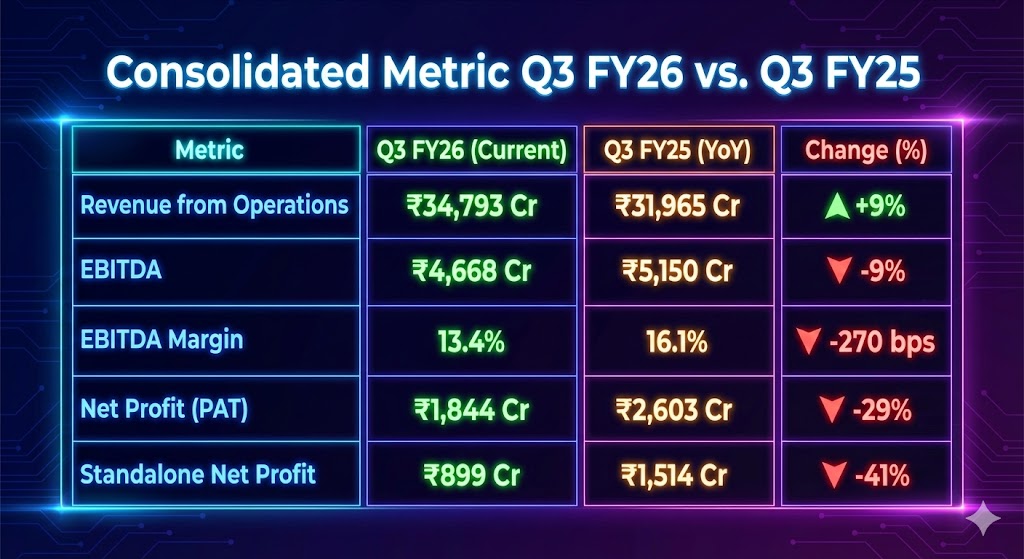
The Q3 FY26 numbers clearly show a widening gap between top-line strength and bottom-line pressure, which is exactly what one expects in the middle of a large capex cycle. Revenue from operations rose to ₹34,793 crore from ₹31,965 crore, driven by financial services, chemicals, and steady cement volumes. However, EBITDA declined 9% to ₹4,668 crore, and EBITDA margins compressed sharply from 16.1% to 13.4%, reflecting higher advertising spends, startup losses in paints, and softer cement realizations. Net profit after tax dropped to ₹1,844 crore from ₹2,603 crore, while standalone profit fell 41%, highlighting how heavily the parent company is funding new growth engines. This divergence is not a warning sign; it is a signal that Grasim is prioritizing market share, scale, and brand creation over near-term earnings optics, something that rarely shows up well in quarterly headlines but matters enormously over five to seven years.
Grasim Industries Ltd
3. Segmental Deep Dive: Understanding Grasim Through a Sum-of-Parts Lens
A conglomerate like Grasim cannot be judged by a single P&L number. The right way to analyze it is through a Sum of the Parts (SOTP) approach, where each business is evaluated independently based on its cycle, capital intensity, and long-term potential. Q3 FY26 is a perfect example of why this matters, because some segments are clearly in investment mode, while others are quietly throwing off cash.
3A. Birla Opus Paints: The Costly Entry That Could Redraw the Industry
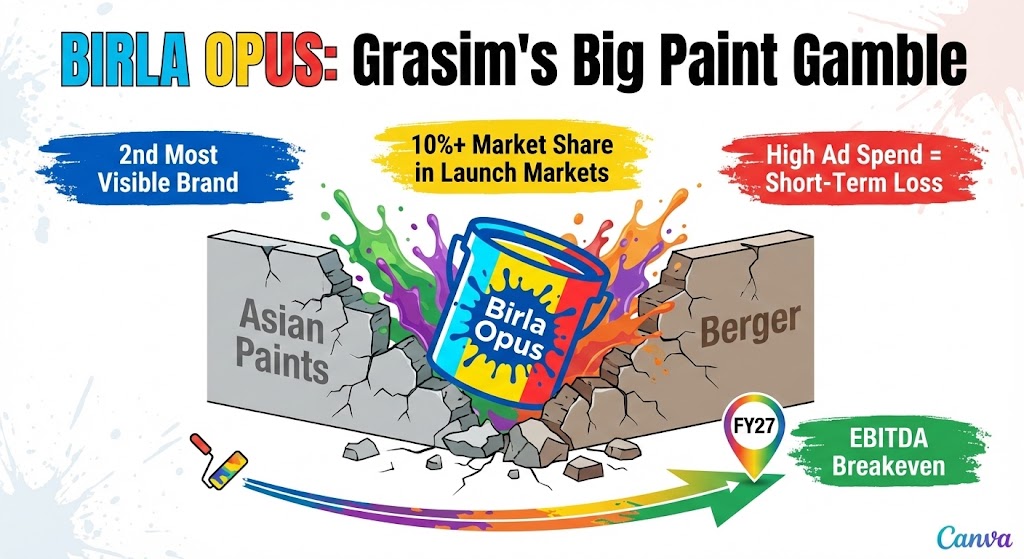
The most important strategic development for Grasim is Birla Opus, its ambitious entry into the decorative paints market. Management confirmed that Birla Opus is already the second most visible paint brand in India by media reach, an extraordinary achievement for a business that is barely a year old. This visibility has come at a cost. The 41% drop in standalone profit is largely due to aggressive advertising, dealer onboarding, logistics setup, and the ramp-up of new manufacturing plants. From a fundamental perspective, this is not wasteful spending—it is classic market entry warfare. The Indian paints industry has long been dominated by Asian Paints and Berger Paints, with high margins protected by brand loyalty and dealer control. Grasim is breaking this structure by using its balance sheet strength to buy visibility and shelf space at scale. Early data shows revenue market share crossing 10% in launch markets, a critical psychological threshold. If Birla Opus reaches EBITDA breakeven by FY27, this phase will later be remembered as the “Jio moment” of Indian paints.
Asian Paints market leadership
3B. Viscose Staple Fibre and Chemicals: Margin Pain, But Structural Strength
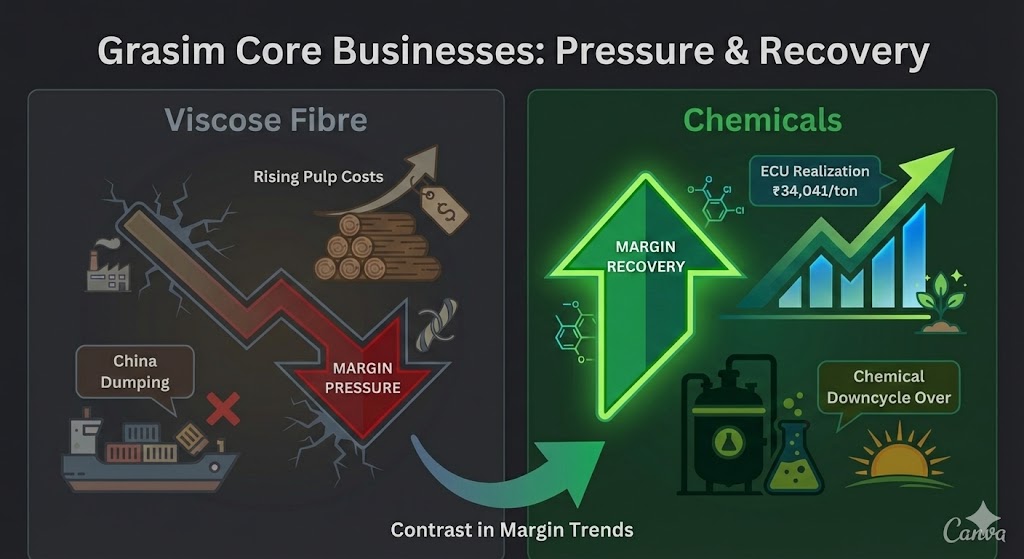
Grasim’s traditional backbone—Viscose Staple Fibre (VSF) and chemicals—had a mixed quarter. VSF revenue grew 6% year-on-year to ₹3,934 crore, but EBITDA declined 18%, mainly due to higher wood pulp prices and dumping of cheap fibre from China earlier in the year. While this has hurt margins, the demand story remains intact. Indian textile manufacturers are gradually shifting from cotton to man-made fibres to meet export demand, especially from the US. On the chemicals side, performance was significantly stronger. Revenue rose 12% to ₹2,226 crore, and ECU realizations improved to ₹34,041 per ton, confirming that the global chemical downcycle has likely bottomed out. Caustic soda prices are recovering in line with global benchmarks, and utilization levels are improving. This segment is once again behaving like a steady cash generator rather than a drag.
3C. Cement and Financial Services: The Quiet Giants at Work
Cement and finance remain the heavyweight contributors to Grasim’s consolidated value. UltraTech Cement continued to add volumes and revenue, but margins were under pressure due to a temporary dip in cement prices and higher freight costs. Importantly, this is a cyclical issue, not a structural one. Demand from infrastructure and housing remains strong, and pricing discipline historically returns once regional supply stabilizes. The real star of the quarter was Aditya Birla Capital, which posted 27% revenue growth with a rapidly expanding lending book. Asset quality remains stable, and credit costs are under control. In fact, this segment is now the single largest contributor to Grasim’s consolidated market value, even though it often receives less attention than paints or cement.
4. Geopolitics and Policy: How Regulation Is Quietly Helping Grasim
One of the most underappreciated aspects of Grasim’s Q3 performance is the role of geopolitics and domestic policy support. The improvement in chemical margins is directly linked to stricter quality enforcement by the Bureau of Indian Standards, which has reduced the inflow of substandard Chinese chemical imports. In addition, shifting trade dynamics between India, United States, and China have helped Indian producers regain pricing power. On the textile side, the government’s Production Linked Incentive (PLI) scheme is beginning to show early impact, with exporters increasing capacity in man-made fibres. These policy tailwinds do not show up immediately in quarterly earnings, but they significantly improve medium-term visibility.
5. Risk Factors: When Capital Allocation Becomes a Test of Discipline
No serious analysis is complete without acknowledging risks, and Grasim’s aggressive strategy does carry execution challenges. Consolidated net debt to EBITDA has risen to 1.64x, up from 0.74x in FY24, reflecting heavy capital expenditure. While this level of leverage is not alarming for a capital-intensive group, rising interest costs—up nearly 30% year-on-year—are clearly eating into earnings per share. The biggest execution risk lies in paints. If Birla Opus fails to turn EBITDA positive by FY27, or if marketing spends remain elevated for longer than expected, the market could sharply de-rate the stock. There is also the classic “holding company discount” risk, where investors undervalue Grasim because of its complex structure. These risks are real, but they are measurable and time-bound, which makes them manageable.
Grasim Industries share price
6. Conclusion: Is Grasim a Value Trap or a Long-Term Value Pick?
For investors and readers trying to interpret Q3 FY26, the answer depends entirely on time horizon. In the short term, volatility is inevitable. A 29% profit decline will always attract negative headlines and nervous selling. But for long-term investors, this quarter looks more like an opportunity than a warning. At current valuations, the market is effectively assigning very little value to the paints business, despite clear early evidence of traction. Once the capex cycle peaks in FY26 and Birla Opus stabilizes, free cash flows could rise sharply from FY27 onward. Grasim today resembles other great Indian compounders at the moment they chose growth over comfort. For patient capital, this is not a value trap—it is a classic value pick disguised as bad news.