1. A New Era of “Hard Assets”
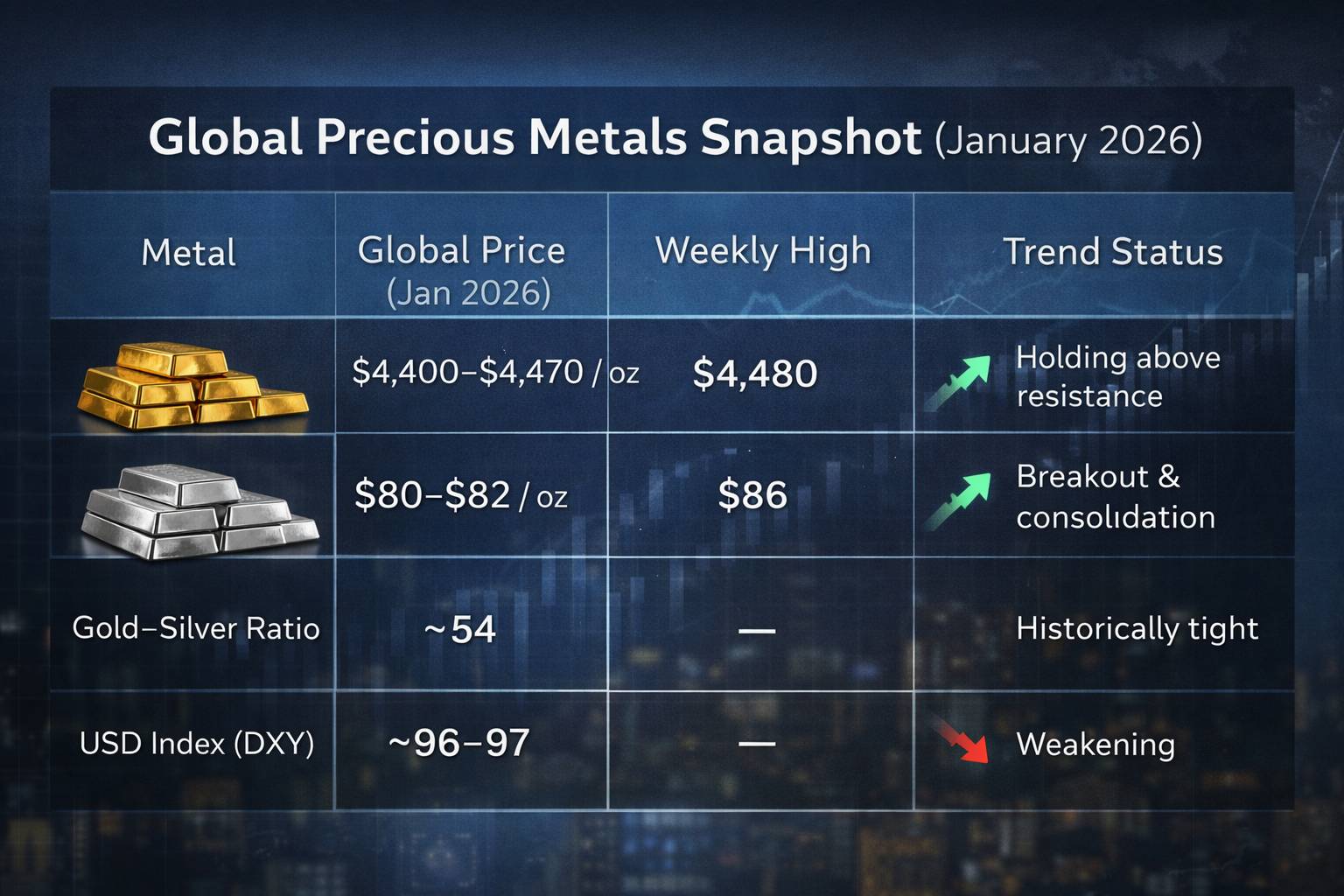
January 3, 2026, did not feel like a normal trading day. Gold was not spiking on panic, nor was silver moving on speculation alone. Instead, both metals were holding firm at levels that would have sounded unbelievable just a few years ago. Gold stayed comfortably above $4,400 per ounce, while silver crossed $80 per ounce, briefly touching $86 last week. These are not flash prices. They are becoming the new normal.
On the ground in India, the change feels even more dramatic. In Delhi, 24K gold is trading around ₹1,35,900 per 10 grams, while silver has surged to about ₹2.41 lakh per kilogram. For households, jewellers, and investors alike, this is not just a price shock—it is a signal. Something deeper is changing in the global financial system.
This is not a simple inflation story. Inflation alone does not explain why investors across continents are choosing metals over currencies, bonds, and even equities. What we are seeing is a “safe-haven rotation.” Money is moving out of paper promises—fiat currencies, government debt, and long-dated bonds—and into assets that cannot be printed, frozen, or digitally erased. Gold and silver are not rising because people are greedy. They are rising because people want certainty in an uncertain world.
2. The Geopolitical Engine: “Safe-Haven” Re-Defined
For decades, gold rallied mainly during wars or recessions. In 2026, the definition of “risk” has expanded. One major trigger has been renewed attacks on energy infrastructure around the Black Sea region, including ports and supply routes critical for oil and gas flows into Europe. Every disruption there pushes energy prices higher, and history shows that rising energy costs almost always strengthen gold.
But energy shocks are only one part of the story. Tensions between the United States and Venezuela have escalated again, with fresh trade and financial sanctions on Venezuelan oil exports. Even though Venezuela is not the world’s largest producer, these actions send a loud message: energy supply is political, and access can be cut off overnight. Investors respond to this kind of uncertainty by buying assets that sit outside political control.
The bigger driver, however, is the global debt trap. Debt-to-GDP ratios in the US, Europe, and Japan are at or near record highs. Governments must keep borrowing just to service existing debt. This raises a simple but uncomfortable question for investors: What is truly risk-free anymore? Gold stands out because it carries no counterparty risk. It does not depend on a government’s promise or a bank’s balance sheet. In a world drowning in debt, neutrality has value—and gold is the most neutral asset of all.
2️⃣ International Monetary Fund (IMF)
3. The Geoeconomic Catalyst: Central Bank Accumulation
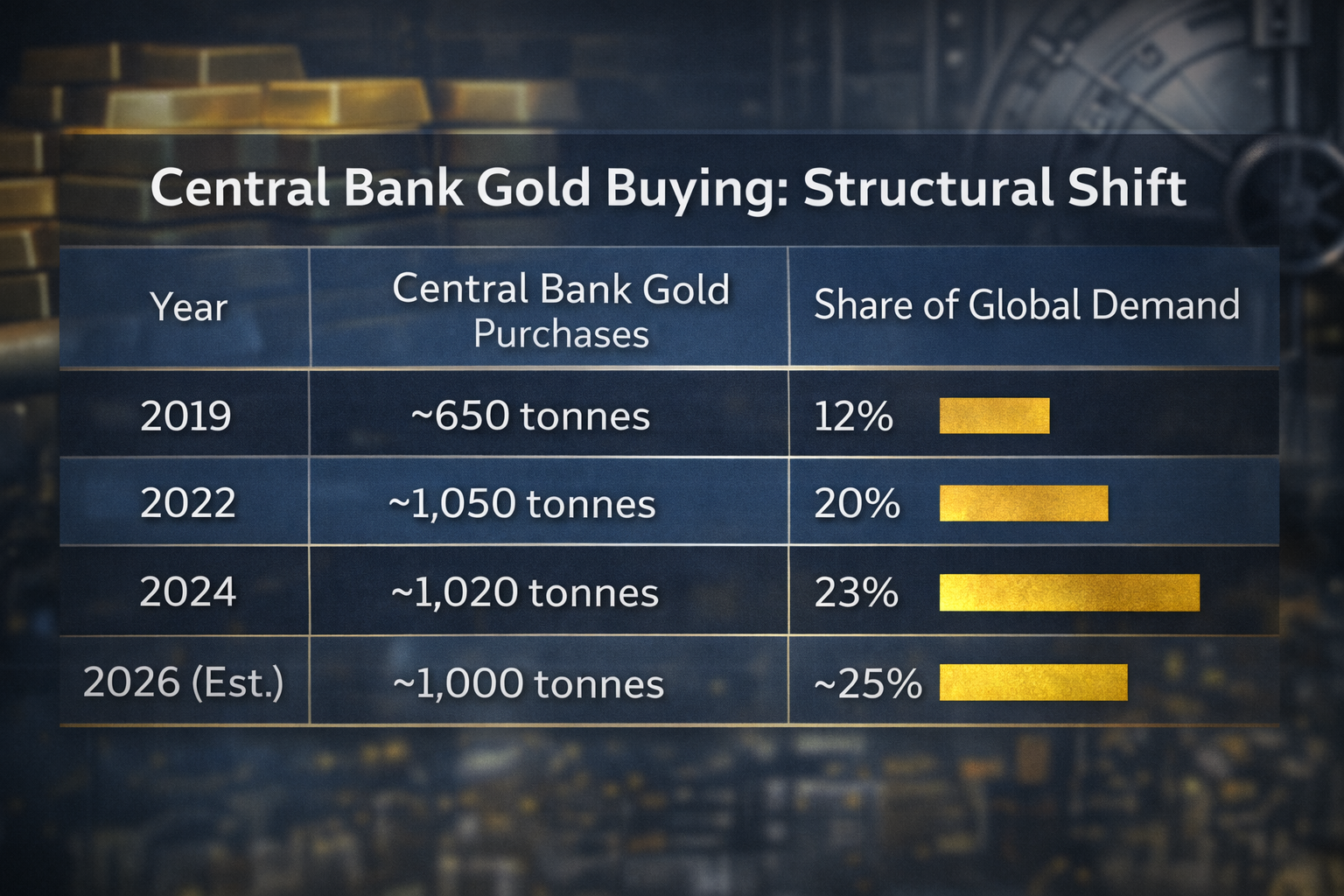
Perhaps the strongest proof that this metals rally is structural—not speculative—comes from central banks. For the third year in a row, central banks are on track to buy close to 1,000 tonnes of gold in a single year. This buying is not led by small economies alone. Countries like China, Poland, and Kazakhstan have been steady, large buyers.
Why does this matter? Because central banks move slowly and think long-term. When they buy gold, they are not chasing short-term returns. They are protecting national balance sheets. After the 2024–2025 sanctions era, many countries realized that reserves held in foreign currencies can be frozen or weaponized. Gold cannot be sanctioned. It cannot be blocked by payment systems. It sits quietly in vaults and answers to no one.
The shift is visible in the numbers. In 2019, central banks accounted for roughly 12% of total global gold demand. By 2026, that share has climbed to nearly 25%. In other words, one-fourth of all gold demand now comes from institutions that do not panic-sell and do not trade on headlines. This creates a powerful price floor. When central banks buy on dips, dips become shallow.
4. Silver: The “Critical Mineral” Outperformer
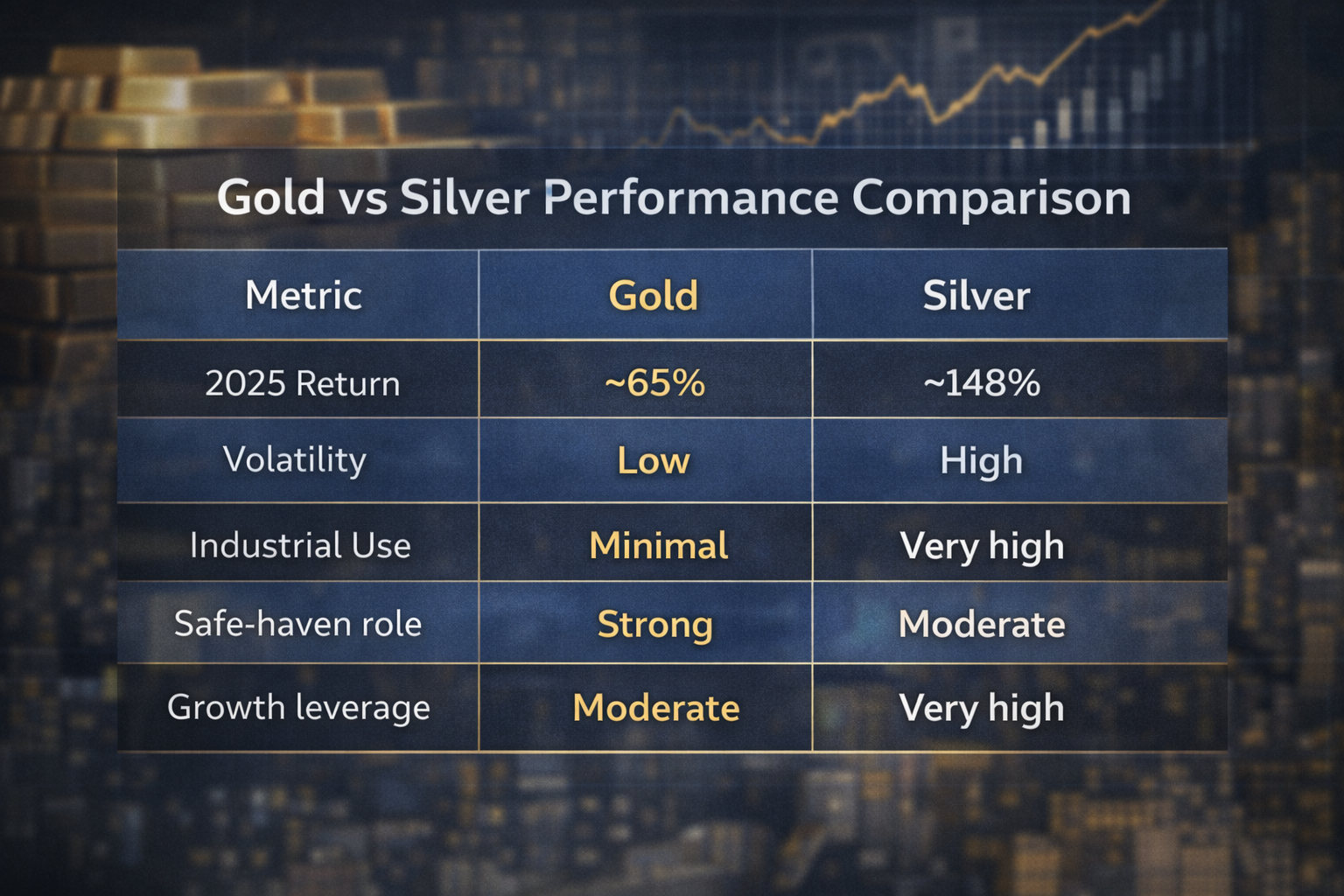
If gold has been the symbol of safety, silver has become the symbol of necessity. In 2025, gold rose by about 65%, an extraordinary move for any asset. But silver did something even more dramatic—it surged by nearly 148%. This was not luck. It was supply and demand colliding at full speed.
Silver is no longer just a precious metal. It is now officially classified as a “critical mineral” in both the US and the EU. The reason is simple: modern technology cannot function without it. High-efficiency solar panels use silver paste to conduct electricity. Electric vehicles rely on silver in battery systems and power electronics. And the explosion of AI data centres and hardware in 2025–2026 has pushed demand even higher, because silver is unmatched in electrical conductivity.
At the same time, supply has failed to keep up. New silver mines take years to develop, and most silver is produced as a by-product of other metals like copper and zinc. This limits how quickly supply can respond to rising prices. As a result, global silver inventories are now at a 15-year low. When industrial users compete with investors for limited metal, prices do not just rise—they squeeze. That squeeze is what pushed silver beyond $80 and may keep it there.
5. India’s Domestic Impact: From Ornament to Asset
In India, the metals boom is reshaping behaviour at the household level. Traditionally, silver played a big role in weddings and festivals. But with prices touching ₹2.4 lakh per kilogram, gifting physical silver has become expensive. Many families are now turning to Digital Gold, Digital Silver, and metal ETFs as alternatives. The emotional value remains, but the form is changing.
Gold, too, is being viewed less as jewellery and more as a financial hedge. Indian investors have lived through rupee volatility before, but the scale of global currency swings in recent years has made metals feel safer. This is not lost on policymakers. The Reserve Bank of India has continued to add gold to its reserves as part of a broader strategy to protect against dollar volatility and external shocks.
Here is how prices and returns look as of January 2026:
| Metal | International Price (Jan 2026) | Delhi Price (Estimated) | 1-Year Return |
|---|---|---|---|
| Gold (24K) | $4,467 / oz | ₹1,35,900 / 10g | ~74% |
| Silver | $82 / oz | ₹2,41,400 / kg | ~166% |
These numbers explain why metals are no longer seen as “idle assets.” For Indian savers, they have become a serious part of wealth protection.
6. Conclusion: The Roadmap to $5,000 Gold
Where does this leave us for the rest of 2026? Increasingly, large institutional desks are becoming bold with their forecasts. J.P. Morgan and other global banks are now openly talking about $5,000–$5,100 per ounce gold by the end of the year. This is not based on hype. It is based on math: limited supply, steady central-bank demand, rising geopolitical risk, and falling trust in paper assets.
Silver’s story may be even more powerful. With ongoing supply deficits and unstoppable industrial demand from green energy and AI, silver is no longer gold’s “poor cousin.” It is a strategic metal. In such an environment, short-term pullbacks should not be mistaken for trend reversals. They are pauses in a structural bull market.
Final word: We are living through a reset. The world is fragmenting geopolitically, and technology is accelerating economically. Gold benefits from fear and fragmentation. Silver benefits from growth and innovation. Rarely do both forces align at the same time. In 2026, they have.
Expert Analysis Tip – SR Vishwa:
“In my 30 years, I’ve rarely seen such a perfect alignment of industrial need and geopolitical anxiety. Silver is no longer just gold’s shadow—it is the fuel of the green and AI revolutions. Watch it closely. History is being priced in, one ounce at a time.”
❓ Frequently Asked Questions (FAQ)
1. Why are gold prices above $4,400 in 2026?
Gold prices are above $4,400 because of a mix of global uncertainty and policy shifts. Rising geopolitical tensions, record government debt, weakening trust in fiat currencies, and heavy gold buying by central banks have all pushed demand higher. Unlike paper assets, gold carries no default risk, which makes it attractive during unstable times.
2. Why has silver crossed $80 per ounce?
Silver crossed $80 due to strong industrial demand and limited supply. It is heavily used in solar panels, electric vehicles, and AI-related hardware. At the same time, global silver inventories are at multi-year lows. When industrial users and investors compete for the same metal, prices rise sharply.
3. Is this gold and silver rally only because of inflation?
No. Inflation is only one part of the story. The bigger drivers are geopolitical risk, currency instability, rising global debt, and central bank diversification away from the US dollar. This makes the current rally structural, not just inflation-driven.
4. Why are central banks buying so much gold now?
Central banks are buying gold to reduce dependence on foreign currencies and protect reserves from sanctions or financial restrictions. Gold is politically neutral and cannot be frozen or devalued by another country. That is why central bank gold demand has doubled since 2019.
5. Is silver a better investment than gold in 2026?
Silver offers higher growth potential but also higher volatility. Gold is more stable and works better as a wealth protector, while silver benefits from industrial growth and technology demand. Many long-term investors prefer holding both for balance.
6. How does a weak US dollar affect gold and silver prices?
When the US dollar weakens, gold and silver usually rise. A weaker dollar makes metals cheaper for non-US buyers and increases their appeal as alternative stores of value. This inverse relationship is one of the oldest patterns in global markets.
7. What does this mean for Indian investors?
For Indian investors, higher gold and silver prices help protect wealth against rupee volatility and global shocks. Many households are shifting from heavy jewellery to digital gold, silver ETFs, and sovereign gold bonds for flexibility and safety.
8. Will gold reach $5,000 per ounce in 2026?
Several global investment banks expect gold to approach or cross $5,000 if current trends continue. Central bank demand, geopolitical fragmentation, and slow mine supply growth support this possibility. However, prices may still see short-term corrections along the way.
9. Can silver cross $100 per ounce in the future?
Silver crossing $100 is possible if industrial demand continues to grow and supply remains tight. Large-scale solar adoption, EV growth, and AI infrastructure expansion make silver one of the most strategically important metals this decade.
10. Are gold and silver still safe investments after such a big rise?
Gold and silver are not short-term trading tools. Their main role is long-term protection against uncertainty, inflation, and currency risk. Even after big rallies, they remain relevant as strategic assets rather than speculative bets.
🔍 People Also Ask (PAA)
Why are gold and silver prices rising together in 2026?
Gold and silver are rising together because investors are moving away from paper assets toward hard assets. Gold benefits from geopolitical risk and currency weakness, while silver gains from strong industrial demand in solar energy, EVs, and AI infrastructure. When both fear and growth exist at the same time, both metals rise.
Is gold still a safe-haven asset in 2026?
Yes. Gold remains one of the most trusted safe-haven assets in 2026 because it is not linked to any government or currency. During periods of high debt, geopolitical tension, and financial uncertainty, investors continue to use gold to preserve value.
Why is silver considered a critical mineral now?
Silver is classified as a critical mineral because modern technologies depend on it. High-efficiency solar panels, electric vehicles, semiconductors, and AI hardware require silver for conductivity. Supply growth is limited, making silver strategically important for future industries.
How do central bank gold purchases affect prices?
When central banks buy gold, they reduce available supply in the open market. Since central banks buy for long-term reserves and rarely sell, their demand creates a strong price floor and supports long-term upward trends in gold prices.
What is the gold–silver ratio and why does it matter?
The gold–silver ratio shows how many ounces of silver equal one ounce of gold. A lower ratio, like around 54 in 2026, suggests silver is relatively strong compared to gold. Investors use this ratio to judge relative value between the two metals.
Does a falling US dollar increase gold prices?
Yes. Gold usually rises when the US dollar weakens because gold is priced in dollars globally. A weaker dollar makes gold cheaper for international buyers and increases its appeal as an alternative store of value.
Is silver more volatile than gold?
Yes. Silver is more volatile because its market is smaller and more sensitive to industrial demand cycles. While this volatility can bring higher returns, it also means sharper short-term price swings compared to gold.
Should investors buy gold after it has already risen so much?
Many long-term investors still buy gold after big rallies because gold is used for protection, not speculation. Short-term corrections can happen, but gold’s role as a hedge against uncertainty remains unchanged.
How does AI growth affect silver demand?
AI data centres, servers, and advanced chips require high-conductivity materials, including silver. As AI infrastructure expands globally, industrial silver demand continues to rise, adding long-term support to prices.
What role does geopolitics play in precious metal prices?
Geopolitical tensions increase uncertainty in energy supply, trade routes, and currencies. During such periods, investors prefer assets like gold and silver that are independent of political systems, pushing prices higher.