
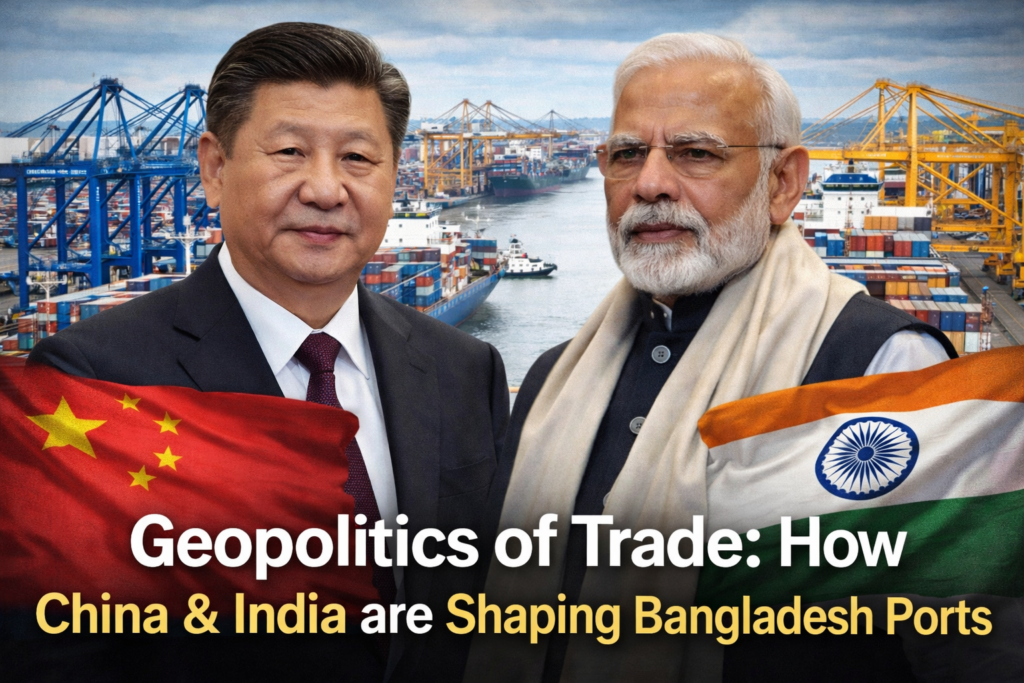
The Battle of the Giants: Why China and India are Racing to Build Bangladesh
If you have been following the news lately, you probably noticed that Bangladesh is becoming one of the most talked-about spots in the world. Between the passing of long-time leader Khaleda Zia and the new political shifts under Tarique Rahman, there is a lot of noise. But behind the politics, there is another, much bigger battle happening: The Battle of the Bridges and Ports.
For the last ten years, China and India have been in a “friendly” (and sometimes not-so-friendly) race to see who can build more in Bangladesh. Why? Because Bangladesh is sitting on a goldmine of location. It is the gateway to Southeast Asia and a key neighbor for India’s Northeast.
In this article, we will break down who is winning, what is being built, and why this matters for your pocket and the future of the region.
1. The “Dragon” in the Room: China’s Massive Projects
China has been the biggest spender in Bangladesh for a while now. Under its Belt and Road Initiative (BRI), Beijing has treated Bangladesh like a star player.
What are they building?
The Padma Bridge Rail Link: This is a “dream project” for many. China helped build the bridge and is now finishing a massive rail link that connects Dhaka to the southwest. This isn’t just a road; it’s a lifeline that helps farmers get their goods to the city faster.
The Karnaphuli Tunnel: This is South Asia’s first underwater tunnel! It runs under a river in Chittagong, making it a masterpiece of engineering.
The Payra Deep Sea Port: China is pouring billions into this port. They want it to be a massive hub for ships coming across the Indian Ocean.
The Strategy: China’s goal is simple. They want to be the “technical partner.” By 2025, Chinese investment in Bangladesh reached nearly $42 billion. They aren’t just building roads; they are building the 5G networks and data centers that run the country.
2. The “Neighborhood First” Strategy: India’s Response
India knows it cannot match China’s “checkbook diplomacy” dollar-for-dollar, but India has something China doesn’t: Geography.
India and Bangladesh share a massive border. For India, building in Bangladesh isn’t just about business; it’s about security and helping its own landlocked Northeast states like Tripura and Assam.
What is India building?
The Akhaura-Agartala Rail Link: This project is a game-changer. It connects Bangladesh directly to India’s Northeast. What used to take days by truck can now happen in hours by train.
The Maitree Super Thermal Power Plant: India helped build this massive $1.6 billion power plant in Rampal to help solve Bangladesh’s electricity shortage.
Mongla Port Upgrades: Recently, India secured the rights to help modernize the Mongla Port. This was a “strategic win” because it keeps India’s influence alive in the Bay of Bengal.
The Strategy: India’s focus is on Connectivity. They want “Transit and Transshipment.” Basically, India wants to use Bangladeshi roads and ports to reach its own remote states more easily.
3. The Real-Time Crisis: 2025 by the Numbers
As we enter late 2025, the “race” has become even more intense. The new interim government in Dhaka, led by Muhammad Yunus, has been trying to balance both sides. However, the numbers show a worrying trend for Bangladesh.
| The Fact Check | China’s Influence | India’s Influence |
| Total Investment | $42 \text{ Billion}$ (approx) | $8 \text{ Billion (LOC)}$ |
| Military Gear | $72\%$ of all arms | Basic training & patrol |
| Main Focus | Large Ports & Tech | Rails & Electricity |
The Debt Trap Warning: Many experts are worried that Bangladesh is taking on too much debt. In 2025, debt payments became the second-largest expense in the country’s budget. If Bangladesh cannot pay back the billions it borrowed from China, it could end up in a “debt trap” like Sri Lanka did a few years ago.
4. The “New Guard” and the Future
With Tarique Rahman now leading the BNP, the world is watching to see who he picks as his “best friend.”
If he leans too much toward China, India gets worried about its border security.
If he leans too much toward India, he might face pressure from people at home who want more independence.
The likely path? Multi-Vector Diplomacy. This is a fancy way of saying: “Take money from both, but don’t join either side.” Bangladesh is trying to sit in two chairs at one table.
5. Why Should You Care?
You might be wondering, “How does a bridge in Chittagong affect me?”
Trade & Prices: Better roads and ports mean cheaper goods. If India and Bangladesh trade more, the price of everyday items like clothes, fish, and electronics stays stable.
Jobs: Thousands of people in Bangladesh now work in these new industrial zones built by foreign money.
Regional Peace: When two giants like India and China are “competing” to build things, it usually keeps the region busy with business instead of conflict.
Conclusion: The Road Ahead
Bangladesh is no longer just a “small neighbor.” It is a rising power at a crossroads. The death of the old political guard has opened a door for a more modern, business-focused country.
The battle between India and China to build Bangladesh isn’t going to end soon. In fact, in 2026, we expect even more deals to be signed. For the reader, the lesson is simple: Keep an eye on the infrastructure. The country that builds the most bridges often has the most say in the future.
The official foreign affairs ministry of the Government of India
Frequently Asked Questions (FAQs)
Q1. Is Bangladesh falling into a “Debt Trap” with China? Answer: According to 2025 financial data, Bangladesh’s external debt has risen significantly, with debt servicing becoming a major budget expense. While Bangladesh has managed its finances better than Sri Lanka, high-interest loans for massive projects like the Payra Deep Sea Port have increased the risk of economic vulnerability if returns on investment are delayed.
Q2. Why are Bangladesh’s ports so strategically important for India? Answer: For India, access to the Mongla and Chattogram ports is the shortest route to its landlocked Northeastern states (the “Seven Sisters”). Using these ports reduces transit time and costs by nearly 50%, bypasses the narrow “Chicken’s Neck” corridor, and is a pillar of India’s “Act East” policy.
Q3. What is the status of the India-Bangladesh CEPA trade agreement? Answer: India and Bangladesh are currently fast-tracking the Comprehensive Economic Partnership Agreement (CEPA). Once fully implemented, it is projected to boost bilateral trade past the $25 billion mark within a decade by removing duty barriers and simplifying customs procedures.
Q4. How does the China-built Karnaphuli Tunnel impact regional trade? Answer: As South Asia’s first underwater tunnel, it connects the port city of Chattogram to a burgeoning industrial zone. This significantly improves supply chain efficiency for garment exporters and is a crown jewel of China’s Belt and Road Initiative (BRI) in the region.
Q5. Can political instability stop these infrastructure projects? Answer: While political transitions (like the post-Zia era) may lead to delays or contract reviews, the projects themselves are unlikely to be scrapped. Bangladesh’s economic survival depends on modern infrastructure, forcing any new leadership—including the BNP under Tarique Rahman—to maintain these geoeconomic ties.
The official portal of China’s foreign ministry,
People Also Ask (PAA)
1. Are China and India rivals in Bangladesh? Yes, they are in a “geoeconomic race.” China focuses on heavy infrastructure and technology (like 5G and submarines), while India focuses on connectivity (rail, road, and electricity) to integrate Bangladesh with its own domestic economy.
2. How does the Akhaura-Agartala rail link benefit traders? The rail link provides a direct, low-cost logistics route between India’s Northeast and Bangladesh’s rail network. It allows for the bulk movement of goods like grains, cement, and fuel, making trade significantly cheaper for small and medium enterprises (SMEs).
3. What is the “Blue Economy” potential of the Bay of Bengal? The Bay of Bengal is rich in untapped gas reserves and fisheries. The port developments by India and China are not just about trade, but also about securing future rights to these maritime resources, which are vital for Bangladesh’s energy security.
4. What role does the U.S. play in Bangladesh’s geoeconomics in 2026? The U.S. has largely shifted to a “monitoring” role, focusing on labor rights and democratic stability. However, through the “Indo-Pacific Strategy,” it encourages Bangladesh to diversify its investments to avoid over-reliance on a single superpower like China.
5. How has the Bangladeshi Taka’s value affected cross-border trade? The fluctuation of the Taka against the Indian Rupee and the US Dollar in 2025 has made imports more expensive for Bangladesh. This has led to a push for Rupee-Taka trade settlement to reduce dependency on the Dollar for bilateral business.
People Also Ask (PAA)
1. Strategic Rivalry & Influence
Why is China interested in Bangladesh’s ports?
Context: China views Bangladesh as a critical node in its Belt and Road Initiative (BRI).2 Access to the Bay of Bengal helps China bypass the “Malacca Dilemma” (the risk of its trade routes being choked at the Malacca Strait) by providing a direct land-sea link to its landlocked western provinces like Yunnan.3
How is India countering Chinese influence in Bangladesh?
Context: India uses its “Neighbourhood First” and “Act East” policies.4 It focuses on gaining transshipment rights (using Chittagong and Mongla ports to reach its Northeast “Seven Sisters” states) and investing in competing infrastructure to ensure it isn’t “encircled” by what it calls the “String of Pearls.”5
What is the “String of Pearls” vs. “Necklace of Diamonds”?
Context: This refers to the geopolitical theory of China building a network of military and commercial facilities (Pearls) around India, while India counters with its own strategic naval and trade partnerships (Diamonds) across the Indian Ocean.
2. Specific Port Projects
What is the strategic importance of the Matarbari Deep Sea Port?
Context: Unlike the shallow Chittagong port, Matarbari is Bangladesh’s first deep-sea port (funded largely by Japan).6 It is a “game-changer” because it allows massive mother vessels to dock directly, reducing reliance on transshipment hubs like Singapore or Colombo.7
Why was the Sonadia Deep Sea Port project cancelled?
Context: Originally a Chinese-led project, it was scrapped (officially for environmental reasons) but widely seen as a result of strategic pressure from India, the U.S., and Japan, who feared a Chinese military presence so close to Indian waters.
Who manages the Mongla and Payra ports?
Context: While Bangladesh retains control, India has secured significant development and transshipment rights at Mongla, whereas China has been heavily involved in the dredging and infrastructure of Payra.8
3. Economic & Regional Impact
How do Bangladesh’s ports benefit India’s landlocked Northeast?
Context: By using the Chittagong (Chattogram) and Mongla ports, India can transport goods to states like Tripura and Assam much faster than via the narrow “Chicken’s Neck” (Siliguri Corridor).9
Is Bangladesh at risk of a “debt trap” from Chinese port investments?10
Context: This is a frequent concern following Sri Lanka’s experience with Hambantota. However, analysts note that Bangladesh has traditionally been more cautious, diversifying its lenders to include the World Bank, ADB, and Japan (JICA).
How does the 2025 political shift in Bangladesh affect port geopolitics?
Context: With recent changes in Dhaka’s leadership, there is increased scrutiny on whether the government will pivot more toward Beijing or maintain the delicate balance with New Delhi, especially regarding trade restrictions and transit fees.11
Quick Comparison Table: Port Influence
| Port | Primary Foreign Partner | Primary Strategic Use |
| Chittagong | Balanced (India/China) | Main commercial gateway; Indian transshipment. |
| Mongla | India | Vital for connectivity to India’s Northeast. |
| Matarbari | Japan | Deep-sea access; regional logistics hub. |
| Payra | China / Belgium | Industrial development and energy imports. |
After Khaleda Zia: How Tarique Rahman Is Resetting Bangladesh’s India Strategy








1 thought on “Geopolitics of Trade: How China & India are Shaping Bangladesh Ports”