Why Governments Are Trading Your Purchasing Power for Debt Sustainability—and How to Pivot
1. Introduction: The Death of “Inflation Targeting”
For nearly thirty years, global central banks followed one simple rule: keep inflation close to 2%. This target acted like a compass. It guided interest rates, bond markets, and economic expectations. Investors trusted it. Savers relied on it. Governments built policies around it.
By 2026, that compass no longer works.
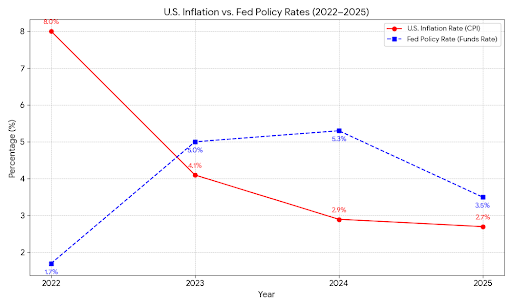
Inflation targeting has quietly died—not because central banks forgot about it, but because they can no longer afford to follow it. The world has entered a new phase known as fiscal dominance, where government debt needs now control monetary policy decisions.
In the United States, debt-to-GDP has reached around 120%, and annual interest payments have crossed $1.1 trillion, making them one of the largest single budget expenses. At this level, the debt cannot realistically be paid back in the same-value dollars in which it was borrowed.
The only practical solution left is to reduce the real value of debt over time. That means allowing inflation to stay higher than interest rates. In simple words, governments are choosing inflation over default. This is the core of financial repression, and it defines the brave new world of 2026.
📍 U.S. Bureau of Labor Statistics (BLS) — CPI Data
2. Section I: The Mathematics of the “Debt Trap”
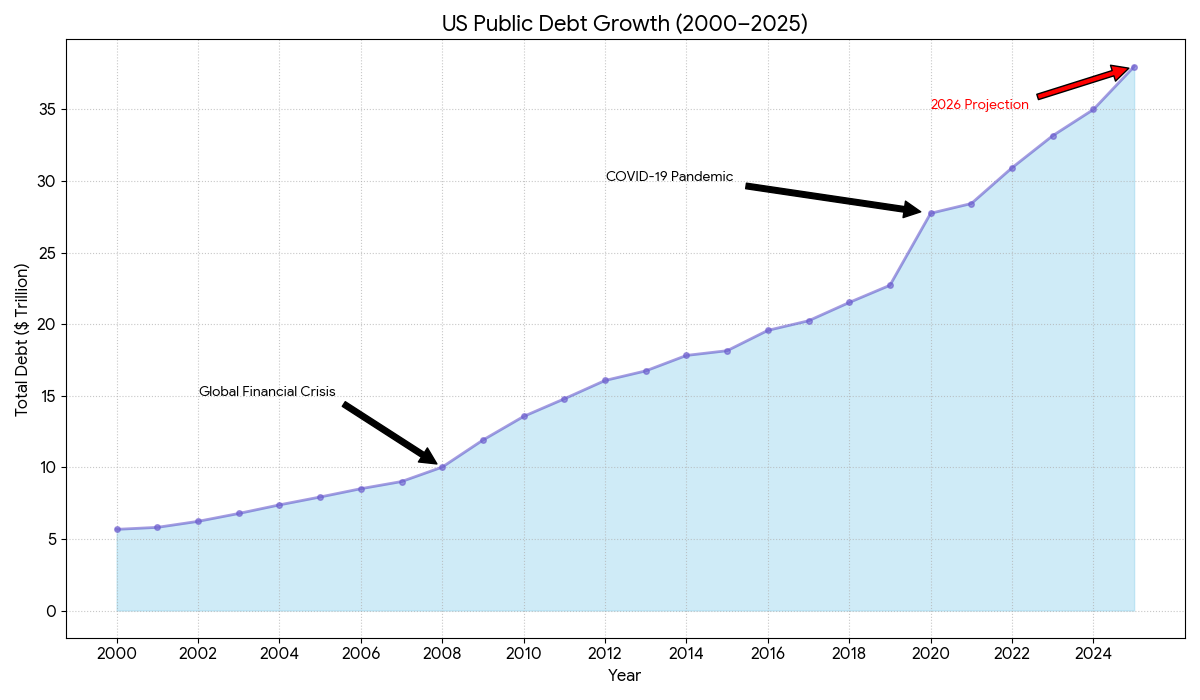
To understand why financial repression has become unavoidable, we must look at the numbers. As of 2026, the U.S. debt clock has crossed $38 trillion. This is not just a large number—it is a structural constraint.
More worrying than total debt is the interest-to-revenue ratio, which has reached about 20%. Historically, when a government spends one-fifth of its revenue just to pay interest, it enters a danger zone. At this point, interest costs begin to crowd out spending on defense, infrastructure, healthcare, and social programs.
Raising interest rates to fight inflation would make the problem worse. Higher rates mean higher interest payments, which force more borrowing, which increases debt further. This is the debt trap.
Financial repression is the escape route. Governments keep nominal interest rates—for example, around 3.5%—below the true inflation rate, which is closer to 5–6% when housing, healthcare, and education costs are included. This creates negative real yields.
Negative real yields act like a hidden tax. When you hold a “safe” government bond, your money loses 2–3% of its purchasing power every year. That loss does not disappear. It flows to the state by slowly reducing the real value of its debt. This is how debt is “paid” without repayment.
3. Section II: Historical Mirror – The Post-WWII Playbook (1945–1955)
This strategy may feel new, but it is not. History offers a clear mirror.
In 1945, after World War II, the United States had a debt-to-GDP ratio of 116%, very similar to today. By 1955, that ratio had fallen to 66%. Many assume this happened because of rapid growth or strict austerity. That is not true.
The real reason was financial repression.
For nearly a decade, the U.S. government capped interest rates while allowing moderate inflation. Bond yields were kept artificially low. Inflation ran above yields. Savers lost purchasing power, but the government’s debt burden shrank in real terms.
The modern version looks different but works the same way. Instead of direct rate caps, governments use regulation. Banks, insurance companies, and pension funds are encouraged—or forced—to hold government bonds through liquidity rules and capital requirements.
The 2025 reforms to the Supplementary Leverage Ratio (SLR) are a good example. They made it easier and more attractive for financial institutions to hold sovereign debt. Capital is being “crowded in” toward government bonds, not because they are attractive, but because they are required.
History does not repeat exactly, but it clearly rhymes. The 2026 system is a digital-age version of the 1940s playbook.
📍 Federal Reserve — Federal Funds Rate History
4. Section III: The Geopolitical Catalyst – Fragmentation and Debasement
Financial repression is not happening in isolation. It is being accelerated by geopolitical fragmentation.
The world is splitting into blocs. Trade is being regionalized. Sanctions are being used more frequently. This weakens the old global system that relied on trust and shared rules.
One major shift is the expansion of BRICS+ and the launch of new settlement systems like mBridge and the BRICS “Unit” between 2025 and 2026. These systems allow countries to settle trade without using the U.S. dollar.
This matters because global trade historically created forced demand for U.S. Treasuries. Countries needed dollars, and they parked those dollars in U.S. government bonds. As trade bypasses the dollar, that forced demand weakens.
Sanctions have also changed perceptions. When foreign exchange reserves can be frozen, the dollar is no longer seen as purely risk-free. It becomes a political asset, not a neutral one.
This is why the “debasement trade” has accelerated. Investors and central banks are moving toward assets that cannot be printed, frozen, or sanctioned. This is a major reason why gold has crossed $4,400 per ounce. Gold is not just a hedge—it is a sovereign asset with no counterparty risk.
📍 U.S. Treasury – Debt to the Penny and Interest Expense
5. Section IV: The “Brave New World” Portfolio Shift
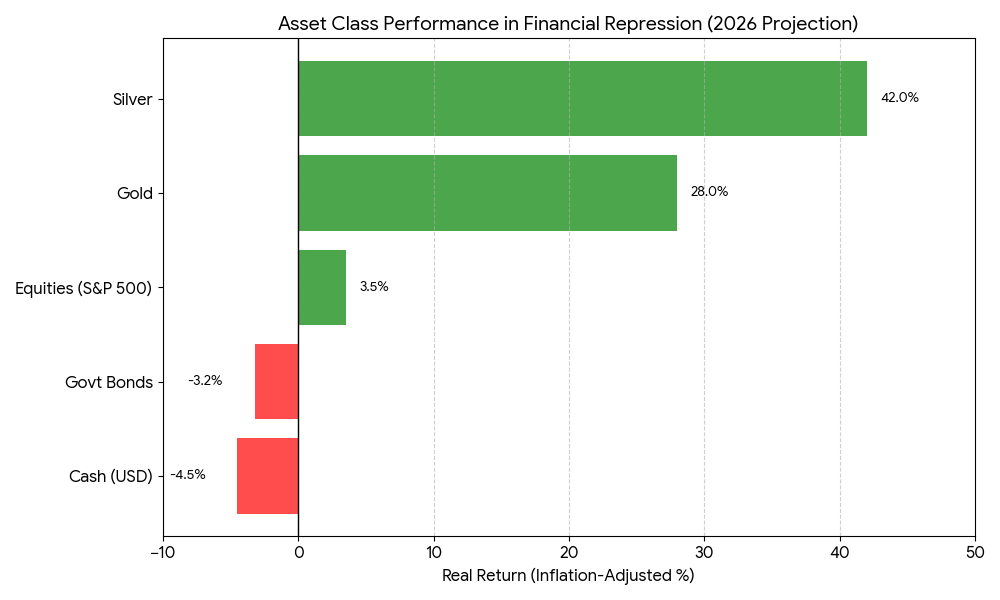
In 2026, traditional investment rules are being rewritten. Asset classes are behaving in ways that would have seemed strange a decade ago.
Bonds, once considered safe, now guarantee a loss of purchasing power if held long-term. Many investors now call them “certificates of confiscation.” They provide stability, but at the cost of real value.
Equities are no longer a simple inflation hedge. Only companies with pricing power—those that can raise prices without losing customers—are doing well. Businesses stuck in competitive, low-margin markets struggle.
Hard assets are the clear winners. Gold and silver are at the center of this shift. Gold protects against monetary debasement. Silver adds something extra.
By 2026, silver is trading near $85 per ounce. This reflects its dual engine nature. It is both a monetary hedge and a critical industrial metal. Demand from solar energy, electric vehicles, data centers, and AI infrastructure continues to rise, while supply remains limited.
The definition of risk has changed. In the brave new world of 2026, holding cash is often riskier than holding a volatile real asset.
6. Synthesis: The 2026 Leadership Mandate
What we are witnessing is the great deleveraging of the West. Governments are reducing debt burdens not through repayment, but through time, inflation, and regulation.
Financial repression works because it is quiet. There are no emergency announcements. No dramatic defaults. Just a slow erosion of purchasing power that most people notice only after several years.
This creates a massive transfer of wealth—from savers to borrowers, from households to the state.
The challenge for individuals is not to predict every market move. It is to recognize the system they are living in. In a world where money loses value by design, traditional savings strategies fail.
The goal in 2026 is not to beat the market. It is to escape debasement.