1. Introduction: The Quiet War on Savings

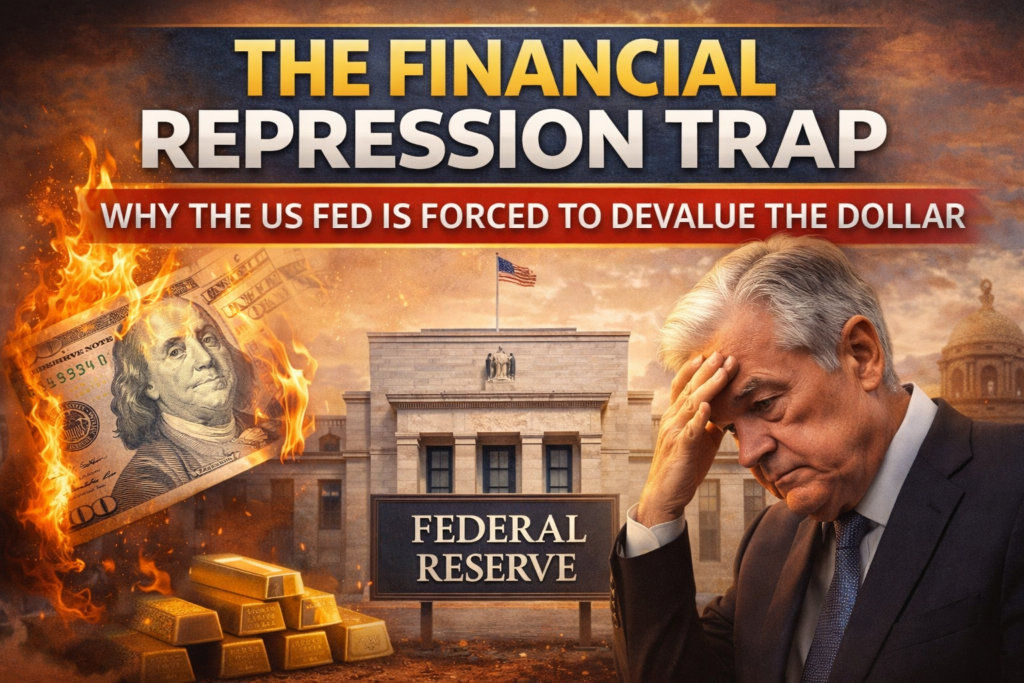
In 2026, one of the biggest economic battles is not being fought with tariffs or sanctions. It is being fought quietly, through interest rates, inflation, and currency value. This battle has a name: financial repression. In simple words, financial repression means allowing inflation to stay higher than interest rates for a long time so that governments can slowly reduce the real value of their debt.
This is exactly where the United States finds itself today. Inflation has come down from its 2022 peak, but it is still above the comfort zone. Yet, the Federal Reserve is clearly signaling future rate cuts. To many ordinary people, this sounds confusing. If inflation is not fully defeated, why reduce interest rates?
The answer lies not in consumer prices, but in government finances. The US is now trapped in a debt-driven system where keeping interest rates high for too long is more dangerous for the Treasury than inflation is for households. This is the core idea of the financial repression trap: inflation hurts quietly, while high interest rates hurt the government loudly and immediately.
Federal Reserve – Monetary Policy & Rate Decisions
2. The Math of Desperation: Why Rates Must Fall

To understand why the Fed is cornered, we must look at the numbers. As we move through 2026, US national debt is approaching the $38–40 trillion mark. This number is no longer abstract. It has real and immediate consequences for the federal budget.
At an average interest rate of around 5%, the US government’s annual interest payments alone cross $1.8 trillion. This is not spending on roads, healthcare, or defense. This is simply the cost of past borrowing. In fact, interest payments are now larger than the entire US defense budget, which is historically unprecedented.
This is the tipping point. When interest costs start eating such a large share of tax revenue, policymakers face a brutal choice: either raise taxes sharply, cut spending aggressively, or reduce interest rates. Politically and socially, the first two options are extremely difficult. That leaves rate cuts as the path of least resistance.
This is why the Fed’s actions should be read carefully. It is not cutting rates because inflation is fully under control. It is cutting because the solvency war is being lost. Debt-to-GDP ratios are already above 120%, and projections show interest payments taking an even larger share of federal revenue by FY 2026 if rates stay high.
US Treasury – National Debt Data
3. The “Weak Dollar” Narrative: A Geoeconomic Weapon
Once interest rates begin to fall, the value of the currency naturally comes under pressure. A weaker dollar is often presented as a side effect, but in reality, it can also serve strategic purposes.
A softer dollar helps the US in two ways. First, it reduces the real burden of debt, because debt is repaid in dollars that are worth less in purchasing power terms. Second, it makes US exports more competitive, supporting domestic manufacturing and jobs.

This approach resembles a modern version of the old “beggar-thy-neighbor” policy, where one country boosts itself by weakening its currency. However, the world today is more interconnected, and other countries are not passive spectators.
The BRICS+ group, along with many Global South economies, is actively reducing overdependence on the dollar for trade and reserves. This does not mean the dollar will collapse, but it does mean its absolute dominance is slowly eroding.
There is also a shift in how markets behave. Traditionally, during uncertainty, investors rushed into the dollar. This idea is captured in the “Dollar Smile” theory. But when inflation remains high and real yields are low, the dollar’s role as a safe haven becomes less attractive. In such a world, the smile begins to fade.
World Bank – Global Debt & Financial Repression Studies
4. Impact on India: The Geoeconomic Ripple Effect
For India, the Fed’s pivot creates both challenges and opportunities. A weakening dollar usually puts upward pressure on the Indian rupee. For the Reserve Bank of India, this creates a delicate balancing act. A stronger rupee helps control imported inflation, but it can hurt export competitiveness.
One major benefit for India is on the energy front. Oil is priced in dollars, and a weaker dollar reduces India’s effective oil import bill. This helps narrow the current account deficit and gives policymakers more room to manage inflation.
Another important channel is capital flows. When US Treasury yields fall, global investors start searching for better returns. India, with its strong growth outlook and deep markets, becomes an attractive destination. This can lead to higher Foreign Institutional Investor (FII) inflows into equities like the Nifty and Sensex.
However, these inflows can be volatile. While they support markets in the short term, sudden reversals remain a risk. This is why India’s macro stability and strong domestic consumption are critical anchors.
5. Winners and Losers in the Financial Repression Era
Financial repression always creates silent winners and losers. The biggest losers are fixed-income savers, retirees, and pension funds. When interest rates stay below inflation, the purchasing power of savings erodes year after year. This erosion is not accidental; it is the very fuel that helps governments reduce debt.
On the other hand, hard assets tend to perform well. Gold and silver act as protection against currency debasement. This is not just theory. Central banks around the world, including India’s, have been buying gold at record levels, and early 2026 continues this trend.
Equities, especially in sectors linked to technology, energy transition, and sovereign AI, also stand to benefit. Companies with pricing power and global reach can adjust better to inflation than households living on fixed incomes.
Emerging markets with strong internal demand, young populations, and reform momentum—India being a prime example—are also relative winners. Their growth is driven less by debt and more by consumption and productivity.
6. Conclusion: Navigating the De-Dollarization Decade
What we are witnessing is not a temporary policy adjustment. It is the gradual end of monetary orthodoxy. The old rules—control inflation at all costs, reward savers with positive real rates—no longer apply in a world drowning in debt.
For the US, devaluing the dollar slowly through financial repression is not a choice; it is a necessity. For the rest of the world, especially India, this creates both risks and opportunities.
The key lesson for investors is simple. In the coming decade, the goal is not just to earn returns on paper. The real challenge is to outrun the devaluation of the currency you are paid in. Understanding financial repression is the first step toward protecting wealth in this new global order.
Congressional Budget Office (CBO) – Debt & Interest Projections
📌 Frequently Asked Questions (FAQ): Financial Repression & the Weak Dollar
What is financial repression in simple terms?
Financial repression is a policy where governments allow inflation to stay higher than interest rates for a long period. This slowly reduces the real value of government debt, but it also erodes the purchasing power of savings held by ordinary people.
Why is the US Federal Reserve forced into financial repression?
The United States has accumulated extremely high public debt. If interest rates remain high, the cost of servicing this debt becomes unsustainable. Financial repression allows the US to manage debt quietly by letting inflation do part of the work.
Why is the US Fed talking about rate cuts even when inflation is not fully controlled?
Because high interest rates now pose a bigger threat to government finances than inflation does to consumers. Rising interest payments are consuming a growing share of US tax revenue, forcing the Fed to prioritise debt stability.
How big is the US debt problem in 2026?
By 2026, US national debt is nearing $38–40 trillion. Annual interest payments alone are estimated at around $1.8 trillion, which is more than what the US spends on defence.
Does financial repression mean the US is intentionally weakening the dollar?
Not officially, but in practice, a weaker dollar helps. It reduces the real burden of debt and improves export competitiveness. This makes controlled dollar weakness a useful side effect of financial repression.
How does a weak dollar affect the global economy?
A weaker dollar changes capital flows worldwide. Investors move money toward emerging markets, commodities, and real assets. It also encourages countries to reduce over-dependence on the dollar for trade and reserves.
What is the impact of US financial repression on India?
For India, a weaker dollar can:
Put upward pressure on the rupee
Reduce the oil import bill
Attract foreign investment into equities
Help manage imported inflation
However, sudden capital flow reversals remain a risk.
Why are central banks buying so much gold in 2025–26?
Gold protects against currency devaluation and geopolitical risk. During periods of financial repression, central banks increase gold reserves to diversify away from paper currencies.
Who loses the most during financial repression?
The biggest losers are:
Fixed deposit holders
Pensioners
Cash savers
Their money earns returns below inflation, causing steady loss of purchasing power.
Who benefits from financial repression?
The main beneficiaries are:
Governments with high debt
Holders of real assets like gold and equities
Emerging markets with strong domestic demand
Inflation quietly transfers wealth from savers to borrowers.
Is financial repression a short-term policy?
No. Financial repression typically lasts many years, sometimes decades. It continues until debt levels become manageable or a new monetary framework emerges.
Does financial repression mean de-dollarisation is inevitable?
Not immediate, but gradual. The dollar is unlikely to collapse, but its global dominance slowly weakens as countries diversify reserves and trade settlement methods.
How should investors protect themselves during financial repression?
Investors should focus on:
Assets that grow faster than inflation
Equity exposure with pricing power
Gold and commodities as hedges
Reducing excessive cash holdings
The goal is to outrun currency devaluation, not just earn nominal returns.