How the Federal Reserve Controls the Global Money Supply

Somewhere in Washington DC, a group of twelve people meets eight times a year in a wood-paneled room. No election determines who sits in that room. No popular vote approves what they decide. And yet their decisions — announced in dry, technical press releases — directly affect the mortgage rate on your home, the cost of your car loan, the value of your savings, the stability of your country’s currency, and the financial fate of billions of people who have never heard their names.
These twelve people are the Federal Open Market Committee — the policy-making body of the United States Federal Reserve. And the Federal Reserve is, without exaggeration, the most powerful financial institution on Earth.
Understanding how it works — and how it affects you, wherever you live in the world — is one of the most important pieces of financial knowledge you can have in 2025. Let’s break it all down, simply and clearly.
What Is the Federal Reserve? The Simple Explanation
The Federal Reserve is the central bank of the United States. It was created by Congress in 1913 after a series of devastating bank panics — the financial crises of that era — convinced lawmakers that the US needed an institution that could stabilize the banking system and manage the money supply.
The Fed has a “dual mandate” — two goals it is legally required to pursue simultaneously:
1. Maximum employment — keeping unemployment as low as possible without causing unsustainable inflation
2. Price stability — keeping inflation at approximately 2% per year over time
These two goals often conflict with each other — which is why Fed decisions are so consequential and so debated. Cutting rates supports employment but risks inflation. Raising rates fights inflation but risks unemployment. Every FOMC meeting is a balancing act between these competing priorities, watched by financial markets around the globe.
Fed International Dollar Role 2025 (federalreserve.gov)
The 3 Main Tools: How the Fed Controls Money
The Federal Reserve has three primary tools for controlling the money supply and influencing economic conditions. Each works differently but they all serve the same ultimate purpose — managing the availability and cost of money in the economy.
Tool 1 — The Federal Funds Rate (The Most Powerful Tool)
This is the interest rate at which banks lend money to each other overnight — the most fundamental price in all of finance. When the Fed raises this rate, all borrowing becomes more expensive. Banks pass higher costs to consumers through mortgages, car loans, and credit cards. Businesses borrow less. Investment slows. Money becomes scarce. Inflation cools. When the Fed lowers rates, the opposite happens — borrowing explodes, money flows freely, the economy accelerates, and if taken too far, inflation rises. This single number — the federal funds rate — is transmitted through every level of the global financial system because the dollar is the world’s reserve currency.
📊 Recent range: 0–0.25% (2020–2022) → 5.25–5.50% (2023–2024) → 4.25–4.50% (late 2025)
Tool 2 — Quantitative Easing (QE) & Quantitative Tightening (QT)
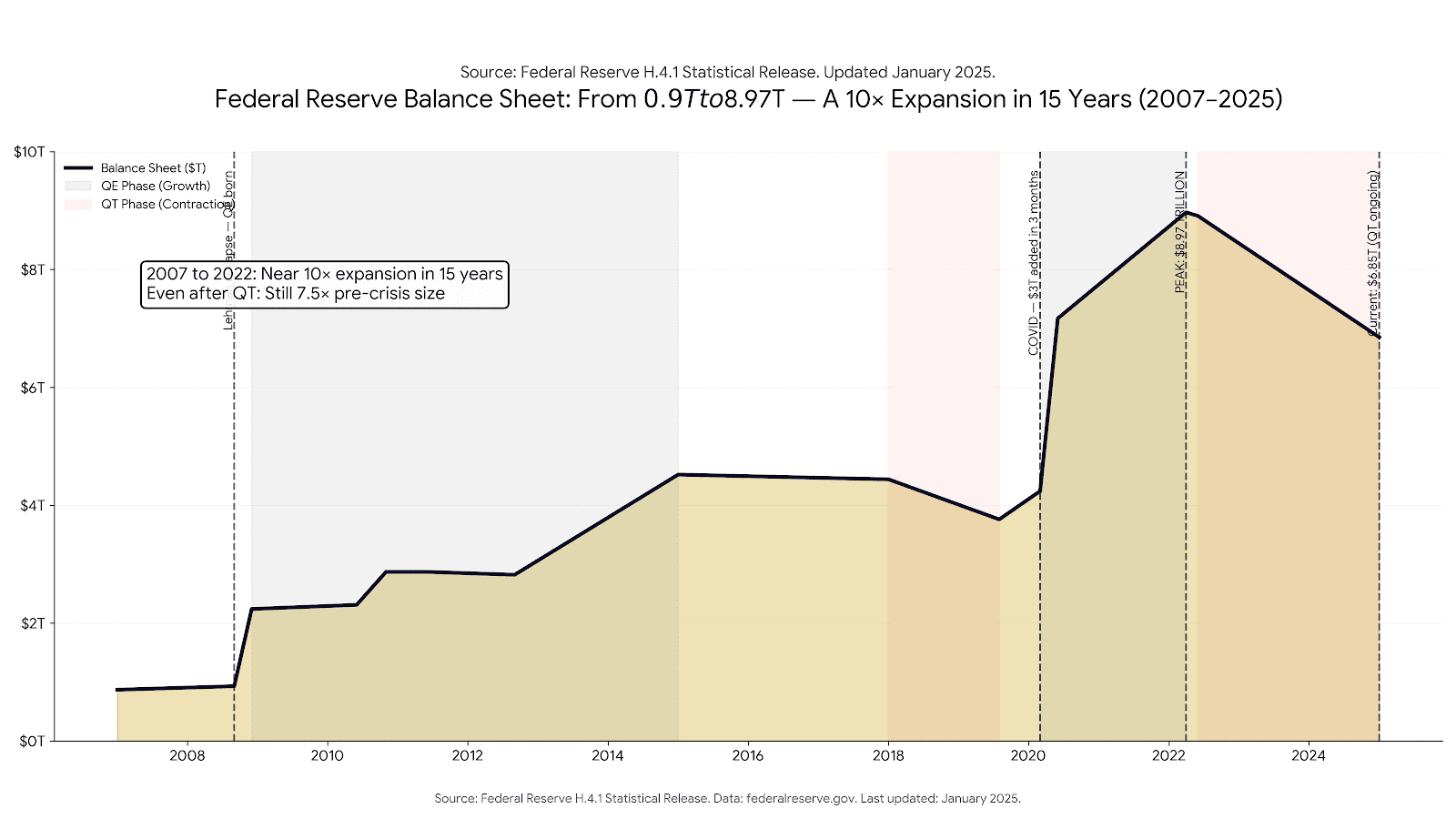
When the Fed wants to stimulate the economy beyond just cutting rates (especially when rates are already near zero), it buys bonds — primarily US Treasury securities and mortgage-backed securities — directly from financial institutions. This “quantitative easing” (QE) creates new money, injects it into the banking system, drives down long-term interest rates, and floods global financial markets with dollars. When the Fed wants to tighten, it does the opposite — “quantitative tightening” (QT), allowing bonds to mature without replacement, withdrawing dollars from the system. The Fed’s balance sheet grew from $0.9 trillion in 2007 to a peak of $8.97 trillion in 2022 — a near 10-fold expansion that fundamentally changed global financial conditions.
📊 Balance sheet: $0.9T (2007) → $8.97T peak (2022) → $6.85T (January 2025)
Tool 3 — Interest on Reserve Balances (IORB)
Banks are required to hold reserves — a portion of deposits — either as cash or deposits at the Federal Reserve. By paying banks interest on those reserves (IORB), the Fed can incentivize banks to hold more reserves (reducing money creation) or less (increasing money creation). This tool became critical after 2008 when the Fed paid banks interest on their excess reserves to prevent the massive QE liquidity from causing runaway inflation. The FOMC minutes from October 28-29, 2025 discussed the careful management of reserve levels, noting that “excessive money market rate volatility would pose risks to both the control of the policy rate and the stability of funding in the repo market.”
📊 IORB rate tracks the federal funds rate target closely
Mises Institute M2 Analysis (Dec 2025)
The Federal Funds Rate: From 0% to 5.5% and Back — The 2020–2025 Story
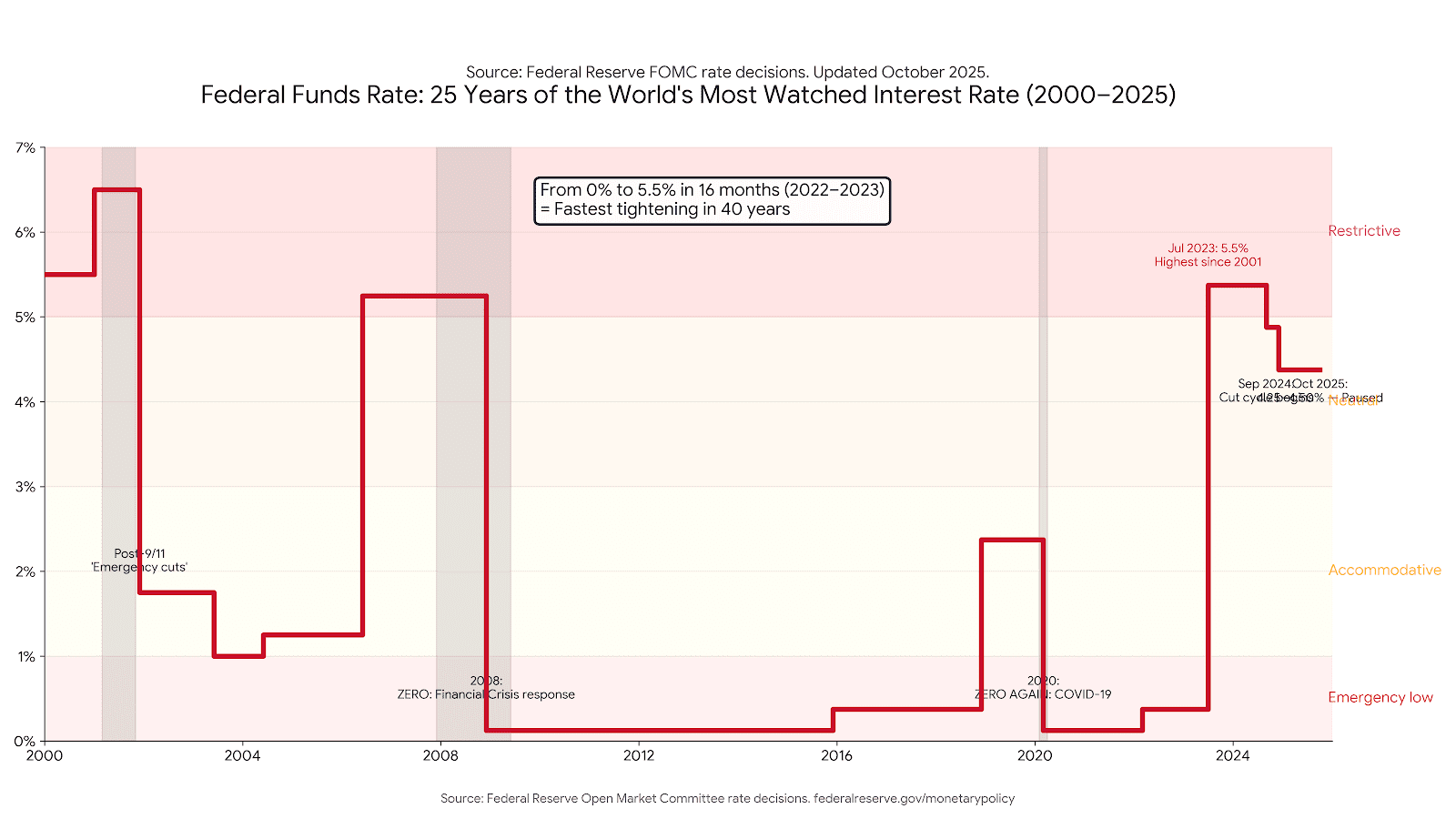
No story better illustrates the Fed’s global power than what happened between 2020 and 2025. In the span of five years, the Fed executed one of the most aggressive monetary policy swings in modern history — and the global consequences were felt in every country on Earth.
Fed Money Stock H.6 Feb 2026 (federalreserve.gov)
The Money Supply: What M1, M2 and QE Actually Mean
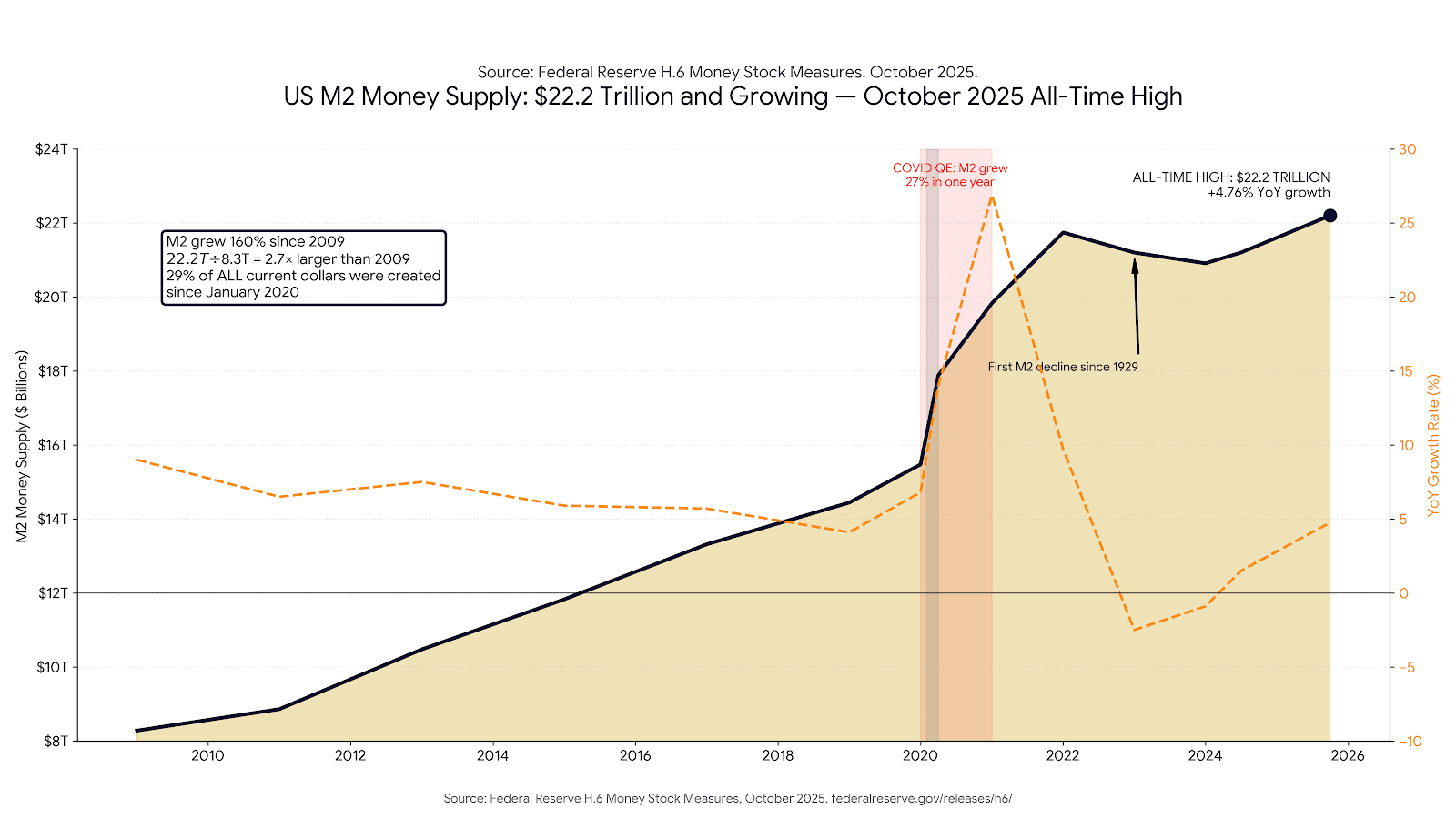
When economists talk about the “money supply,” they use different measures — M1, M2, and others — that can be confusing. Here’s what each one means in plain language.
M1 — The Narrowest Measure (Physical + Immediately Accessible Money)
M1 includes physical currency in circulation (notes and coins), plus checking account deposits (money you can spend immediately with a debit card or check). This is the “narrowest” definition of money — only what can be spent immediately without any conversion.
M2 — The Broader Measure (Most Watched by Economists)
M2 includes everything in M1 plus savings accounts, money market accounts, and small certificates of deposit (CDs under $100,000). This is the measure most economists and analysts watch most closely because it captures money that is very liquid — easily convertible to spending — while also including some savings.
How QE Creates New Money — The Mechanics
Quantitative easing is often described as “money printing” — which is somewhat accurate but oversimplified. Here’s what actually happens: The Federal Reserve’s trading desk contacts major financial institutions (called “primary dealers”) and offers to buy Treasury bonds or mortgage-backed securities from them. The Fed pays for these bonds by creating new electronic deposits in the financial institution’s reserve account at the Fed — new money that did not exist before. The financial institution receives new reserves (which count in the monetary base) and the Fed holds the bonds on its balance sheet. This is why the Fed’s balance sheet grew — it is the accumulated total of all the bonds it has purchased with newly created money over the years.
| Period | QE Program | Amount | Balance Sheet Effect | Global Impact |
|---|---|---|---|---|
| 2008–2014 | QE1, QE2, QE3 | ~$3.7 trillion | $0.9T → $4.5T | Global asset price surge, EM capital inflows |
| 2017–2019 | QT Phase 1 | -$700 billion | $4.5T → $3.8T | Mild EM pressure, dollar strengthened |
| Mar–Jun 2020 | COVID QE | +$3 trillion | $3.8T → $7.1T in 3 months | Massive global liquidity surge, asset prices explode |
| 2020–2022 | Continued QE | +$1.8T more | Peak: $8.97T (Apr 2022) | Global inflation surge, crypto bubble, housing boom |
| 2022–2025 | QT Phase 2 | -$2.1T | $8.97T → $6.85T (Jan 2025) | Global rate rise, EM stress, asset prices fall then recover |
Why Fed Decisions Are GLOBAL Decisions: The Dollar’s Dominance
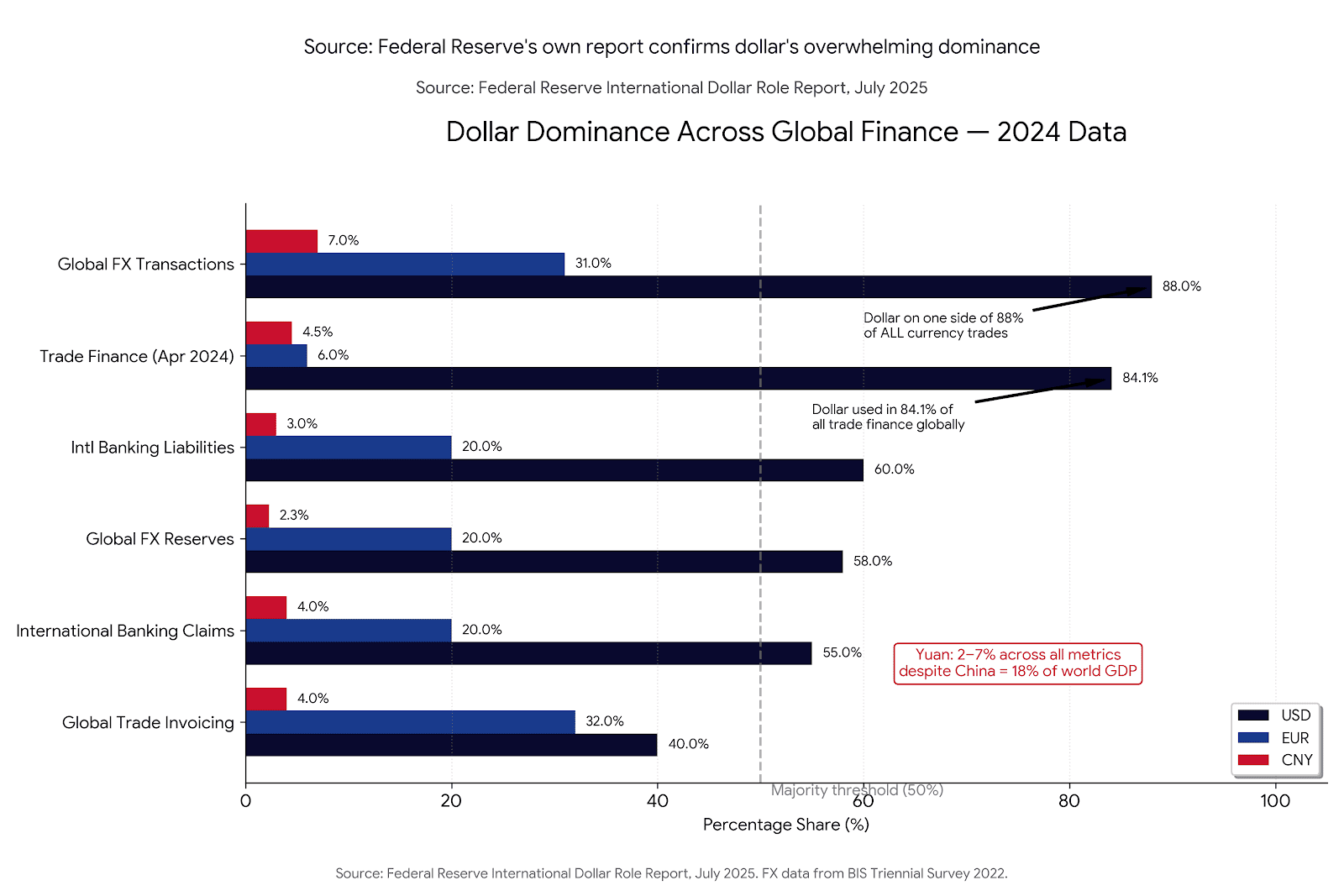
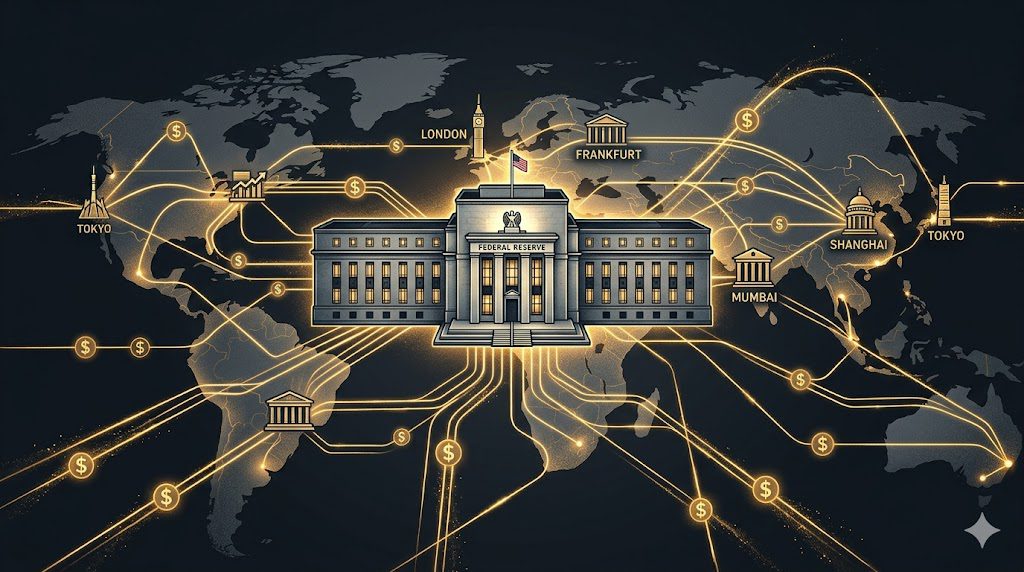
Here is the central fact that elevates the Federal Reserve from “America’s central bank” to “the world’s de facto central bank”: the US dollar is embedded so deeply into the global financial system that it is impossible to separate American monetary policy from global financial conditions.
The Federal Reserve’s own July 2025 International Dollar Role report confirms the scale of this dominance:
| Global Financial Metric | Dollar’s Share (2024) | Nearest Rival | Trend |
|---|---|---|---|
| Official FX reserves | 58% | Euro: 20% | 📉 Down from 72% peak (2001) |
| Global FX transactions | 88% | Euro: 31% | ➡️ Largely stable |
| International banking claims | 55% | Euro: 20% | ➡️ Stable since 2000 |
| International banking liabilities | 60% | Euro: ~20% | ➡️ Stable |
| Global trade invoicing | 40% | Euro: ~32% | ➡️ Stable (3× US trade share) |
| Global trade finance | 84.1% | Yuan: 5% | 📉 Slowly declining |
| Cross-border payments (SWIFT) | Varies | Euro leads messaging | ➡️ Complex picture |
This dominance creates what economists call the “dollar transmission mechanism.” When the Fed raises rates, it strengthens the dollar, raises US Treasury yields (the global risk-free benchmark), and tightens global financial conditions — even in countries that have no formal connection to the US monetary system. The IMF estimated that a 1 percentage point increase in the US federal funds rate reduces economic output in other advanced economies by 0.5% and in emerging market economies by up to 0.8% — effects that persist for 2-3 years.
Real-World Global Impacts: What Fed Decisions Did to Other Countries
 Argentina — Currency Crisis
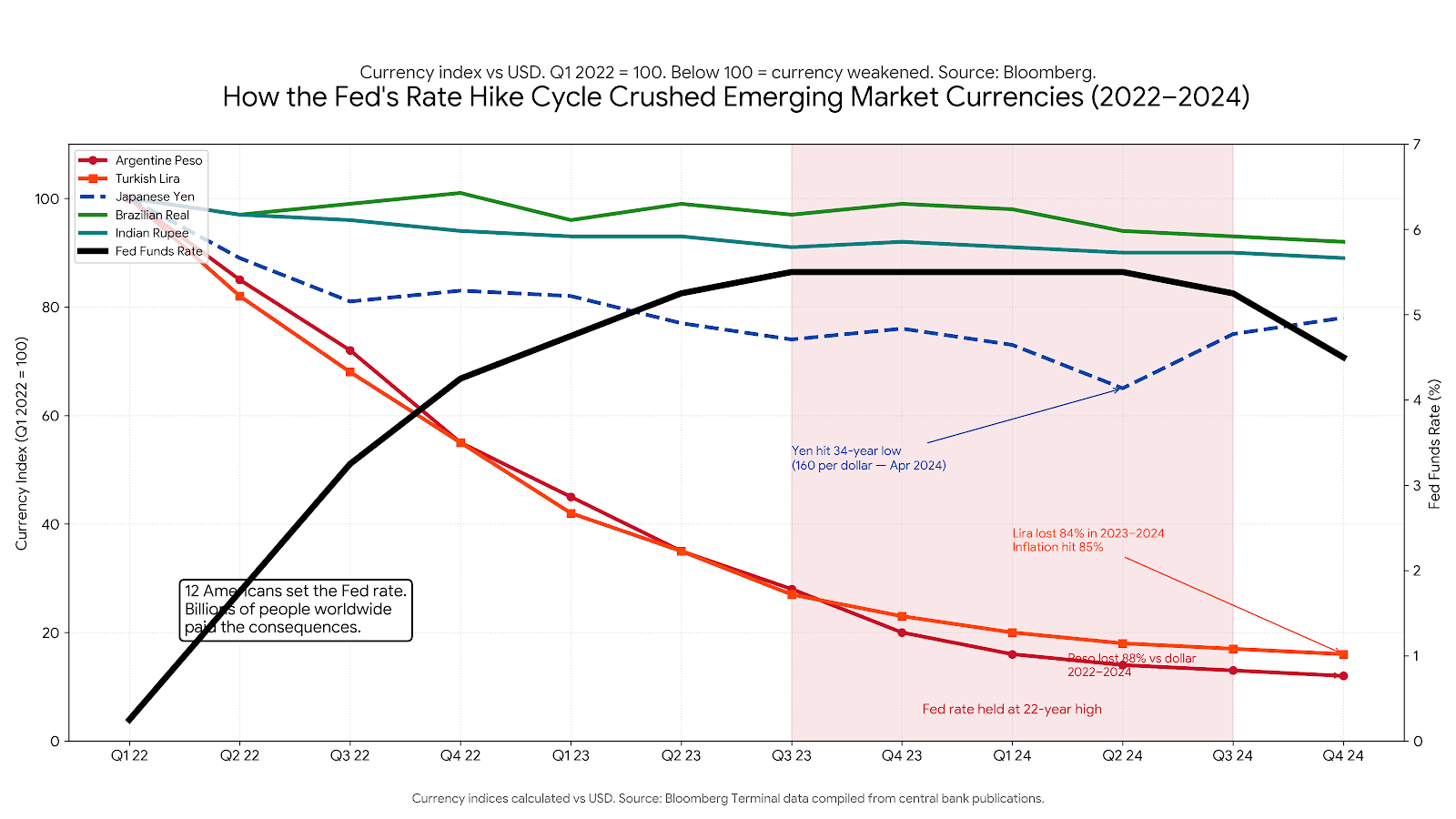
Argentina has been in chronic financial stress through the 2022–2024 Fed tightening cycle. Dollar-denominated debt became more expensive to service. Capital fled to higher-yielding US assets. The peso collapsed, losing over 70% of its value against the dollar in 2023 alone. The Fed’s rate decisions were not the only cause — but they amplified existing vulnerabilities dramatically.
Peso lost 70%+ in 2023 partly driven by dollar strengthening
🇹🇷
Turkey — Inflation Spiral
Turkey’s combination of high domestic inflation, dollar-denominated corporate debt, and a weakening lira was severely worsened by Fed rate hikes. As the dollar strengthened during the 2022–2024 cycle, Turkish companies with dollar debts faced soaring repayment costs. Turkey’s inflation hit 85% in late 2022 — a crisis that the Fed’s tightening significantly deepened by making dollar alternatives more expensive.
Turkey inflation hit 85% (2022) — Fed tightening worsened the crisis
🇮🇳
India — Calibrated Response
India’s relatively well-managed external position allowed it to navigate Fed tightening more successfully than more vulnerable emerging markets. The Reserve Bank of India raised rates in coordination with the Fed but maintained currency stability. However, India’s dollar-denominated external debt still became more expensive, and capital inflows moderated as US yields became more attractive. India illustrates how strong fundamentals mitigate but don’t eliminate Fed transmission effects.
RBI raised rates in response to Fed — relatively managed outcome
🇯🇵
Japan — The Yen Crisis
Japan maintained near-zero interest rates while the Fed raised to 5.5% — creating one of the largest interest rate differentials in history. The result: the yen fell to its weakest level since 1990, hitting 160 yen per dollar in April 2024. This “carry trade” (borrow in cheap yen, invest in high-yield dollars) caused massive capital flows out of Japan. When it unwound in August 2024, it triggered a global market mini-crash — showing how Fed-Japan rate divergence creates global instability.
Yen hit 160/dollar (Apr 2024) — 34-year low — carry trade collapse in Aug 2024
🇪🇺
Europe — Forced to Follow
The European Central Bank (ECB) found itself effectively forced to raise rates in coordination with the Fed — partly to prevent capital flight to dollar assets that would weaken the euro and import dollar-priced inflation. ECB rate hikes slowed European economies at a time when they were also dealing with the energy crisis from the Ukraine war. The Fed’s decisions constrained European monetary policy choices — a demonstration of the dollar’s dominance over even major rival currency blocs.
ECB raised rates 450 bps in response to Fed tightening cycle
🌍
Africa — Debt Crisis Deepened
Sub-Saharan African nations that borrowed in dollars faced compounding crises during Fed tightening: their dollar-denominated debt became more expensive to service (weaker local currencies + higher dollar rates), commodity prices were pressured by the stronger dollar, and international capital markets became more expensive to access. Ghana defaulted in late 2022, Zambia restructured its debt, and Ethiopia, Kenya, and others faced severe fiscal stress — all amplified by the Fed’s rate decisions.
Multiple African debt restructurings (2022–2024) driven partly by dollar tightening
The 2025 Picture: Where the Fed Stands Now
The Federal Reserve’s October 28-29, 2025 FOMC meeting provides the most current picture of where monetary policy stands. The committee noted a “resilient economy” despite a 23-day government shutdown, with real private domestic final purchases growing at a solid pace in the third quarter.
By October 2025, the federal funds rate stood at 4.25–4.50% — down from the 5.25–5.50% peak but still historically elevated. The Fed was managing competing pressures: tariff-related inflation concerns on one side, and the risk of economic slowdown on the other.
The M2 money supply had surged back to $22.2 trillion — an all-time high — with year-over-year growth of 4.76% in October 2025. The Mises Institute’s analysis noted this acceleration showed “money supply growth is also up sizably compared to October of last year when year-over-year growth was 1.27%.” Critically, the money supply had increased every month for four consecutive months through October 2025 — suggesting the Fed’s tightening had given way to renewed expansion even without officially cutting rates to emergency levels.
Critically, the October FOMC minutes highlighted concerns about reserve levels — the manager recommended “stopping the runoff of the System Open Market Account (SOMA) portfolio soon,” warning that “excessive money market rate volatility would pose risks to both the control of the policy rate and the stability of funding in the repo market, which in turn could affect the stability of the U.S. Treasury market.” This signals that QT may be ending — which would stabilize or expand the Fed’s balance sheet and provide a new wave of global dollar liquidity.
The Independence Question: Can Presidents Control the Fed?
In 2025, the question of Federal Reserve independence became more urgent than at any point since the 1970s. President Trump repeatedly and publicly criticized Chairman Jerome Powell’s interest rate decisions, pressured him to cut rates, and explored whether he could fire Powell — which would have been unprecedented and potentially destabilizing for global markets.
The Fed’s independence from political pressure is not just an institutional nicety — it is a global financial stability factor. Research consistently shows that central banks with greater independence produce lower inflation and more stable financial conditions. When investors worldwide hold US Treasury bonds and maintain the dollar as the world’s reserve currency, they are partly trusting that the Fed will make decisions based on economic data — not on which party currently holds the White House.
The Federal Reserve is required by law to direct its policies toward the dual mandate of achieving maximum employment and price stability and report regularly to Congress. The economy is significantly impacted by monetary and fiscal policies — and the independence of the Federal Reserve from day-to-day political pressure is central to maintaining credibility with global investors who hold $8.5 trillion in US Treasury bonds.
— University of Wisconsin-Stevens Point Analysis of Federal Reserve Independence, 2024
Any significant challenge to Fed independence would immediately affect global financial markets. The dollar’s reserve currency status depends partly on confidence that US monetary policy is set by experts following economic data — not political operatives following electoral cycles. A politically captured Fed that cut rates whenever a president demanded it would eventually cause inflation, erode the dollar’s purchasing power, and accelerate de-dollarization.
The Historical Timeline: How the Fed’s Role Evolved
The Federal Reserve Act is signed by President Woodrow Wilson after the Panic of 1907 demonstrated the need for a central bank. Initially a modest institution, the Fed is designed as a lender of last resort to prevent bank panics — not primarily as a monetary policy body.
The Fed’s biggest historical mistake: it tightened monetary policy and allowed the money supply to contract by one-third during the Great Depression — turning a recession into a catastrophe. Milton Friedman’s landmark research established that the Fed’s failures made the Depression far worse. This history shaped the Fed’s subsequent commitment to never again allow monetary contraction during a crisis.
The Bretton Woods agreement makes the dollar the world’s reserve currency, pegged to gold at $35/oz. The Fed becomes, by default, the global monetary authority — all other currencies are anchored to the dollar it manages.
The US ends the dollar’s gold convertibility — making it a pure fiat currency managed by the Fed. This gives the Fed unprecedented power: it can now expand the money supply without any gold constraint. It also makes Fed decisions more consequential — there is no gold peg limiting what it can do.
Fed Chairman Paul Volcker raises rates to 20% to break the 1970s inflation spiral. It works — but triggers the worst recession since the Great Depression and causes massive financial stress in developing countries (the “Third World Debt Crisis”). This episode defines how powerful Fed policy is and how painfully its global effects are felt.
The Global Financial Crisis forces the Fed to invent quantitative easing when rates hit zero and more stimulus is still needed. The balance sheet expands from $0.9T to $2.3T in months. A new era of monetary policy begins — one where the Fed’s balance sheet becomes as important as its interest rate.
The most dramatic monetary expansion in Fed history. Rates cut to zero in two emergency meetings. $3 trillion in QE in three months. Balance sheet hits $8.97 trillion. M2 grows 27% in one year. The global consequences: asset price explosion, then 8% inflation — the highest since 1991.
To fight the inflation its own stimulus helped create, the Fed raises rates from 0% to 5.5% in 16 months — the fastest tightening cycle since Volcker. Global consequence: dollar surges, emerging markets squeezed, yen hits 34-year low, multiple EM debt restructurings, global real estate markets cool sharply.
The Fed faces unprecedented political pressure from Trump while managing tariff-driven inflation and economic uncertainty. M2 hits $22.2 trillion (all-time high). Balance sheet stabilizes at $6.85T. FOMC minutes signal possible end of QT. The Fed’s decisions will determine global financial conditions through 2026 and beyond.
What Fed Decisions Mean for YOU — Wherever You Live
For Americans
Fed decisions affect every American’s financial life directly. When the Fed raised rates to 5.5%, 30-year mortgage rates hit 8% — the highest since 2000 — effectively freezing the housing market for millions. Credit card rates rose to record highs above 20% APR. Car loan rates more than doubled. Conversely, high-yield savings accounts briefly paid 5%+ — rewarding savers for the first time in 15 years. As the Fed cuts back toward 4.25%, mortgages are slowly becoming more affordable again — but the pace of cuts directly determines when housing becomes accessible for the next generation of buyers.
For People in Emerging Markets
Fed tightening is often the most painful for emerging market citizens who have no vote in US elections and no influence over FOMC decisions. When the Fed raises rates, their governments pay more to borrow in dollars, their currencies weaken (importing dollar-priced inflation), and capital that was funding development projects flows back to higher-yielding US assets. The 2022–2024 cycle caused debt restructurings in Ghana, Zambia, and Sri Lanka — countries where ordinary people faced fuel shortages, food price spikes, and economic devastation partly driven by a committee meeting in Washington DC.
For Savers and Investors Everywhere
The Fed’s balance sheet and rate decisions directly affect gold prices, stock markets, real estate values, and cryptocurrency prices globally. QE eras see asset prices surge worldwide — the 2020 QE helped fuel the biggest crypto bull market in history and global real estate booms from Canada to Australia to Germany. QT reverses these flows. Understanding where the Fed is in its cycle is one of the most important inputs to any investment strategy anywhere in the world.
The Bottom Line: The World’s Most Powerful Unelected Institution
The Federal Reserve was created in 1913 to prevent bank panics in the United States. Over 112 years, it has evolved into something far more consequential: the de facto central bank of the entire world — the institution that sets the global cost of money, the global benchmark interest rate, and the conditions for dollar liquidity that flows through every financial system on Earth.
Its tools are powerful: the federal funds rate, quantitative easing, and reserve management collectively determine how much money exists in the global economy, how expensive it is to borrow that money, and whether financial conditions are loose or tight everywhere from New York to Nairobi to New Delhi.
The 2025 picture is complex. M2 is at an all-time high of $22.2 trillion. The balance sheet stands at $6.85 trillion — nearly 8 times its pre-2008 size. Rates are at 4.25–4.50% — still historically elevated but declining. Political pressure on Fed independence is greater than at any point since the 1970s. And the dollar, despite years of de-dollarization, still anchors 58% of global reserves and 88% of FX transactions.
The Federal Reserve remains the institution that no single country can control, no democratic election can change, and no financial market can ignore. Understanding what it does and why it matters is essential knowledge for anyone navigating the modern financial world — wherever on Earth they happen to live.

Related Articles