
1️⃣ Hook & Context: Why Everyone Is Suddenly Searching “FD vs Mutual Fund”
Walk into a small town bank branch today and you’ll notice something interesting: long queues, passbooks in hand, and conversations centered around fixed deposits. Scroll through social media in a metro city at the same time, and you’ll see the opposite — screenshots of stock portfolios, SIP reminders, and reels about “multibagger” returns. This contrast captures the moment India’s financial behavior is living in right now.
Recent data reported by The Times of India shows rural fixed deposit (FD) growth jumping by around 14%, clearly outpacing deposit growth in metro and urban centers. That’s a sharp signal. It tells us this is no longer just a banking statistic — it’s a story about risk appetite, confidence, and financial priorities changing across the country.
The core question driving search trends today is simple but powerful: Why are rural savers choosing safety, while urban investors are choosing risk? Behind this question lies anxiety about inflation, curiosity about markets, and confusion about where money is actually safest in 2025. This article breaks down both sides of India’s money divide and helps you decide where your money should realistically go.
2️⃣ The Rural Fixed Deposit Boom: Why Villages Are Choosing Safety Over Returns
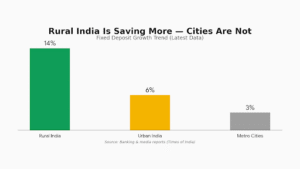
The 14% growth in rural fixed deposits didn’t happen by accident. It reflects a deep-rooted financial mindset shaped by stability, trust, and lived experience. In many rural households, money flows are seasonal but predictable — agricultural income, government scheme payments, pensions, and remittances from family members working in cities or abroad. When cash arrives, the priority is preservation, not experimentation.
Fixed deposits fit perfectly into this mindset. They offer guaranteed returns, capital protection, and clarity — you know exactly how much you’ll receive and when. For families that cannot afford uncertainty, this predictability matters more than chasing higher returns. Add to this the cultural trust in banks, especially public sector banks, and FDs become the natural choice.
Rising interest rates over the past year have only strengthened this preference. When banks began offering FD rates in the 7–8% range, many rural savers saw it as a revival of an old, trusted product. Banks noticed this shift early and actively targeted rural areas with special FD drives, doorstep banking, and simplified account processes. In villages, FDs are not just financial products — they are peace of mind.
3️⃣ Urban India’s Shift: Why Cities Are Moving Away From Fixed Deposits
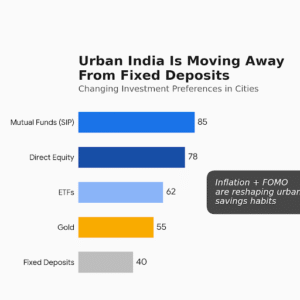
In India’s cities, the emotional equation with money looks very different. Urban investors are increasingly uncomfortable with fixed deposits, not because they’re unsafe, but because they feel inadequate. Inflation has become the silent enemy. When daily expenses, school fees, rent, and healthcare costs rise faster than FD returns, savers start feeling their money is standing still.
This is where FOMO — fear of missing out — kicks in. Urban investors are constantly exposed to stories of market success. A friend doubles money in equities, a colleague brags about SIP returns, and social media amplifies every rally. Add easy access to trading apps, instant KYC, and educational content, and the psychological barrier to markets collapses.
As a result, cities are witnessing a steady shift toward mutual funds, direct equities, SIPs, and ETFs. Unlike rural savers, urban investors are more willing to tolerate short-term volatility for long-term growth. Financial literacy, digital access, and exposure to market narratives are accelerating this trend. Fixed deposits haven’t disappeared from cities — but they’ve lost their status as the “default” investment choice.
4️⃣ FD vs Mutual Fund vs Equity: Where Is Real Money Being Made Today?
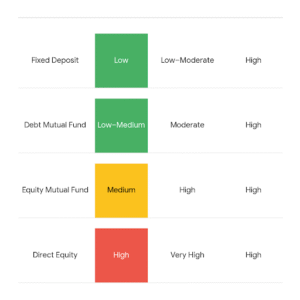
This debate isn’t about which product is “better” — it’s about what each product is designed to do. Fixed deposits, mutual funds, and equities serve very different financial purposes, and confusion arises when they’re compared without context.
Fixed deposits score highest on safety and certainty. They carry minimal risk, offer predictable returns, and are highly liquid. However, after tax and inflation, real returns are often modest. Mutual funds sit in the middle — they balance risk and return, offering diversification and professional management, especially through SIPs that smooth market volatility. Equities sit at the high-risk, high-reward end, capable of generating significant wealth over time but demanding patience and emotional discipline.
The reality is this: FDs protect money, equities grow money, and mutual funds help manage the journey in between. Rural investors prioritizing capital safety are acting rationally. Urban investors chasing growth are also acting rationally — they simply have different goals, income stability, and risk tolerance. The smartest investors don’t blindly copy trends; they choose tools aligned with their lives.
5️⃣ What This Behavioural Split Means for Banks, Markets & the Economy
This rural–urban investment divide has meaningful implications for India’s financial system. For banks, rising rural FD inflows mean access to stable, low-cost deposits, which improves lending margins and balance sheet strength. These deposits support credit growth in agriculture, MSMEs, and infrastructure without excessive reliance on volatile wholesale funding.

On the other hand, increased urban participation in markets strengthens capital market depth. More SIPs mean steady inflows into mutual funds, supporting stock market liquidity even during volatile phases. Asset management companies, brokers, and fintech platforms benefit directly from this trend.
At a macro level, this split could shape policy decisions. The RBI must balance deposit growth, credit expansion, and inflation management while ensuring financial stability. Over the next decade, India’s economy may increasingly rely on this dual engine — banks fueled by rural savings and markets powered by urban risk-taking.
6️⃣ Should You Follow the Crowd? Or Choose a Smarter Middle Path?
This is where the story becomes personal. Should you rush to lock money into FDs because rural India is doing it? Or should you abandon FDs entirely because cities are chasing stocks? The honest answer is neither.
A smarter approach is balance. Fixed deposits still make sense for emergency funds, short-term goals, and mental comfort during uncertain times. Market-linked investments make sense for long-term goals like retirement, children’s education, and wealth creation. Problems arise when decisions are driven by headlines, fear, or peer pressure.
Asset allocation matters more than the product itself. Mixing stability with growth allows investors to sleep peacefully at night while still participating in long-term economic growth. The goal isn’t to choose sides — it’s to build resilience into your finances.
7️⃣ Why Google Searches on “Where to Invest” Are Exploding Right Now
The surge in Google searches like “FD vs mutual fund,” “best investment in 2025,” and “safe investment options India” perfectly reflects this national dilemma. Rural investors want to confirm they’re doing the right thing by choosing safety. Urban investors want reassurance that market risk will pay off.
Inflation worries, volatile markets, and conflicting financial advice have pushed people to seek clarity. Search behavior is acting like a mirror — reflecting India’s collective financial psychology at a moment of transition. People aren’t confused; they’re cautious, curious, and trying to adapt.
This is why content around savings, investing, and money choices is trending so strongly on Google Discover. It speaks directly to lived experience.
8️⃣ Final Verdict: India Isn’t Confused — It’s Evolving
At first glance, India’s split investment behavior looks contradictory. Dig deeper, and it makes perfect sense. Rural investors are prioritizing safety and certainty. Urban investors are prioritizing growth and opportunity. Both are logical responses to different realities.
India’s financial evolution isn’t about choosing between FDs and stocks. It’s about learning how to use each tool wisely. The future belongs to investors who understand their goals, respect risk, and avoid emotional decisions.
To visit official website of RBI Click Here
❓ Frequently Asked Questions (FAQ)
❓ Why are fixed deposits growing faster in rural India?
Fixed deposits are growing faster in rural India mainly because rural savers prefer safety and guaranteed returns. Stable income from agriculture, government schemes, pensions, and remittances makes FDs an easy and trusted choice. Rising FD interest rates have further boosted rural participation, while trust in banks remains stronger than trust in stock markets.
❓ Why are urban investors moving away from fixed deposits?
Urban investors are moving away from fixed deposits because FD returns often fail to beat inflation. With rising living costs, city investors are seeking higher long-term returns through mutual funds, SIPs, ETFs, and direct equities. Easy access to trading apps and market success stories have also increased risk-taking in cities.
❓ Is fixed deposit still a good investment in 2025?
Yes, fixed deposits are still a good investment in 2025 for capital protection, emergency funds, and short-term goals. However, they may not be ideal for long-term wealth creation because post-tax returns are often lower than inflation. FDs work best as part of a balanced portfolio, not as the only investment.
❓ FD vs mutual fund: which is better for middle-class investors?
Neither is universally better. Fixed deposits offer safety and predictability, while mutual funds offer higher long-term growth potential. Middle-class investors should ideally combine both — using FDs for stability and mutual funds for wealth creation through SIPs.
❓ Why is “FD vs mutual fund” trending so much on Google?
The search term is trending because Indians are confused about where to invest amid inflation, volatile markets, and rising interest rates. Rural investors are validating safety choices, while urban investors are reassessing market risks. This split is driving massive search interest.
❓ Should I stop investing in stocks if markets are volatile?
No. Market volatility is normal. Long-term investors should stay invested and avoid emotional decisions. Instead of exiting stocks completely, adjusting asset allocation and continuing SIPs is often a smarter strategy than panic selling.
❓ How does this rural-urban investment split impact the Indian economy?
Rural fixed deposits strengthen banks by providing stable, low-cost funds, while urban market participation increases stock market liquidity and capital formation. Together, this balance supports economic stability and long-term growth in India.
To visit official website of NSE Click Here
🔍 People Also Ask (PAA)
🔹 Why do rural investors prefer fixed deposits?
Rural investors prefer fixed deposits because they offer guaranteed returns, low risk, and capital safety, which suit their income stability and financial goals.
🔹 Are mutual funds riskier than fixed deposits?
Yes, mutual funds carry higher risk than fixed deposits, but they also offer better long-term return potential. Risk depends on the type of fund and investment horizon.
🔹 What is the safest investment option in India right now?
Fixed deposits, government bonds, and small savings schemes are among the safest investment options in India, especially for short-term needs.
🔹 What gives better returns: FD or equity?
Equities generally give better returns over the long term, while fixed deposits provide stable but lower returns. The right choice depends on time horizon and risk tolerance.
🔹 Why is urban India investing more in stocks?
Urban India invests more in stocks due to higher financial literacy, digital access, exposure to market trends, and the need to beat inflation.
🔹 Is it risky to invest in stocks in 2025?
Stocks involve short-term risk but remain one of the best options for long-term wealth creation if invested with discipline and diversification.
🔹 How much money should I keep in fixed deposits?
Most financial experts suggest keeping 6–12 months of expenses in fixed deposits or other safe instruments for emergencies.
🔹 Should beginners invest in mutual funds or stocks?
Beginners should start with mutual funds, especially SIPs, before investing directly in stocks to reduce risk and learn market behavior.