1. The Introduction: Corruption Masquerading as Strategy
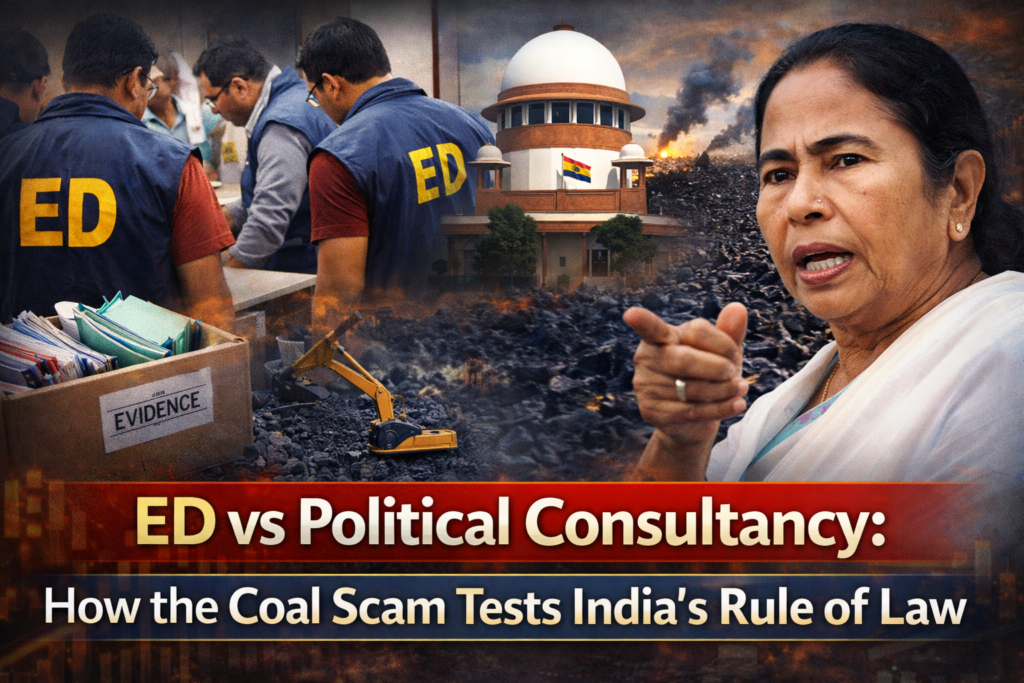
In January 2026, a new phrase entered India’s political vocabulary — “strategy theft.” West Bengal Chief Minister Mamata Banerjee alleged that central agencies were not investigating crime but attempting to steal her party’s internal political strategy during raids linked to the coal scam. The charge was dramatic, emotional, and instantly viral. But it also raised a serious legal question that cannot be ignored.
If a firm handles political strategy, does that automatically place it beyond the reach of money-laundering law?
India has seen many political confrontations over investigative agencies in the last three decades. The phrase “political vendetta” has been used by governments of all colours — Congress, BJP, Left, regional parties. That argument is not new. What is new in 2026 is the legal threshold of evidence now required by courts, and the scale of financial documentation available in the digital age.
The moment that changed everything was not the raid itself. It was when a sitting Chief Minister entered a raid site and allegedly removed laptops and digital devices. At that point, the issue stopped being about “strategy” and became about tampering with evidence. In any democracy governed by law, this is not a political question — it is a constitutional one.
2. Real-Time Data: The ₹2,742 Crore Paper Trail
To understand why the ED’s case does not begin or end with I-PAC, one must go back to 2020, when the coal pilferage scam in West Bengal first came to light. The key accused in the scheduled offence was Anup Majee, also known as Lala, allegedly involved in illegal coal mining and transportation from Eastern Coalfields Limited (ECL) areas.

By 2026, investigative agencies had pieced together a massive paper trail.
Coal Pilferage & Mining Irregularities
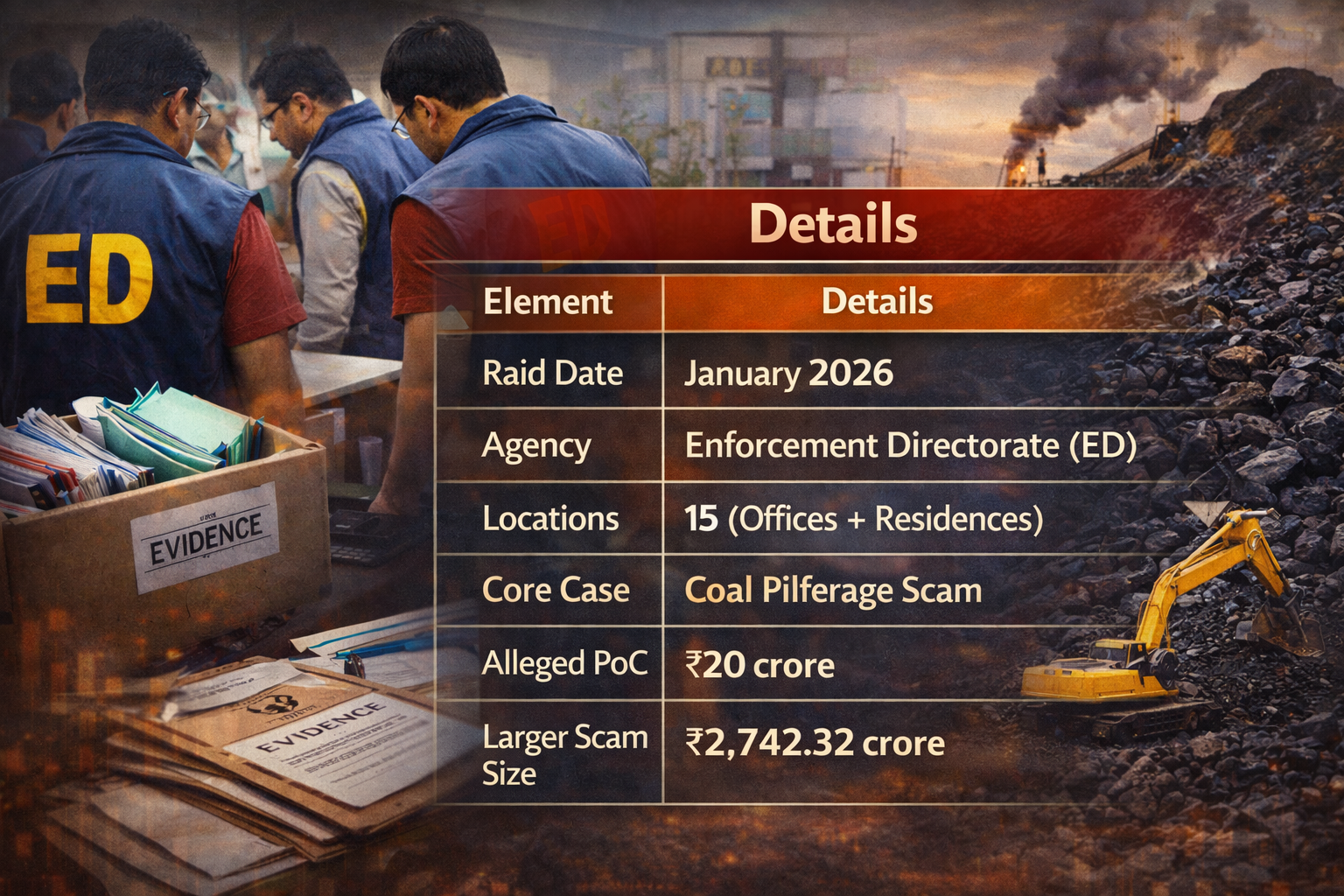
According to ED filings and court records, the estimated size of the coal scam stands at ₹2,742.32 crore, covering illegal activities between 2017 and 2020. This money did not sit idle. It moved — through cash couriers, shell entities, and hawala networks.
The critical point is not the total amount, but how the money was layered.
The ED alleges that ₹20 crore of “Proceeds of Crime” (PoC) was routed through hawala channels — specifically via the Kolkata–Goa route — and then funnelled into election-related services. The agency claims this money ultimately financed political campaign management through intermediary firms.
One of the alleged collection hubs was “Bhamuria Number 1”, described as a central cash aggregation point. From there, money allegedly moved to event and digital firms such as ASM Event Technology and Hertz & Pixelz, which acted as sub-contractors linked to political consultancy work.
This is important. The ED is not accusing I-PAC of mining coal. It is investigating whether illicit cash was converted into “clean” consultancy fees, which is a textbook definition of money laundering.
Enforcement Directorate – Role & Powers
3. The Logic of Governance: Obstruction Is Not Federalism
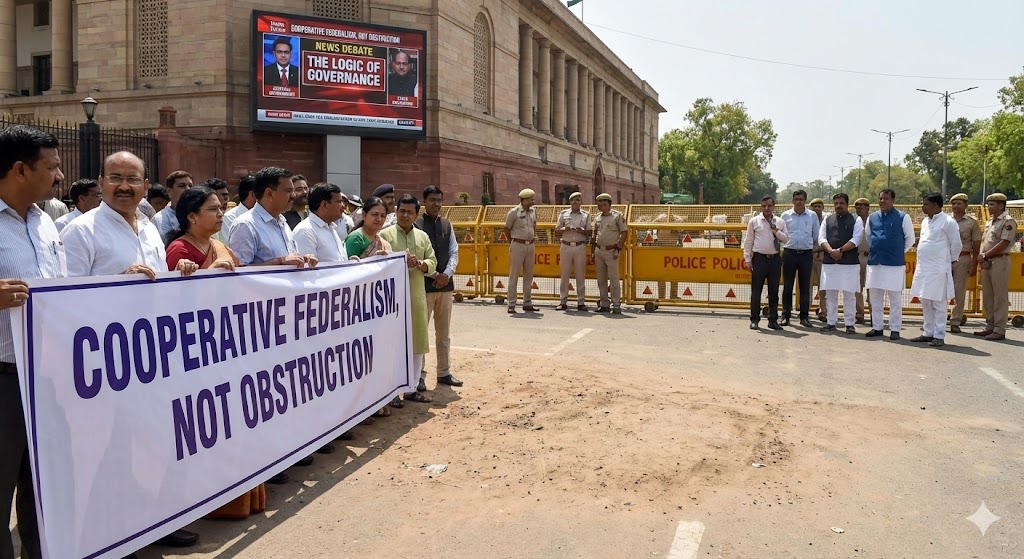
Supporters of the Chief Minister framed her intervention as an act of federal resistance — a state standing up to central overreach. But federalism, in constitutional terms, does not mean physically obstructing a lawful investigation.
The ED has moved an Article 32 petition in the Supreme Court, alleging obstruction and removal of digital evidence. Article 32 is not used lightly. It is reserved for matters involving constitutional rights and institutional breakdown.
From the BJP’s perspective, the optics were damaging not just politically, but institutionally. A Chief Minister entering the residence of a private individual under investigation sends a message that executive power can override investigative process.
A basic question needs to be asked logically:
If the seized material truly consisted only of “candidate lists” or campaign planning documents, why not allow the ED to complete the search and then challenge the seizure legally?
India’s courts have a long history of returning seized material when agencies overstep. But physical removal of devices during a raid crosses a line that no democratic system can normalise.
The idea that the ED is interested in campaign slogans or booth-level messaging is a myth. Investigators follow ledgers, invoices, emails, payment trails, and server logs. Political “strategy” becomes relevant only when it is used to hide or justify illegal financial flows.
4. The Geoeconomic Impact: Cleaning Up the “Consultancy Economy”
Political consulting is no longer informal or small-scale. By 2026, it has become a high-value professional services industry, involving data analytics, digital outreach, voter segmentation, and large financial contracts.
Recognising this, the Indian government has steadily expanded the scope of the Prevention of Money Laundering Act (PMLA). The law now applies not only to banks and real-estate firms, but also to non-traditional financial actors, including consultancies handling large sums of money.

This is not political targeting. It is economic necessity.
India aspires to be a global economic powerhouse, attract foreign investment, and maintain currency stability. For that to happen, election financing must be clean and transparent. When black money enters politics through consultancy routes, it does not just distort democracy — it damages India’s credibility in global markets.
There is irony in the data-privacy argument being used here. The Digital Personal Data Protection (DPDP) Act, 2023, whose rules became operational by 2026, clearly provides exemptions for law enforcement and national security. Data privacy is a right, but it is not absolute when investigating serious financial crimes.
No democracy allows “data protection” to become a shield for laundering money. If that were allowed, shell companies and consultancies would become the modern equivalent of Swiss bank accounts — safe havens within national borders.
Prevention of Money Laundering Act (PMLA)
5. The Supreme Court Battle: Setting the 2026 Precedent
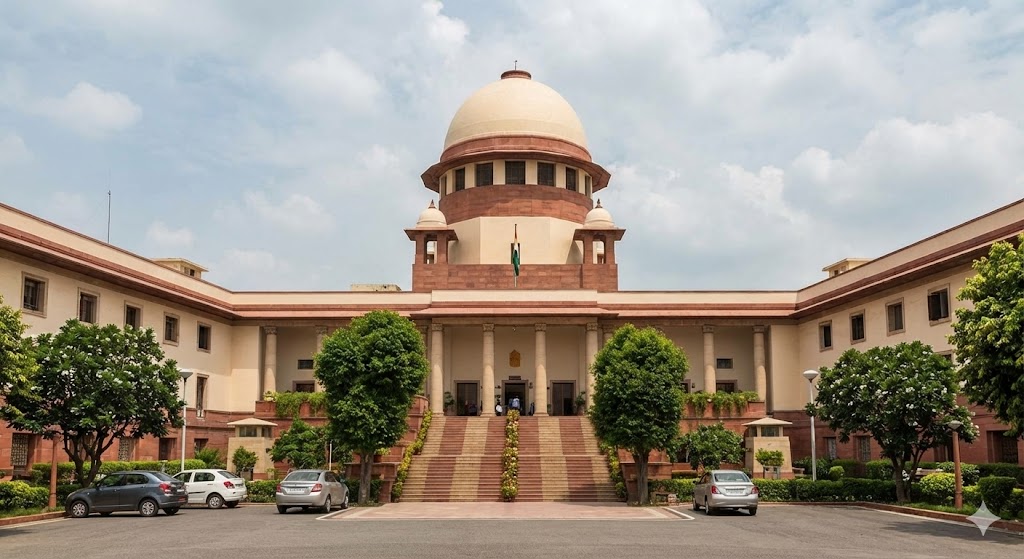
Anticipating legal escalation, the West Bengal government filed a caveat in the Supreme Court, ensuring it would be heard before any adverse order. This was a strategic move, but it also confirmed that the issue had reached constitutional gravity.
The Centre’s response — seeking a CBI probe into the alleged removal of evidence — is not about politics alone. It is about protecting the sanctity of central investigative agencies. If raids can be interrupted by political authority, the rule of law collapses.
This is where the debate shifts from federalism to something more uncomfortable: feudalism.
Cooperative federalism means cooperation within the framework of law. It does not mean elected leaders deciding which laws apply to them and which do not. A Chief Minister is not above the investigative process, just as a corporate leader or bureaucrat is not.
The Supreme Court’s ruling will likely define a 2026 precedent: whether political power can physically interfere with financial investigations, or whether legal remedies must remain the only path of resistance.
6. Conclusion: The Law Is Equal for All
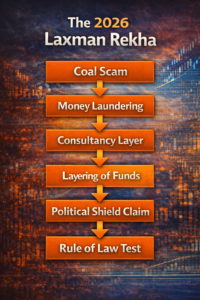
At its core, this case is not about Mamata Banerjee, I-PAC, or the BJP. It is about a simple principle: the law follows the money, not the ideology.
Whether the entity involved is a corporate house, an NGO, or a political consultancy, PMLA jurisdiction applies wherever proceeds of crime are found. There is no constitutional exemption for “internal strategy” when financial crimes are alleged.
West Bengal cannot become an island where central law does not apply. Nor can political consultancies become safe channels for unaccounted cash disguised as professional fees.
The Supreme Court’s decision will determine whether India closes a dangerous loophole or allows a new one to open. If “consultancy fees” are allowed to replace “Swiss banks” as vehicles for domestic corruption, the cost will be paid not just in lost revenue, but in weakened democracy.
In 2026, the message must be clear:
Strategy may win elections, but only the law protects the republic.
Scheduled Offences under PMLA
❓ Frequently Asked Questions (FAQ)
1. What is the coal scam being investigated by the ED?
The coal scam refers to alleged illegal mining, transportation, and sale of coal in parts of West Bengal between 2017 and 2020. Investigative agencies estimate the total value of the scam at over ₹2,700 crore. The Enforcement Directorate (ED) is probing how the proceeds of this illegal activity were generated and laundered.
2. Why is a political consultancy being linked to the coal scam?
The ED alleges that a portion of the proceeds of crime—around ₹20 crore—was routed through hawala channels and later shown as consultancy or event management payments. The investigation is focused on whether consultancy services were used to disguise illegal political funding.
3. What does “money laundering” mean in this case?
Money laundering means converting illegally earned money into seemingly legitimate income. In this case, the allegation is that cash generated from illegal coal operations was layered through intermediaries and consultancy payments to hide its criminal origin.
4. Can “internal political strategy” be protected from investigation?
Political strategy as an idea is not illegal. However, if financial records, invoices, or digital systems connected to strategy work are suspected to be linked to proceeds of crime, they fall under investigation. Strategy does not grant immunity from financial law.
5. Why is the Prevention of Money Laundering Act (PMLA) important here?
The PMLA allows the ED to investigate, search, and seize assets connected to money laundering. The law applies to individuals, companies, and service providers if they are suspected of handling proceeds of crime, regardless of political affiliation.
6. Does the Digital Personal Data Protection (DPDP) Act stop the ED from accessing data?
No. The DPDP Act protects citizens’ personal data, but it also provides clear exemptions for law enforcement and national security. Data privacy cannot be used to block investigations into serious financial crimes.
7. Why is the Chief Minister’s intervention during the raid controversial?
In a constitutional system, legal remedies are available after a search or seizure. Physical intervention during an ongoing raid raises concerns about obstruction and potential evidence tampering, which is why the issue has reached the Supreme Court.
8. What is the significance of the Supreme Court in this case?
The Supreme Court is expected to clarify the limits of investigative power, political authority, and data access in the digital age. Its ruling may set a precedent on how financial crimes involving digital data are investigated in the future.
9. Is this case about federalism or about obstruction of law?
Federalism allows states autonomy, but it does not permit interference with lawful investigations by central agencies. Courts will decide whether actions taken were constitutional resistance or unlawful obstruction.
10. How does this case affect political consulting firms in India?
The case signals that political consulting firms handling large sums of money will face the same scrutiny as other professional services. Transparency, clean accounting, and compliance with financial laws are now essential for such firms.
11. Why does money laundering in elections harm the economy?
Unaccounted political funding weakens trust in democratic institutions and damages investor confidence. It also distorts fair competition and can negatively impact currency stability and economic credibility.
12. Is political consulting illegal in India?
No. Political consulting is legal. The investigation is not about consulting itself but about whether illegal funds were routed through consulting arrangements to hide their source.
13. What does “proceeds of crime” mean under PMLA?
Proceeds of crime refer to any property or money obtained directly or indirectly through illegal activities. If such funds are found to be disguised or routed through other entities, money laundering charges can apply.
14. What precedent could this case set for the future?
The case may lead to clearer legal protocols on digital searches, data seizure, and the boundary between political activity and financial crime. It could shape how future investigations involving data-driven organisations are conducted.
15. What is the key takeaway for citizens?
The core issue is accountability. Regardless of political power or professional status, financial laws apply equally. Protecting democracy requires transparency, rule of law, and respect for constitutional processes.
🔍 People Also Ask
What is the coal scam in West Bengal?
The coal scam refers to alleged illegal mining and transportation of coal in parts of West Bengal between 2017 and 2020. Investigators estimate the scam’s value at over ₹2,700 crore and are examining how the money generated was distributed and used.
Why is the Enforcement Directorate investigating political consultancy firms?
The ED is not investigating political strategy itself. It is probing whether consultancy firms were used to route or disguise proceeds of crime as legitimate professional fees, which can fall under money laundering laws.
Can consultancy fees be treated as money laundering?
Yes, if consultancy fees are used to hide the source of illegal money. Under the PMLA, any transaction that converts illicit funds into apparently legitimate income can qualify as money laundering.
What does the PMLA allow the ED to do?
The Prevention of Money Laundering Act allows the ED to investigate, search, seize assets, and examine records linked to proceeds of crime. These powers apply to individuals, companies, and service providers alike.
Is political strategy protected from investigation in India?
Political strategy as an idea is not illegal. However, documents, payments, or digital systems linked to suspected financial crimes are not protected from investigation simply because they relate to politics.
Why is data privacy being mentioned in this case?
Some parties argue that voter and campaign data should be protected under the Digital Personal Data Protection Act. However, the law allows exemptions for law enforcement investigations involving serious crimes.
Does the DPDP Act override the PMLA?
No. The DPDP Act and PMLA operate together. Data protection laws do not prevent lawful investigations into money laundering or economic offences.
Why did the case reach the Supreme Court?
The case reached the Supreme Court due to allegations of obstruction during an ED raid and concerns about constitutional boundaries between state authority and central investigative agencies.
Is this case about federalism or misuse of power?
Courts will decide this. Federalism allows states autonomy, but it does not permit interference with lawful central investigations. The distinction between resistance and obstruction is central to the case.
What is meant by “proceeds of crime”?
Proceeds of crime are assets or money obtained directly or indirectly from illegal activities. If such funds are concealed, transferred, or used through other entities, money laundering charges may apply.
How does money laundering affect democracy?
Money laundering in elections distorts fair competition, weakens public trust, and undermines democratic institutions. Transparent political funding is essential for healthy democracy.
Are political consulting firms legal in India?
Yes. Political consulting is legal. The investigation focuses on financial flows, not on the profession itself.
What impact could this case have on future investigations?
The case may set guidelines for handling digital data during raids, clarify limits of political authority, and strengthen accountability in election-related financial activities.
Can a Chief Minister intervene in a central agency raid?
There is no clear precedent allowing physical intervention during an ongoing raid. Legal remedies typically come after the search, which is why the issue is under judicial scrutiny.
Why is this case important for ordinary citizens?
The case highlights how rule of law works in practice. It affects transparency, data rights, election integrity, and how power is exercised within a constitutional system.