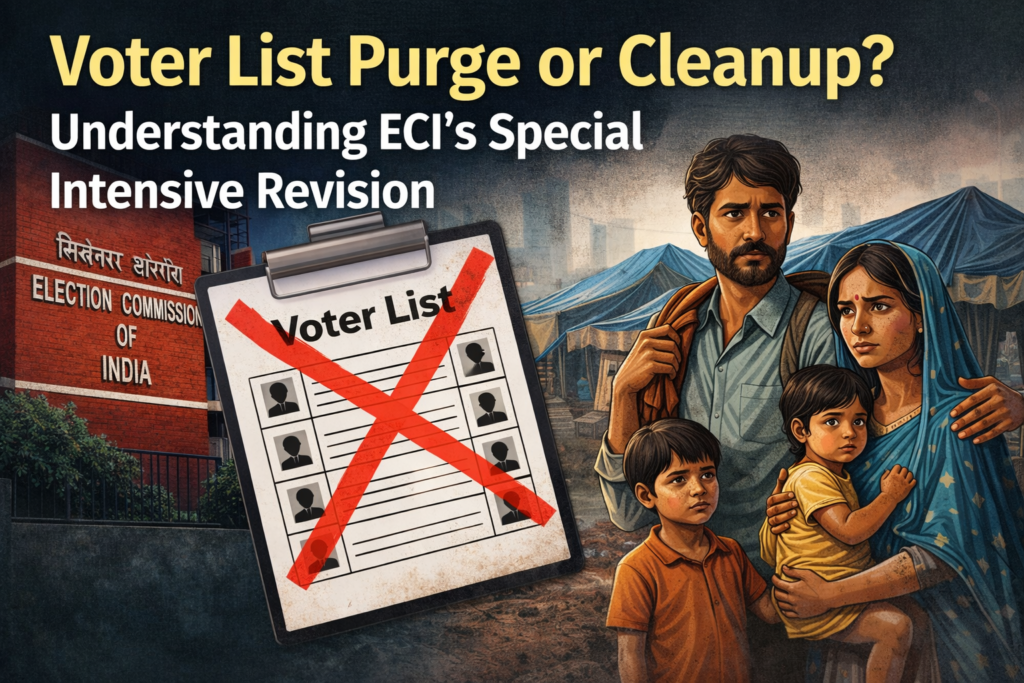
I. Introduction: The Logistics of a ‘Digital Cleanup’
In mid-2025, India quietly entered one of the most important democratic exercises of the decade. The Election Commission of India (ECI) launched a Special Intensive Revision (SIR) of electoral rolls—the first such nationwide exercise in more than 20 years. The last full SIR was conducted in 2003, when India’s population, migration patterns, and digital infrastructure looked very different.
According to official data, around 3 crore voter names were removed from electoral rolls across the country during this revision. This was not a routine annual update. Unlike a summary revision that relies on forms and local inputs, the SIR involved house-to-house physical verification, backed by digitised databases and cross-checks.
The ECI’s justification is simple on paper. Over two decades, India has seen massive internal migration, rapid urbanisation, and millions of unreported deaths. These changes, the ECI argues, created a “ghost electorate”—duplicate voters, outdated addresses, and names of people who no longer exist or no longer live there. Such distortions, if left unchecked, can affect polling accuracy and electoral integrity.
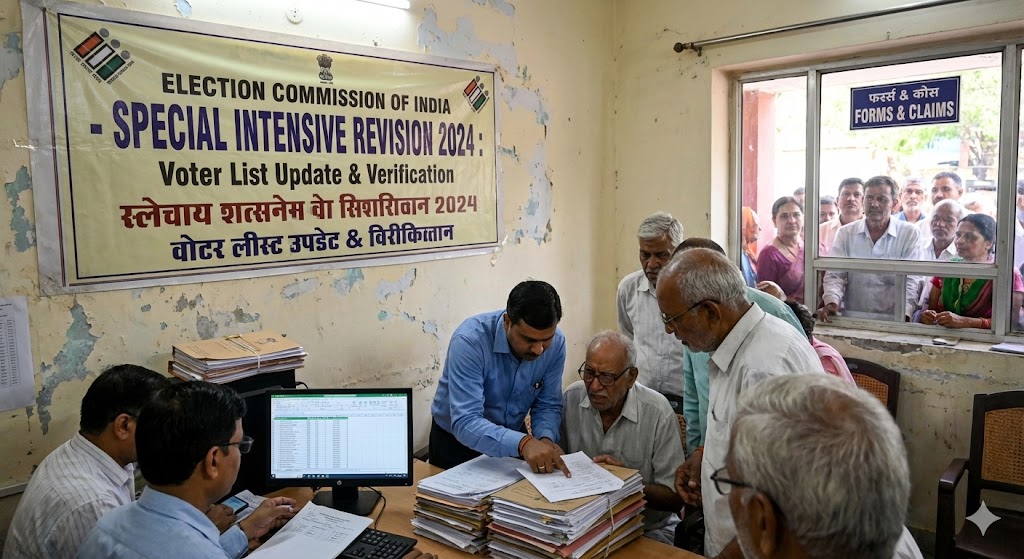
Yet, what began as a technical cleanup soon became a political and constitutional flashpoint. Critics argue that the scale, speed, and documentation demands of the SIR risk excluding genuine voters, especially the poor and migrant workers. The debate has now moved beyond voter lists to a deeper question: can digital precision coexist with democratic inclusion?
Election Commission of India (ECI)
India’s Biggest Electoral Cleanup in 20 Years
| Metric | Data |
|---|---|
| Type of revision | Special Intensive Revision (SIR) |
| Last full SIR | 2003 |
| Current SIR launch | Mid-2025 |
| Total deletions | ~3 crore voters |
| Method used | House-to-house + digital verification |
II. Case Study: The Bihar ‘Seismic Shift’
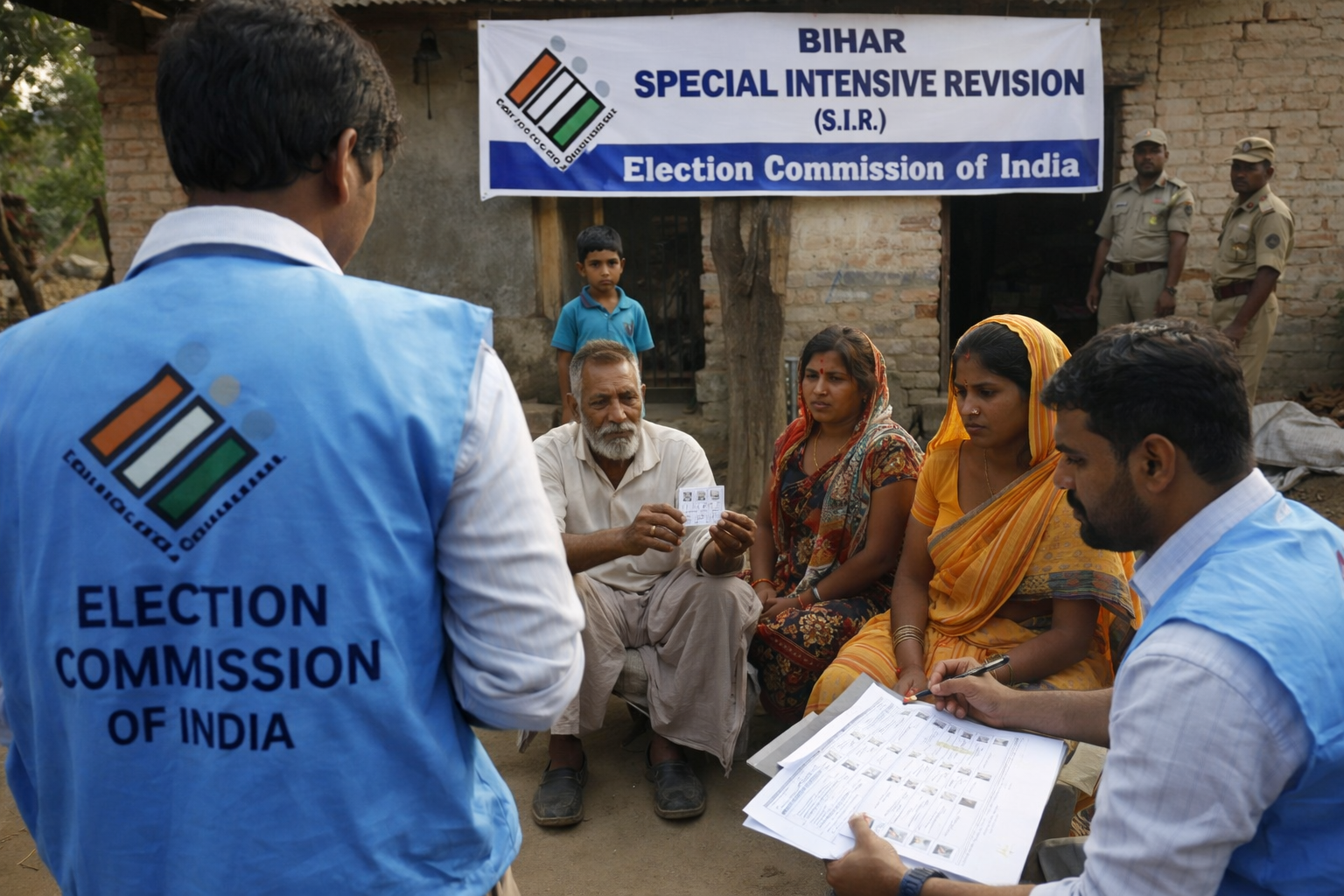
No state illustrates the controversy better than Bihar. When the draft rolls were released on August 1, 2025, they showed that around 65 lakh names—roughly 6.5 million voters, or about 6% of the state’s electorate—had been deleted.
From the ECI’s perspective, Bihar represents decades of accumulated inaccuracies. High out-migration, poor death registration, and repeated address changes made the rolls especially vulnerable to duplication. Officials claimed that the deletions reflected reality rather than political targeting.
However, the numbers raised eyebrows. Investigations by independent groups, including media consortiums, found that even after the deletions, over 14 lakh suspected duplicate entries still remained in the so-called “final” lists. This created a paradox: if the aim was purification, why did large inconsistencies persist?
The political fallout was immediate. Opposition parties under the Mahagathbandhan banner accused the ECI of “Vote Chori” (vote theft). They alleged that deletions were disproportionately concentrated in urban poor localities, migrant-heavy districts, and minority-dominated areas. The ECI denied these claims, stating that deletions were based solely on verification outcomes, not demographics.
Bihar thus became the testing ground for the SIR’s credibility. For supporters, it proved that tough decisions were finally being taken. For critics, it exposed the risks of large-scale deletions without airtight safeguards.
III. The ‘Burden of Proof’ Battle: Legal & Constitutional Friction
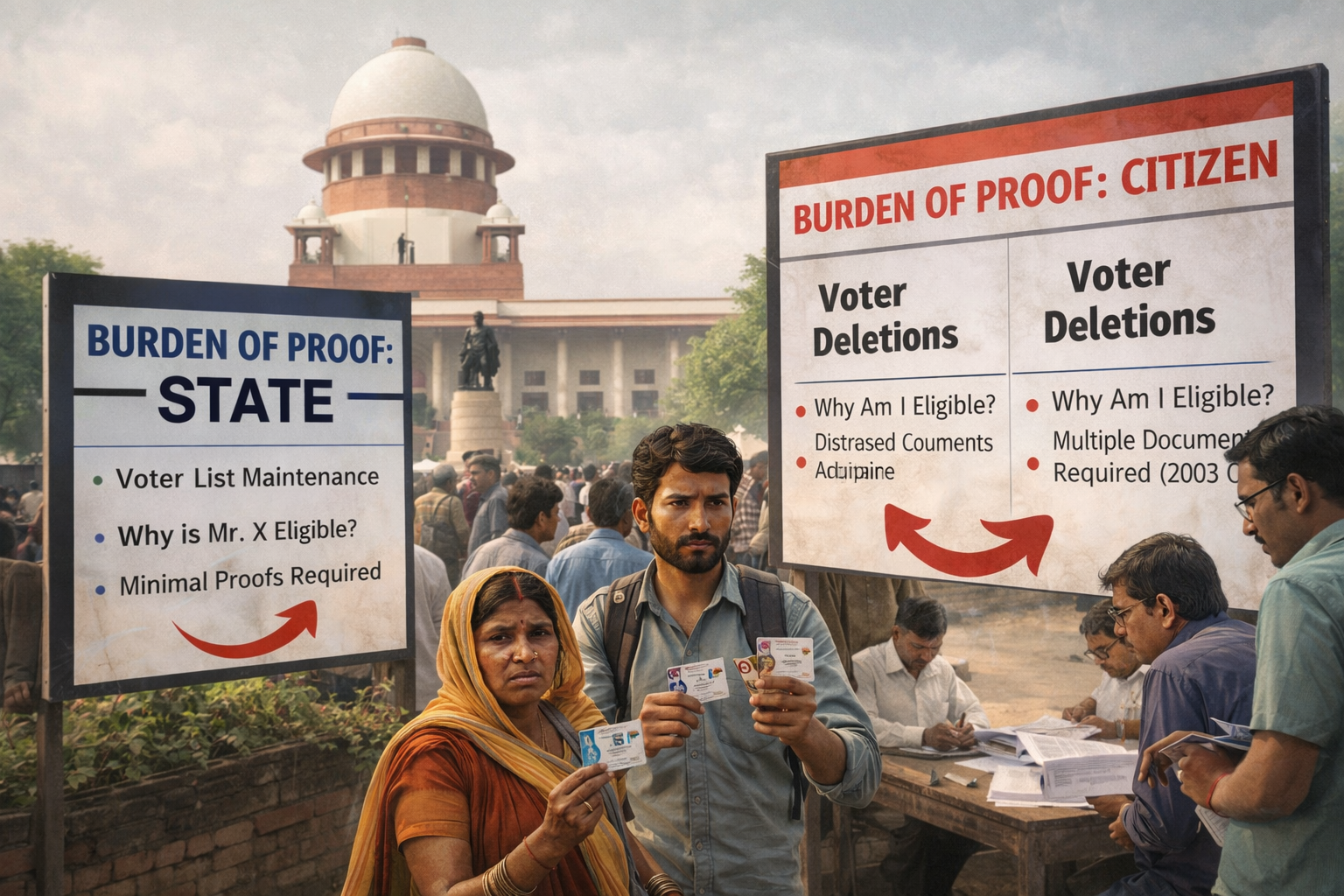
At the heart of the controversy lies a subtle but critical shift: the burden of proof. Traditionally, it was the state’s responsibility to maintain accurate voter rolls. Under the SIR framework, that burden effectively moved toward the citizen.
During early phases of the revision, the ECI asked voters whose names were flagged to submit specific legacy documents, especially proof of inclusion after 2003. Notably, Aadhaar was initially excluded as valid proof, on the grounds that it establishes identity but not voting eligibility.
This requirement triggered widespread concern. Migrant workers, elderly citizens, and informal-sector employees often lack older documents. Civil society groups warned that genuine voters could lose their franchise simply because they could not produce paperwork.
The issue reached the Supreme Court of India, following petitions from Kerala and Tamil Nadu. In August and December 2025, the Court issued key directions:
The ECI must accept Aadhaar, Voter ID, and Ration Cards as valid supporting documents.
The ECI must publish specific reasons for every deletion online, ensuring transparency and allowing citizens to challenge errors.
These orders temporarily eased tensions but did not end the debate. State governments in Kerala and Tamil Nadu argued that the timing of the SIR—during monsoon months and festival seasons—made compliance difficult for daily-wage workers and migrants.
The clash highlighted a deeper constitutional question: how much procedural rigor is too much in a democracy where access itself is unequal?
IV. The Geoeconomic Angle: Migration, AI, and ‘Pax Silica’
Beyond law and politics lies a structural reality—migration. India has an estimated 15 crore internal migrant workers, according to government and academic studies. Many live away from their home constituencies for years but retain strong social and political ties to their villages.
The SIR relies heavily on the concept of being “ordinarily resident”, a legal standard that can disadvantage migrants who are temporarily absent during verification visits. If applied strictly, this interpretation risks deleting voters who are economically mobile but democratically rooted.
Technology adds another layer. The ECI has acknowledged the use of AI-powered anomaly detection systems to flag duplicate or suspicious entries. While such tools increase efficiency, experts warn of algorithmic bias. If software flags names based on similarity or commonality without nuanced checks, large communities with common surnames or naming patterns could be disproportionately affected.
Census of India / Registrar General of India
This debate mirrors a global trend sometimes described as “Pax Silica”—a world where digital systems and algorithms increasingly govern state functions. In elections, this means the line between efficiency and exclusion is thinner than ever.
The challenge for India is not whether to use technology, but how to govern it—with audits, human oversight, and strong appeal mechanisms.
V. The SIR Controversy at a Glance
| State | Deletions (Approx) | Status / Key Challenge |
|---|---|---|
| Bihar | 65 lakh | Finalized; challenged for duplications & address errors |
| Tamil Nadu | 97 lakh | ~15% of electorate removed; Chennai accounts for ~35% |
| Kerala | 25 lakh | Anticipated; SC urged a “sympathetic view” on deadlines |
| Uttar Pradesh | Ongoing | Deadline extended to Dec 26 after political pressure |
This snapshot shows that the issue is not confined to one region. The SIR has national implications, touching states with very different political and social profiles.
VI. Conclusion: Integrity vs. Inclusion
The Special Intensive Revision represents one of the most ambitious electoral exercises in India’s history. On one hand, clean rolls are essential for “One Person, One Vote.” Duplicate and outdated entries undermine trust and fairness. On the other hand, democracy is not only about accuracy; it is about access.
The real risk of the SIR lies not in intent but in execution. If even a small percentage of genuine voters are wrongly excluded, the legitimacy of elections can be questioned. If transparency, appeal mechanisms, and flexibility are enforced, the SIR could strengthen Indian democracy for decades.
The 2026 Assembly Elections will be the ultimate litmus test. They will show whether the ECI’s “purified” rolls deliver cleaner elections without shrinking the electorate.
India now stands at a crossroads familiar to many modern democracies: how to balance digital efficiency with human inclusion. The answer will shape not just voter lists, but public trust itself.
ECI Electoral Search Portal
❓ Frequently Asked Questions (FAQ)
1. What is the Special Intensive Revision (SIR) by the ECI?
The Special Intensive Revision (SIR) is a large-scale voter list verification exercise conducted by the Election Commission of India. It involves house-to-house verification to remove duplicate, shifted, or incorrect voter entries. The last such nationwide exercise was done in 2003.
2. Why did the ECI remove around 3 crore voters?
The ECI says the deletions were due to unreported deaths, migration, duplicate registrations, and outdated addresses. Over 20 years, demographic changes created what the ECI calls a “ghost electorate.”
3. Is this a voter purge or a routine cleanup?
Officially, the ECI describes it as a cleanup to protect electoral integrity. Critics argue that the scale and speed risk excluding genuine voters. The final impact depends on transparency, appeal mechanisms, and corrections.
4. Which states were most affected by the SIR?
States like Bihar, Tamil Nadu, Kerala, and Uttar Pradesh saw large deletions. Bihar alone had about 65 lakh names removed, while Tamil Nadu saw nearly 97 lakh deletions, especially in urban areas.
5. Can genuine voters be deleted by mistake?
Yes, especially migrant workers, the elderly, and the urban poor. This is why the Supreme Court directed the ECI to allow multiple documents and publish reasons for every deletion.
6. What documents are valid to restore a deleted name?
As per Supreme Court directions, voters can use Aadhaar, Voter ID, Ration Card, Passport, or other basic documents to apply for re-inclusion through Form 6.
7. Does Aadhaar prove voting eligibility?
No. Aadhaar proves identity, not citizenship or voting rights. However, it can be used as a supporting document along with other records during voter list correction.
8. How can a voter check if their name is on the list?
Voters can check their status on the official ECI portal:
https://electoralsearch.eci.gov.in
They should verify details well before elections.
9. What is the ‘burden of proof’ controversy?
Earlier, the state was responsible for maintaining accurate rolls. Under SIR, voters are often required to prove eligibility themselves. This shift has raised constitutional and ethical concerns.
10. What role has the Supreme Court played in this issue?
The Supreme Court intervened in 2025, directing the ECI to accept common documents, publish deletion reasons, and take a sympathetic view for migrants and marginalised voters.
11. Is AI being used in voter list verification?
Yes, the ECI uses AI-based tools to detect duplicates and anomalies. Experts warn that without human oversight, algorithmic bias could lead to wrongful deletions.
12. Will deleted voters be able to vote in the 2026 elections?
Yes, if they apply for correction or re-inclusion before the final voter rolls are published, expected around February 2026.
13. Does migration disqualify someone from voting?
No. Temporary migration for work does not remove voting rights. Voters remain eligible at their native address if they maintain ordinary residence there.
14. What is the biggest risk of the SIR exercise?
The biggest risk is voter disenfranchisement—excluding eligible citizens due to documentation gaps, timing issues, or verification errors.
15. What is the biggest benefit if SIR is done correctly?
If implemented fairly, SIR can improve electoral integrity, reduce fraud, and strengthen public trust in elections.
🔍 People Also Ask (PAA)
What is the Special Intensive Revision (SIR) of voter lists?
The Special Intensive Revision is a detailed voter roll verification exercise conducted by the Election Commission of India to remove duplicate, outdated, or incorrect entries through physical and digital checks.
Why did the ECI delete so many voter names in 2025–26?
The ECI says the deletions were due to migration, unreported deaths, address changes, and duplicate registrations that accumulated over two decades since the last full revision.
Is the ECI voter list revision legal?
Yes, voter roll revisions are legally allowed. However, the Supreme Court has stressed that the process must be transparent and must not unfairly exclude eligible voters.
How can I check if my name was deleted from the voter list?
You can check your voter status on the official ECI portal using your name or EPIC number. If missing, you can apply for correction or re-inclusion.
Can a voter whose name was deleted vote in the 2026 elections?
Yes, if the voter applies for re-inclusion or correction before the final voter rolls are published, expected in early 2026.
Which states saw the highest voter deletions?
States like Bihar, Tamil Nadu, Kerala, and Uttar Pradesh reported large-scale deletions due to migration and urbanisation-related issues.
Does migration for work cancel voting rights?
No. Temporary migration does not cancel voting rights. Migrant workers remain eligible to vote at their native place if they meet residency rules.
Is Aadhaar mandatory for voter list correction?
No. Aadhaar is not mandatory. It can be used as a supporting document along with other valid identity or residence proofs.
Why is the ‘burden of proof’ being debated?
The debate arises because voters are now often required to prove eligibility themselves, whereas earlier the responsibility rested mainly with election authorities.
Is artificial intelligence being used in voter verification?
Yes, AI tools are being used to detect duplicate or suspicious entries. Experts say human oversight is essential to avoid errors or bias.
What documents are accepted for voter re-inclusion?
Documents such as Voter ID, Aadhaar, Ration Card, Passport, and utility bills can be used, as per Supreme Court directions.
What happens if a voter misses the correction deadline?
If deadlines are missed, the voter’s name may not appear in the final roll, which could prevent voting in the upcoming election.
Why is the Bihar SIR particularly controversial?
Bihar saw about 65 lakh deletions, and reports suggested inconsistencies remained even after cleanup, raising questions about accuracy and fairness.
Can voter list errors affect election results?
Yes. Large-scale errors can impact voter turnout and public trust, which is why transparency and correction mechanisms are critical.
What is the main concern raised by critics of the SIR?
Critics fear voter disenfranchisement, especially among migrants, the poor, and the elderly, due to documentation and verification challenges.