🇮🇳 DRDO’s QMF Seeker Technology: Inside India’s Next-Gen Missile Guidance Revolution
What is QMF Seeker Technology, how it works, which countries have it, and why it matters for India’s defence future.
🛰️ Introduction: India’s Leap in Missile Precision
In a major technological leap for India’s defence capability, the Defence Research and Development Organisation (DRDO) has successfully developed a next-generation QMF Seeker — a radar-based guidance system designed to make Indian missiles smarter, faster, and more accurate.
This innovation puts India in a select group of nations mastering advanced missile seeker technologies — a key element that determines how precisely a missile locks on to and destroys its target.
But what exactly is QMF Seeker Technology, and why is it being hailed as a “game changer” for India’s missile arsenal?
Let’s explore this in detail.
🔹 What Is QMF Seeker Technology?
The QMF Seeker stands for Quadrature Monopulse Frequency seeker — a sophisticated radar seeker that provides real-time target tracking during a missile’s final phase of flight.
To understand its importance, imagine a missile as a flying spear. While its engine propels it and its fins guide it, the seeker is its “eye” — the component that actually sees and locks onto the target.
Traditional seekers rely on single-pulse signals or external radar guidance. In contrast, QMF technology uses multiple radar beams (quadrature channels) to measure target position with extreme precision, even under heavy jamming or electronic interference.
In simple words, a QMF seeker gives a missile the ability to think and react in real-time — just like a smart predator that never loses sight of its prey.
🔹 How Does QMF Seeker Work in a Missile?
Every modern missile goes through three main stages after launch:
Initial & Mid-Course Phase: Guided by GPS or inertial navigation.
Target Acquisition: Seeker activates and starts searching for the target.
Terminal Homing: The seeker locks onto the target and guides the missile precisely until impact.
Here’s where the QMF seeker shines:
It transmits radar pulses and instantly compares the echo signals received in multiple channels (quadrature/monopulse).
Using the difference between these channels, it calculates the exact angle and direction of the target.
The seeker continuously sends correction commands to the missile’s flight computer — ensuring accuracy even if the target is maneuvering or using jamming tactics.
In short: QMF = Quick, Multi-Channel, Foolproof guidance.
The result? A missile that hits harder, reacts faster, and resists countermeasures.
🔹 Why Is This Technology Important for India?
Until now, only a few advanced nations — like the United States, Russia, and China — had indigenous monopulse or active radar seeker capabilities.
By mastering QMF seekers, India achieves strategic autonomy in a critical technology area that was once tightly guarded.
✳️ Key Advantages for India:
Indigenisation: Reduces reliance on foreign seekers and critical imports.
Better Accuracy: Enhances hit probability in air-to-air and surface-to-air missions.
Jam-Resistant: QMF’s design makes it resilient against electronic warfare (EW) attacks.
Export Potential: Strengthens India’s credentials in global defence markets.
Technology Leadership: Positions DRDO as a global competitor in smart-missile systems.
This development aligns with India’s ‘Atmanirbhar Bharat’ (Self-Reliant India) and ‘Make in India’ Defence Vision.
🔹 Which Countries Have QMF or Similar Seeker Technology?
Only a handful of nations possess indigenous seeker manufacturing capability at this sophistication level:
| Country | Example Missiles with Similar Seeker Tech |
|---|---|
| 🇺🇸 United States | AIM-120 AMRAAM, SM-6, Patriot PAC-3 |
| 🇷🇺 Russia | R-77 (RVV-AE), 9M96E2, Kh-31 |
| 🇨🇳 China | PL-15, HQ-9B, YJ-91 |
| 🇫🇷 France | Meteor, MICA-NG |
| 🇮🇳 India | Astra Mk-2, Akash-NG, SFDR project (with QMF Seeker) |
With QMF, India joins this elite club — a mark of its growing technological independence.
🔹 Indian Missiles Equipped or Planned with QMF Seeker
DRDO is integrating its QMF seeker across multiple missile platforms:
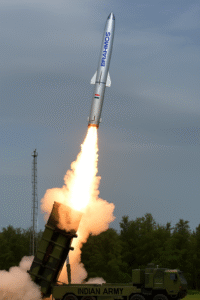
Astra Mk-2 (BVR Air-to-Air Missile) – India’s indigenous equivalent of the AMRAAM, featuring advanced radar seeker guidance.
Akash-NG (Surface-to-Air Missile) – Enhanced range and accuracy using active radar seekers.
SFDR Missile Project (Solid Fuel Ducted Ramjet) – Future long-range missile expected to use QMF-based seekers for pinpoint tracking.
XR-SAM (Upcoming System) – May employ QMF seeker for layered air defence.
These seekers are entirely developed and produced in India, reducing dependence on foreign radar hardware.
🔹 How QMF Seeker Compares Globally
| Feature | QMF (India) | AIM-120 AMRAAM (US) | R-77 (Russia) |
|---|---|---|---|
| Radar Type | Quadrature Monopulse | Active Monopulse | Doppler Monopulse |
| Range | Up to 100+ km (est.) | 75–160 km | 80–110 km |
| Anti-Jam | High | High | Medium-High |
| Development | Indigenous (DRDO) | Raytheon | AGAT (Russia) |
India’s QMF seeker design aims to combine AMRAAM-level performance with homegrown reliability, paving the way for indigenous export potential in Asia, the Middle East, and Africa.
🔹 Limitations and Challenges
Despite the success, certain challenges remain:
Testing & Validation: Seeker performance must be proven across environments — sea, desert, mountain, and high-altitude conditions.
Industrial Scale-Up: Requires precision RF components and fabrication facilities, still scaling up in India.
Electronic Counter-Countermeasures (ECCM): Needs continuous upgrades to match evolving jamming systems.
Integration Time: Retrofitting new seekers into older missile designs demands rigorous trials.
However, DRDO’s track record — from the Astra missile to the Akash-NG system — shows India’s capability to iterate and improve rapidly.
🔹 Strategic and Global Impact
🔸 For India
Enhanced Air Superiority: QMF-equipped missiles will give India’s air forces better kill ratios in BVR (Beyond Visual Range) combat.
Export Competitiveness: India can offer complete missile systems without foreign technology restrictions.
Industrial Growth: Indigenous seeker manufacturing will boost defence startups and MSMEs.
🔸 For the World
Shift in Tech Balance: India’s entry into this advanced seeker domain challenges long-held Western and Russian dominance.
Regional Security: Neighbouring nations will likely respond with their own tech upgrades, reshaping South Asia’s defence balance.
🔹 Future Outlook
The QMF seeker programme is not just a technological milestone — it’s a strategic enabler.
In the next 5 years, India plans to:
Integrate QMF seekers into all upcoming missile systems.
Expand indigenous seeker production under DRDO-Bharat Dynamics Ltd partnerships.
Develop dual-mode seekers (RF + IR) for multi-target engagement.
As India continues this trajectory, it could soon rival global defence giants in seeker design and missile precision.
🧠 Summary
| Aspect | Details |
|---|---|
| Technology | Quadrature Monopulse Frequency (QMF) Radar Seeker |
| Purpose | High-accuracy target tracking & guidance in missiles |
| Developer | DRDO, India |
| Advantages | Jam-resistant, precise, indigenous, export-ready |
| Comparable Systems | AMRAAM (US), PL-15 (China), R-77 (Russia) |
| Strategic Value | Strengthens India’s missile independence & deterrence |
🩸 Conclusion
The development of the QMF Seeker by DRDO is a landmark achievement that brings India into the league of global missile powers.
This indigenous technology not only strengthens India’s defence self-reliance but also sets the foundation for future missile generations capable of operating in the most complex warfare environments.
In short, the QMF seeker is more than an electronic eye — it’s a symbol of India’s technological sovereignty and its growing confidence on the world stage.