
Is the Dollar Losing Its Reserve Currency Status?

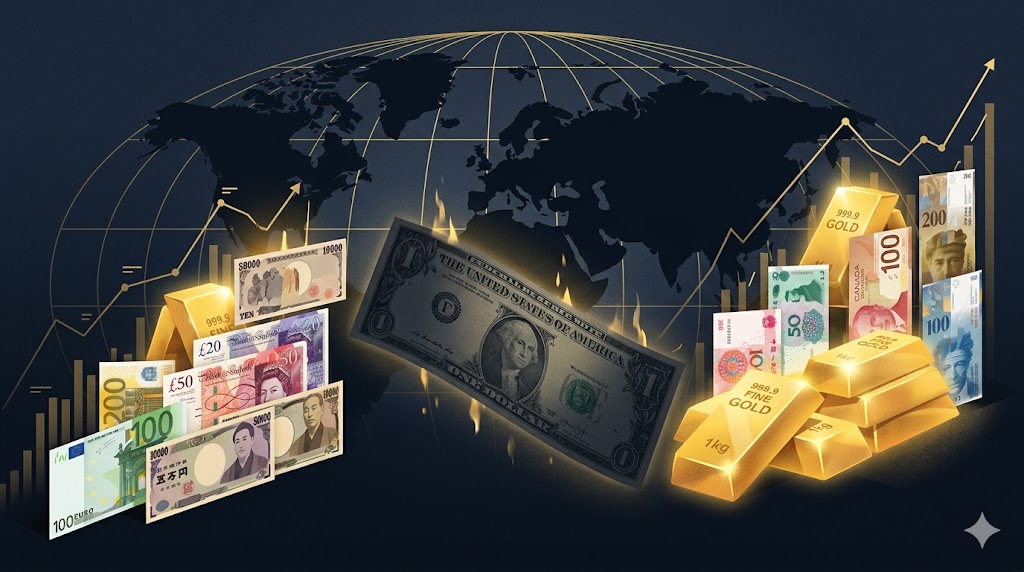
ou’ve probably seen the headlines: “Dollar in danger,” “BRICS wants to ditch the dollar,” “De-dollarization is here.” It’s enough to make anyone nervous. But what’s actually happening? Is the US dollar really losing its grip on the world? Or is this just media noise?
The truth, as usual, sits somewhere in the middle — and it’s actually fascinating. Let’s dig into the real numbers, the history, and what it all means for you.
First Things First: What Even Is a “Reserve Currency”?
Think of a reserve currency like the world’s “universal money.” When countries trade with each other — when Japan buys oil from Saudi Arabia, or India imports electronics from Germany — they often don’t pay in their own currency. They use a common currency everyone trusts. For the past 80+ years, that currency has been the US dollar.
Central banks (the big government banks that manage a country’s money) hold stockpiles of foreign currencies to keep their own economies stable. The currency they hold the most of? Dollars. That’s what “reserve currency status” means.
This status gives the United States enormous power. It can borrow cheaply, run large deficits, and sanction other countries by cutting off their access to dollar-based finance. That’s why changes here matter — a lot.
The Numbers Don’t Lie: The Dollar Is Slipping — Slowly
Let’s look at the hard data. According to the IMF’s COFER (Currency Composition of Official Foreign Exchange Reserves) reports:
| Year | Dollar’s Share of Global Reserves | Notable Event |
|---|---|---|
| 1977 | ~85% | Peak dollar dominance |
| 1991 | ~46% | Hit all-time low after 1970s inflation crisis |
| 1999 | ~71% | Euro introduced; dollar recovered |
| 2015 | ~66% | Start of current decline phase |
| 2020 | ~59% | COVID-era stimulus concerns |
| 2024 (End) | 57.8% | Lowest level since 1994 |
| Q1 2025 | 57.7% | Continued slow decline |
| End 2025 | ~56.3% | US tariff shock, dollar weakens 10% |
So yes, the dollar’s share has fallen by about 8–9 percentage points in the last decade. That is real. But let’s put it in perspective: the dollar still holds nearly three times more global reserves than its nearest rival, the euro (around 20%). The Chinese yuan — which many say will “replace” the dollar — holds a mere 2% of global reserves.
A Quick History Lesson: This Has Happened Before
Here’s the part most news articles skip: the dollar has faced this kind of crisis before — and survived.
After World War II, 44 nations met in Bretton Woods, New Hampshire. They agreed to peg their currencies to the US dollar, and the dollar would be backed by gold at $35 per ounce. The dollar became the world’s official reserve currency almost overnight.
President Nixon “closed the gold window” — meaning dollars could no longer be converted to gold. The world held its breath. Would confidence in the dollar collapse?
Inflation exploded in the US. The dollar’s reserve share plunged from 85% in 1977 to just 46% by 1991. The world started looking for alternatives. Sound familiar?
The Fed tamed inflation. The US economy boomed. Central banks loaded up on dollars again. The “death of the dollar” talk faded away.
A brand new rival! Many predicted the euro would overtake the dollar within years. The euro peaked at about 28% of reserves — and has since fallen back to around 20%.
When the US and Europe froze $300 billion of Russia’s dollar reserves after the Ukraine invasion, every country in the world took notice. If it could happen to Russia, it could happen to anyone. The drive to diversify away from dollars accelerated sharply.
The dollar’s reserve share falls to about 57–58%, its lowest since 1994. Trade wars, tariff shocks, and geopolitical tensions push central banks to buy more gold and diversify further.
Why Are Countries Moving Away from the Dollar?
There isn’t one single reason — it’s a mix of several forces all pushing in the same direction at once.
1. The “Weaponization” of the Dollar
The US has increasingly used the dollar as a foreign policy tool — freezing assets, cutting countries off from SWIFT (the global banking messaging system), and imposing sanctions. After Russia’s reserves were frozen in 2022, countries like China, India, Saudi Arabia, and others started thinking: “What if this happens to us someday?” They began quietly building alternative arrangements.
2. America’s Growing Debt
The US national debt has grown from $16 trillion in 2012 to over $35 trillion in 2024. When a country owes that much, some investors start to wonder: will the US always be the safest place to park money? The government’s interest payments are also rising sharply, raising questions about long-term fiscal stability.
3. Central Banks Are Buying Gold — Aggressively
Gold’s share of global central bank reserves has risen to about 20% in 2025, making it the second-largest reserve asset — ahead of the euro. China has been on an 11-month gold-buying spree, pushing its gold reserves to over 2,303 tonnes valued at $283 billion. Russia and China together have added over 3,600 tonnes of gold to their reserves since 2005. Gold has no country, pays no allegiance, and can’t be frozen by sanctions. That’s exactly why it’s attractive right now.
4. The Petrodollar Is Under Pressure
Since 1974, oil has been priced and traded almost exclusively in US dollars. This “petrodollar” system has been one of the dollar’s most important pillars. But the rise of electric vehicles is threatening this. In 2025, one in four new cars sold globally is electric. By 2030, that number could be two in five. Less oil demand means fewer dollar-denominated energy transactions — and a weaker case for holding dollars in reserve.
5. BRICS Nations Are Pushing Alternatives
The BRICS group (Brazil, Russia, India, China, South Africa — now expanded to include Egypt, Ethiopia, Iran, UAE, and others) has been exploring alternatives to dollar-based trade. They’ve discussed (though not yet created) a common currency, and many member nations are increasingly settling bilateral trade in their own currencies rather than dollars.
So Who’s Gaining What the Dollar Is Losing?
This is where it gets interesting — because the dollar isn’t losing ground to one single rival. It’s losing ground to many smaller alternatives at once.
| Currency / Asset | Share of Global Reserves (2025) | Trend |
|---|---|---|
| 🇺🇸 US Dollar | ~57–58% | 📉 Declining slowly |
| 🇪🇺 Euro | ~20% | ➡️ Roughly flat |
| 🥇 Gold | ~20% | 📈 Rising fast |
| 🇬🇧 British Pound | ~5% | ➡️ Stable |
| 🇯🇵 Japanese Yen | ~6% | ➡️ Stable |
| 🇨🇳 Chinese Yuan | ~2% | 📈 Slowly rising |
| Other currencies | ~5–6% | 📈 Rising (diversification) |
The biggest winner isn’t the euro, the yuan, or any single currency — it’s gold and a collection of smaller “non-traditional” reserve currencies. The IMF actually calls this group “nontraditional reserve currencies,” and their collective rise explains much of the dollar’s lost ground.
What Are the Real Risks for the Dollar?
Even experts who believe the dollar will remain dominant for decades admit there are genuine risks worth watching.
Risk 1: Disorderly decline. A slow decline in the dollar’s reserve share is manageable. A sudden, panicked shift away from dollars — triggered by a debt crisis, political shock, or loss of confidence — would be far more dangerous.
Risk 2: The US debt ceiling and deficits. Foreign holdings of US Treasuries fell from about 50% of the total in the early 2010s to around 30% today. While total foreign holdings are still at a record $9.35 trillion, the trend matters.
Risk 3: Policy unpredictability. When questions arose in 2025 about whether the US president might dismiss the Federal Reserve chair, the dollar fell 1.2% in a single hour. Markets are watching US policy decisions more nervously than before.
Risk 4: Sanctions overuse. The more the US uses dollar-based sanctions, the more other countries are motivated to build alternatives. It’s a long-term structural incentive that doesn’t go away.
But Here’s Why the Dollar Isn’t Going Anywhere Soon
For all the concern, most serious economists and analysts agree: the dollar’s replacement is not happening anytime soon. Here’s why.
No real alternative exists. The yuan accounts for only about 2% of global reserves and 4% of global trade. China’s capital markets are restricted — you can’t freely move money in and out of China the way you can with dollars. The euro has its own issues. No other currency has the size, liquidity, or institutional backing to replace the dollar.
US financial markets are unmatched. The US Treasury market is the largest, most liquid bond market in the world. When there’s a global crisis, investors still run to US Treasuries as the safest bet. That “safe haven” status is incredibly hard to replace.
Dollar-denominated contracts dominate the world. Most international loans, commodity contracts, and financial derivatives are written in dollars. Changing this would require rewriting trillions of dollars in legal contracts across every corner of the globe.
History shows the dollar is resilient. It fell from 85% to 46% in the 1970s-80s — and came roaring back. The dollar has survived the end of the gold standard, multiple recessions, inflation crises, and every “death of the dollar” prediction for 50 years.
What Does This Mean for Regular People?
You might be wondering: “Okay, but what does any of this mean for me?” Fair question. Here’s the practical impact:
If the dollar weakens gradually, imported goods get more expensive — your electronics, clothes, and even groceries can cost more. A weaker dollar can also make US exports cheaper for foreign buyers, which can help American manufacturers and farmers.
If the US loses reserve status over a longer period, borrowing becomes more expensive for the US government, which could push up interest rates and squeeze household budgets through higher mortgage and loan rates.
For investors, a world shifting toward gold and diversified currencies might mean gold becomes a better portfolio hedge than it was in the past two decades.
And for emerging market countries, a less dollar-dominant world could actually be a good thing — moves in the dollar have historically destabilized their economies. A more balanced, multi-currency world could reduce that risk.
The Bottom Line: Decline, Not Death
Here’s the honest takeaway: The US dollar is losing reserve currency share — that part is real, and the data is clear. From 71% in 1999 to 57.7% in early 2025, the trend is undeniable. The pace has accelerated lately, driven by geopolitical tensions, sanctions, US debt concerns, and rising gold buying.
But “decline” and “collapse” are very different things. The dollar still dominates global finance in a way no other currency comes close to matching. The yuan’s share of reserves is a tiny 2%. Gold is rising but can’t fully replace a currency. The euro has been stuck at around 20% for over two decades.
What’s most likely? A gradual shift toward a more multi-currency world — not a dramatic overthrow of the dollar, but a slow erosion of its absolute dominance over many years and decades. The Atlantic Council put it well: this transition is “likely to be marked by considerable volatility and anxiety.”
So keep watching the data — not the headlines.

About Anant Jha
Anant Jha is the Editor-in-Chief of SRVISHWA.com, where he writes on geopolitics, geoeconomics, and global financial trends. As a geopolitical and geoeconomic analyst (and continuous learner), he focuses on decoding global power shifts, currency dynamics, and economic strategies shaping the modern world.He is also a stock market fundamental analyst and learner, exploring how macroeconomic events influence businesses and long-term investment opportunities. Through his work, he aims to simplify complex global issues and connect them with real-world economic impact for readers.
[…] Is the Dollar Losing Its Reserve Currency Status? (2025 Data) […]
[…] Is the Dollar Losing Its Reserve Currency Status? (2025 Data) […]
[…] Is the Dollar Losing Its Reserve Currency Status? (2025 Data) […]
[…] Is the Dollar Losing Its Reserve Currency Status? (2025 Data) […]
[…] Is the Dollar Losing Its Reserve Currency Status? (2025 Data) […]
[…] Is the Dollar Losing Its Reserve Currency Status? (2025 Data) […]