With nearly 30 years of observing India’s journey from a kirana-dominated economy to a structured retail powerhouse, the Q3 FY26 performance of Avenue Supermarts (DMart) stands out as a case study in discipline. Declared on Saturday, January 10, 2026, the numbers did more than beat expectations—they reinforced a belief that steady execution still matters in an era obsessed with speed.
At a time when “quick commerce” companies are burning cash to promise 10-minute deliveries, DMart continues to grow by doing something unfashionable: controlling costs, buying smartly, and passing savings to customers. This approach may not generate headlines every day, but it builds trust with India’s middle class—and trust, in retail, is the most valuable currency.
. DMart Official Investor & Company Information
From a government and policy lens, DMart also represents something deeper. It is a symbol of formalisation—of transparent billing, GST compliance, predictable pricing, and employment generation. In a country where food inflation and household budgets are politically sensitive, DMart quietly acts as a stabiliser.
1. The Pro-Growth Narrative: Retail as a National Pillar
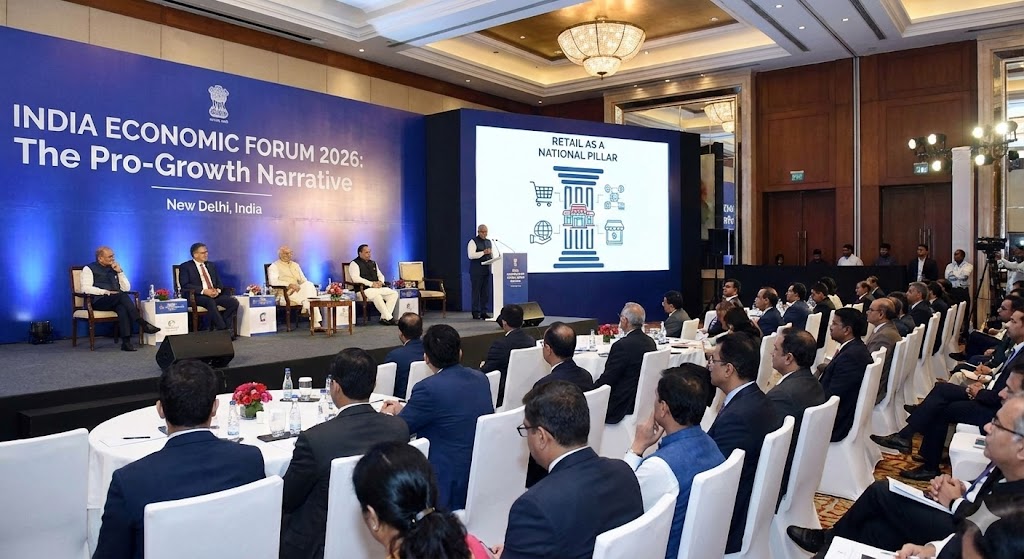
Retail is often seen as a private business story, but in India it plays a national role. DMart is not just selling groceries; it is influencing how inflation behaves at the ground level. Its Everyday Low Price (EDLP) model keeps essential items affordable, especially for lower- and middle-income households.
When large retailers squeeze inefficiencies out of procurement and logistics, the benefit flows directly to consumers. This creates what economists call deflationary pressure on staples, helping governments manage inflation without heavy intervention. In simple words, DMart makes daily life cheaper by being efficient.
Over the last three decades, I have seen Indian retail evolve slowly, then suddenly. Today, we are in what can be called the golden age of Indian retail. Government initiatives like Digital India, DBT transfers, and rooftop solar schemes have increased household disposable income. When electricity bills fall and subsidies reach bank accounts directly, families spend more confidently. Retailers like DMart capture this confidence.
This is why retail is now a pillar of the “Ease of Living” framework. It links growth, jobs, inflation control, and tax compliance into one visible ecosystem.
2. Real-Time Q3 FY26 Financial Snapshot (Declared Jan 10, 2026)
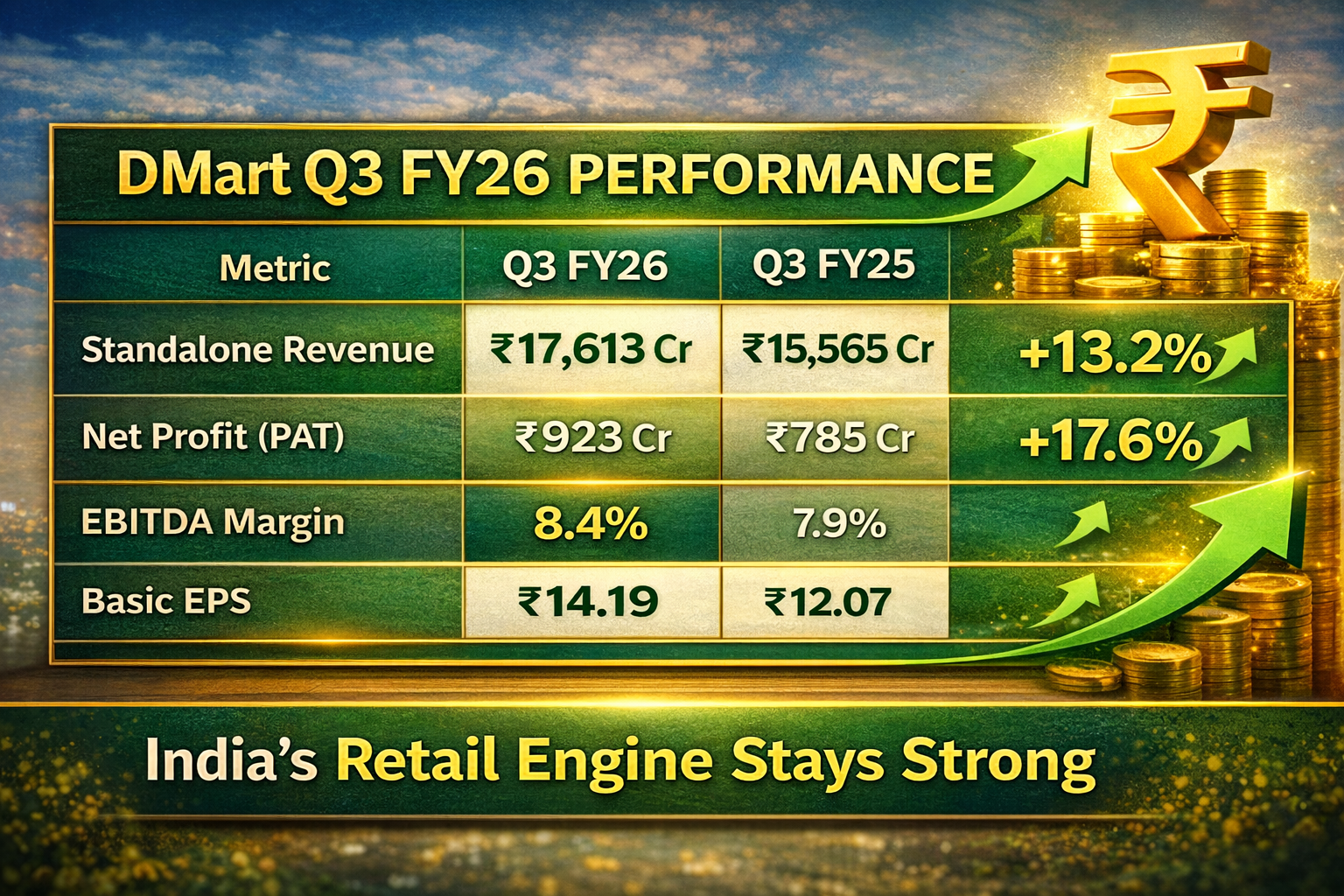
The Q3 FY26 numbers of DMart reflect this broader story with clarity. Standalone revenue for the quarter came in at ₹17,613 crore, a 13.2% year-on-year increase from ₹15,565 crore in Q3 FY25. In a consumption environment where urban demand has been uneven, this growth is meaningful.
Standalone net profit (PAT) rose to ₹923 crore, registering a 17.6% YoY increase. What is important here is not just profit growth, but the fact that profit grew faster than revenue. This indicates operating leverage—DMart is earning more from each rupee of sales.
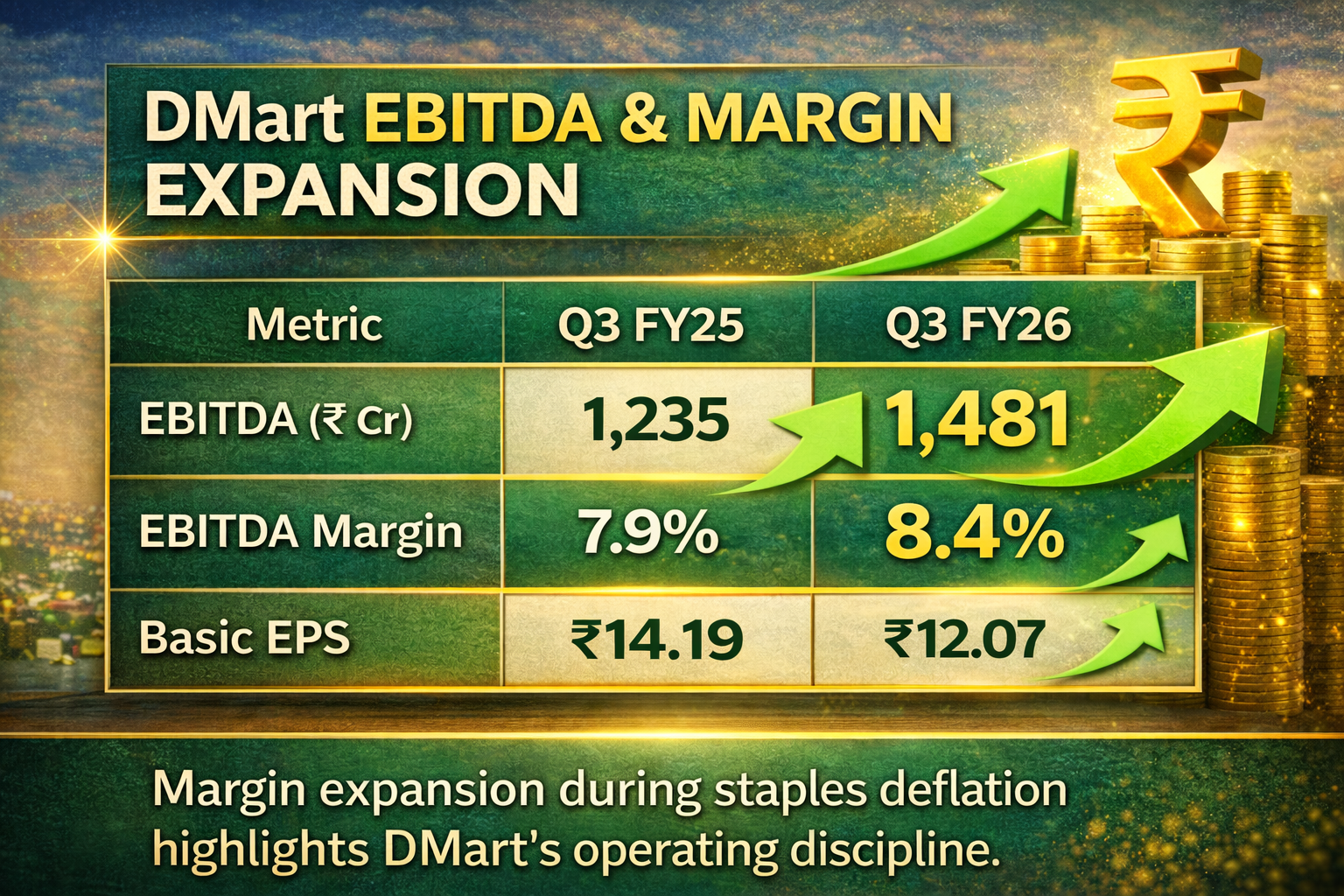
Consolidated revenue stood at ₹18,101 crore, reflecting contributions from subsidiaries and backend operations. EBITDA for the quarter rose sharply to ₹1,481 crore, compared to ₹1,235 crore last year, a growth of nearly 20%.
The EBITDA margin improved to 8.4%, up from 7.9% in Q3 FY25. This margin expansion surprised markets because it came during a period of staples price softness. It shows that cost discipline, not price hikes, drove profitability.
Basic EPS increased to ₹14.19, reinforcing DMart’s reputation as a steady earnings compounder.
Q3 FY26 Financial Results (Stock Exchange Filing)
3. Fundamental Analysis: The “Neville to Anshul” Transition
One of the most under-appreciated aspects of DMart’s Q3 FY26 performance is leadership stability. After a historic 20-year tenure, Neville Noronha is stepping down, with Anshul Asawa set to take charge as CEO from February 1, 2026.
In Indian corporate history, leadership transitions often create uncertainty. In DMart’s case, the transition has been planned, gradual, and calm. This reflects what many investors call the “Damani style” of management—quiet, conservative, and long-term oriented.
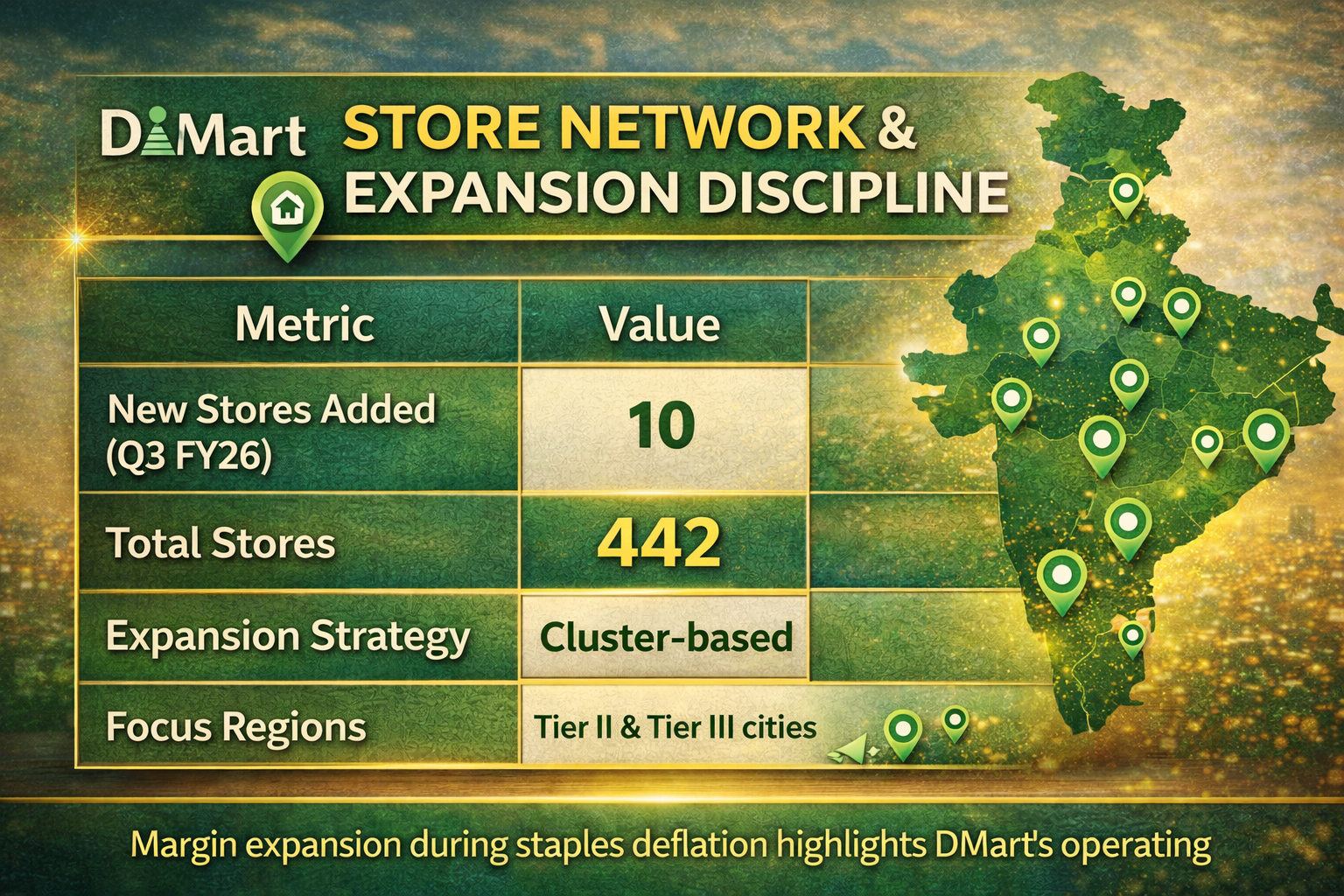
Operationally, the company added 10 new stores during the quarter, taking the total store count to 442. This expansion was not aggressive, but targeted. DMart continues to follow a cluster-based strategy, where stores are added close to existing logistics hubs. This keeps transportation and inventory costs among the lowest in the global retail industry.
Even as food prices softened in some categories, inventory efficiency remained high. DMart’s ability to rotate stock quickly and negotiate directly with suppliers ensures margins remain protected even in a deflationary environment.
4. The Government Angle: “Viksit Bharat” and Organized Retail
From a policy perspective, DMart’s growth mirrors the success of structural reforms. GST implementation, digital payments, and tighter scrutiny of the informal economy have shifted demand towards organised players. DMart’s 13%+ growth is not accidental—it is the outcome of a more transparent system.
Under the vision of Bharatiya Janata Party’s “Viksit Bharat”, formal enterprises are rewarded for compliance. Organised retailers collect and remit GST efficiently, strengthening state and central finances.
DMart’s expansion into Tier II and Tier III cities such as Hassan, Halol, and Chirala aligns well with the government’s rUrban mission, which aims to bring urban-level facilities to semi-rural regions. These stores reduce dependence on informal supply chains and bring consistent pricing to smaller towns.
Employment generation is another key aspect. With 442 stores, DMart is one of India’s largest private-sector employers in retail. It supports local hiring, women employment, and skill development—complementing initiatives like “Lakhpati Didi” indirectly by strengthening local economies.
GST & Formalisation of Retail (Government Source)
5. Geoeconomic Logic: Defying the Global Slowdown
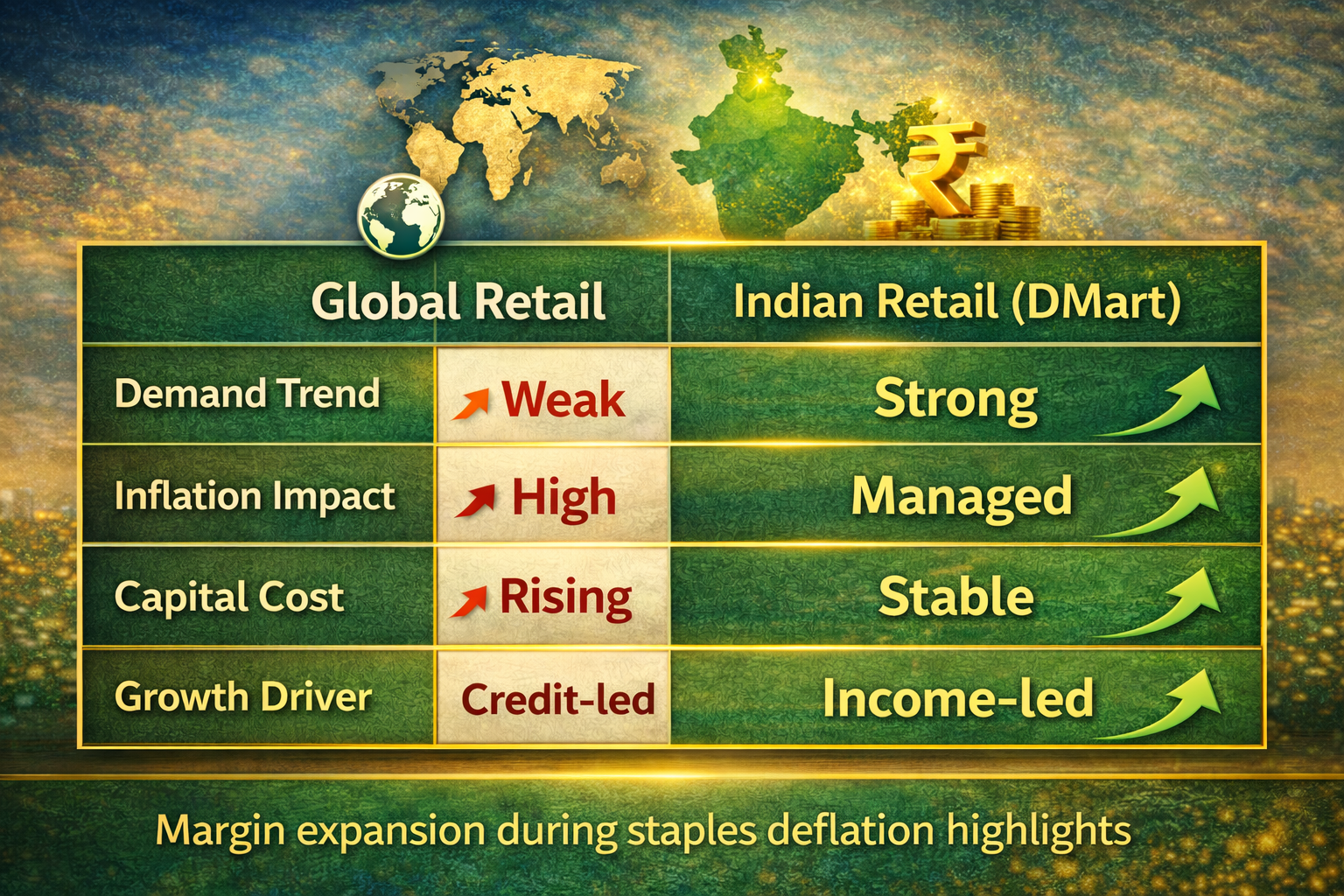
Globally, retail is under pressure. High interest rates in the West, slowing consumption, and rising operating costs have hurt major retailers in the US and Europe. India, however, remains an exception.
With GDP growth expected around 7.4%, domestic consumption acts as an insulated fortress. DMart benefits from this insulation because it focuses almost entirely on domestic demand, not exports or luxury spending.
Foreign Institutional Investor (FII) confidence reflects this reality. Despite global volatility, FII holding in DMart has remained stable at around 8.7%. This stability shows that global investors view Indian consumption as a long-term story, not a cyclical bet.
Unlike quick-commerce models that rely on continuous capital infusion, DMart’s model generates cash internally. This makes it resilient in a world where capital is becoming expensive and selective.
6. Conclusion: The “Long India” Trade
The Q3 FY26 results confirm what long-term observers already know: DMart is a compounding machine. It does not chase trends. It builds habits. Even as competition from 10-minute delivery apps intensifies, the value-conscious Indian consumer continues to trust the DMart cart.
The company’s discipline in pricing, expansion, and leadership transition sets it apart in a noisy retail environment. It shows that scale, efficiency, and patience can still win.
As the Union Budget 2026 approaches, any relief aimed at the middle class—whether through income tax tweaks or consumption incentives—will directly benefit organised retailers like DMart. In that sense, DMart is not just riding India’s growth; it is quietly shaping it.
For those who believe in the “Long India” trade, DMart’s Q3 FY26 performance is not just a quarterly update. It is a reminder that real wealth is built slowly, predictably, and with discipline.
Recommended Data Table (For Blog Use)
| Standalone Metric | Q3 FY26 (Actual) | Q3 FY25 (Actual) | Growth |
|---|---|---|---|
| Total Revenue | ₹17,613 Cr | ₹15,565 Cr | 13.2% |
| EBITDA | ₹1,481 Cr | ₹1,235 Cr | 19.9% |
| Net Profit (PAT) | ₹923 Cr | ₹785 Cr | 17.6% |
| Store Count | 442 | 400+ | Expansion Focus |
❓ Frequently Asked Questions (FAQs) on DMart Q3 FY26 Results
1. What are DMart Q3 FY26 results in simple terms?
The Q3 FY26 results show that Avenue Supermarts (DMart) continued to grow steadily despite a challenging global retail environment. Revenue increased by 13.2%, net profit rose by 17.6%, and operating margins improved, reflecting strong cost control and stable consumer demand.
2. How much profit did DMart make in Q3 FY26?
DMart reported a standalone net profit (PAT) of ₹923 crore in Q3 FY26. This was an increase from ₹785 crore in Q3 FY25, showing a 17.6% year-on-year growth.
3. Why did DMart’s profit grow faster than revenue?
Profit grew faster than revenue because DMart improved its operational efficiency. Better inventory management, lower logistics costs, and disciplined pricing helped expand EBITDA margins from 7.9% to 8.4%, even during a period of staples price softness.
4. What is DMart’s total revenue in Q3 FY26?
DMart’s standalone revenue for Q3 FY26 stood at ₹17,613 crore, compared to ₹15,565 crore in the same quarter last year. This reflects consistent demand from value-conscious consumers across urban and semi-urban areas.
5. How many DMart stores are there in India now?
As of Q3 FY26, DMart operates 442 stores across India. The company added 10 new stores during the quarter, focusing mainly on Tier II and Tier III cities.
6. What is DMart’s expansion strategy?
DMart follows a cluster-based expansion strategy. This means new stores are opened near existing warehouses and supply hubs. This approach keeps logistics costs low and ensures faster stock replenishment.
7. How is DMart different from quick-commerce platforms?
Unlike quick-commerce apps that focus on ultra-fast delivery and discounts, DMart follows an Everyday Low Price (EDLP) model. It prioritises low costs, bulk buying, and predictable pricing rather than speed. This makes its business model more stable and less capital-intensive.
8. Has DMart’s margin improved in Q3 FY26?
Yes. DMart’s EBITDA margin improved to 8.4% in Q3 FY26 from 7.9% in Q3 FY25. This improvement indicates strong cost discipline and better operating leverage.
9. How does government policy support organised retail like DMart?
Policies such as GST reforms, digital payments, and formalisation of the economy encourage consumers and suppliers to move toward organised retail. This benefits companies like DMart that operate transparently and comply fully with tax systems.
10. Why is DMart considered important for India’s economy?
DMart supports price stability, generates large-scale employment, contributes significantly to GST collections, and strengthens domestic consumption. In this way, organised retail acts as a stabilising force for India’s middle-class-driven economy.
11. How has leadership transition been handled at DMart?
The transition from long-time CEO Neville Noronha to incoming CEO Anshul Asawa has been planned and gradual. This smooth succession reflects DMart’s conservative and long-term management philosophy.
12. What should readers watch for in the coming quarters?
Key factors to watch include:
Store expansion pace
Margin stability amid competition
Impact of Union Budget 2026 on middle-class consumption
Trends in food inflation and discretionary spending
These will shape DMart’s performance in FY26 and beyond.
🔍 People Also Ask: DMart Q3 FY26 Results & Indian Retail
What is DMart and who owns it?
Avenue Supermarts, commonly known as DMart, is one of India’s largest organised retail chains. It was founded by investor Radhakishan Damani and focuses on selling daily-use products at affordable prices through a cost-efficient business model.
Why are DMart Q3 FY26 results important?
DMart’s Q3 FY26 results are important because they show profit growth, margin expansion, and steady store addition at the same time. This combination suggests long-term business strength rather than short-term demand spikes.
How much did DMart’s revenue grow in Q3 FY26?
DMart’s standalone revenue grew by 13.2% year-on-year, reaching ₹17,613 crore in Q3 FY26. This growth reflects stable demand from middle-class consumers across cities.
Did DMart’s profit increase in Q3 FY26?
Yes. DMart’s net profit increased to ₹923 crore in Q3 FY26, compared to ₹785 crore in Q3 FY25. This represents a 17.6% year-on-year rise, showing improved operating efficiency.
Why is DMart able to maintain margins despite competition?
DMart controls costs through bulk procurement, limited advertising, owned store properties, and a cluster-based logistics network. These factors help protect margins even when competition increases.
Is organised retail growing in India?
Yes. Organised retail in India is growing steadily due to GST implementation, digital payments, and formalisation of the economy. Consumers are increasingly shifting from unorganised kirana stores to large retail chains.
How does DMart differ from quick-commerce companies?
Quick-commerce platforms focus on fast delivery and convenience, often at higher costs. DMart focuses on low prices and predictable value, making it more resilient during economic slowdowns.
What role does DMart play in controlling inflation?
By offering everyday essentials at consistently low prices, DMart creates price discipline in local markets. This helps reduce sudden price spikes, especially for food and household products.
Why are Tier II and Tier III cities important for DMart?
Tier II and Tier III cities are witnessing rising incomes and urbanisation. DMart’s expansion into these regions allows it to capture new demand while keeping rental and operating costs lower than metro cities.
Has DMart’s leadership change affected performance?
No immediate impact has been observed. The leadership transition has been planned well in advance, ensuring continuity in strategy and execution.
Is Indian retail insulated from global slowdown?
Compared to Western markets, Indian retail is more dependent on domestic income growth rather than credit. This makes it relatively insulated from global economic shocks.
Why do foreign investors track DMart closely?
Foreign investors view DMart as a proxy for India’s consumption story. Stable earnings, strong governance, and predictable growth make it a long-term indicator of middle-class spending trends.
What factors will influence DMart’s future growth?
Future growth will depend on store expansion pace, margin stability, consumer demand, inflation trends, and government policies that affect household spending power.