1. Executive Summary: Headline Noise vs Operational Reality
When Divi’s Laboratories announced its Q3 FY26 results on February 11, 2026, the headline looked underwhelming. Net profit came in at ₹583 crore, almost flat compared to last year’s ₹589 crore. On paper, that is a 1% decline. For many short-term traders, that might look disappointing.
But serious investors look deeper.
Total income rose 12% to ₹2,692 crore. Operational EBITDA surged 20% to ₹898 crore. Margins expanded sharply. The reason profit looked flat was a ₹74 crore one-time exceptional charge related to India’s new Labor Code implementation. If we adjust for that, profit would have grown by more than 11%.
And the market understood this clearly. The stock gained around 2.5% on results day. That tells you something important: investors are buying operational strength, not reacting to accounting noise.
This quarter is a classic example of how statutory adjustments can distort perception while the real business improves significantly underneath.
Divi’s Laboratories Limited
2. Financial Dashboard: Clearing the Noise with Numbers
Let’s break down the key data clearly.
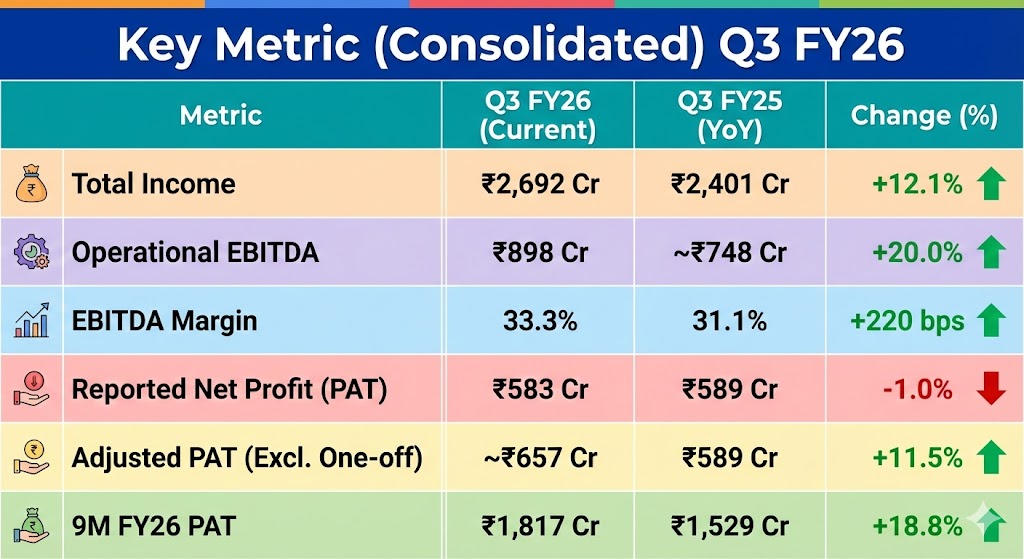
Total income increased from ₹2,401 crore to ₹2,692 crore, up 12.1% year-on-year. Operational EBITDA rose from roughly ₹748 crore to ₹898 crore, a strong 20% jump. EBITDA margin expanded from 31.1% to 33.3%, a 220 basis point improvement.
Reported net profit came in at ₹583 crore, slightly below last year’s ₹589 crore. However, adjusted profit (excluding the ₹74 crore one-off) would have been approximately ₹657 crore, which implies 11–12% growth.
Even more important is the nine-month trend. For the first nine months of FY26, profit stands at ₹1,817 crore compared to ₹1,529 crore last year. That is an 18.8% increase.
The quarterly dip is not the trend. The nine-month performance is the real story.
When you see strong EBITDA growth, margin expansion, and healthy nine-month profit growth, you know the business is structurally improving.
Divi’s Labs share price on NSE
3. Fundamental Breakdown: Inside the Engine Room
A. Custom Synthesis (CDMO): The Sticky Revenue Machine
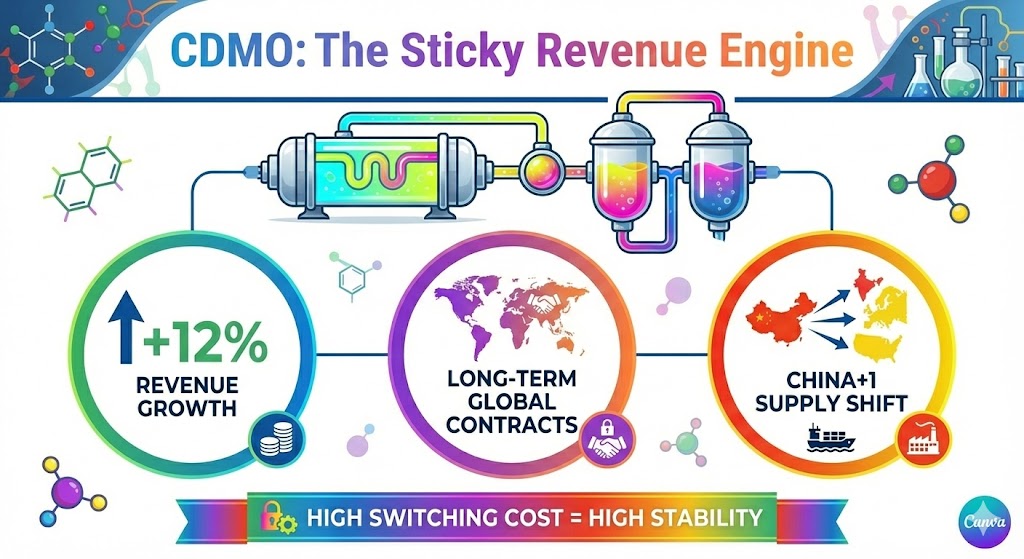
Divi’s is no longer just an API manufacturer. It has become a global CDMO powerhouse. CDMO stands for Contract Development and Manufacturing Organization. In simple words, large global pharmaceutical companies outsource their complex drug manufacturing to Divi’s.
This is not transactional revenue. It is sticky revenue.
Once a global pharma innovator chooses Divi’s as a partner for a molecule, switching is difficult. Regulatory approvals, plant audits, and process validation take years. That creates high entry barriers.
Revenue growth of 12% in a challenging global pharma environment shows resilience. Many global drug companies are restructuring supply chains to reduce dependency on China. The “China+1” strategy is real. India is benefiting. Divi’s, with decades of USFDA-compliant manufacturing experience, is one of the biggest beneficiaries.
The fact that revenue continues to grow steadily indicates long-term contracts are intact and expanding.
India pharmaceutical export statistics
B. Margin Expansion: The Elite Performance
Expanding EBITDA margins to 33.3% in today’s environment is not normal. It is elite.
Most chemical and pharma companies struggle with utility costs, energy inflation, and raw material volatility. Divi’s margins improved despite these challenges.
Why?
Backward integration.
Divi’s manufactures many of its own starting materials. That reduces dependence on volatile imports. It protects gross margins. It also gives control over quality and supply.
Another key factor is operational efficiency at its Kakinada facility. The plant is designed for scale and efficiency. As utilization improves, fixed costs get absorbed better, improving margins.
Margin expansion is often a better indicator than revenue growth. It shows pricing power and cost discipline. Divi’s delivered both.
C. The Export Surge: A Leading Indicator
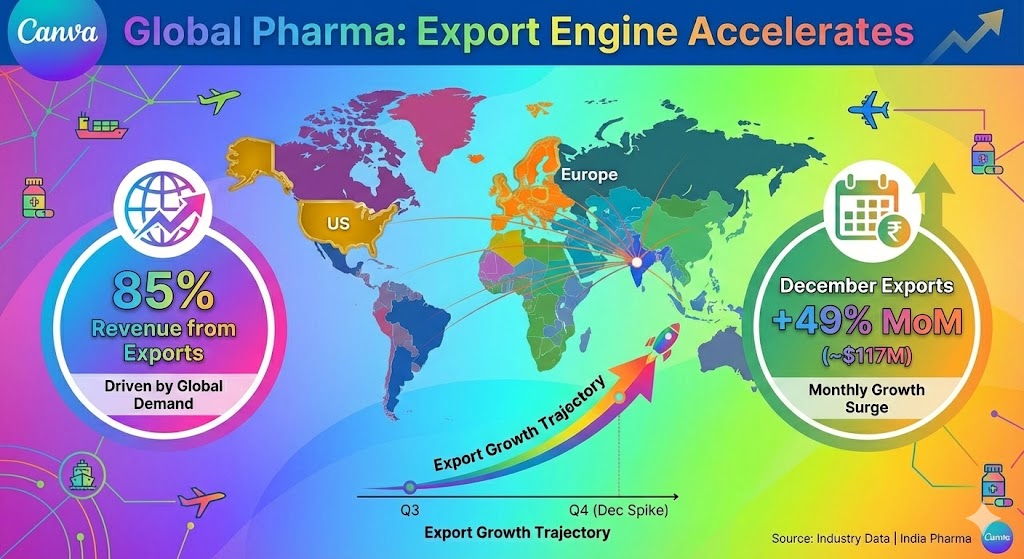
One of the most interesting signals in the results is export momentum. December export shipments reportedly surged 49% month-on-month, touching around $117 million.
That is not random.
Global pharma inventory cycles move in waves. After a period of destocking in the US and Europe, restocking begins. This typically leads to strong export quarters for Indian CDMO companies.
The December spike suggests Q4 FY26 could be very strong. When export shipments accelerate sharply, it usually signals future revenue visibility.
More than 85% of Divi’s revenue comes from exports. So global demand trends matter significantly.
Right now, that engine is running fast.
Indian pharmaceutical industry growth report
4. Geopolitics & Policy: Trade Deal and Structural Shifts
Global pharma supply chains are being reshaped.
The India-US trade dynamics in early 2026 have further strengthened bilateral pharmaceutical cooperation. US pharmaceutical companies are accelerating diversification away from China.
Divi’s has a clean compliance history with the USFDA and European regulators. That reputation matters enormously. In pharma manufacturing, trust equals contracts.
Another important development is India’s new Labor Code implementation. The ₹74 crore exceptional charge this quarter is due to revaluation of gratuity and leave encashment liabilities.
Let’s be clear: this is not operational weakness. It is a statutory compliance adjustment. It does not recur every quarter. It is a sovereign accounting adjustment mandated by law.
Long-term investors understand this difference. That is why the stock reacted positively despite flat reported profit.
USFDA drug manufacturing compliance standards
5. Risk Factors: Premium Valuation Comes with Pressure
There is one major reality investors must accept.
Divi’s is expensive.
The stock trades at around 67 times earnings. That is one of the highest valuations in Indian pharma.
At this valuation, expectations are very high. There is no room for execution mistakes.
If Kakinada plant ramp-up faces delays, or if US regulatory inspections raise observations, the stock could correct sharply. High valuation magnifies both good and bad news.
Another risk is currency movement. Since most revenue comes from exports, rupee appreciation can reduce reported earnings. If capital inflows strengthen the rupee significantly, margins may face mild pressure.
However, historically Divi’s has managed forex cycles well through hedging strategies.
6. The Bigger Picture: 9-Month Trend Matters More Than One Quarter
It is easy to overreact to a single quarter. But serious investing requires trend analysis.
Nine-month profit growth stands at nearly 19%. Operational margins are expanding. Export momentum is strong. CDMO contracts remain sticky.
These are structural strengths.
Even during global pharma slowdowns, Divi’s has maintained balance sheet strength. It carries minimal debt. Cash reserves provide flexibility for capex expansion.
That is why many institutional investors consider Divi’s a core pharma holding.
7. Conclusion: Buy the Business, Ignore the Accounting Blip
The Q3 FY26 result is a textbook example of “optics vs reality.”
Headline profit looked flat. But operational EBITDA surged 20%. Margins improved. Adjusted profit grew in double digits. Nine-month trend remains strong.
The ₹74 crore Labor Code adjustment is a one-time compliance cost. It does not change the underlying growth trajectory.
Divi’s remains one of the highest-quality pharmaceutical companies in India. Its strong compliance record, global partnerships, backward integration, and operational discipline make it structurally competitive.
Yes, valuation is premium. That means volatility can happen. But premium businesses rarely come cheap.
For long-term investors, the key takeaway is simple:
The business is improving. The export engine is firing. The margin profile is strengthening.
The Q3 dip is an accounting illusion. The operational beat is very real.