1. The Opening Hook: A Tactical Retreat by the CAQM
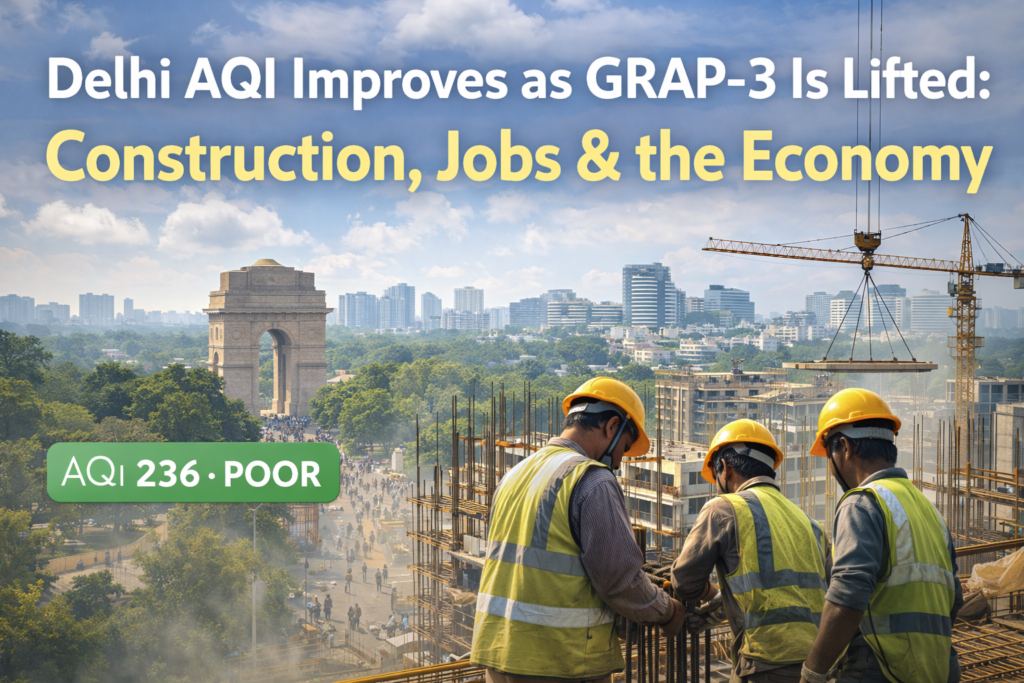
On January 2, 2026, the Commission for Air Quality Management (CAQM) announced the revocation of Stage-III of the Graded Response Action Plan (GRAP-3) across Delhi-NCR. For residents, it felt like relief. For policymakers, it was a pause. For the economy, it was a restart button pressed—carefully.
2️⃣ Central Pollution Control Board (CPCB) – AQI Data
The numbers tell the story. Delhi’s Air Quality Index (AQI) fell sharply from 380 (Very Poor) to 236 (Poor) within 24 hours, a 37% improvement. The key driver wasn’t new policy or structural reform. It was 15 kmph westerly winds that dispersed pollutants and diluted the smog layer.
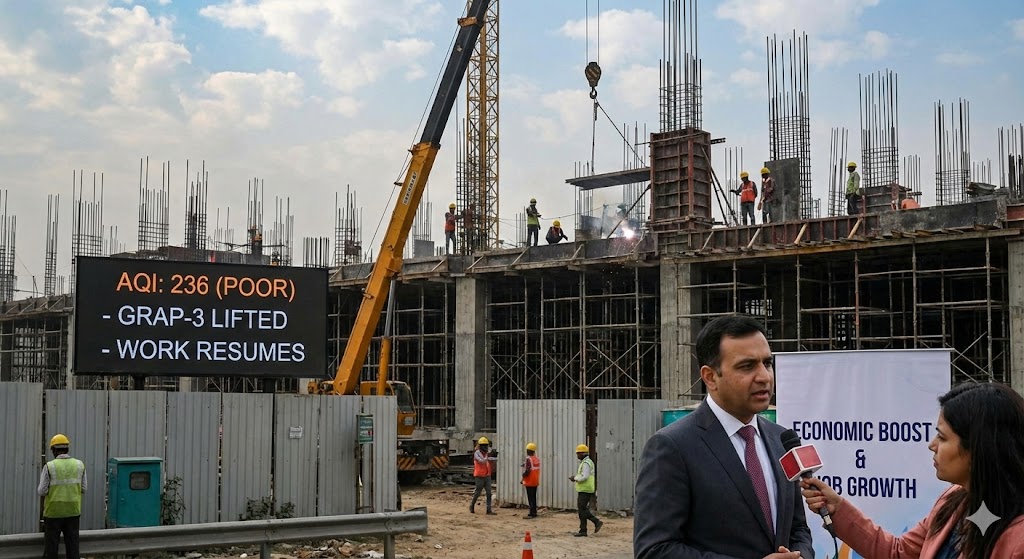
That’s why experts describe this not as a victory, but as a meteorological bailout. The air improved because nature intervened, not because emissions fell permanently. The decision to lift GRAP-3 was therefore tactical, not transformational—aimed at preventing economic damage while the weather window stayed open.
1️⃣ Commission for Air Quality Management (CAQM) – Official Updates
2. The Economic “Restart” Button: Construction & Real Estate
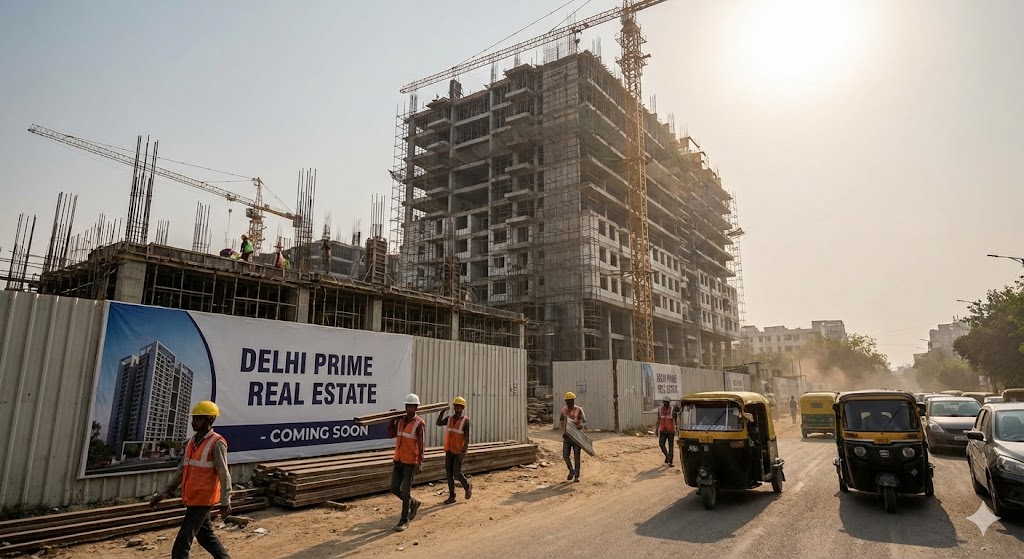
When GRAP-3 is lifted, construction activity is usually the first lever policymakers pull—and for good reason. Construction is a high-multiplier sector. It employs lakhs of workers, supports dozens of MSMEs, and feeds directly into housing supply.
The data is stark. Industry estimates show that every 15 days of a construction ban in NCR leads to:
3 months of project delay
~3% increase in capital costs, mainly due to labour remobilisation, machinery downtime, and material price volatility
Delhi-NCR accounts for nearly 25% of India’s residential property sales. When sites shut, developers can’t complete projects, banks delay disbursements, and homebuyers face uncertainty. The entire completion-to-cash cycle—critical for developer balance sheets—gets stressed.
With GRAP-3 lifted, activities like earthwork, piling, welding, and structural work resumed. These are not just on-site jobs; they revive ancillary MSMEs—cement dealers, steel suppliers, transporters, and equipment renters—creating a ripple effect across the NCR economy.
3. Labor Geopolitics: The Invisible Migrant Crisis
Environmental policy often looks neutral on paper. In practice, it can behave like a regressive tax on the informal workforce.
In Delhi-NCR, an estimated 2–3 lakh daily-wage workers depend on construction and logistics. During GRAP-3 halts, these workers lose roughly ₹8,000 per month—a devastating amount for households already living on thin margins.
The deeper risk is labour attrition. Skilled workers—masons, electricians, scaffolders—are increasingly choosing Mumbai, Hyderabad, or Pune projects over Delhi. Why? Because Delhi’s winter work cycle is uncertain. Repeated stop-start bans make income unpredictable.
Once workers leave, they don’t return easily. This creates a skills shortage when construction restarts, pushing wages up and timelines further out. In other words, air-quality bans today can quietly raise housing costs tomorrow.
4. Logistics & the Supply Chain Thaw
Another immediate impact of lifting GRAP-3 is on transport and logistics.
Under Stage-III, BS-III petrol and BS-IV diesel four-wheelers are restricted, and non-essential diesel-run medium goods vehicles (MGVs) are barred. This hits the last-mile delivery economy hard.
E-commerce and retail data shows that during GRAP-3/4 phases, last-mile delivery costs in NCR rise by 12–15%. These costs eventually reach consumers through higher prices or delayed deliveries.
The revocation also allowed non-electric/CNG inter-state buses from Uttar Pradesh, Haryana, and Rajasthan to re-enter Delhi. This matters because Delhi’s service economy—hospitality, retail, healthcare—depends heavily on daily regional labour mobility. When buses stop, workers can’t commute, and services slow down.
In simple terms, lifting GRAP-3 thaws the supply chain—from warehouses to doorsteps.
5. The Geoeconomic Externalities: Health vs. Growth
Here lies the hardest truth. Economic relief comes with a long-term cost.
According to World Economic Forum (WEF) estimates, air pollution costs India about $95 billion annually, roughly ₹7.9 lakh crore, or ~3% of GDP. This loss comes from reduced productivity, higher healthcare spending, and premature deaths.
Local sentiment mirrors this macro data. Recent surveys in Delhi-NCR indicate that 73% of residents are “very worried” about future healthcare affordability due to prolonged exposure to polluted air—especially for children and the elderly.
This reframes the debate. It is no longer “Environment vs Economy.” The real trade-off is “Current Production vs Future Workforce Health.” A city that breathes poorly today will work poorly tomorrow.
6. Strategic Forecast: The Sunday Warning
The relief may not last.
The India Meteorological Department (IMD) has already issued a Yellow Alert for dense fog. Forecasts suggest wind speeds could weaken around January 4–5, increasing the risk of pollutant accumulation.
If AQI rises again, GRAP-3—or even GRAP-4—could return. This is the fragility problem: Delhi’s winter economy is hostage to daily weather charts.
That’s why experts argue for a shift from reactive bans to incentivized compliance. Instead of blanket shutdowns, policymakers could:
Offer green credits to construction sites using anti-smog guns year-round
Fast-track approvals for projects adopting dust-suppression tech
Differentiate between compliant and non-compliant sites
This approach keeps jobs running while still targeting emissions.
3️⃣ India Meteorological Department (IMD) – Weather & Fog Alerts
7. Conclusion: The “Stop-Start” Economy
Lifting GRAP-3 gave Delhi a ₹8,000-crore economic breath—from wages saved, projects restarted, and supply chains revived. But it also exposed a structural weakness.
As one industry leader put it:
“We cannot run a $5-trillion economy on the whims of a westerly wind.”
Delhi’s winter crisis is no longer seasonal; it is systemic. If policies remain reactive, the city will continue to lurch between shutdown and restart—hurting workers, businesses, and long-term health alike.
Call to Action for Readers:
Should Real Estate Regulatory Authority (RERA)-compliant projects that use certified dust-suppression technology be exempt from blanket bans? Or is a one-size-fits-all approach still justified?
The answer will shape not just Delhi’s air—but its economic future.
❓ Frequently Asked Questions (FAQ)
1. What does it mean when GRAP-3 is lifted in Delhi?
When GRAP-3 is lifted, strict pollution-control restrictions are relaxed. This allows construction work to restart, vehicle curbs to ease, and economic activity to resume. The decision is taken by the Commission for Air Quality Management (CAQM) based on air quality and weather conditions.
2. Why did Delhi’s AQI improve so quickly in January 2026?
Delhi’s AQI improved mainly due to strong westerly winds (around 15 kmph), which helped disperse pollutants. Experts call this a weather-driven or meteorological improvement, not a permanent solution to pollution.
3. Is the improvement in Delhi AQI permanent?
No. The improvement is temporary. If wind speeds fall or fog increases, pollution levels can rise again within days. This is why Delhi often sees stop–start GRAP restrictions during winter.
4. How does lifting GRAP-3 affect construction and real estate?
Lifting GRAP-3 allows construction activities like earthwork, piling, and structural work to resume. This helps:
Prevent project delays
Reduce cost overruns
Protect housing delivery timelines
Delhi-NCR accounts for a large share of India’s housing market, so construction bans have nationwide impact.
5. Who benefits the most when GRAP-3 is lifted?
The biggest beneficiaries are:
Daily wage and migrant workers
Construction companies and MSMEs
Transport and logistics operators
Homebuyers waiting for project completion
For many workers, GRAP-3 halts mean losing ₹7,000–₹8,000 per month.
6. How does GRAP-3 impact migrant workers in Delhi-NCR?
During GRAP-3 bans, 2–3 lakh migrant workers face income loss. Repeated winter shutdowns push many skilled workers to move to other cities, creating long-term labour shortages in Delhi-NCR.
7. What is the link between air pollution and Delhi’s economy?
Air pollution reduces productivity, increases healthcare costs, and affects workforce health. According to global estimates, air pollution costs India about 3% of GDP every year, making it both a health issue and an economic issue.
8. Why does Delhi rely so heavily on GRAP restrictions every winter?
Delhi’s pollution spikes due to a mix of:
Vehicle emissions
Construction dust
Industrial activity
Seasonal weather conditions
GRAP is a reactive emergency tool, not a long-term pollution solution.
9. Can Delhi reduce pollution without stopping construction and transport?
Experts suggest moving toward incentive-based compliance, such as:
Green credits for dust-control technology
Continuous monitoring of construction sites
Differentiating between compliant and non-compliant projects
This approach can protect jobs while controlling pollution.
10. Will GRAP-3 be imposed again soon?
Possibly. The India Meteorological Department (IMD) has warned of fog and weakening winds. If AQI rises again, authorities may reintroduce GRAP-3 or even stricter measures.
🔎 People Also Ask
Why was GRAP-3 lifted in Delhi?
GRAP-3 was lifted because Delhi’s air quality improved from Very Poor to Poor levels due to stronger winds that helped disperse pollution. The decision was taken by the Commission for Air Quality Management after reviewing AQI trends and weather conditions.
What is GRAP-3 and why is it important?
GRAP-3 is Stage III of the Graded Response Action Plan, which includes strict restrictions like construction bans and vehicle curbs. It is important because it directly affects jobs, transport, housing projects, and daily life in Delhi-NCR.
Is Delhi’s AQI really improving or is it temporary?
The improvement is temporary. Experts say the drop in AQI is mainly due to favorable weather, not permanent emission reduction. If wind speeds drop or fog increases, pollution levels can rise again.
How does lifting GRAP-3 affect construction workers?
When GRAP-3 is lifted, construction sites reopen. This helps daily wage and migrant workers resume work and recover income losses that can reach ₹7,000–₹8,000 per month during bans.
Does GRAP-3 lifting reduce property prices in Delhi-NCR?
Not directly. However, restarting construction helps avoid project delays and cost overruns, which prevents further price increases for homebuyers and reduces delivery risks.
How does air pollution impact Delhi’s economy?
Air pollution reduces worker productivity, increases healthcare costs, and lowers overall economic output. Studies estimate that air pollution costs India around 3% of GDP every year, making it a major economic issue.
Why does Delhi impose construction bans during winter?
During winter, low wind speed and temperature inversion trap pollutants close to the ground. Construction dust adds to this pollution, so authorities impose bans to prevent AQI from worsening further.
Can Delhi control pollution without stopping construction and transport?
Yes, experts suggest incentive-based policies, such as rewarding construction sites that use dust-control technology, instead of blanket bans. This can protect jobs while still reducing pollution.
Will GRAP-3 be imposed again soon in Delhi?
It is possible. The India Meteorological Department has warned that wind speeds may weaken. If AQI rises sharply, GRAP-3 or even stricter stages could return.
What should residents watch next regarding Delhi AQI?
Residents should track:
Daily AQI trends
Weather forecasts
IMD fog and wind alerts
CAQM advisories
These factors decide whether restrictions return.
📊 Infographic Table 1: GRAP-3 Lift — What Changed Overnight
| Indicator | Before (GRAP-3) | After Lift | Why It Matters |
|---|---|---|---|
| AQI Level | 380 (Very Poor) | 236 (Poor) | Immediate breathing relief |
| AQI Change | — | ↓ 37% in 24 hrs | Shows weather-driven improvement |
| Wind Speed | Weak | ~15 kmph Westerlies | Pollution dispersion |
| Construction | Fully Banned | Partially Resumed | Economic restart |
| Vehicle Curbs | Strict | Relaxed | Logistics recovery |
🏗️ Infographic Table 2: Construction Ban vs Economic Cost
| Factor | Impact of 15-Day GRAP-3 Ban |
|---|---|
| Project Delay | ~3 months |
| Capital Cost Increase | ~3% |
| Labour Remobilisation Cost | High |
| Equipment Idle Loss | Significant |
| Buyer Delivery Risk | Elevated |
🏘️ Infographic Table 3: Why NCR Real Estate Is Sensitive
| Metric | Latest Reality |
|---|---|
| NCR Share in India Home Sales | ~25% |
| Dependence on Construction Labour | Very High |
| Impact of Stop-Start Policy | Cash-flow stress |
| Buyer Confidence | Weakens during bans |
| Developer Risk | Project deadline slippage |
👷 Infographic Table 4: Migrant Labour Income Shock
| Indicator | Data |
|---|---|
| Daily Wage Workers Affected | 2–3 lakh |
| Monthly Income Loss | ~₹8,000 per worker |
| Most Affected Sectors | Construction, Transport |
| Migration Risk | High |
| Skill Loss for NCR | Long-term |
🧭 Infographic Table 5: Policy Options — Old vs New
| Policy Model | How It Works | Outcome |
|---|---|---|
| Reactive Bans (GRAP) | Blanket shutdowns | Economic shock |
| Incentivised Compliance | Green credits, tech use | Balanced growth |
| Dust-Control Enforcement | Site-level checks | Cleaner air |
| Differentiated Rules | Reward compliant projects | Less disruption |
💰 Infographic Table 6: Health Cost vs Growth Debate
| Metric | Value |
|---|---|
| Annual Economic Loss from Air Pollution | ~$95 billion |
| Rupee Equivalent | ~₹7.9 lakh crore |
| Share of India’s GDP | ~3% |
| Delhi-NCR Residents Worried About Health | ~73% |
| Long-Term Risk | Weaker workforce |