
De-Dollarization: Why the World Is Walking Away from the Dollar

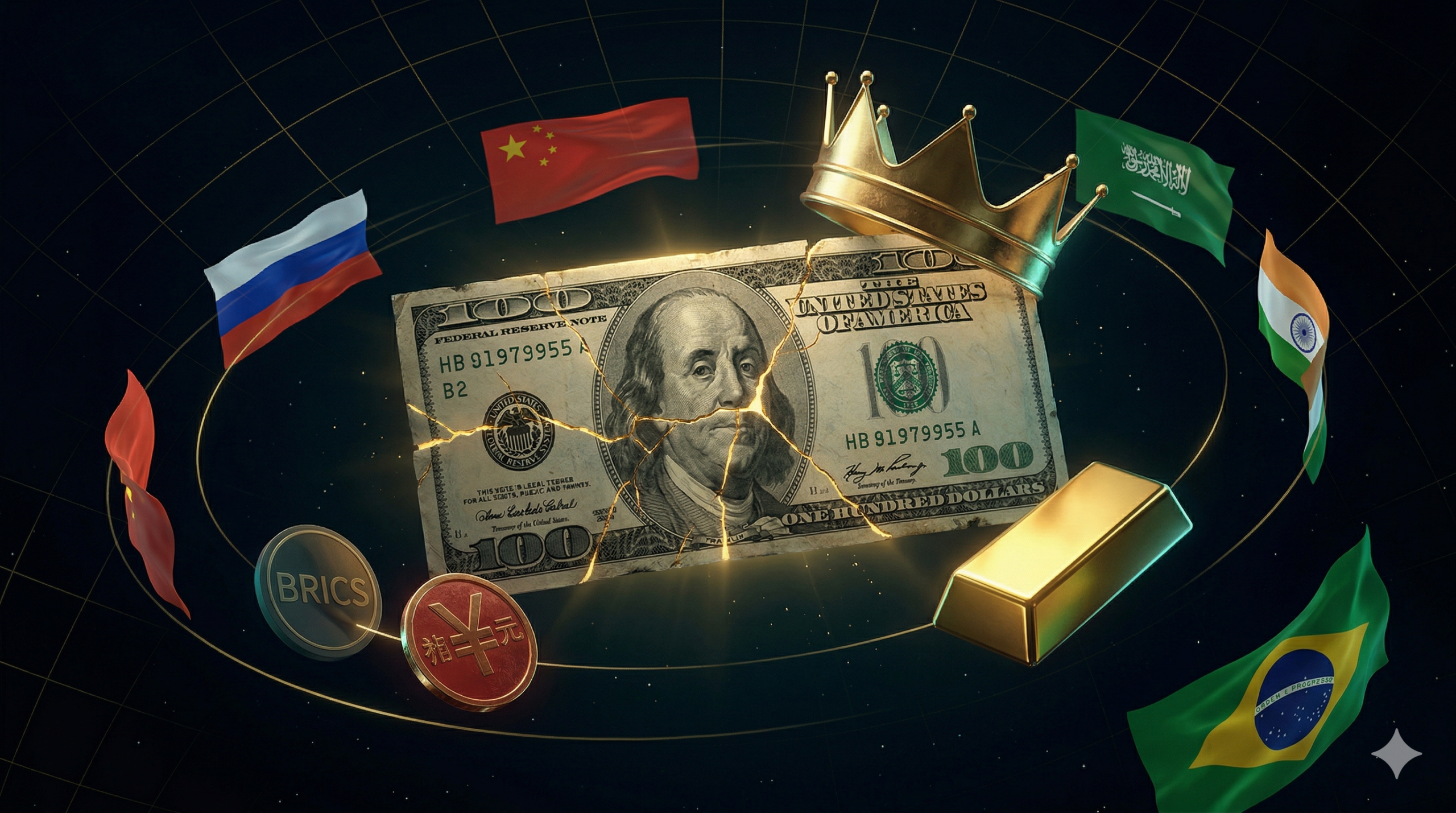
Let us start with a simple question. When a farmer in Brazil sells soybeans to China, why does he get paid in US dollars — a currency that neither Brazil nor China uses domestically? When Saudi Arabia pumps oil out of its own ground and sells it to Japan, why does the transaction happen in dollars — the currency of a country that buys less than 5% of Saudi oil? The answer is a system built over 80 years that has given the United States an almost unimaginable financial privilege. And right now, for the first time in modern history, that system is being systematically dismantled — country by country, trade deal by trade deal, barrel by barrel.
This is de-dollarization. Explained in simple terms, it is the process by which nations are reducing their dependence on the US dollar for trade, savings, and financial transactions — replacing it with their own currencies, gold, or new alternatives. It is not a sudden event. It is not a conspiracy. It is a deliberate, data-backed, geopolitically driven movement that is already reshaping global finance, and what investors must know is that it will reshape their portfolios too — especially by 2026, when several critical milestones converge.
In this analysis, we trace exactly how de-dollarization began, what is driving it today, which countries are leading the charge, what the data actually shows, and — most importantly — what it means for your money, your investments, and the economic order you have always taken for granted.
De-Dollarization Explained in Simple Terms — What It Really Means
To understand de-dollarization, you first need to understand what the dollar’s dominance actually looks like in practice. After World War II, the United States produced roughly half of the entire world’s economic output. The 1944 Bretton Woods agreement made the dollar the anchor of the international monetary system, tied to gold at $35 per ounce. Every other currency was pegged to the dollar. The world needed dollars to trade, to borrow, and to hold as savings.
When Nixon ended the gold convertibility of the dollar in 1971, the system should have collapsed. Instead, it was reinvented. Henry Kissinger negotiated a secret agreement with Saudi Arabia in 1973 and 1974: the Saudis would sell oil exclusively in US dollars, and in return, America would provide military protection and weapons. OPEC followed. The “petrodollar” was born. Every country that needed oil — which was every country — needed dollars. The demand for dollars became permanently embedded in the global economy, giving the US the ability to print money and spend beyond its means in ways no other nation could ever attempt.
De-dollarization is the unwinding of that system. It happens at three levels. First, at the trade level — countries conducting bilateral trade in their own currencies instead of dollars. Second, at the reserve level — central banks reducing their dollar holdings and buying gold, euros, yuan, and other assets instead. Third, at the infrastructure level — nations building alternative payment systems, development banks, and financial networks that do not route through dollar-denominated institutions or the US-controlled SWIFT network.
De-dollarization = the gradual shift of global trade, savings, and financial infrastructure away from reliance on the US dollar toward a more multipolar monetary system. It is not the “dollar collapse” — it is the dollar’s slow, structural demotion from undisputed king to first-among-equals.
What investors must know from the very start is that de-dollarization does not mean the dollar disappears overnight. The dollar has been the world’s dominant reserve currency for over 80 years and has extraordinary structural inertia. What is changing is the degree of dominance — and even a movement from 58% reserve share to 45% reserve share over the next decade represents trillions of dollars in redirected global capital, with profound consequences for US interest rates, import prices, and the government’s ability to finance its debt cheaply. That shift is already underway, and the data-backed analysis below proves it.
Why Is De-Dollarization Accelerating Now? The Three Triggers
De-dollarization is not a new idea. Economists and policymakers have debated the dollar’s outsized role in global finance for decades. What has changed — what has turned theoretical debate into concrete policy action — is the convergence of three powerful triggers that arrived simultaneously, each reinforcing the others.
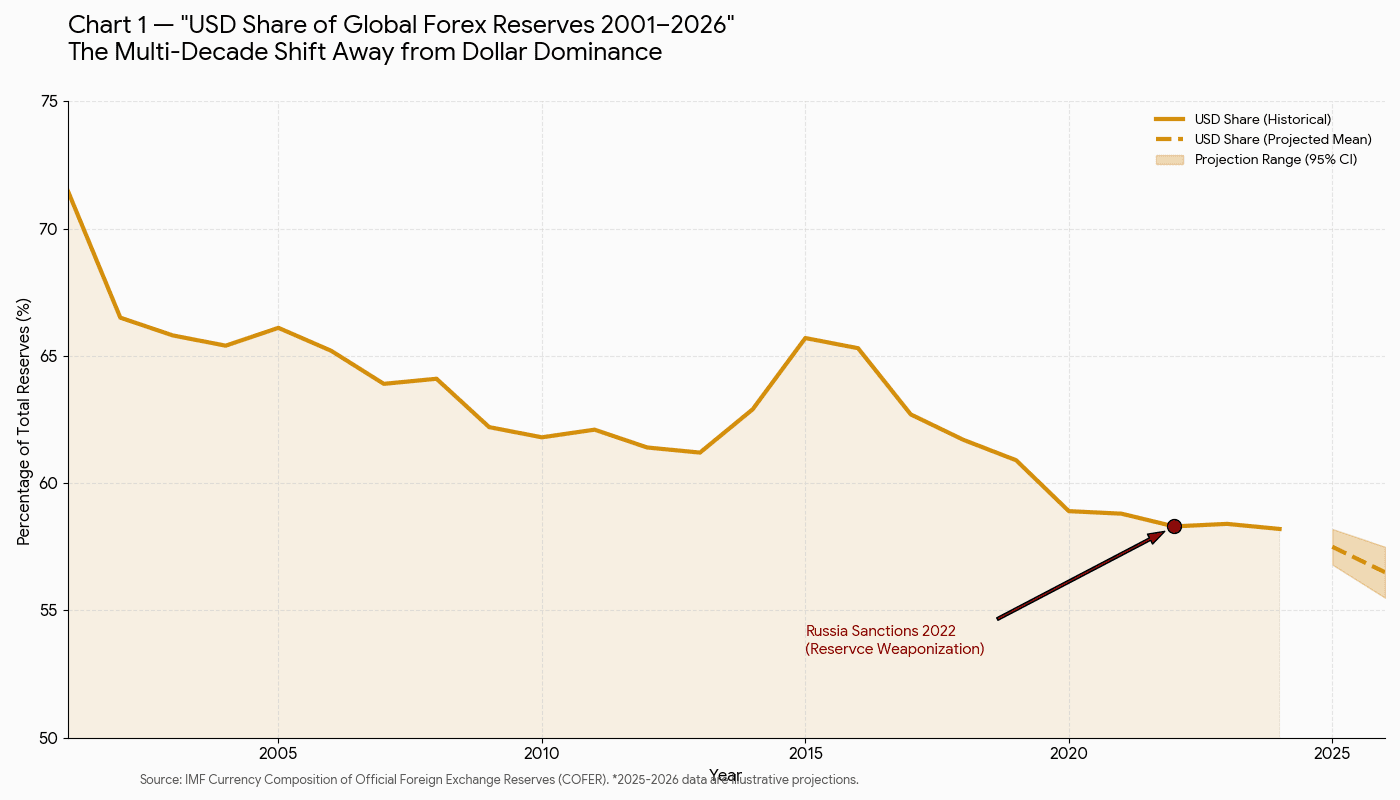
The first and most powerful trigger was the weaponization of the dollar after Russia’s 2022 invasion of Ukraine. When the United States and its allies froze approximately $300 billion in Russian central bank reserves held in Western financial institutions — effectively seizing a sovereign nation’s savings as punishment for its foreign policy — they sent a message heard in every finance ministry and central bank on earth: dollar reserves can be taken away. Overnight, the dollar was reframed not as a neutral global utility but as a political weapon controlled by Washington. Nations that had never considered themselves adversaries of the US — including India, Saudi Arabia, Brazil, and much of the Global South — began asking a dangerous question: if our relationship with Washington ever deteriorates, are our dollar reserves safe? The answer, after February 2022, was obviously no.
The second trigger is the chronic mismanagement of American fiscal policy. The US national debt has exceeded $34 trillion — over 123% of GDP — and is growing by approximately $1 trillion every 100 days. Annual interest payments on that debt have crossed $1 trillion, exceeding the entire defense budget. When foreign governments hold dollars and US Treasury bonds as reserves, they are effectively lending money to Washington. As America’s debt trajectory becomes increasingly unsustainable, the attractiveness of that lending — and the creditworthiness of the borrower — naturally diminishes. The data-backed analysis from the IMF consistently shows that dollar reserve share declines correlate with periods of US fiscal deterioration.
The third trigger is China’s deliberate and well-funded construction of alternative financial infrastructure. Over the past decade, China has built CIPS — the Cross-Border Interbank Payment System — as a yuan-denominated alternative to SWIFT. It has signed currency swap agreements with over 40 nations, allowing bilateral trade to occur without touching the dollar. It has established the Asian Infrastructure Investment Bank and expanded the BRICS New Development Bank as alternatives to the IMF and World Bank. And it has convinced several major oil producers — including Saudi Arabia, the UAE, and Russia — to accept yuan for some energy transactions, cracking the petrodollar architecture that has sustained dollar dominance since 1974.
When a country’s money becomes a weapon, the world starts looking for a different weapon — or no weapon at all. That is the moment de-dollarization stopped being a theory and became a policy.
Which Countries Are Moving Away — The Full Scorecard
This is where the data-backed analysis becomes most revealing. De-dollarization is not a fringe movement of rogue states. It involves some of the world’s largest, most economically significant nations — together representing a majority of the world’s population and a rapidly growing share of global GDP.
| Country | Key De-Dollarization Action | Scale / Progress | Status |
|---|---|---|---|
| 🇨🇳 China | Yuan trade settlements, CIPS, gold accumulation, Belt & Road in yuan | Yuan now in 4.7% of global trade finance | Most Advanced |
| 🇷🇺 Russia | Banned dollar from reserves, trades in yuan/ruble/INR, disconnected from SWIFT | 85%+ of Russia-China trade in non-dollar currencies | Fully Committed |
| 🇸🇦 Saudi Arabia | Accepting yuan for China oil sales, considering non-dollar pricing | First yuan-denominated oil sale completed 2023 | Accelerating |
| 🇮🇳 India | Bilateral trade in rupee with Russia, UAE, & multiple partners | Rupee trade settled with 18+ countries | Active |
| 🇧🇷 Brazil | Yuan settlement with China, BRICS payment framework advocacy | China-Brazil trade fully de-dollarized since 2023 | Active |
| 🇦🇪 UAE | Non-dollar energy trade, gold trading hub, BRICS associate | Dubai becoming major yuan clearing hub | Growing |
| 🇮🇷 Iran | Fully disconnected from SWIFT, trades in gold, yuan, barter | Decades of forced de-dollarization experience | Complete |
| 🇩🇪 Germany / EU | Euro-denominated energy contracts, digital euro development | Slow but growing; euro reserve share rising | Early Stage |
What is most significant in this data-backed analysis is not any single country’s actions — it is the collective weight. When Russia, China, India, Saudi Arabia, Brazil, and the UAE are all simultaneously reducing dollar dependence through different mechanisms, the cumulative effect on global dollar demand is structural rather than episodic. The IMF’s COFER database confirms what these individual actions predict: dollar reserves as a share of global holdings have fallen from approximately 72% in 2001 to around 58% in 2024 — a 14-percentage-point decline representing trillions of dollars of redirected global savings.
Dollar Share of Global Reserves — Historical Decline
The BRICS Currency — What Investors Must Know About the Dollar’s Challenger
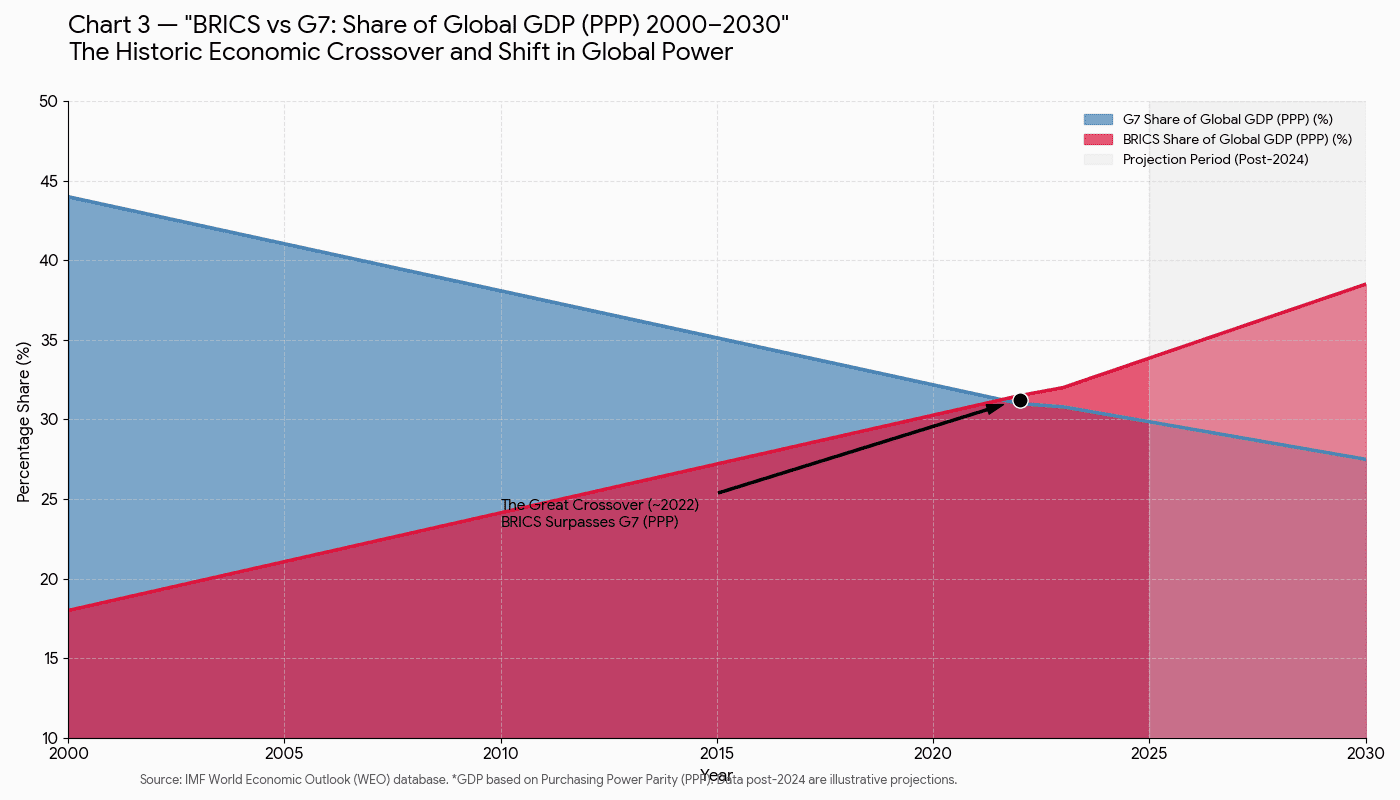
No discussion of de-dollarization is complete without addressing the BRICS currency question — the one topic that generates the most sensationalist headlines and the most investor confusion. So let us address it directly, honestly, and with the clarity that the data-backed analysis demands.
As of 2025, there is no single BRICS currency in circulation. The proposal for a common BRICS currency — sometimes called the “R5” after the initial letters of founding members’ currencies (Real, Ruble, Rupee, Renminbi, Rand) — has been discussed at BRICS summits since at least 2022. The Kazan Declaration of October 2024 committed BRICS members to developing a common payment system and exploring alternative reserve asset mechanisms. But turning political commitment into a functioning common currency requires overcoming enormous practical obstacles: How is exchange rate set? Who manages monetary policy? How are trade imbalances resolved? These questions have taken the eurozone decades to partially answer.
What is more immediately realistic — and what investors must know for 2026 planning — is a BRICS unit of account or settlement token: a reference basket of member currencies and gold used to settle bilateral trade and central bank transactions without touching the dollar. Think of it less like the euro (a common currency replacing national ones) and more like SDRs (the IMF’s Special Drawing Rights) — a common accounting unit that reduces the need for any single national currency as an intermediary.
A full BRICS common currency replacing the dollar is not realistic before 2030. But a BRICS payment and settlement mechanism that allows $5–10 trillion of annual trade to occur without touching the dollar is realistic by 2026–2027. For investors, the meaningful risk is not “the dollar dies” — it is “the dollar earns less interest from global demand,” which pushes US rates higher and pressures dollar-denominated asset returns.
China’s yuan remains the most credible individual challenger to dollar dominance. The yuan’s share of global payments through SWIFT reached an all-time high of 4.7% in 2024, up from under 2% in 2020. The People’s Bank of China has the world’s largest gold reserves program — Chinese central bank gold purchases have been reported for 18 consecutive months. The digital yuan (e-CNY), already deployed domestically to hundreds of millions of users, is being tested in cross-border settlement through projects like mBridge — a multi-central-bank digital currency platform involving China, the UAE, Thailand, and Saudi Arabia. These are not hypothetical developments. They are operational systems being tested at scale right now.
Why Central Banks Are Hoarding Gold — The Silent Proof of De-Dollarization
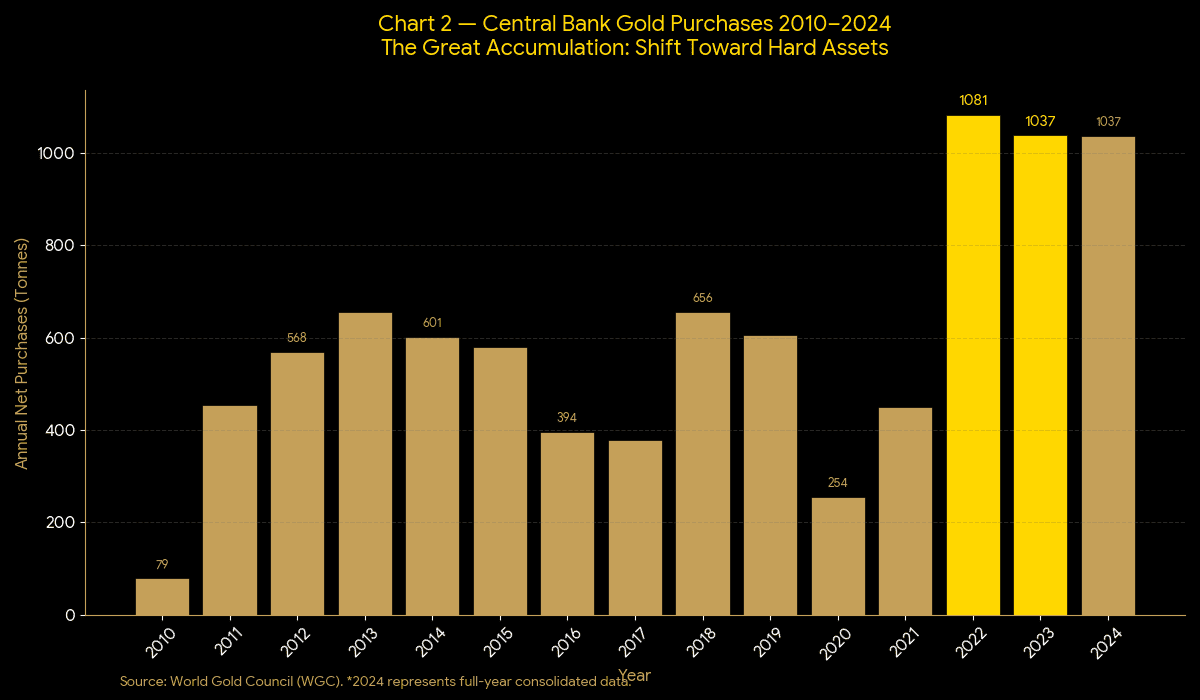
If you want the cleanest, most unambiguous data-backed analysis of de-dollarization in action, do not look at trade invoicing statistics or SWIFT payment data. Look at gold. Central banks do not buy gold for sentimental reasons. They buy it as a reserve asset when they want to reduce reliance on dollar-denominated assets — particularly US Treasury bonds — and hold something that no government can freeze, sanction, or print more of.
In 2022, global central banks purchased 1,136 tonnes of gold — the highest level recorded since data collection began in 1950. In 2023, they purchased 1,037 tonnes. In 2024, the pace continued above 1,000 tonnes annually. The buyers are revealing: China, India, Poland, Turkey, Kazakhstan, Singapore, Qatar, and the UAE are among the most active. These are not fringe economies. They are some of the world’s most strategically significant financial actors, and they are collectively voting with their reserves against dollar dependency.
The deeper significance of this gold accumulation is what it implies about the future of the monetary system. Gold has historically served as the anchor of alternative monetary arrangements — Bretton Woods was built on gold convertibility, and proposals for a BRICS reserve asset consistently involve a gold component. When 40+ central banks simultaneously increase gold holdings at record rates, the data-backed analysis can only support one conclusion: they are positioning for a monetary system in which the dollar plays a smaller role and gold plays a larger one. What investors must know is that this central bank demand is structurally supportive of gold prices for years ahead — regardless of short-term market movements.
De-Dollarization and Your Portfolio — The 2026 Outlook
All of this geopolitical and monetary analysis is only useful if it connects to something actionable. So here, explicitly, is what investors must know about de-dollarization and their portfolios as we approach the 2026 outlook — a year when several critical developments in BRICS payment infrastructure, US fiscal policy, and global trade architecture are expected to converge.
The most direct financial implication of de-dollarization is on US interest rates. When foreign central banks, sovereign wealth funds, and private investors hold fewer dollars and fewer US Treasury bonds, the demand that has kept American borrowing costs artificially low for decades begins to erode. The Federal Reserve may then need to raise rates to attract buyers — or print more money to cover deficits, which creates inflation. Either outcome pressures bond-heavy portfolios, particularly long-duration US Treasury holdings. This is not a 2030 risk. The data shows it is already beginning to materialize.
These are not investment recommendations. They are the key asset classes and themes that de-dollarization makes strategically relevant for informed 2026 portfolio planning.
The second critical implication for the 2026 outlook is commodity price volatility. When oil begins to be priced and settled in multiple currencies rather than exclusively in dollars, the feedback loop between dollar strength and oil prices — which has been one of the most reliable dynamics in global markets for 50 years — begins to break down. Investors and corporations that have built risk models around this relationship will need to fundamentally revise their hedging strategies.
The 2026 Outlook — Four Milestones That Will Define the Next Chapter
De-dollarization is not a headline event. It is a slow-motion tectonic shift that occasionally produces visible ruptures. The 2026 outlook is particularly significant because several independent processes — BRICS payment infrastructure, US fiscal policy, global trade architecture, and central bank reserve diversification — are all approaching critical decision points simultaneously. Here is what the data-backed analysis of current trajectories suggests about the four most important milestones.
What investors must know about the 2026 outlook is this: none of these milestones alone will “end the dollar.” But their cumulative effect — each validating and accelerating the others — is to make the transition to a multipolar monetary system increasingly irreversible. The window for dismissing de-dollarization as theoretical is closing. The institutions, infrastructure, and political coalitions required to sustain a post-dollar trading system are being assembled in real time, and by 2026, they will be far more complete than they are today.
The Dollar Is Not Dying — But Its Crown Is Slipping
Let us close with the same honesty with which we began. De-dollarization does not mean the dollar collapses next year, or in five years, or perhaps ever in the absolute sense. The United States remains the world’s largest nominal economy, the issuer of the deepest and most liquid financial markets on earth, and the anchor of a military and technological power that no rival can match in the near term. The dollar has faced existential challenges before — in the 1970s during the stagflation crisis, in the early 2000s with euro competition — and it has survived them all.
But something is genuinely different this time. The convergence of US sanctions weaponization, unsustainable fiscal dynamics, BRICS organizational capacity, and Chinese financial infrastructure investment has created conditions that no previous challenge to dollar dominance possessed. The movement is broader, more institutionally embedded, and more strategically deliberate than anything that came before. The data-backed analysis of reserve shares, gold purchases, payment system development, and bilateral trade arrangements all point in the same direction.
Explained in simple terms: the dollar is transitioning from undisputed global king to first-among-equals in a multipolar monetary system. That transition will take a decade or more to complete. But it has already begun — and understanding it is no longer optional for investors, policymakers, or anyone whose financial future is shaped by the global economy. The 2026 outlook makes the next twelve to twenty-four months a particularly important window to pay attention, position thoughtfully, and never stop asking the question that every serious observer of global finance must keep asking: what does the world look like when the dollar is just one currency among several — and who profits when that world arrives?
For a deeper dive into the connected forces shaping this monetary shift, read our full analyses on The Iran-Israel-USA War and Its Hidden Goals, U.S. vs China Economy: Who Dominates by 2030?, and The Petrodollar System: How It Works and Why It Is Breaking Down.
