1. The Lead: An Analyst’s Insight into a Misread Quarter
After three decades of closely watching India’s capital goods and industrial engines sector, I can say that Cummins India is one of those companies where the headline numbers often hide the real story. Its Q3 FY26 results, released between February 4 and 5, 2026, are a perfect example of this disconnect.
At first glance, the numbers appear disappointing. Cummins India reported a standalone net profit of ₹453.10 crore, which is 11.8% lower year-on-year. For a company known for consistency, this drop naturally raised eyebrows. But stopping here would be a mistake.
Dig a little deeper and the picture changes completely. The profit decline was largely due to a one-time exceptional expense of around ₹50 crore. If you strip this out and focus on the core business, the company’s operational profit before tax actually grew by 7.3%. That tells us the engine is not weakening—it is becoming more efficient.
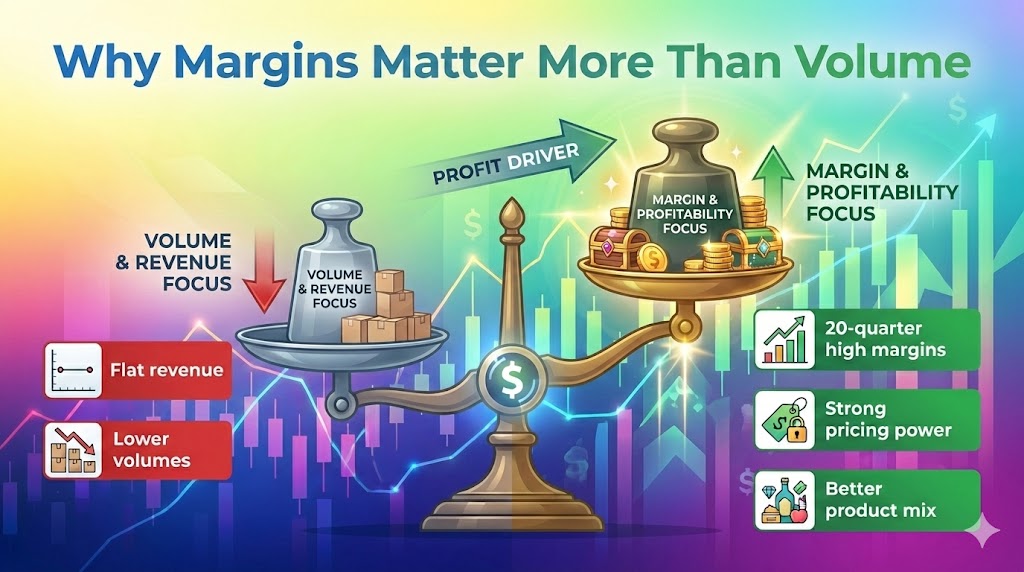
The most striking data point of the quarter is margin performance. Even with revenue almost flat at ₹3,006 crore, Cummins India delivered a 20-quarter high in gross margins of around 38%. In simple terms, the company earned more on every rupee of sales than it has in nearly five years.
This is not a quarter about chasing volume. It is a quarter about quality over quantity. Cummins is consciously moving away from low-margin, commoditised engine sales and doubling down on high-technology, high-margin segments such as CPCB IV+ compliant engines, data centers, and advanced power solutions. That strategic shift explains almost every number in this result.
Cummins India – Official Financial Results (PRIMARY SOURCE)
2. Financial Dashboard: Q3 FY26 vs Q3 FY25
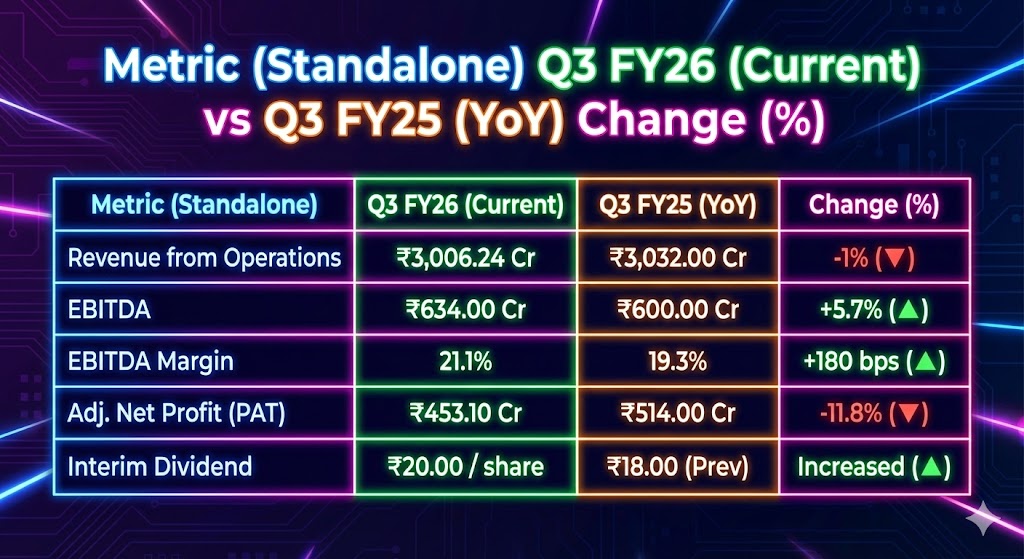
To understand what really changed in Q3 FY26, it helps to lay the key numbers side by side.
Revenue from operations came in at ₹3,006.24 crore, marginally lower than ₹3,032 crore in Q3 FY25. This 1% decline confirms that demand was not the driver of this quarter’s performance.
EBITDA, however, rose to ₹634 crore, compared with ₹600 crore last year—an increase of 5.7%. This is where the real strength shows up.
As a result, EBITDA margin expanded sharply to 21.1%, up from 19.3% a year ago. An expansion of 180 basis points in a flat-revenue quarter is a strong signal of operational discipline and pricing power.
On the profit line, adjusted net profit stood at ₹453.10 crore, down year-on-year due to the exceptional item. Importantly, the board announced an interim dividend of ₹20 per share, higher than the ₹18 paid previously, reinforcing management’s confidence in cash flows.
In short, while revenue stalled and reported profit dipped, efficiency, margins, and shareholder payouts all moved in the right direction.
NSE India – Cummins India Stock & Valuation
3. Fundamental Breakdown: Where the Money Is Really Coming From
A seasoned analyst always asks one question: Which parts of the business are creating value, and which parts are creating noise? Cummins India’s Q3 FY26 performance clearly shows a segmental divergence.
A. The Data Center “Lumpiness” Explained
One of the biggest drags on headline revenue was the Power Generation (Power Gen) segment, where domestic sales fell 16% year-on-year. For many investors, this immediately raised concerns about weakening demand.
Management clarified that this decline was largely due to the absence of large data center project executions during the quarter. Data centers do not generate smooth, predictable revenue every quarter. Orders come in large blocks, tied to project commissioning timelines.
What matters more is the structural trend. Data centers now account for about 25% of Cummins India’s total Power Gen revenue. India’s digital economy—cloud services, AI workloads, fintech, and e-commerce—continues to expand rapidly. Every hyperscale data center needs reliable backup and prime power solutions, and Cummins is one of the most trusted suppliers in this space.
So, Q3 FY26 was not a demand problem. It was a timing problem. The pipeline remains strong, suggesting that revenue could bounce back sharply when large projects move into execution, especially in Q4 FY26 and FY27.
B. The Distribution Business: The Unsung Hero
While Power Gen grabbed attention for the wrong reasons, Cummins India’s Distribution business quietly delivered outstanding performance, growing 26% year-on-year.
This segment includes spares, maintenance, servicing, and overhaul for Cummins engines already operating across India. As the installed base grows over decades, distribution revenue becomes recurring, predictable, and high-margin.
This is what analysts call “sticky revenue.” Once a customer installs a Cummins engine, they tend to rely on authorised service and genuine parts to ensure uptime and compliance. In a slow industrial cycle, new engine sales may fluctuate, but service revenue keeps flowing.
In Q3 FY26, this distribution growth acted as a shock absorber, cushioning the impact of weak Power Gen execution and supporting margin expansion.
C. The Export Outlook: Mixed but Improving
Exports grew 2% year-on-year, but fell 14% sequentially. The sequential decline reflects global inventory corrections and geopolitical tensions, particularly in parts of the Middle East and Gulf region, which affect demand for lower-horsepower engines.
The silver lining is in high-horsepower engines, where exports grew 15% year-on-year. These engines are typically used in specialised industrial, mining, and infrastructure applications and carry better margins.
This trend again reinforces Cummins India’s strategic shift—less focus on commoditised volumes and more emphasis on complex, high-value products.
Ministry of Heavy Industries – Capital Goods Policy
4. Geopolitics and Policy: The India-US Trade Deal Tailwind
One aspect often overlooked in quarterly analysis is geopolitics, but for Cummins India, it matters a lot. The company is a subsidiary of Cummins Inc., USA, and benefits directly from closer India-US economic ties.
The February 2026 India-US Trade Deal has reduced reciprocal tariffs to around 18% and removed several punitive duties. This makes “Make in India” Cummins engines more competitive in North American and allied markets.
Beyond tariffs, the deal strengthens technology collaboration frameworks. Cummins Inc. is investing heavily in hydrogen engines, fuel cells, and low-carbon power solutions. With smoother tech-sharing and supply-chain integration, Cummins India is well positioned to localise and manufacture next-generation power systems.
This is not just about exports. It is about future-proofing the product portfolio as emission norms tighten and customers demand cleaner solutions.
5. Investor Verdict: “Buy the Efficiency, Not the Noise”
From an investor’s perspective, Cummins India presents a classic trade-off.
On one hand, the stock is not cheap. Trading at a price-to-earnings multiple of around 48x, it commands a premium compared to most capital goods peers.
On the other hand, the company delivers exceptional return metrics—a ROCE of about 36% and ROE of roughly 28%—with a debt-free balance sheet and strong cash reserves.
The ₹20 interim dividend, with a record date of February 11, 2026, reinforces Cummins India’s status as a top-tier dividend play within the industrial sector.
Management has also maintained double-digit revenue growth guidance for FY26, implying a strong Q4 (January–March 2026) to compensate for the flat Q3. If large data center and infrastructure projects move into execution, that guidance looks achievable.
For long-term investors, the message is clear: don’t buy Cummins India for short-term volume growth; buy it for efficiency, margins, and technology leadership.
6. Conclusion: A Transition Quarter, Not a Trouble Quarter
Cummins India’s Q3 FY26 results should be read as a transition quarter, not a weak one. Yes, profits dipped on paper. Yes, revenue was flat. But beneath the surface, the business is becoming leaner, more focused, and more profitable per unit of output.
The shift to CPCB IV+ compliant engines, the growing role of data centers, the strength of the distribution business, and the tailwinds from the India-US economic corridor all point in the same direction.
Quarterly “lumpiness,” especially in data center orders, may continue to create noise and short-term volatility. But for a fundamental analyst, the signal is unmistakable: expanding margins, a debt-free balance sheet, strong dividends, and a clear technology roadmap.
In an industrial sector often defined by cycles and commoditisation, Cummins India stands out as a company that is choosing quality over quantity—and getting paid for it.