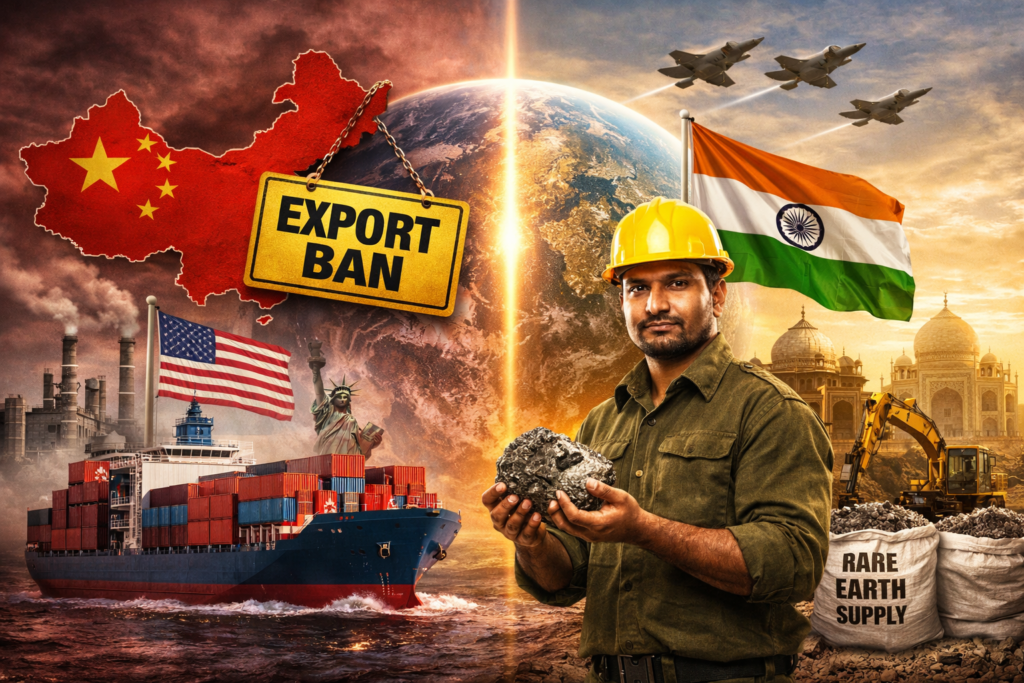
1️⃣ Introduction: Why Rare Earth Metals Are Suddenly Front-Page News
When we talk about rare earth metals (REEs), most people nod politely without really grasping why these obscure minerals — with names like neodymium, terbium, dysprosium or yttrium — suddenly dominate global headlines. Industrial revolutions of the 21st century — from electric vehicles (EVs) to 5G, satellites, defence systems, AI chips and wind turbines — run on rare earths. They are the backbone of modern technology, and their supply shapes economic fortunes and geopolitical strategies.
For decades, China has controlled roughly 70 % of global rare earth mining and well over 90 % of refining and advanced magnet production that downstream industries rely on. GQG Partners This dominance gives Beijing a potent lever: supply disruptions or export restrictions can rattle entire industries across the United States, Europe, Japan and South Korea almost overnight.
In 2025, this lever was pulled harder than ever — China substantially tightened export controls on certain rare earth elements and related technologies, especially those critical for defence and semiconductor manufacturing. The result? Shockwaves through global markets, rising prices, scrambling supply chains, and strategic urgency among nations looking to reduce reliance on Beijing.
India, long on the sidelines of rare earth supply, now finds itself in play. With significant reserves, growing political will, and strategic global interest, India could evolve from a passive resource holder to a key player in the global rare earth supply chain. But the journey is neither simple nor quick.
2️⃣ What Are Rare Earth Metals — And Why They Matter to Everyone
Despite the name, rare earth metals are not rare in geology — but they are rare in economically mineable concentrations, and difficult to extract and process without advanced technology. There are 17 critical metallic elements grouped under the rare earth category.

These elements are indispensable in:
Defense technologies: Jet engines, radar, precision guided munitions, and actuation systems rely on rare earth magnets.
Electric vehicles (EVs): Permanent magnets made with neodymium and dysprosium are essential in efficient motors.
Consumer electronics: Smartphones, laptops, and audio components use rare earth phosphors and magnets.
Renewable energy: Wind turbine generators depend on heavy rare earths.
Semiconductors & AI hardware: Used in precision equipment and manufacturing processes.
China’s deep grip — dominating both upstream mining (~70 % of extraction) and downstream processing (>90 % of value-added production) — has made the world heavily dependent on Beijing’s output and policies.
3️⃣ China’s Strategy: Why Export Cuts Happened Now

Over the last two years, China has consistently tightened export licences and controls on rare earth metals, magnets, and related refining technologies. In October 2025, Beijing added five more rare earth elements and expanded export scrutiny to semiconductor-related usage. These moves are part of a broader shift in China’s geopolitical strategy:
Strategic leverage: By restricting rare earth supply, China gains negotiating power in trade talks and diplomatic leverage.
Tech conflict with the US: As US–China tech tensions escalate, rare earths have become a new flashpoint in the broader trade and technology war.
National security protection: Export curbs are pitched as a way to safeguard China’s own industrial supply chains.
Interestingly, by late December 2025 China also began issuing general export licences meant to streamline some shipments even as control regimes remain tight — a tactical shift that may reflect global supply pressure and diplomatic signalling.
In short, China’s rare earth policy is not static. It swings between tightening leverage and managing global criticism — but the fundamental message is clear: rare earths are now a core geopolitical tool.
4️⃣ US Reaction: Panic, Diversification, and a Policy Overhaul
The United States has reacted with urgency. For years, policymakers recognised the danger of over-dependence on Chinese rare earths, but recent export restrictions have turned concern into action.
Key moves include:
Tariffs and technology partnerships: The US has threatened steep tariffs on imported Chinese rare earth magnets to discourage reliance and foster domestic alternatives.
Defense and critical minerals funding: Conditional loans and investments, such as roughly $620 million towards neodymium magnet production facilities, aim to build domestic capacity.
Strategic trade negotiations: A 2025 trade agreement between Washington and Beijing temporarily eased some rare earth controls in exchange for tariff roll-backs — but the truce is seen as fragile and short-term.
In essence, the US goal is to diversify supply, incentivise domestic production, and build alliances with non-China producers — a reset of vulnerability that has exposed American industries to geopolitical risk.
5️⃣ India’s Big Opportunity: Reserves and Rising Attention

Here’s where India’s story gets interesting.
According to the US Geological Survey, India holds approximately 6.9 million metric tons of rare earth oxide equivalent reserves, making it one of the world’s top five reserve holders. These reserves are found largely in coastal sands — particularly in Odisha, Andhra Pradesh, and Tamil Nadu — as well as in inland mineral deposits.
But there’s a crucial gap: India currently produces only about 2,900 metric tons per year, a tiny fraction (~1 % or less) of global output. This disparity — between reserve size and production capacity — highlights both the opportunity and the challenge.
India’s Atomic Minerals Directorate (AMD) and the Geological Survey of India (GSI) have ramped up exploration initiatives. Meanwhile, the government is designing policies to encourage investment in mining, processing, and downstream manufacturing under missions like the National Critical Mineral Mission.
Western governments — especially the US, Japan, and Europe — now view India as a potential partner in securing alternative supply chains, precisely because India is not politically aligned with China’s strategic bloc.
6️⃣ India + Global Partnerships: Strategic Collaborations in Play

Global supply chain realignment is in full swing, and India is positioning itself at the centre of several strategic partnerships:
Quad alliance opportunities: Discussions are underway between India, the US, Japan and Australia on critical mineral supply frameworks.
India–Japan cooperation: Tokyo has long depended on China for rare earths and is increasingly backing Indian mineral development.
European interest: The EU’s strategic autonomy roadmap includes diversifying rare earth sources — with India as a candidate.
While these partnerships remain nascent, they reflect a tectonic shift in how critical mineral geopolitics are unfolding — from a China-centric supply chain to a more diversified, resilient system involving India.
7️⃣ Impact on Global Tech Industries: From EVs to AI Chips

Rare earth supply isn’t an abstract economic story — it’s a foundation of daily technology. Think about:
Electric vehicles: Most EV motors rely on high-strength magnets containing neodymium and dysprosium. Restrictions in supply can push prices up and delay manufacturing timelines.
Semiconductors & AI hardware: Precision manufacturing and chip fabrication require rare earth-enhanced components. Supply disruptions ripple through entire ecosystems.
Renewable energy infrastructure: Wind turbines and advanced generators use rare earth magnets. Shortages could slow green transitions.
In 2024, China exported roughly **58,000 metric tons of rare earth magnets worth nearly $2.9 billion, with Germany, the US, South Korea and Vietnam among the largest buyers.
These numbers show that any disruption isn’t small — it sends shockwaves through global industrial output, consumer prices, and strategic competition.
To visit official website of Ministry of Mines click here
8️⃣ Challenges India Must Overcome
Despite all the promise, India faces real hurdles:
Processing technology gap: India still lacks advanced separation and refining capability, a domain dominated by China.
Infrastructure & investment needs: Mining and processing require huge capital and technical expertise.
Environmental & regulatory complexity: Mining rare earths often involves radioactive by-products and strict safety norms.
China’s potential retaliation: Beijing can also use subtler economic signals to maintain leverage.
These challenges mean India’s ascendancy won’t be immediate — but the momentum is real.
9️⃣ Stock Market Angle: Investors Watch Rare Earth Plays
From an investment perspective, rare earths are a unique sweet spot where geopolitics and tech markets intersect. High-CPC finance keywords like critical minerals stocks, EV supply chain investors, and defence metals ETFs are trending — especially in India as markets price in strategic shifts.
Watch for companies involved in:
Exploration and mining partnerships
Downstream processing technology
Magnet production
Battery materials supply chains
Countries that develop end-to-end rare earth ecosystems stand to capture far more value than those that only extract raw ores.
🔟 Future Scenario: Could Rare Earths Trigger a New Cold War-Style Competition?
The emerging rare earth landscape closely resembles a new type of geopolitical fault line — not defined just by military might but by materials sovereignty. Just as oil defined 20th-century power struggles, rare earths are shaping 21st-century strategic competition between China, the US, India, Japan, and Europe.
Whether this becomes an “economic cold war” depends on:
How many nations build independent value chains
The speed of technological innovation in mining and processing
Diplomatic alliance structures
Supply chain security policies
India’s role is likely to grow — but the journey will be shaped by global trade negotiations, investment flows, and strategic patience.
1️⃣1️⃣ India’s Dollar-Rupee Advantage: A Financial Twist
In the long term, rare earth exports — or even the perception of supply stability — could strengthen the Indian rupee against the dollar by attracting foreign direct investment and export income. Energy, auto, tech and defence sectors all benefit from less reliance on expensive imports. Over time, this could help India negotiate better trade balances, lower its external account volatility, and assert new economic leverage on the world stage.
🔚 Conclusion: India at a Strategic Crossroads
Rare earths might seem like obscure minerals, but they are the invisible engines driving modern technology, defence systems, and clean energy transitions. As China recalibrates its export policies and the West accelerates diversification strategies, India finds itself uniquely placed to transition from an under-utilised reserve holder into a strategic critical minerals node.
The journey is complex and full of challenges, but the geopolitical and economic payoff could be enormous — for India, for global tech industries, and for nations seeking resilience in an unpredictable world.
Frequently Asked Questions
1️⃣ Why is China restricting rare earth exports?
China is tightening rare earth exports mainly as a geopolitical and economic leverage tool in its rivalry with the United States. Beijing controls over 70% of global rare earth mining and nearly 90% of processing capacity, which gives it huge influence over international supply chains. As US sanctions, semiconductor restrictions, and defence technology bans intensify against China, Beijing is using rare earths to apply pressure back. The export curbs are also aimed at protecting domestic industries, ensuring Chinese companies get priority access for EV motors, batteries, satellites, and AI chip manufacturing. Additionally, China wants to increase pricing power, keep value-added production at home, and discourage Western competitors from developing parallel supply chains.
2️⃣ How big are India’s rare earth reserves?
India holds some of the world’s largest rare earth reserves — estimated at around 6.9 million metric tonnes, placing India among the top five globally. These reserves are mostly found in Odisha, Andhra Pradesh, Tamil Nadu, Jharkhand, and Rajasthan. However, India currently extracts only a tiny fraction of its available reserves — roughly 1% or less of global production annually. The true value lies not just in quantity, but in the variety of heavy and light rare earths available in monazite sands, including neodymium, cerium, and lanthanum. The Indian government is now accelerating surveys and opening private-sector participation to unlock commercial scale mining and refining.
3️⃣ Which industries will suffer globally?
A rare earth shortage would hit almost every modern technology industry. The immediate impact would be felt in the EV sector, because electric motors depend on rare earth permanent magnets. Semiconductor manufacturing, AI hardware, and data centre infrastructure would also struggle because precision tools require rare earth components. The renewable energy sector, especially wind turbine production, would face delays. Defence industries — jet fighter engines, laser systems, radar, missile hardware — need rare earth elements for performance metals. Consumer electronics like smartphones, laptops and TVs also depend on rare earth phosphors and magnets. In short: if China blocks supply, modern tech slows down worldwide.
4️⃣ Can India replace China in rare earth supply?
India can become a significant supplier, but not a full one-to-one replacement in the near term. China’s advantage isn’t only mining — it owns the entire value chain, from refining to magnet manufacturing to end-use technology. India has large reserves and strong geopolitical trust, which positions it well to become a major extraction and export hub. With the right investment in processing, technology collaboration, and environmental infrastructure, India can capture a big slice of the market in the next decade. Partnerships with the US, Japan, Australia and Europe give India a pathway to become a major non-China supply alternative. But reaching China’s scale will take time, capital and tech transfer.
5️⃣ How will defence tech be affected?
Rare earth elements play a critical role in advanced defence systems. Neodymium and samarium magnets are used in fighter jet engines, missile guidance, submarine communication systems, and night vision equipment. If global supply is disrupted, defence manufacturers will face higher component costs, project delays and weapon system shortages. The US, Japan and India are already prioritising defence-grade rare earths through strategic stockpiles and private supplier deals. For India, rare earth independence could support Tejas aircraft upgrades, missile propulsion systems, radar networks, naval propulsion motors, and space projects. In future wars, control over rare earths may be just as decisive as control over oil and silicon chips.
Can rare earth mining make India rich?
Yes, rare earth mining has the potential to significantly boost India’s economic strength. India holds one of the world’s largest untapped rare earth reserves, yet produces less than 1% of global output today. If India successfully builds mining infrastructure, refining plants, and export channels, it could earn billions in revenue from critical minerals used in EVs, smartphones, aircraft, satellites and green energy systems. This can create jobs, reduce import dependence, and attract foreign investment. However, wealth will come only if India moves beyond exporting raw ore and focuses on high-value magnet manufacturing, processing, and technology exports, which is where China dominates today.
Which Indian state has rare earth mines?
Several Indian states have proven and potential rare earth deposits. The richest concentrations are found in Odisha, Andhra Pradesh, Tamil Nadu, Kerala, Jharkhand and Rajasthan. Beach sand minerals along India’s eastern coastline — especially in Odisha and Tamil Nadu — contain monazite deposits rich in neodymium, cerium and lanthanum. Andhra Pradesh is emerging as a key exploration zone with government surveys identifying multi-metallic deposits. India is now expanding geological surveys to map inland zones, including Maharashtra and Chhattisgarh, to boost domestic supply.
How will rare earth boost Indian rupee?
If India becomes a major exporter of rare earth elements and magnet products, it could strengthen the Indian rupee by increasing dollar-denominated export earnings and reducing high-value tech imports. Rare earth revenues would flow into foreign exchange reserves and lower India’s trade deficit. Export growth in EV battery materials, semiconductor components and defence metals could raise India’s global financial credibility. In the long run, a strong rare earth sector combined with new foreign partnerships may help India push back against dollar dependency and elevate the rupee’s stability in global trade.
Will China attack rare earth ships?
A direct military attack on rare earth shipments is unlikely, but geopolitical interference cannot be ruled out. China may use economic pressure, maritime surveillance, diplomatic influence, cyber-tracking and shipping logistics disruption to protect its dominance. Rare earth shipping routes from the Indian Ocean to East Asia and Europe will naturally carry military sensitivity. India’s maritime presence, US-India naval cooperation, and Quad patrols reduce the risk of open confrontation. However, if rare earth minerals become as valuable as oil, sea-lane control and naval competition could intensify, especially near the South China Sea.
Are rare earth metals used in nuclear reactors?
Yes. Rare earth metals play roles in nuclear power technology. Elements like yttrium, cerium and lanthanum are used in reactor control systems, neutron shielding, heat-resistant alloys and high-temperature turbines. Rare earth magnets also support radiation-resistant sensors and fuel handling mechanisms. Although uranium and plutonium are the core nuclear fuels, rare earth components contribute to building reactor stability, efficiency and safety systems. As India expands its civilian nuclear programme, demand for specialised rare earth alloys is expected to grow.
70 Syrian Sites Hit by US Jets: Global Shockwaves & India’s Big Geopolitical Lesson