
How a Digital Dollar Could Give Governments Total Control Over Your Money — And Why the IMF Is Already Warning About It

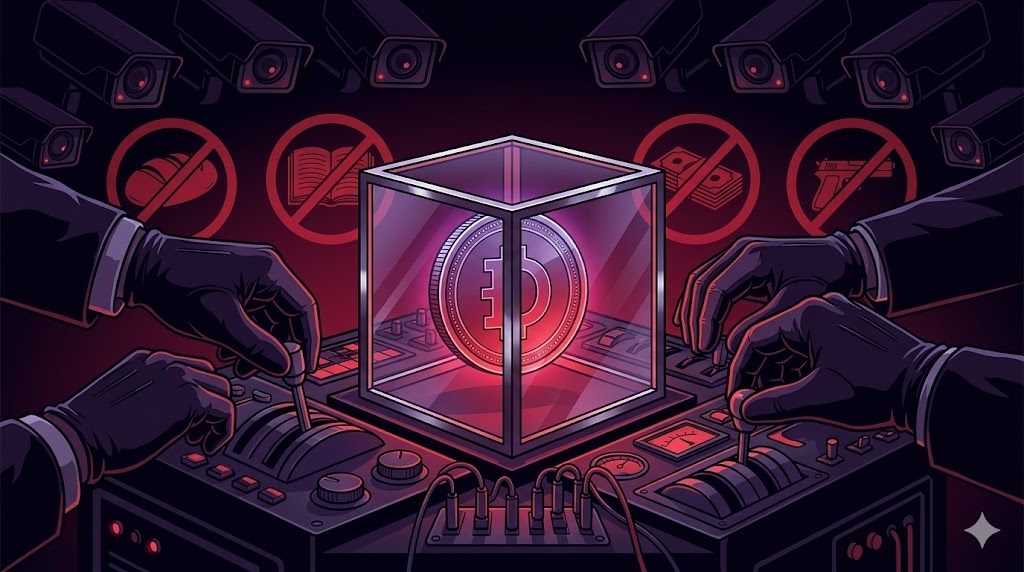
Imagine you wake up one morning and try to buy a perfectly legal item — a firearm, a political book, a donation to a cause you believe in, or simply more food than the government thinks you should have during an “emergency.” And your digital money just… refuses.
No error message. No explanation. Your money is right there in your wallet. But it won’t let you spend it the way you want.
This is not a dystopian fantasy. This is a technically real capability of programmable Central Bank Digital Currencies — digital money that governments worldwide are building right now. And the IMF, the world’s most powerful financial institution, has already put it in writing.
In this article, we go deeper than the headlines. We look at the real documented evidence — from the IMF’s own reports, from what happened in Nigeria, from legislation passed by the US House of Representatives, and from academic research — on exactly how a government-controlled digital currency could become the most powerful financial control mechanism ever invented.
What Makes a Digital Dollar Different From Your Money Today?
Before we talk about control, we need to understand why a CBDC is fundamentally different from the digital money you already use — because most people assume they’re the same thing. They’re not.
Right now, the money in your bank account is technically digital. When you tap your debit card or pay online, digital numbers move between databases. So what’s the big deal about a CBDC?
The difference comes down to three things: who holds it, who can see it, and what rules are built into it.
| Feature | 💳 Your Bank Account Today | 🏛️ CBDC (Digital Dollar) |
|---|---|---|
| Who holds your money? | A private bank (JP Morgan, Wells Fargo, etc.) | The central bank (the government itself) |
| Who can see transactions? | Your bank, tax authorities (with legal process) | The central bank — potentially in real time |
| Can spending be restricted? | Rarely — your bank can decline suspicious transactions | Yes — programmable rules can block specific purchases |
| Can account be frozen? | Yes — requires court order typically | Yes — potentially with a single government keystroke |
| Does money expire? | No — money never expires | Potentially — programmable expiry is technically possible |
| Privacy from government? | Partial — requires legal process to access | Minimal — central bank holds all data directly |
| Works if bank fails? | FDIC insured up to $250,000 | Yes — government-backed directly |
| Is it programmable? | No — money is inert | Yes — by design |
IMF November 2024 CBDC Report
The IMF’s Own Warning: “Instrument for State Surveillance”
This isn’t coming from conspiracy theorists. It’s coming from the world’s most mainstream financial institution — the International Monetary Fund.
In its November 2024 report titled “Central Bank Digital Currency: Progress and Further Considerations,” the IMF made a series of remarkable admissions about CBDC risks that deserve to be read carefully:
CBDC could be perceived as an instrument for state surveillance. Some may worry that the government or the central bank could use it to control or restrict payments users can make with CBDC, thereby undermining public trust in central bank money. This can be a particular concern in countries with severe governance and corruption vulnerabilities.
— IMF, “Central Bank Digital Currency: Progress and Further Considerations,” November 2024
CBDC, as a digital form of central bank money, may allow for a ‘digital trail’ — data — to be accessed, collected, processed and stored. In contrast to cash, CBDC could be designed to potentially include a wealth of personal data encapsulating transaction histories, user demographics, and behavioral patterns.
— IMF, “Central Bank Digital Currency: Progress and Further Considerations,” November 2024
If poorly designed or managed, CBDC personal data use could pose risks to privacy, arising from events such as data leakages, data abuses, and cyber-attacks, thus also negatively affecting CBDC adoption.
— IMF, “Central Bank Digital Currency: Progress and Further Considerations,” November 2024
Let that sink in. The IMF — the institution that advises governments on building CBDCs — is itself warning that these systems could track your “behavioral patterns,” be used for state surveillance, and restrict what payments you can make. This is not alarmist speculation. This is the mainstream consensus of the global financial establishment acknowledging the risks in its own official documents.
Centre for International Governance Innovation
The 7 Control Powers a Programmable Digital Dollar Could Give Governments
Let’s get specific. Here are the seven distinct control capabilities that programmable CBDCs could give governments — each technically possible, each sourced from credible institutions.
Total Transaction Surveillance
Every purchase you make — what you bought, where, when, how much — recorded permanently in a government database. The IMF confirms CBDCs could include “transaction histories, user demographics, and behavioral patterns.” Unlike cash (anonymous) or even bank cards (requires legal process to access), CBDC data sits directly with the central bank.
Programmable Spending Restrictions
Money that can be coded to block specific purchases. Governments or central banks could program digital currency so it cannot buy firearms, alcohol, gambling, political donations, or any category they define. The IMF explicitly states CBDCs “can be designed with programmability” and could be used to “control or restrict payments.” The ECB’s preparation phase is actively discussing how to prevent this — which means it’s a real technical option being considered.
Expiry Dates on Money
CBDC tokens that expire if not spent — eliminating the right to save. The Sustainable Business Network documents that programmable CBDC could include “tokens which would expire if not spent.” Officially presented as a tool to stimulate spending during recessions, expiring money would destroy financial autonomy — you would be forced to spend or lose your savings. No cash system in history has ever had this feature.
Instant Account Freezing
Accounts frozen without court orders. A CBDC held directly by the central bank can be frozen with a technical command — no private bank, no judicial process, no due process. Canada’s 2022 freezing of truckers’ bank accounts (using traditional banking) required bank cooperation and created legal controversy. With a CBDC, the same action could happen in seconds, directly, with no intermediary to push back.
Geographic Spending Limits
Money that only works within approved areas. Programmable CBDCs could be restricted geographically — your digital currency might only work within your city, your country, or approved zones. This could be used for legitimate purposes (welfare payments restricted to local businesses) or as a control mechanism to prevent capital flight or restrict citizens’ economic movement.
Behavioral Scoring Integration
Financial access tied to social compliance. The most extreme risk: linking CBDC access to a social or behavioral scoring system — similar to China’s Social Credit System. If your “score” falls below a threshold due to political activity, social media posts, or other behavior, your CBDC wallet could be restricted. This is not currently implemented in democratic countries — but the technical infrastructure for it would exist the moment a fully programmable CBDC is deployed.
Cross-Border Surveillance & Control
The IMF’s own data privacy research notes that cross-border CBDC transactions could expose users to “foreign government surveillance” — transferring personal financial data to countries with lower privacy standards without the user’s consent. In a world where 137 countries build interconnected CBDCs, your financial behavior could be visible to governments you’ve never interacted with.
Nigeria: The First Real-World Warning Sign
We don’t have to speculate entirely about what CBDC-enabled government control looks like in practice. Nigeria has already given us the world’s first documented real-world example — and it should concern everyone watching.
🇳🇬 Nigeria: What Happened After the eNaira Launch
Nigeria launched its eNaira CBDC in October 2021 — the first African nation to do so. Initial uptake was slow. Citizens weren’t enthusiastic about switching from cash to a government digital currency.
Then, in December 2022, the Central Bank of Nigeria made a dramatic move: it restricted cash withdrawals for individual citizens to just 100,000 naira — approximately $225 USD — per week. For a country where most economic activity involves cash, this was devastating.
The timing was not coincidental. By making cash scarce and difficult to access, the Nigerian government was effectively forcing citizens toward the eNaira. Citizens took to the streets in protest. The cash shortage created genuine economic hardship, and the restriction was widely viewed as coercive CBDC adoption by financial rationing rather than genuine choice.
This is documented by academic researchers at the Centre for International Governance Innovation and confirmed by Reuters reporting. It represents the first case in modern history of a government using CBDC infrastructure as a lever to restrict citizens’ access to private, non-government-monitored money.
America Fights Back: The Anti-CBDC Surveillance State Act
The United States has been one of the most vocal opponents of government-controlled digital currency — and its legislative response tells us a great deal about how seriously the threat is taken by lawmakers.
The US House of Representatives passed the Anti-CBDC Surveillance State Act — legislation that would amend the Federal Reserve Act to explicitly prohibit the Federal Reserve from testing, studying, developing, creating, or implementing a CBDC. As of 2025, the bill has passed the House and is pending Senate passage.
The name of the legislation itself is significant. Lawmakers didn’t call it the “Slow Down Digital Currency Act” or the “CBDC Caution Act.” They named it explicitly after surveillance and the surveillance state — acknowledging directly that the primary risk they were legislating against was government monitoring and control of citizens’ financial lives.
This was reinforced by Trump’s January 2025 executive order, which prohibited a US retail CBDC while explicitly framing the concern in terms of protecting “the financial privacy, individual sovereignty, and free market principles of the American people.”
Florida became the first US state to go further — banning state payments using CBDCs by state law, with Governor DeSantis explicitly citing the risk of federal government surveillance of ordinary citizens’ transactions.
The Academic Consensus: Privacy Must Be Designed In — Not Assumed
The academic literature on CBDCs is remarkably consistent on one crucial point: privacy protections in a CBDC are not automatic. They must be deliberately designed in — and if they are not, or if they are later removed, the surveillance infrastructure already exists.
A 2024 systematic review of CBDC privacy literature published in the academic journal EDP Audit, Control, and Security found that privacy concerns in CBDCs include “extensive data collection in the direct CBDC model, challenges related to central bank data retention in the hybrid CBDC model, and increased operational complexity in the intermediated CBDC approach.” The researchers called for “urgent” additional research into privacy and security protections.
Critically, academic researchers at the Centre for International Governance Innovation note that “even if safeguards are put in place, CBDC infrastructure could be changed and initial safeguards overridden” — meaning privacy protections written into law today could be removed by future governments with the stroke of a pen, while the surveillance infrastructure would remain.
The BIS — the Bank for International Settlements, which coordinates between the world’s central banks — has similarly acknowledged that token-based CBDCs, while more privacy-friendly, “can still be exploited for surveillance purposes.”
Authorities’ access to citizens’ data could lead to state-level surveillance, threatening civil liberties and human rights. Even if safeguards are put in place, CBDC infrastructure could be changed and initial safeguards overridden, rendering this risk ever-present.
— Centre for International Governance Innovation, CBDC Governance Research Paper, 2024
Sustainable Business Network BSR
Three Scenarios: How This Could Actually Play Out
The future of CBDC and government control isn’t binary — it’s not either “everything is fine” or “total dystopia.” The reality will depend enormously on who implements these systems, under what laws, with what oversight, and in what political environment. Here are three realistic scenarios:
Strong Privacy, Strong Oversight, Cash Preserved
A democratic government implements CBDC with robust privacy legislation written into its foundational law — not just policy, but constitutional protections. Independent oversight bodies monitor data access. Physical cash remains available and widely used. The CBDC provides genuine benefits (financial inclusion, faster payments) while courts actively enforce privacy rights. Citizens have meaningful alternatives. This is theoretically possible and is what the ECB publicly claims to be working toward.
Good Start, Then Slow Drift Toward Control
A CBDC launches with sincere privacy protections. Cash is “coexisting” initially. But over 10–20 years, cash infrastructure is gradually reduced (fewer ATMs, fewer businesses accepting it, higher fees). The CBDC becomes effectively mandatory. Privacy protections are slowly weakened through regulatory changes. Each individual change seems minor — but the cumulative effect is a financial system where government has access to all transaction data and the practical ability to restrict spending. This is the scenario most privacy experts worry about most, because it requires no dramatic single “bad” event — just slow institutional drift.
Full Control in Non-Democratic States
In countries without strong rule of law, independent judiciary, or democratic accountability, a CBDC becomes exactly what critics fear. Every transaction monitored. Spending restrictions applied to political opponents, religious minorities, or dissenters. Accounts frozen without due process. Social compliance integrated with financial access. Cash abolished as “inefficient.” Nigeria’s cash restriction is just the first, relatively mild example of this spectrum. China’s e-CNY, operating in a system with no independent central bank and no political opposition, represents the most advanced example of what this looks like at scale.
Canada’s 2022 Bank Account Freezing: A Preview Without CBDC
One of the most instructive recent examples of financial control didn’t even involve a CBDC. In February 2022, the Canadian government invoked emergency powers to freeze the bank accounts of participants in the “Freedom Convoy” truckers’ protest in Ottawa.
Around 200 bank accounts were frozen — without individual court orders — using emergency financial powers. This created enormous controversy, with civil liberties organizations raising serious legal challenges. The freezing was eventually reversed after significant political pressure and legal scrutiny. The episode required coordination with private banks, who pushed back internally. Multiple legal processes were involved. The government faced real accountability.
Now consider: if Canada had a fully operational retail CBDC at the time, with accounts held directly at the Bank of Canada, the same action could have been taken with a single technical command — no bank cooperation required, potentially no court involvement, faster, more complete, and harder to reverse.
The CBDC doesn’t create the impulse to restrict financial freedom. Governments — including democratic ones — sometimes have that impulse regardless. What CBDC does is remove the friction, the intermediaries, and the institutional checks that today make such actions slow, controversial, and legally challengeable.
What Protects You — And What Doesn’t
It’s important to be fair and balanced here. There are genuine protections being proposed and implemented around CBDCs. Let’s look at what actually offers protection — and what doesn’t.
🛡️ Protections That Could Work — If Properly Implemented
- Constitutional privacy protections: If CBDC privacy is written into a country’s constitution (not just policy), it becomes very hard to override. Some countries are discussing this.
- Privacy-enhancing technologies (PETs): Cryptographic techniques can allow transaction verification without revealing the content of transactions to the government. The Reserve Bank of India is exploring a “right to be deleted” — allowing users to request transaction deletion from the ledger.
- Two-tier models with private banks: If CBDCs flow through private banks rather than direct government accounts, the privacy layer provided by banking relationships partially survives. The ECB and Federal Reserve have proposed intermediated CBDC models for this reason.
- Cash preservation laws: If governments are legally required to maintain cash as a viable alternative, citizens retain an opt-out from the surveillance infrastructure. The ECB has publicly committed to this — but commitment is not the same as legal obligation.
- Independent oversight bodies: Dedicated, politically independent data protection authorities with real enforcement power and public reporting requirements.
- Legislative prohibitions on programmable controls: Laws that explicitly ban spending restrictions, expiry dates, and behavioral linking in CBDC design — not just policy statements, but enforceable legislation with criminal penalties for violation.
Bank for International Settlements (BIS)
The Cashless Society Risk: When Your Only Option Is Government Money
Perhaps the most underappreciated risk isn’t the features of the CBDC itself — it’s the gradual disappearance of alternatives.
Cash is the last form of money that is truly private, truly anonymous, and truly beyond government surveillance. A $20 bill leaves no trace. You can give it to anyone, for anything legal, and it is simply a transaction between consenting parties with no record.
In Europe, cash was still used in 52% of transactions in 2024 — a majority of all point-of-sale purchases. But cash use has been declining steadily for a decade. Sweden is already nearly cashless. Many UK businesses refuse cash. Australia has been discussing cash caps.
The danger of CBDC is not that it will immediately replace cash by government mandate — though Nigeria showed that’s possible. The danger is that cash gradually becomes inconvenient, then unusual, then effectively unavailable — and one day you realize the last private form of money is gone, and everything you buy flows through government-monitored infrastructure.
At that point, the government’s theoretical control over your money becomes practical control. Not because a new law was passed. But because the alternative quietly disappeared while everyone was distracted.
The Bottom Line: The Danger Is Real — And So Is the Choice
Let’s be clear about what this article is and isn’t saying.
It is NOT saying that every CBDC will become a tool of totalitarian control. Democratic governments with strong institutions, independent courts, and robust privacy laws could implement CBDCs that genuinely respect financial privacy.
It IS saying that the technical capabilities for total financial control exist within programmable CBDC architecture — and they are acknowledged as such by the IMF itself, by academic researchers, by the BIS, and by legislators in the United States who passed a law specifically to prevent them.
It IS saying that real-world precedent already exists: Nigeria restricted cash to force CBDC adoption. Canada froze bank accounts without individual court orders — and a CBDC would have made that faster and easier. The IMF warns about “transaction histories, user demographics, and behavioral patterns” being collected in CBDC systems.
And it IS saying that the most important decisions about CBDC design — privacy protections, programmability limits, cash preservation — need to be made before these systems are built and deployed at national scale, not after. Because once the infrastructure exists, rolling it back is extraordinarily difficult.
You have a right to understand what is being built. You have a right to demand that your government explains specifically what privacy protections will be legally guaranteed — not just promised. And you have a right to insist that cash — the last truly private form of money — remains available as long as people want it.
The conversation about CBDC control is not a conversation about rejecting technology. It’s a conversation about what kind of relationship you want between citizens and their governments — and whether financial freedom belongs on the list of rights worth protecting.

About Anant Jha
Anant Jha is the Editor-in-Chief of SRVISHWA.com, where he writes on geopolitics, geoeconomics, and global financial trends. As a geopolitical and geoeconomic analyst (and continuous learner), he focuses on decoding global power shifts, currency dynamics, and economic strategies shaping the modern world.He is also a stock market fundamental analyst and learner, exploring how macroeconomic events influence businesses and long-term investment opportunities. Through his work, he aims to simplify complex global issues and connect them with real-world economic impact for readers.
[…] How a Digital Dollar Could Give Governments Total Control Over Your Money […]
[…] How a Digital Dollar Could Give Governments Total Control Over Your Money […]