1. Executive Summary: Why Britannia’s Q3 FY26 Results Matter Beyond Biscuits
After tracking Indian consumption cycles for nearly three decades, one simple truth has always held: when low-ticket staples start selling more, the economy is healing from the bottom up. That is why the Q3 FY26 results of Britannia Industries, released on February 10, 2026, are far more important than they look at first glance. Britannia reported a 17% year-on-year rise in net profit to ₹680 crore, but the real story lies beneath that number. After four consecutive quarters of weak volume growth stuck between 1% and 2%, the company finally delivered volume growth of around 5.5%, a clear sign that rural and semi-urban demand is returning. This is what makes the quarter special. It is not just about better margins or accounting gains; it is about households at the base of the pyramid starting to spend again. When ₹5 biscuits move faster across kirana shelves, macro data eventually follows. Britannia’s Q3 numbers are that early signal.
2. Financial Dashboard: A Clean Example of Quality Earnings
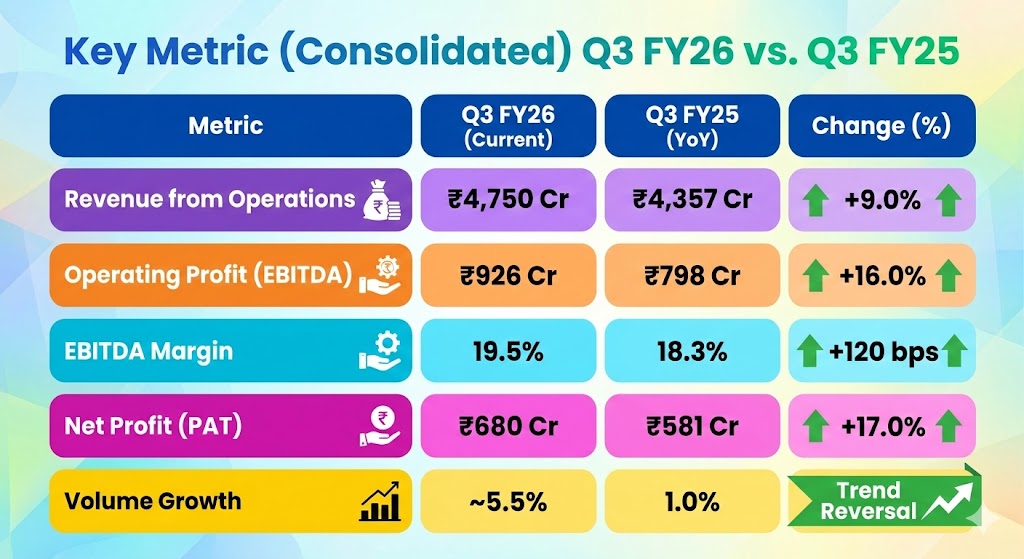
The Q3 FY26 financials present a rare combination that investors love but seldom see—simultaneous improvement in volumes, margins, and profits. Revenue from operations grew 9% year-on-year to ₹4,750 crore, up from ₹4,357 crore in Q3 FY25, reflecting both higher sales volumes and selective price hikes. Operating profit (EBITDA) rose 16% to ₹926 crore, while EBITDA margins expanded by 120 basis points to 19.5%, showing strong cost control and better product mix. Net profit increased 17% to ₹680 crore, broadly in line with operating performance, which confirms that this was not a one-off tax or accounting-driven quarter. Most importantly, volume growth of ~5.5% marks a clear trend reversal from the sluggish growth seen earlier in FY25. In simple terms, Britannia did not just earn more per biscuit; it sold more biscuits too, which is the healthiest form of earnings growth in consumer businesses.
🔗 Official Results Confirmation
3. The Three-Legged Stool: Volume, Price, and Product Mix Working Together
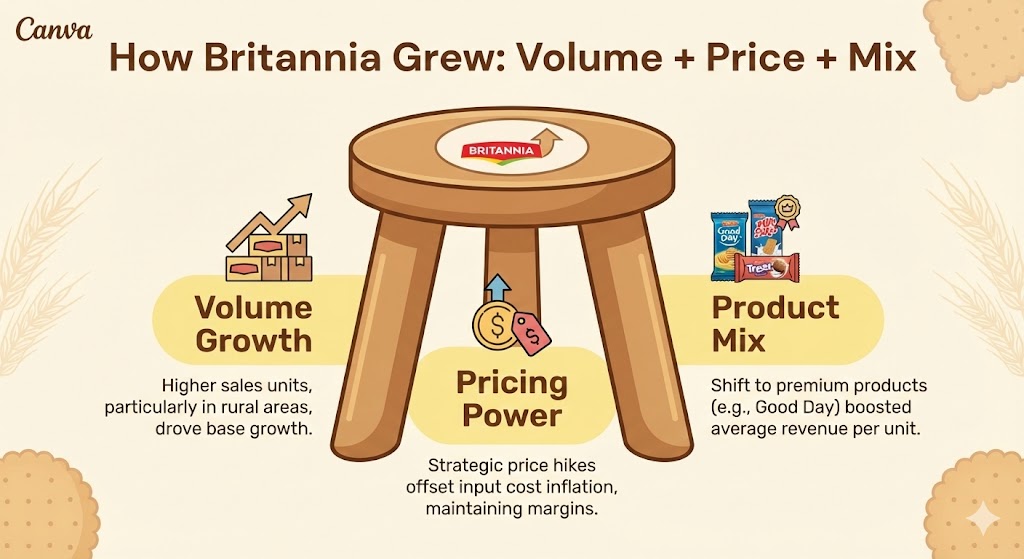
A fundamental analyst never looks at profits alone. Sustainable growth in FMCG depends on three pillars: how much you sell (volume), how much you charge (price), and what you sell more of (product mix). Britannia’s Q3 FY26 performance is a textbook example of all three legs moving in the right direction at the same time.
3A. The Rural Revival: Why Volume Growth Has Returned
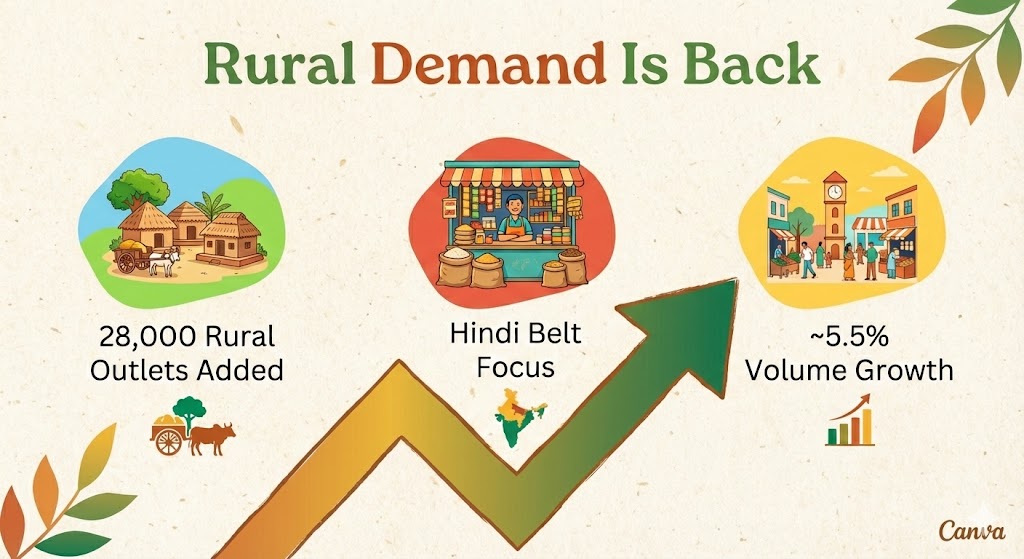
The biggest positive surprise in this quarter was the clear recovery in volumes, driven largely by rural and semi-urban markets. Over the last two years, high food inflation and weak farm incomes had squeezed discretionary spending in villages and small towns. Britannia anticipated this early and invested heavily in distribution rather than waiting for demand to magically return. By FY25, the company had expanded into 28,000 additional rural outlets, especially across the Hindi belt. This investment is now paying off. The relaunch of mass products like Tiger Glucose and Marie Gold with “20% extra” packs directly targeted value-conscious consumers who had shifted to unbranded local biscuits during inflationary times. As rural wages stabilized and food inflation cooled, these consumers returned to trusted brands. The result is visible in the numbers: volume growth jumped to ~5.5%, proving that rural demand distress is no longer the headwind it was last year.
rural consumption trends in India
3B. The Cheese and Dairy Moat: Margin Expansion Through Premiumization
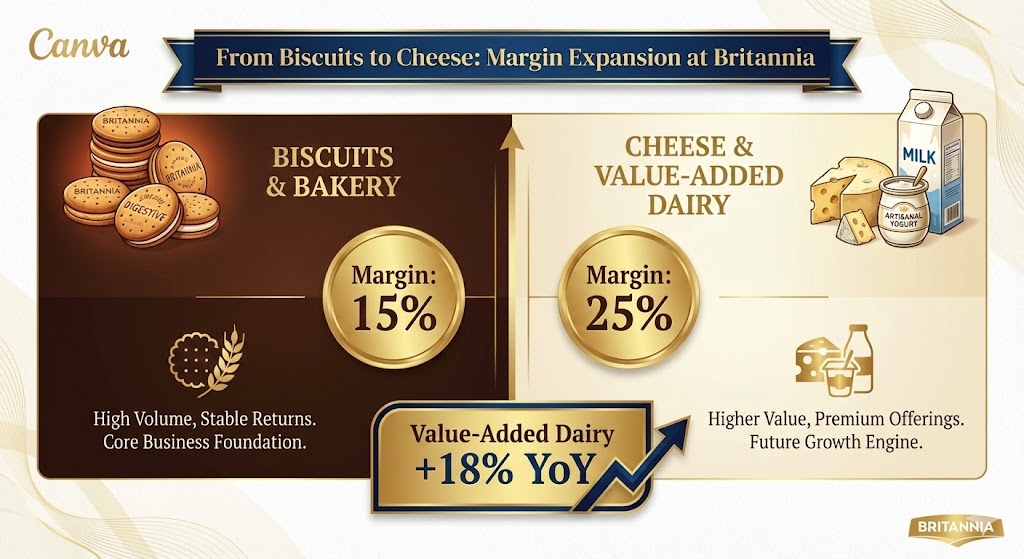
While biscuits drive volumes, margins increasingly come from Britannia’s expanding dairy and adjacent food portfolio. The joint venture with Bel SA, known globally for brands like The Laughing Cow, reached EBITDA breakeven during the quarter—an important milestone. Value-added dairy products such as cheese, yogurt, and flavored milk drinks grew 18% year-on-year, significantly faster than the core biscuit business. The margin logic here is simple and powerful. Traditional biscuit categories typically operate at 14–16% margins, while cheese and dairy-based value-added products can deliver 25% or higher margins once scale is achieved. As Britannia gradually shifts its sales mix toward these premium categories, overall profitability rises without aggressive price hikes. This structural change in product mix is one of the strongest long-term drivers of Britannia’s earnings growth.
Bel Group dairy business
3C. Input Cost Management: Protecting Margins Without Hurting Demand
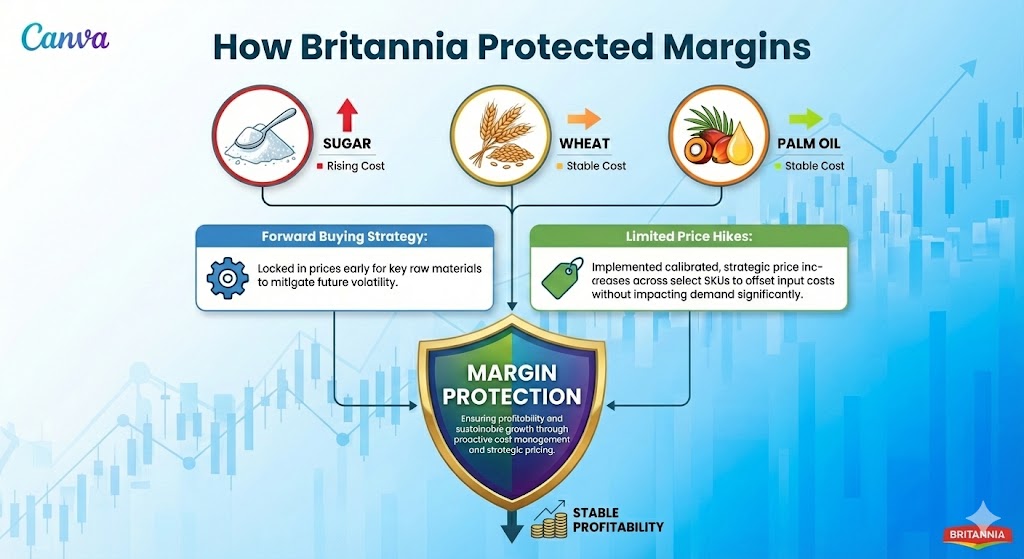
One of the quiet successes of Q3 FY26 was Britannia’s handling of input costs. Sugar prices rose nearly 8% year-on-year, which could have pressured margins in a price-sensitive category like biscuits. However, wheat and palm oil—two other major inputs—remained largely stable due to government supply interventions and global trends. Britannia’s management used forward buying strategies, especially in wheat procurement, locking in prices before post-harvest volatility set in. This allowed the company to pass on only limited price increases to consumers without affecting demand. The result was margin expansion alongside volume growth, a rare outcome during periods of commodity inflation. This disciplined cost management reflects operational maturity rather than short-term luck.
4. Policy and Inflation: The Invisible Tailwind Supporting Consumption
Britannia’s Q3 performance did not occur in isolation; it was supported by a favorable policy environment. The government’s aggressive rollout of subsidized Bharat Atta and Bharat Rice played a key role in controlling headline food inflation during the quarter. When essential staples remain affordable, households have more discretionary budget left for branded foods like biscuits, cakes, and dairy products. This “inflation shield” is particularly important for rural consumers, who are the first to cut back when food prices rise. In addition, Britannia benefited from incentives under the Production Linked Incentive (PLI) Scheme for Food Processing, especially in the ready-to-eat segment. The incentives accrued in Q3 FY26, estimated at around ₹45 crore, directly supported profitability. These policy tailwinds strengthened Britannia’s earnings quality without creating artificial demand.
Tata Consumer Q3 FY26 Results Analysis: Why This Is No Longer Just a Tea Company
5. Competitive Landscape: Where the Real Threats Lie
Despite its strong quarter, Britannia operates in one of the most competitive FMCG segments in India. Local unorganized players remain active in rural markets, but they struggle to match Britannia’s scale, brand trust, and distribution efficiency. The more serious competitive challenge comes from Amul, which is rapidly expanding its presence in cookies, bakery, and packaged foods. Amul’s advantage lies in its unmatched dairy supply chain and deep rural penetration. While Britannia continues to dominate urban and premium segments, Amul’s aggressive pricing and cooperative backing make it the most credible long-term challenger. That said, Britannia’s brand equity, product innovation, and diversified portfolio give it a strong defensive moat, especially in biscuits and value-added dairy.
6. Risk Factors: What Investors Should Watch Carefully
No investment story is complete without acknowledging risks. One key risk is palm oil price volatility, driven by global supply disruptions and geopolitical disputes involving major producers like Indonesia and the European Union. A sharp rise in palm oil prices could pressure margins in the near term. Another risk is competitive intensity, particularly if large players like Amul decide to prioritize bakery and biscuits more aggressively. Finally, valuation itself is a risk. Britannia currently trades at a price-to-earnings multiple of around 52x, which leaves little room for disappointment. Any slowdown in volume growth or margin compression could trigger short-term stock volatility. However, these risks are operational rather than structural, and none currently threaten the core business model.
7. Conclusion: Britannia as the King of Defensive Growth
Britannia’s Q3 FY26 results confirm why it is often described as the safest growth stock in India’s FMCG sector. The company has demonstrated that it can grow volumes even when the broader economy is only beginning to recover. It has expanded margins through premiumization rather than excessive price hikes, protected profitability through smart cost management, and positioned itself well within a supportive policy environment. While the stock is not cheap by traditional valuation metrics, investors are paying for certainty, consistency, and resilience. In a market where volatility remains high, Britannia stands out as a rare example of defensive growth—a business that protects capital while still delivering steady earnings expansion. For 2026 and beyond, Britannia remains the benchmark against which all other FMCG stocks will be measured.
Britannia Industries share price
❓ FAQ
Q1. Why did Britannia Industries’ profit rise in Q3 FY26?
Britannia’s profit rose due to higher volume growth, better product mix from value-added dairy, and improved operating margins, despite moderate input cost inflation.
Q2. What does Britannia’s volume growth indicate?
Volume growth of around 5.5% indicates a revival in rural and semi-urban demand, suggesting that consumption stress at the lower end of the economy is easing.
Q3. How did Britannia manage rising sugar prices?
Britannia controlled costs through forward buying of wheat and selective price increases, allowing it to absorb sugar inflation without hurting demand.
Q4. Is Britannia benefiting from government policies?
Yes. Lower food inflation due to subsidized staples and incentives under the PLI scheme for food processing supported profitability during the quarter.
Q5. Is Britannia Industries a good long-term investment?
Britannia is considered a defensive FMCG stock with stable demand, strong brands, and consistent margins, though it trades at a premium valuation.