Big Tech Layoffs vs AI Hiring Explained: Are Jobs Really Disappearing in 2025?
Introduction: Why Tech Job News Feels So Confusing Today
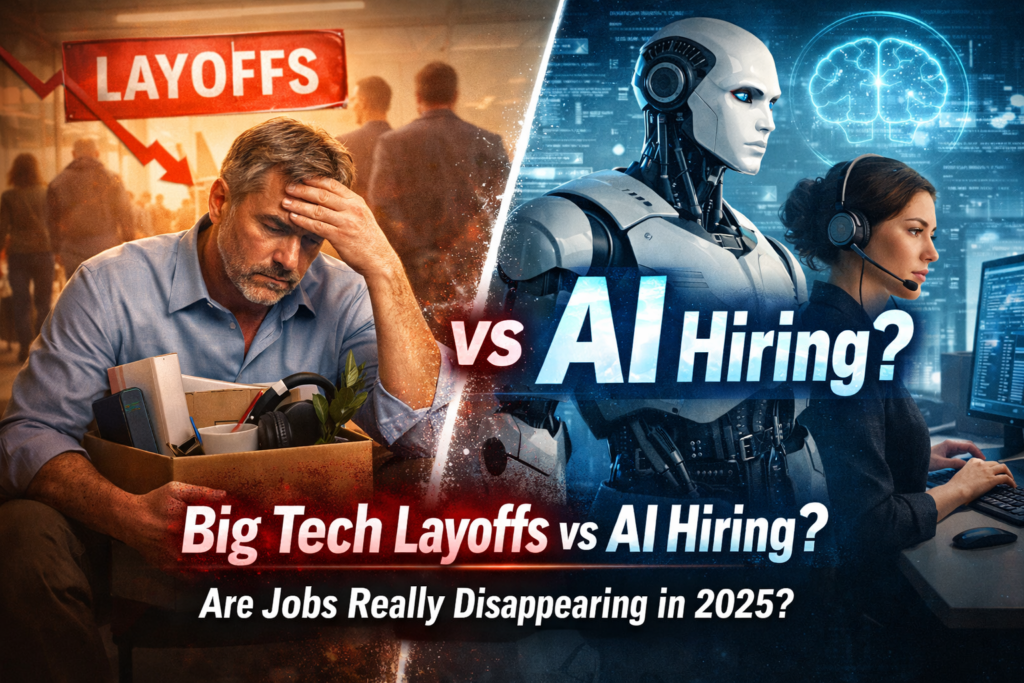
Over the last two years, one type of news has dominated headlines again and again: Big Tech layoffs. Every few weeks, people read about thousands of jobs being cut by technology companies that were once seen as the safest employers in the world. At the same time, another headline runs parallel to this fear—companies are aggressively hiring for AI roles.

This creates confusion. If technology companies are freezing hiring and laying off workers, why are they also paying very high salaries to AI engineers, data scientists, and machine learning experts? Are jobs really disappearing, or are they simply changing shape?
This article explains this paradox in simple language, using real data from 2024–2025, lessons from history, and clear logic. The aim is not to scare readers, but to help them understand what is actually happening in the global tech job market—and what it means for workers, students, and policymakers.
Big Tech Layoffs: What the Numbers Actually Show
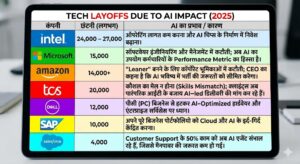
The scale of tech layoffs looks alarming at first glance. Between 2023 and early 2025, global technology companies have cut more than 550,000 jobs. The peak came in 2023, but layoffs continued into 2024 and early 2025, though at a slower pace. This steady flow of job cuts has kept the topic alive in public discussion.
However, it is important to understand where these layoffs are happening. Most job cuts are concentrated in non-core roles—such as recruitment, human resources, customer support, middle management, and marketing teams that expanded rapidly during the pandemic years. These roles were built for a phase of aggressive growth that no longer exists.
The key point is this: layoffs are selective, not universal. Engineering teams working on core platforms, cloud infrastructure, cybersecurity, and artificial intelligence have largely been protected. This shows that companies are not shrinking because they are failing; they are restructuring because their priorities have changed.
Why Tech Companies Are Cutting Jobs Despite Profits
| Role Type | Layoff Risk |
|---|---|
| Recruiters & HR | 🔻 Very High |
| Middle management | 🔻 High |
| Customer support (Tier-1) | 🔻 High |
| Marketing & non-core teams | 🔻 Medium |
| AI engineers | 🔺 Very Low |
| Cloud & cybersecurity | 🔺 Very Low |
One of the biggest misunderstandings is the belief that layoffs mean companies are in financial trouble. In reality, many large technology firms remain profitable and cash-rich. So why cut jobs?
The first reason is over-hiring during the pandemic. Between 2020 and 2022, tech companies hired aggressively because online demand exploded. When the world reopened, growth slowed, but the workforce remained oversized.
The second reason is higher interest rates. Cheap money is no longer available. When borrowing becomes expensive, companies focus on efficiency instead of expansion. Shareholders now reward profitability and cost control, not just growth.
The third reason is automation and productivity gains. Many tasks once done by large teams can now be handled by software tools and AI systems. This allows companies to operate with fewer people while maintaining output.
Together, these factors explain why layoffs are happening even when revenues remain strong.
The AI Hiring Boom: Where Jobs Are Actually Growing

While headlines focus on layoffs, a quieter but powerful trend is unfolding: AI hiring is expanding fast. Companies are actively recruiting machine learning engineers, data scientists, AI infrastructure specialists, and cybersecurity professionals who understand AI systems.
This hiring is very different from earlier tech hiring waves. AI teams are small but extremely skilled. A single AI engineer can deliver productivity equal to many traditional roles. As a result, companies are willing to pay very high salaries for these positions.
AI hiring is not about numbers; it is about strategic value. These roles directly influence future products, automation systems, and competitive advantage. That is why even companies cutting thousands of jobs continue to hire aggressively in AI-related areas.
Understanding the Paradox in Simple Terms
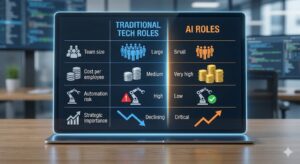
The paradox becomes easy to understand when explained simply. Technology companies are removing roles that can be automated and investing in roles that build automation.
Think of it like a factory. When machines are introduced, some manual jobs disappear. But new jobs are created to design, maintain, and operate those machines. The total number of workers may reduce, but productivity rises.
In the tech industry today, AI is the machine. Companies are replacing large teams performing repetitive tasks with smaller teams that design intelligent systems. This is not job destruction—it is job transformation.
What History Teaches Us About Technology and Jobs
Fear of job loss due to technology is not new. During the Industrial Revolution, machines replaced manual labour. In the 1980s, computers were seen as job killers. In the early 2000s, the internet caused massive layoffs during the dot-com crash.
In every case, some jobs disappeared, but new industries and roles emerged. Over time, employment recovered in different forms. The real problem was not technology itself, but the speed of change and the lack of preparation.
AI follows the same pattern. Jobs that depend on routine, repetition, and fixed rules are vulnerable. Jobs that require judgment, creativity, domain knowledge, and system design become more valuable.
Which Jobs Are Most at Risk from AI Automation
Not all tech jobs face the same risk. Roles that are highly repetitive and rule-based are more likely to be automated. These include entry-level testing, basic coding tasks, routine data processing, and tier-one customer support.
AI systems are very good at recognising patterns, following instructions, and handling large volumes of simple tasks. When companies adopt these tools, the need for large teams performing such work declines.
This does not mean people in these roles are no longer useful. It means that the nature of these jobs must change, with workers moving toward more complex and decision-based tasks.
Which Skills Are Becoming More Valuable Because of AI
As some roles lose importance, others gain power. Skills related to AI system design, oversight, and integration are becoming critical. People who understand both technology and a specific domain—such as finance, healthcare, manufacturing, or law—are in high demand.
Another growing area is AI governance and ethics. As AI systems affect real lives, companies and governments need people who can manage risks, bias, and regulation.
The key lesson is simple: depth matters more than volume. AI rewards people who can adapt, learn continuously, and work alongside intelligent systems.
Is There Really a Tech Hiring Freeze?
The phrase “tech hiring freeze” is misleading. Hiring has not stopped; it has become selective. Companies are slowing down mass recruitment but continuing to hire for roles that align with long-term strategy.
Many firms are also moving people internally—reskilling existing employees instead of hiring fresh workers. Contract and project-based hiring has increased, especially for specialised skills.
So, the reality is not a freeze, but a filter. Only roles that add clear value are being approved.
India’s Tech Workforce: Threat or Opportunity?
India plays a special role in this story. The country has a large technology workforce, especially in IT services and outsourcing. These sectors face pressure because low-end, repetitive work is easiest to automate.
However, India also has a major opportunity. Global companies need AI services, system integration, model training, and enterprise-level AI deployment. With the right skills, Indian professionals can move up the value chain.
The real challenge for India is speed of reskilling. If training systems adapt quickly, AI can become a growth engine. If not, job mismatches will increase.
The Geopolitical Angle: AI Talent as National Power
AI is no longer just a business tool; it is a strategic asset. Countries that control AI talent gain economic strength, military advantage, and global influence. This is why governments are competing to attract skilled workers and protect domestic innovation.
Immigration policies, education reforms, and national AI strategies are now part of geopolitics. The tech job market is shaped not only by companies, but also by government decisions.
In this sense, the AI hiring boom reflects a larger struggle for future leadership in technology.
What Policymakers Must Learn from the AI Job Shift
Governments cannot stop technological change, but they can manage its impact. Education systems must focus on lifelong learning instead of one-time degrees. Labour laws need flexibility to support transitions between roles.
Social safety nets are also important. Workers affected by automation need support during reskilling periods. Countries that handle this transition well will gain long-term economic stability.
Ignoring the shift will only deepen inequality and social stress.
The Road Ahead: Fewer Jobs or Better Jobs?
Looking ahead to 2030 and beyond, the future of work depends on choices made today. AI will reduce some job categories, but it will also create new ones that we cannot fully imagine yet.
The most likely outcome is a polarised job market—high rewards for skilled roles and pressure on low-skill work. The challenge is to help more people move into the high-value category.
Technology itself is neutral. The outcome depends on how societies prepare for it.
Conclusion: Understanding the Real Story Behind the Headlines
Big Tech layoffs and AI hiring are not contradictory. They are two sides of the same transformation. Companies are not abandoning workers; they are reshaping how work is done.
AI is not killing jobs—it is killing outdated job structures. The future belongs to those who adapt, learn, and work with intelligent systems rather than against them.
For readers, the key takeaway is clear: fear is understandable, but knowledge is more powerful. Understanding this shift helps individuals, institutions, and nations prepare for a future where technology changes work—but does not eliminate human value.
To visit the official website of National Statistical Office (NSO). click here
❓ Frequently Asked Questions (FAQ)
1. Why are Big Tech companies laying off employees in 2024–2025?
Big Tech companies are laying off employees mainly because of over-hiring during the pandemic, rising interest rates, pressure to reduce costs, and increased automation. Most layoffs are part of restructuring, not because companies are failing.
2. Are tech companies really facing a hiring freeze?
No, there is no complete hiring freeze. Tech companies have slowed mass hiring but are actively recruiting for critical roles, especially in artificial intelligence, cloud computing, cybersecurity, and data science.
3. Is AI responsible for job losses in the tech industry?
AI is not directly destroying all jobs, but it is automating repetitive and routine tasks. Jobs that rely heavily on fixed processes are at higher risk, while roles that design, manage, or work alongside AI are growing.
4. What does “AI job loss” actually mean?
“AI job loss” means certain tasks and roles are becoming less necessary due to automation. It does not mean work is disappearing completely. Instead, jobs are changing, and new roles are being created around AI systems.
5. Which tech jobs are most at risk from AI automation?
Jobs most at risk include entry-level coding, routine testing, basic data processing, content moderation, and tier-one customer support roles. These tasks are repetitive and can be easily automated.
6. Which jobs are growing despite tech layoffs?
Jobs related to artificial intelligence, machine learning, data science, AI infrastructure, cloud services, and cybersecurity are growing. These roles are considered strategic and future-critical.
7. Why are AI jobs paid more even when layoffs are happening?
AI jobs are paid more because they require rare skills and deliver high productivity. Companies prefer hiring a small number of highly skilled AI professionals rather than maintaining large traditional teams.
8. How does this tech job shift affect India?
India faces pressure in low-end IT outsourcing jobs, but it also has big opportunities in AI services, enterprise automation, and digital transformation. The main challenge is reskilling the workforce quickly.
9. Will AI completely replace human workers in the future?
No. AI can automate tasks but cannot fully replace human judgment, creativity, and decision-making. The future of work will involve humans working alongside AI, not being replaced by it.
10. What skills should people learn to stay relevant in the AI era?
Skills in AI basics, data analysis, problem-solving, system design, domain expertise combined with technology, and continuous learning will be most valuable in the coming years.
11. Is this situation similar to past technology disruptions?
Yes. Similar fears existed during the Industrial Revolution, computerisation, and the internet boom. In each case, jobs changed rather than disappeared, and new industries emerged over time.
12. Are tech layoffs expected to continue beyond 2025?
Layoffs may continue in specific roles, but large-scale job cuts are likely to slow. Future hiring will focus more on skills, productivity, and adaptability rather than headcount growth.
To visit official website of 🏛️ 1. U.S. Bureau of Labor Statistics (BLS) click here
🔍 People Also Ask (PAA)
Is AI causing job losses in Big Tech?
AI is contributing to job losses in roles that involve repetitive and routine tasks, but it is also creating new jobs that focus on building, managing, and supervising AI systems.
Why are tech companies laying off workers while hiring AI talent?
Tech companies are cutting roles that can be automated and hiring AI talent to improve efficiency, reduce costs, and stay competitive in the future.
What does tech hiring freeze really mean?
A tech hiring freeze does not mean hiring has stopped completely. It means companies are pausing mass recruitment and hiring selectively for critical roles like AI, cloud, and cybersecurity.
Which jobs are most at risk from AI automation?
Jobs involving routine coding, basic testing, data entry, content moderation, and entry-level customer support are most at risk from AI automation.
Which tech jobs are still in demand in 2025?
AI engineers, machine learning experts, data scientists, cloud engineers, cybersecurity specialists, and AI product managers remain in high demand.
Will AI replace software engineers completely?
No. AI can assist software engineers but cannot fully replace human creativity, problem-solving, and system design skills.
Is AI job loss a short-term or long-term problem?
AI job loss is mainly a short-term transition problem. In the long term, new roles and industries are expected to emerge as technology evolves.
How can workers protect themselves from AI-driven layoffs?
Workers can protect themselves by upgrading skills, learning AI basics, developing domain expertise, and staying adaptable to new tools and technologies.
What impact do tech layoffs have on the global economy?
Tech layoffs can slow consumer spending in the short term but often lead to higher productivity and innovation over the long run.
How does AI hiring affect salaries in the tech industry?
AI hiring pushes salaries higher for skilled roles while reducing demand for low-skill and repetitive positions, leading to wage inequality.
Is India more vulnerable to AI-related job losses?
India faces higher risk in low-end IT services, but it also has major opportunities in AI services, automation, and digital transformation if reskilling happens fast.
Are tech layoffs expected to continue in 2026 and beyond?
Large-scale layoffs are likely to slow, but restructuring will continue as companies adapt to AI-driven business models.
India Manufacturing Boom vs China Slowdown: Who Are the Real ‘Make in India’ Winners in 2025?