I. Introduction: The 2026 AI Skills Crisis
Let’s start with a hard truth.
In 2026, writing basic code is no longer a superpower. It is a commodity.
Across India, the United States, and Europe, companies are quietly restructuring hiring strategies. A major 2026 Indian IT sector report revealed that nearly 65% of large technology firms have reduced hiring for routine programming roles. Tasks like basic debugging, template-based coding, and manual software testing are increasingly handled by AI tools.
But this is not an employment disaster. It is a skills reset.
While entry-level programming roles are shrinking, demand for AI engineers, data scientists, and machine learning specialists is exploding. NASSCOM estimates that India alone faces a 51% demand-supply gap in AI and data talent. Demand has crossed 1 million professionals, but the available skilled workforce is far lower.
Globally, the picture is even bigger. The World Economic Forum projects that while automation may displace certain jobs, the AI transition is expected to create nearly 170 million new roles by the end of this decade. These roles are focused on AI engineering, data orchestration, AI governance, and model deployment.
This is not the end of tech jobs. It is the beginning of AI-native careers.
And that is why the education market is booming.
The global AI in Education market was valued at more than $7 billion in 2025 and is projected to reach nearly $137 billion by 2035. That growth tells us one thing clearly: professionals are rushing to upskill.
The real question is how.
AI Job Market & Skills Gap Data
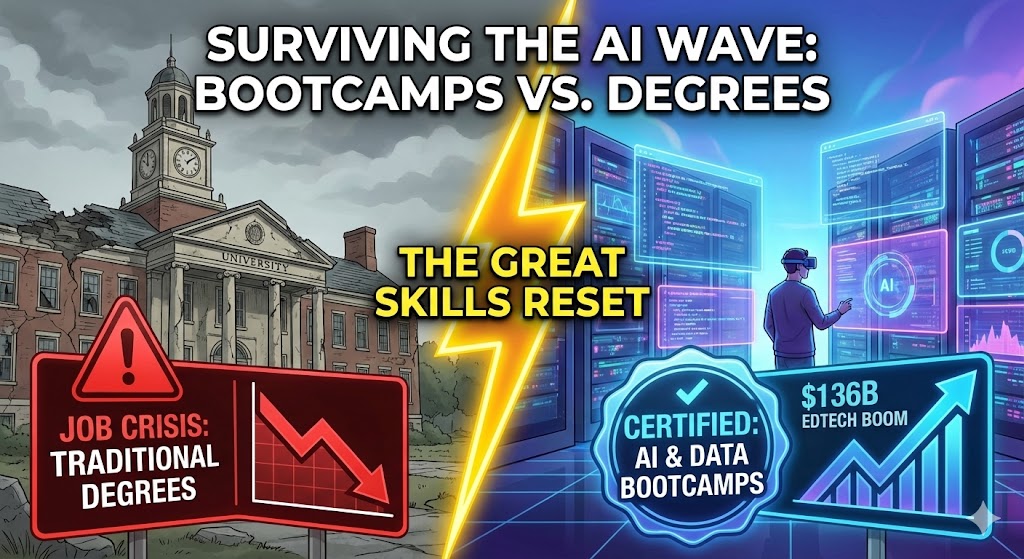
II. The Great Reset: Bootcamps vs. Traditional Degrees
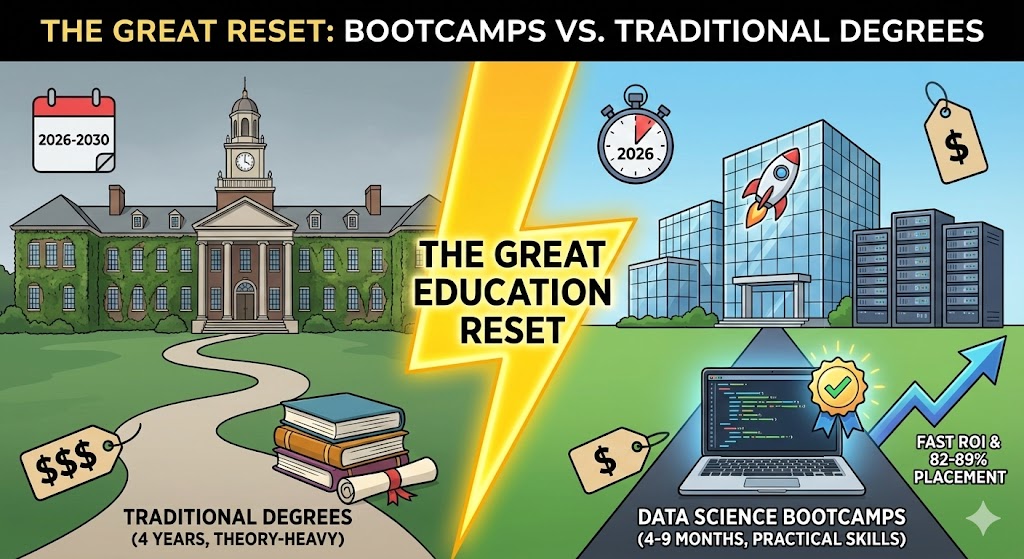
For decades, a four-year university degree was the golden ticket to a high-paying tech job. If you wanted to work in software or data, you enrolled in a computer science program and waited.
But the world in 2026 does not move at four-year speed.
Technology cycles are faster than academic curriculum updates. Universities often teach theory that may already be outdated by the time students graduate.
At the same time, employers are changing how they hire. In 2026, roughly 65% of employers globally report that they are prioritizing skills-based hiring over traditional degrees. What matters now is whether you can build, deploy, and solve real problems — not just whether you passed theoretical exams.
Now let’s compare timelines and costs.
A traditional master’s degree in data science can take 2 to 4 years and cost tens of thousands of dollars. During those years, students are often not earning full-time salaries.
Data science bootcamps, on the other hand, compress learning into 4 to 9 months. They focus on hands-on training. Students build portfolios. They learn tools like Python, SQL, TensorFlow, PyTorch, and cloud ML platforms.
The return on investment is what makes the difference.
In 2026, top-tier data analytics bootcamps report job placement rates between 82% and 89% within six months of graduation. Average starting salaries for career changers range from $65,000 to $78,000 annually in the United States. In India and Southeast Asia, AI specialists often command 40% to 60% salary premiums compared to traditional software roles.
When a bootcamp costs between $6,000 and $15,000, and a graduate earns a $20,000–$30,000 salary increase, the financial math becomes very clear.
The investment can pay for itself within the first year.
That is why bootcamps are not just surviving — they are winning.
World Economic Forum – Future of Jobs Report
III. The Most Lucrative AI Certifications in 2026
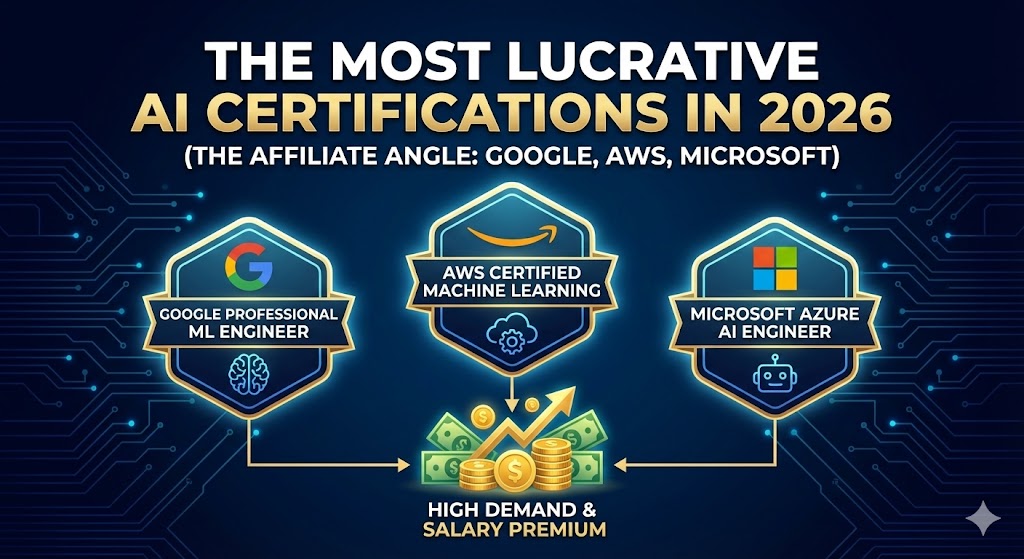
If you want to stand out in 2026, general “AI knowledge” is not enough. Employers are looking for validated, platform-specific expertise.
Let’s break down the certifications that truly move the needle.
Google Professional Machine Learning Engineer
This certification focuses on building and deploying machine learning models into production. It tests real-world MLOps skills, including data preparation, model training, evaluation, and monitoring.
Companies value this certification because it shows you can take a model beyond experimentation and into scalable deployment.
For engineers aiming to work in cloud-native AI systems, this is considered one of the gold standards.
AWS Certified Machine Learning – Specialty
Amazon Web Services continues to dominate global cloud infrastructure. Because of this dominance, AWS certifications carry strong enterprise recognition.
This certification focuses on end-to-end machine learning pipelines. It tests your ability to collect data, design ML solutions, and deploy models using AWS tools.
Many multinational companies require AWS knowledge for their AI teams. Having this certification signals readiness for enterprise-grade projects.
Microsoft Certified: Azure AI Engineer Associate (AI-102)
Microsoft’s ecosystem is deeply integrated into enterprise environments worldwide. Azure AI certifications are highly valued in B2B companies.
This certification emphasizes integrating cognitive services, computer vision, and natural language processing into existing systems.
For professionals targeting enterprise AI roles, especially in corporate IT departments, Azure certifications can open doors quickly.
The key pattern here is clear. Employers want cloud-integrated AI skills.
Knowing machine learning theory is important. But being able to deploy AI solutions inside AWS, Azure, or Google Cloud environments is what drives hiring decisions.
AI Education Market Growth Data
IV. The Rise of “Business AI” Specializations
Here is something important that many people misunderstand.
You do not need to be a hardcore programmer to benefit from the AI wave.
A new category of roles is emerging — business AI professionals.
These individuals sit between technical AI teams and business strategy.
Generative AI Product Managers
Companies launching AI-powered tools need professionals who understand both machine learning capabilities and customer needs.
AI Product Managers are responsible for defining features, guiding development teams, and aligning AI products with revenue goals.
Because they directly influence growth and profitability, compensation is strong.
AI in Finance
Financial institutions are heavily investing in AI for fraud detection, credit risk modeling, and algorithmic trading.
Professionals who understand both financial systems and AI modeling can command salaries ranging from $130,000 to $200,000 annually in global markets.
Why? Because improving fraud detection by even a small percentage can save millions of dollars.
AI in Marketing
Marketing automation powered by AI is transforming customer targeting.
Professionals who can integrate predictive analytics, generative content tools, and customer data modeling are becoming extremely valuable.
When AI directly increases revenue, companies are willing to pay premium salaries.
The lesson here is simple.
AI is not just a coding skill. It is a multiplier skill across industries.
Harvard Business Review – Skills-Based Hiring
V. The ROI of Upskilling in 2026
Let’s bring this back to personal decision-making.
Imagine two professionals.
One decides to pursue a four-year advanced degree starting in 2026. By the time they graduate, the AI market may have evolved significantly.
The other enrolls in a six-month AI bootcamp, builds a portfolio, earns a certification, and enters the workforce within a year.
The second professional gains practical experience faster. They earn earlier. They build real-world credibility.
In fast-moving industries, speed matters.
That does not mean traditional degrees are useless. They still provide strong theoretical foundations. But for professionals looking to pivot quickly, bootcamps and certifications offer faster returns.
And in a market with a 50% talent gap, employers are not waiting.
They are hiring now.
Google Professional ML Engineer
VI. Conclusion: How to Future-Proof Your Career
The AI transition is not a distant future event. It is happening now.
Routine coding roles are shrinking. AI-integrated roles are expanding. The demand-supply gap is widening.
The global AI education market crossing into a $100+ billion growth trajectory tells us something important: professionals understand the urgency.
The window is open.
If you are currently in a traditional IT role, marketing job, finance position, or even a non-technical field, the AI wave is not something to fear. It is something to leverage.
You do not need to become a research scientist.
You need to become AI-literate.
Whether through a focused data science bootcamp, a cloud ML certification, or a hybrid business-AI specialization, the path forward is clear.
The biggest risk in 2026 is not that AI will replace you.
The biggest risk is standing still while others upskill.
Because in this new economy, skills — not degrees — determine opportunity.
And the AI skills crisis is not just a challenge.
It is the largest career opportunity of this decade.
AWS Certified Machine Learning – Specialty
Frequently Asked Questions (FAQ)
1. Are data science bootcamps worth it in 2026?
Yes, for many professionals they are. In 2026, companies are prioritizing skills-based hiring over traditional degrees. Top data science bootcamps report job placement rates above 80% within six months. Because programs are shorter and focused on practical projects, many graduates see salary increases within a year, making the return on investment faster than traditional multi-year degrees.
2. What is the average salary after completing an AI bootcamp?
In the United States, entry-level AI and data science roles often start between $65,000 and $85,000 annually. In India and Southeast Asia, AI-specialized roles can command 40% to 60% higher salaries compared to standard software jobs. Salaries depend on portfolio strength, certifications, and industry domain knowledge.
3. Which AI certification has the highest salary potential?
Certifications tied to major cloud platforms typically offer the strongest salary impact. Google Professional Machine Learning Engineer, AWS Certified Machine Learning – Specialty, and Microsoft Azure AI Engineer Associate are highly recognized. These certifications signal that candidates can deploy real-world AI systems, which is what employers value most.
4. Do employers still value traditional computer science degrees?
Yes, traditional degrees still provide strong theoretical foundations. However, in 2026 many employers prioritize demonstrated skills and project portfolios over academic credentials. Candidates who combine a degree with hands-on certifications or bootcamp training often have a competitive advantage.
5. How long does it take to transition into an AI career?
Bootcamps typically take 4 to 9 months to complete. With consistent project building and certification preparation, many professionals transition into AI-related roles within one year. The timeline depends on prior technical background and learning commitment.
6. Can non-programmers switch to AI careers?
Yes. Roles such as AI product management, AI marketing analytics, AI business strategy, and data analysis do not always require deep coding expertise. Professionals with finance, marketing, or operations backgrounds can combine domain expertise with AI literacy to unlock high-paying hybrid roles.
7. Is the AI job market oversaturated in 2026?
No. Despite layoffs in routine programming roles, there is still a significant talent gap in advanced AI, data engineering, and machine learning deployment roles. Reports show demand for AI professionals continues to exceed supply, particularly in cloud-based ML operations and applied generative AI.
8. What skills are most in demand for AI jobs right now?
The most in-demand skills include:
Machine learning model deployment (MLOps)
Cloud ML platforms (AWS, Azure, Google Cloud)
Prompt engineering and generative AI tools
Data analytics and visualization
AI system integration into business workflows
Employers increasingly look for candidates who can apply AI to real business problems, not just build models.
9. Are online AI certifications respected by employers?
Yes, especially when they come from major technology providers like Google, AWS, or Microsoft. These certifications are often aligned with real enterprise tools and are updated frequently to match industry changes.
10. How do I choose the best AI bootcamp?
Look for programs that offer:
Hands-on projects
Real-world case studies
Cloud platform training
Strong job placement support
Transparent salary outcome data
Always evaluate curriculum relevance to 2026 AI tools and industry standards.
Microsoft Azure AI Engineer Associate
People Also Ask (PAA)
Is 2026 a good time to switch to an AI career?
Yes. While entry-level coding roles are being automated, demand for AI, data engineering, and machine learning deployment roles continues to grow. Many companies report a talent shortage in applied AI skills. Professionals who upskill now can enter the market while demand still exceeds supply.
What is the fastest way to become an AI engineer?
The fastest path typically includes completing a focused AI or data science bootcamp (4–9 months), building real-world projects, and earning a cloud-based machine learning certification such as AWS, Google, or Azure. Practical portfolio work is often more important than theory alone.
How much does a data science bootcamp cost in 2026?
Most reputable data science bootcamps cost between $6,000 and $15,000 depending on program length and mentorship level. Some offer installment plans or income-share agreements. When compared to the potential salary increase, many graduates recover their investment within the first year of employment.
Do AI certifications really increase salary?
Yes, especially cloud-based AI certifications. Employers value certifications that demonstrate hands-on ability to deploy models in production environments. Professionals with verified cloud ML credentials often qualify for higher-paying enterprise roles.
Can AI replace data scientists?
AI tools can automate repetitive coding and model tuning tasks, but companies still need professionals who understand data interpretation, deployment, governance, and business integration. The role is evolving, not disappearing.
Which industries are hiring AI professionals in 2026?
Top hiring industries include finance, healthcare, e-commerce, cybersecurity, marketing technology, and manufacturing automation. Any industry handling large data volumes is actively integrating AI solutions.
Is it better to learn AI online or through a university?
Online AI programs and bootcamps offer faster and more practical training aligned with industry tools. Universities provide strong theoretical depth. For career switchers seeking quick ROI, online certifications often provide faster entry into the job market.
What skills should I learn first for an AI career?
Start with:
Python programming
Data analysis and visualization
Basic machine learning concepts
Cloud platform fundamentals
Generative AI tools
Building practical projects early significantly improves employability.