Major Leadership Shifts at Berkshire Hathaway and JPMorgan Chase: What the December 2025 Changes Mean for Global Finance
The global business world witnessed one of the most significant leadership developments of the decade on 8 December 2025, as two of the world’s most influential financial giants—Berkshire Hathaway and JPMorgan Chase—announced crucial changes in their top management. For investors, analysts, employees, and market followers, these moves represent more than routine corporate reshuffling. They signal the beginning of a new era in American finance, with strategic decisions that could shape both companies for years to come.
In this detailed, human-tone analysis, we break down what happened, why it matters, and how these leadership changes reflect larger shifts across the financial industry, all in simple and easy-to-understand language.
Todd Combs Leaves Berkshire Hathaway: A Major Departure Before Buffett Steps Down
One of the biggest headlines was the announcement that Todd Combs, one of Berkshire Hathaway’s leading investment managers and the CEO of Geico, is stepping down from both positions. This move has surprised many in the investment world because Combs has been seen as one of the key figures shaping Berkshire’s future.
Combs joined Berkshire in 2010 and quickly became one of Warren Buffett’s trusted investment managers, responsible for a growing portion of the company’s massive stock portfolio. In 2020, he took over as the CEO of Geico, Berkshire’s large and well-known insurance subsidiary. His work there, especially in improving performance and modernizing operations, earned him great confidence from Buffett and the board.
Therefore, Combs’ departure—just weeks before Buffett himself retires—has raised questions about how the next generation of Berkshire leadership will handle investments and management responsibilities. Many industry experts believe this marks a clear shift from Buffett’s era of personal oversight to a more structured and modern leadership framework.
Todd Combs’ New Role at JPMorgan: Leading a Massive $10 Billion Strategic Fund
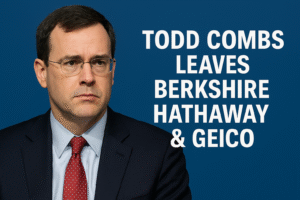
While Combs’ exit from Berkshire is big news, his next role is even more interesting. Starting January 2026, Combs will join JPMorgan Chase, one of the world’s largest banks, as the head of the Strategic Investment Group under its new Security and Resiliency Initiative (SRI).
This initiative is not a typical financial program. JPMorgan has created a $10 billion investment pool designed to support businesses and technologies that are considered vital for economic and national security. The focus of this new division includes:
Defense and aerospace
Energy and critical mineral supply chains
Healthcare innovation
Advanced technologies
Infrastructure and resiliency sectors
In addition to leading this fund, Combs will also serve as a special adviser to Jamie Dimon, the powerful Chairman and CEO of JPMorgan Chase. This gives him direct influence at the highest level of the bank’s strategic decision-making.
What makes this move so notable is the combination of finance, technology, and national security. Combs isn’t just picking stocks—he’s helping JPMorgan shape how America invests in future-critical industries. This aligns with a global trend where major banks are increasingly involved in sectors essential for national stability and technological leadership.
Marc Hamburg Announces Retirement After Four Decades at Berkshire Hathaway

Another major development came from Berkshire’s finance division. Marc Hamburg, the company’s long-serving Chief Financial Officer (CFO), announced his retirement after nearly 40 years of service. Hamburg has been a crucial part of Berkshire since the 1980s, managing its financial systems during the company’s transformation from a textile manufacturer to a global conglomerate worth hundreds of billions of dollars.
Hamburg’s retirement will take place in phases to ensure a smooth leadership handover:
June 1, 2026 – Charles Chang, a respected executive and the current CFO of Berkshire Hathaway Energy, will officially take over as group CFO.
June 1, 2027 – Hamburg will fully retire after a year of supporting Chang in the transition and advising senior leadership.
This thoughtful, multi-stage transition reflects Berkshire’s signature management style—slow, stable, and focused on continuity rather than abrupt change.
A Broader Context: Warren Buffett Steps Down, and Greg Abel Takes Charge
All these leadership changes are happening at a time when Warren Buffett, one of the most iconic figures in business history, is preparing to step down as CEO of Berkshire Hathaway. Buffett, who has led the company since the 1960s, has confirmed that he will retire as CEO on December 31, 2025, though he will remain involved as Chairman and continue shaping Berkshire’s long-term culture.
Starting January 1, 2026, Greg Abel, Vice Chairman of Berkshire Hathaway and head of its non-insurance operations, will officially become the new CEO. Abel is widely respected for his operational skills, discipline, and decades-long experience within Berkshire’s ecosystem. Many believe he is the right leader to steer the company through this generational transition.
With Buffett stepping down, Combs leaving, and Hamburg retiring, the company will now enter a new leadership era led by Abel, along with key figures like Ted Weschler (investment manager) and Charles Chang (upcoming CFO).
How These Moves Impact Berkshire Hathaway’s Future
The combined departure of Combs and Hamburg along with Buffett’s retirement signals the start of a major leadership transformation. For many years, investors debated who would inherit Buffett’s decision-making powers. Now, with a clear transition plan in place, the company appears to be focusing on a more modern, diversified leadership model.
Here’s what this means for Berkshire:
1. Stronger focus on operational management
Greg Abel is an operator at heart. Under him, Berkshire may adopt a more structured and scalable approach to management across its many subsidiaries.
2. Investment decisions may be distributed more evenly
With Ted Weschler likely taking an even larger role, and Abel involved in capital allocation, the firm may adopt a committee-style approach instead of relying heavily on one or two individuals.
3. Corporations may see more modernization
Geico, railroads, utilities, and manufacturing divisions may receive more technological and digital upgrades under the new leadership.
4. Stability is expected despite big changes
Buffett’s long-term philosophy of low debt, long-term investment, and decentralized management is likely to continue.
To stay updated on verious contemperory issues from Geopolitics to Geoeconomics visit now
Why JPMorgan’s Move Is a Powerful Strategic Signal
For JPMorgan, hiring Todd Combs is a signal of ambition. The bank is not just expanding—it is positioning itself at the center of national strategic industries, aligning its investments with government priorities and global geopolitical shifts.
This is important for several reasons:
1. JPMorgan is preparing for a future where finance and national security intersect
With rising global tensions, big banks are becoming partners in national economic strategies.
2. Combs brings Buffett-level discipline
His ability to evaluate businesses and allocate capital long-term will complement JPMorgan’s massive global footprint.
3. It strengthens JPMorgan’s presence in high-growth, high-importance sectors
These include defense, AI, biotech, and clean energy.
4. Jamie Dimon is building a legacy beyond traditional banking
Initiatives like SRI aim to transform JPMorgan into a strategic investment powerhouse.
To visit official website of J P Morgan visit now
Market Reaction and What Investors Should Watch
The initial market response to these leadership announcements has been cautious. Berkshire’s shares dipped slightly due to the uncertainty around Combs’ departure and Hamburg’s retirement. However, analysts agree that the company is structurally strong and well-prepared for the transition.
Investors and market watchers should keep an eye on:
How Greg Abel manages Berkshire’s massive cash reserves
How Geico performs under its new CEO
Who takes over more investment responsibilities long-term
How JPMorgan deploys its $10 billion strategic investment fund
These changes will help shape corporate trends in succession planning, strategic investing, and public-private partnerships in the years ahead.
Conclusion: A New Era for Two Financial Titans
The leadership changes announced on 8 December 2025 mark a turning point for both Berkshire Hathaway and JPMorgan Chase. While one company is preparing for life after Warren Buffett, the other is preparing for a future where strategic investments play a central role in national competitiveness.
For your readers, the message is clear:
This is not just a change of job roles—it is a historic shift in how global finance will operate in the coming decade. The people leading Berkshire and JPMorgan now will shape global investment trends, corporate strategies, and economic priorities for years to come.