1. The Executive Summary (The Macro Hook)
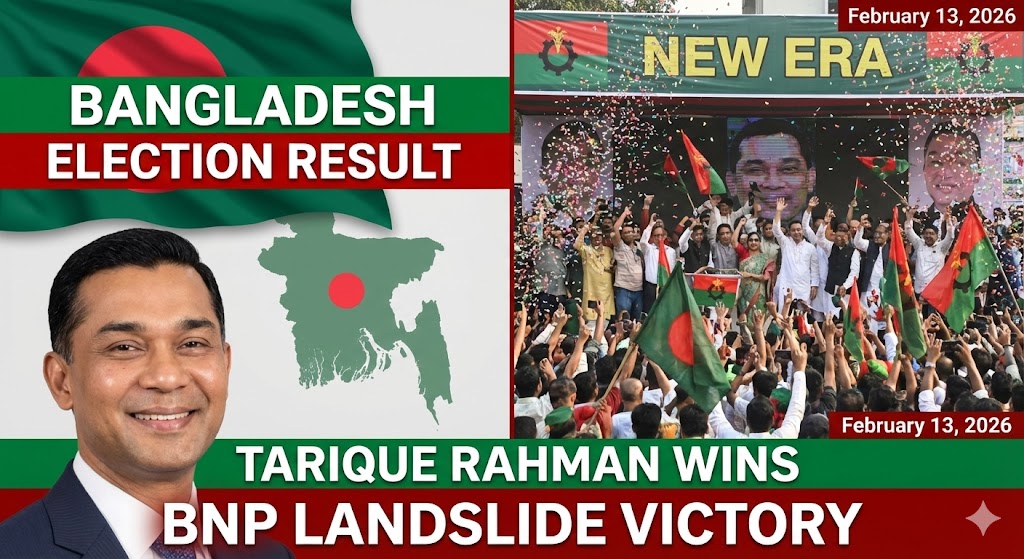
The February 2026 general election in Bangladesh is not just a change of government. It is a structural reset in South Asian geopolitics. The Bangladesh Nationalist Party (BNP), led by Tarique Rahman, has secured a super majority with more than 200 seats out of 300 in Parliament. For the first time in 17 years, India does not have a natural political ally in Dhaka. The long period under Sheikh Hasina and the Awami League, which India considered stable and cooperative, has come to an end.
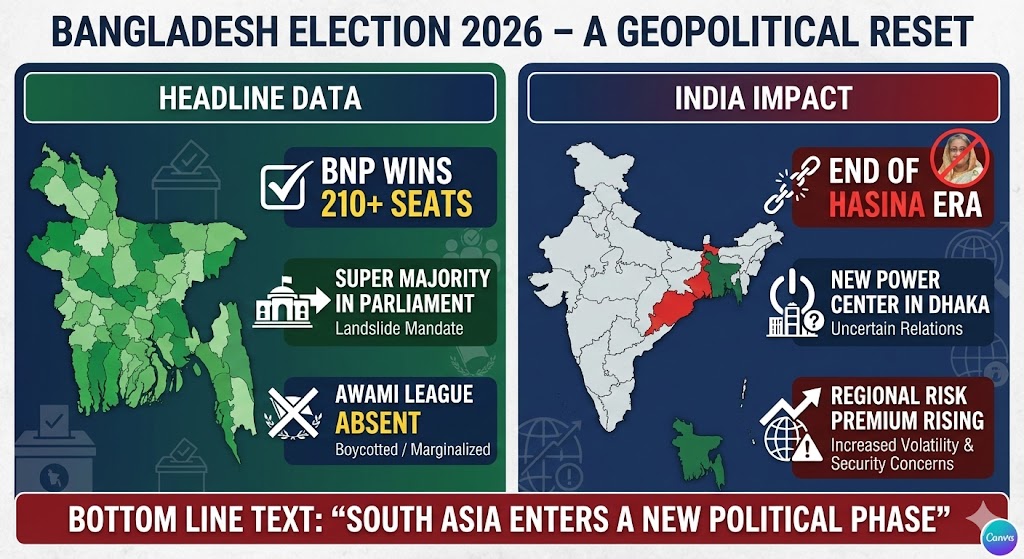
This election also marked the absence of the Awami League, which was barred from contesting. The contest became largely between the BNP and the Islamist Jamaat-e-Islami. The rise of Jamaat, even without forming the government, signals a shift in the ideological direction of Bangladesh’s politics. For investors and geopolitical observers, the asset called “regional stability” has been repriced overnight.
Prime Minister Narendra Modi’s immediate congratulatory message to Tarique Rahman shows India’s strategic pragmatism. New Delhi understands that geography does not change with elections. India must work with whoever is in power in Dhaka to protect its core interests — security cooperation, trade, and connectivity to the Northeast. The tone has already shifted from emotional alignment to practical engagement.
2. The Election Dashboard: Real-Time Data Points
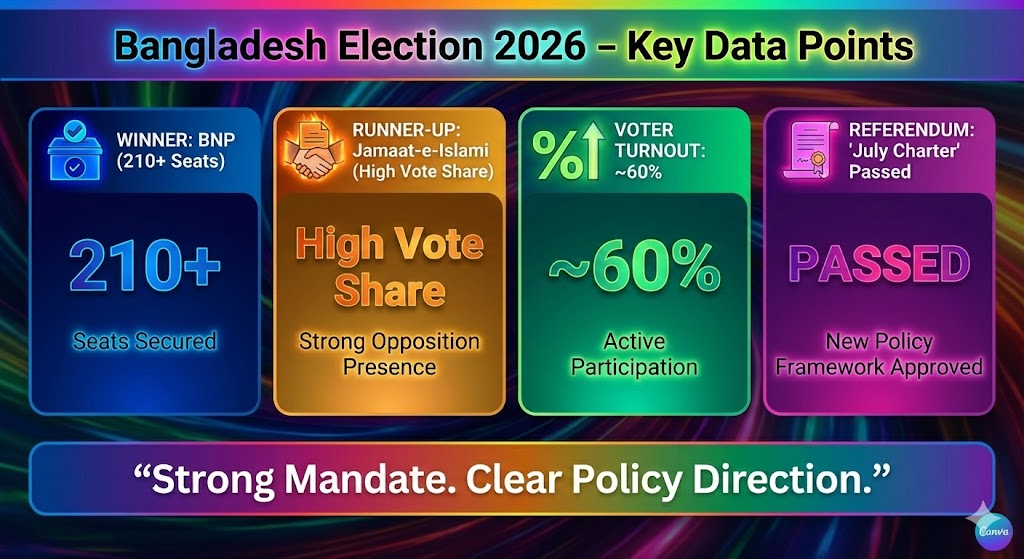
The BNP’s victory with over 210 seats gives it a clear and strong mandate. With this scale of majority, Tarique Rahman does not need unstable coalitions to govern. This means policy decisions can move quickly. For India, this creates both risk and opportunity. There is a new counterparty in Dhaka, and diplomatic channels must be rebuilt almost from scratch.
Jamaat-e-Islami, while not forming the government, secured a high vote share in many constituencies. This is important. A strong Islamist bloc in opposition can influence national discourse, especially on issues like secularism, relations with India, and minority rights. For India’s Northeast, where cross-border ethnic and insurgent networks have existed in the past, this development raises security concerns.
Voter turnout was around 60%, despite political tensions and boycotts. This level of participation gives legitimacy to the new government. The United States and the European Union have already signaled acceptance of the election outcome. That means India cannot isolate the new regime even if ideological differences exist.
Another key development was the passage of the so-called “July Charter” referendum, which is expected to reshape certain constitutional principles. There is strong speculation that the word “secularism” may be diluted or redefined in state policy. If that happens, it would represent a deep ideological shift compared to the Hasina era.
Bangladesh Election Commission official results
3. Fundamental Analysis: The “India Impact” Assessment
To understand what this means for India, we must break the risks into three core buckets: security, connectivity, and geopolitical alignment.
A. The Security “Put Option” Is Gone
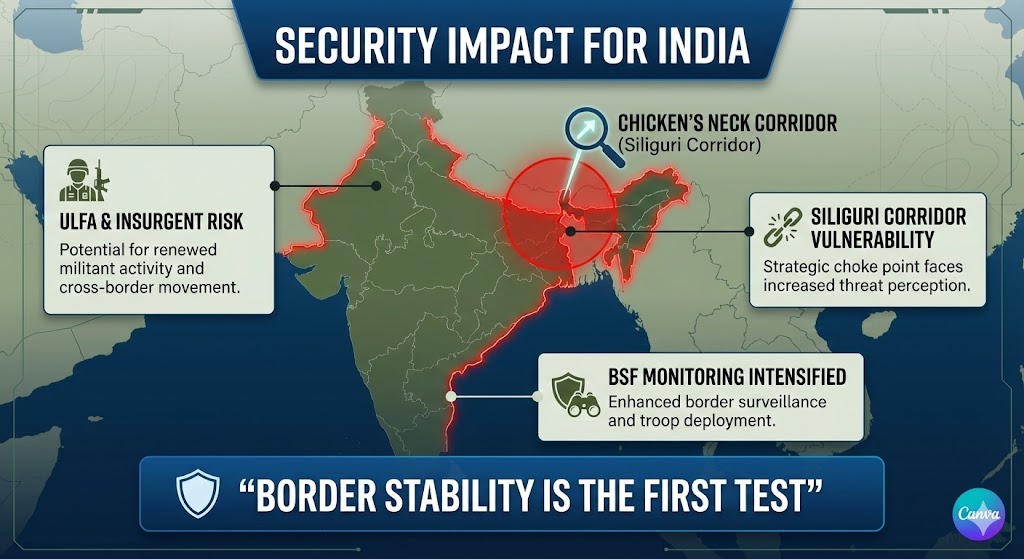
Under Sheikh Hasina, India enjoyed what can be described as a security guarantee. Anti-India insurgent groups like ULFA and other Northeast militant outfits were denied safe havens in Bangladesh. Joint intelligence cooperation improved significantly after 2009. Several insurgent leaders were arrested and handed over to India.
With the BNP in power, that implicit security comfort is no longer automatic. Historically, during BNP rule in the early 2000s, India had concerns about cross-border militant activity. While it is too early to predict policy direction, the risk perception has increased.
India’s “Chicken’s Neck” corridor, also known as the Siliguri Corridor, is a narrow stretch connecting mainland India to the Northeast. Any instability along the Bangladesh border can amplify vulnerability in this region. The first leading indicators to watch will be Border Security Force (BSF) reports. If infiltration attempts rise or border incidents increase, markets and policymakers will quickly reassess risk levels.
Security cooperation may continue, but it will now depend on negotiations rather than political alignment.
B. The Connectivity Valuation
Over the past decade, India invested billions of dollars in connectivity projects with Bangladesh. Rail links such as the Akhaura–Agartala line, access to Mongla Port, and inland waterways agreements were designed to reduce India’s dependence on the narrow Siliguri Corridor. These projects were strategic, not just economic.
The BNP manifesto included promises to review what it called “unequal treaties.” This phrase resonates domestically in Bangladesh, where some sections of society believe India benefited disproportionately from transit agreements.
If the new government decides to renegotiate transit fees or slow down implementation of connectivity projects, it could increase logistical costs for India’s Northeast. Even small policy changes can affect supply chains, especially for goods moving from Kolkata to Agartala or other northeastern states.
However, it is also important to remember that Bangladesh benefits from these arrangements. Transit fees, port usage, and cross-border trade generate revenue. Economic logic may eventually moderate political rhetoric.
C. The China Hedge
Perhaps the most significant long-term factor is China. Tarique Rahman is expected to adopt a balancing strategy, engaging both India and China. Beijing was quick to congratulate the new government, signaling readiness to expand cooperation.
Bangladesh remains part of China’s Belt and Road Initiative (BRI). Infrastructure loans, power plants, and industrial zones funded by China are already part of the landscape. At the same time, Bangladesh’s foreign exchange reserves have faced pressure in recent years. If International Monetary Fund (IMF) conditions become strict, Dhaka may turn to China for financial relief.
This increases Chinese leverage in the Bay of Bengal region. For India, the Bay of Bengal is not just a water body; it is a strategic zone connected to its Act East policy and maritime security interests. A stronger Chinese footprint in Bangladesh complicates India’s strategic calculations.
The Dhaka pivot does not automatically mean anti-India policy. It means multi-alignment. And multi-alignment increases negotiation complexity.
India Ministry of External Affairs statement
4. Government Policy: The “Modi Doctrine” 2.0
Prime Minister Narendra Modi’s congratulatory message was carefully worded. By emphasizing support for a democratic and inclusive Bangladesh, India separated state-to-state relations from party politics. This is a shift from earlier years when political alignment played a visible role.
India is likely to move from political alignment to transactional diplomacy. Instead of relying on shared ideology, New Delhi will focus on projects, trade deals, energy cooperation, and security agreements that create mutual benefit.
One immediate friction point could be the status of Sheikh Hasina. If the new government formally demands her extradition, India will face a sensitive diplomatic situation. It is likely that India may use judicial procedures and legal processes to delay any decision. This issue could become the first test of the new bilateral relationship.
At the same time, India will continue development partnerships, including credit lines and infrastructure funding. Cutting off engagement would push Dhaka further toward Beijing. That is not in India’s interest.
International Crisis Group South Asia analysis
5. Conclusion: The “Long Short” Strategy
In the short term, volatility is expected. Rhetoric around water-sharing agreements, especially the Teesta River treaty, may intensify. Border incidents and nationalist speeches could dominate headlines. For markets and investors, geopolitical risk perception in the region has risen.
However, in the long term, geography remains the ultimate constraint. Bangladesh’s largest trading partner in the region is India. Cross-border trade supports thousands of businesses. Energy cooperation, including electricity exports from India to Bangladesh, creates interdependence.
Bangladesh cannot sustain high growth without regional trade integration. India cannot secure and economically develop its Northeast without cooperation from Bangladesh. These realities create a gravitational pull toward working relations.
Between 2001 and 2006, India and Bangladesh experienced strained ties but eventually stabilized cooperation. A similar pattern may repeat, though with higher stakes due to China’s expanded presence.
The Dhaka pivot is real. The geopolitical risk premium has increased. But history shows that South Asian politics often moves from confrontation to accommodation once economic necessity becomes clear.
For now, caution is justified. But panic is not.
This moment is not the end of India-Bangladesh cooperation. It is the beginning of a new negotiation cycle — one defined less by ideology and more by strategic pragmatism.
And in geopolitics, pragmatism usually wins over time.