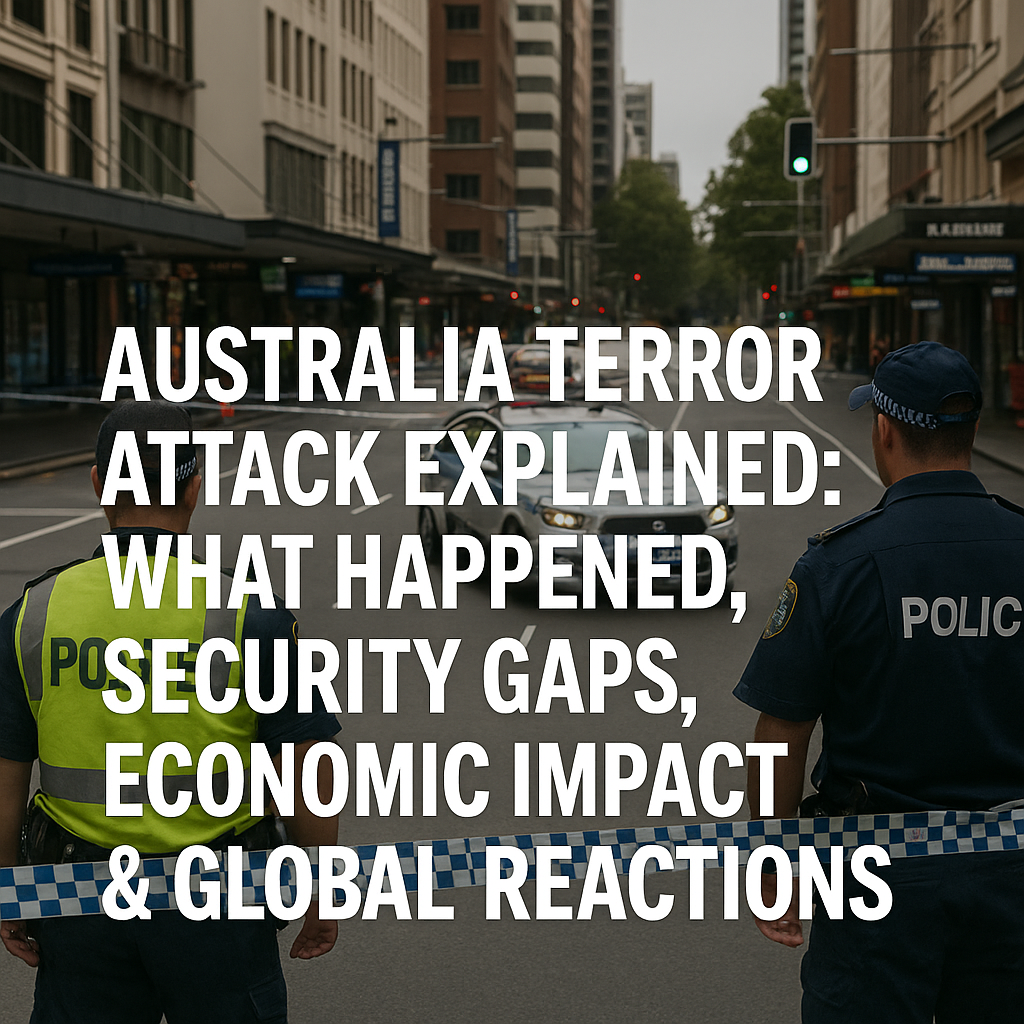
Australia on Edge After Terror Attack: Timeline, Motive & What Comes Next
Introduction: What Happened & Why the World Is Watching
Australia was shaken after a violent terror-linked incident in a major urban center, triggering immediate security alerts across the country and drawing global attention. The attack occurred during busy public hours, forcing authorities to act swiftly to secure the area, evacuate civilians, and launch a counter-terror investigation. Emergency services, local police, and federal agencies coordinated within minutes, underscoring the seriousness of the threat.
What elevates this incident beyond a local crime is Australia’s global standing as a stable, low-risk country with strong intelligence systems. Any breach of public safety here sends a powerful signal to the international community. Governments, investors, airlines, and security agencies worldwide are closely monitoring developments, as such incidents often influence travel advisories, insurance risk models, and counter-terror strategies globally. Diplomatic reactions from major world powers further highlight why this attack matters far beyond Australia’s borders.
Timeline of the Attack: Step-by-Step Breakdown
According to official statements, the attack unfolded rapidly, leaving little reaction time for civilians present at the scene. Initial distress calls were received shortly after the incident began, prompting an immediate response from local police units. Within minutes, specialized counter-terror teams were deployed, and emergency medical services arrived to assist the injured.
Authorities secured the surrounding area, suspended public transport routes nearby, and advised citizens to avoid the location. Hospitals in the region activated emergency protocols, ensuring rapid treatment for casualties. Within hours, federal agencies confirmed that the immediate threat had been neutralized.
The investigation has since moved into a detailed intelligence phase, focusing on the attacker’s background, digital footprint, and any potential connections. Officials have emphasized that inquiries are ongoing, and additional information will be released only after verification to avoid misinformation.
Who Was Targeted and Why? Understanding the Motive
Early assessments by Australian authorities indicate that the attack is being treated as terror-related, though officials have avoided premature conclusions. Initial evidence suggests the involvement of a lone actor rather than a coordinated terrorist cell. This distinction is critical, as lone-wolf attacks are often inspired by extremist ideologies but executed without direct organizational support.
Globally, security agencies have noted a rise in self-radicalized individuals, often influenced through online platforms, extremist propaganda, or encrypted messaging services. Public spaces remain frequent targets because they are open, symbolic, and difficult to fully secure.
Officials have stressed that terrorism should not be associated with any religion, nationality, or community. The focus remains on ideology and individual actions. Understanding motive is essential not only for justice but also for preventing similar incidents in the future.
Australia’s Internal Security: Gaps, Challenges & Preparedness
Australia’s national terror threat level has remained at “Probable” for several years, meaning authorities believe an attack is likely. Since 2014, Australian security agencies have disrupted more than 20 major terror plots, highlighting strong intelligence capabilities. However, this incident underscores persistent vulnerabilities.
Urban environments, crowded public events, and rapid online radicalization present ongoing challenges. Intelligence agencies rely heavily on surveillance, data analysis, and international cooperation, but lone actors often fall outside traditional detection models.
Previous reviews have warned about the difficulty of monitoring individuals who radicalize quickly and act independently. This attack is expected to trigger fresh assessments of intelligence sharing, local policing resources, and early-intervention programs. Preparedness remains strong, but adaptability is now the key focus for policymakers.
Economic Impact: Markets, Tourism & Investor Sentiment
From an economic standpoint, terror incidents often generate short-term uncertainty, even in resilient economies like Australia. While broader markets remained largely stable, sectors such as tourism, airlines, retail, and hospitality are typically the most sensitive to security concerns.
Tourism contributes over AUD 150 billion annually to Australia’s economy and supports millions of jobs directly and indirectly. Any perception of increased risk can affect international travel decisions, hotel occupancy, and airline bookings. Insurance premiums and security costs for businesses may also rise.
The Australian government acted quickly to reassure investors, emphasizing institutional stability and effective law enforcement. Economists note that unless attacks become frequent, long-term growth fundamentals remain intact. Still, confidence management is crucial in preventing broader economic fallout.
Political & Global Reactions: Diplomatic Fallout
Official website of Department of Home Affair Australlia click here
Australian leaders condemned the attack in the strongest terms, reaffirming the nation’s commitment to countering terrorism while preserving democratic values. The Prime Minister emphasized unity, resilience, and the importance of not allowing fear to divide society.
World leaders responded swiftly. The United States, United Kingdom, France, and Germany expressed solidarity and offered intelligence cooperation. Such responses reflect Australia’s role within global security frameworks, particularly the Five Eyes intelligence alliance.
The attack also fits into a broader geopolitical narrative of rising global insecurity and decentralized extremist threats. Diplomatically, incidents like this often accelerate cooperation on counter-terror financing, intelligence sharing, and online extremism controls.
Reactions from Israel, India & Other Global Leaders
Israel, a country with extensive counter-terror experience, expressed strong solidarity with Australia. Israeli leaders emphasized the shared global fight against terrorism and offered expertise in intelligence and public security. Israel’s response highlighted the importance of proactive intelligence and rapid response mechanisms.
India also condemned the attack unequivocally. Indian leadership reiterated that terrorism is a global threat requiring collective action. Given India’s long experience dealing with terror incidents, officials stressed international cooperation, intelligence sharing, and the need to address radicalization at its roots.
Leaders from Japan, Canada, and several Middle Eastern nations echoed similar sentiments. The unified global response reinforces the reality that terrorism is no longer confined by borders and must be addressed through coordinated global strategies.
Impact on Communities & Social Harmony
Beyond physical harm, terror attacks aim to spread fear and disrupt social cohesion. In response, community leaders across Australia called for calm, unity, and compassion. Vigils and messages of solidarity emphasized that violence must not be allowed to divide society.
Authorities warned against misinformation and urged citizens to rely on verified sources. In the digital age, rumors can spread faster than facts, amplifying panic and mistrust. Responsible media reporting and transparent communication from leadership play a critical role during such moments.
Australia’s multicultural fabric has historically shown resilience in the face of adversity. This incident has once again tested that strength, with leaders emphasizing that extremism must be confronted without stigmatizing any community.
What Happens Next? Policy Changes & Security Measures
In the aftermath of terror incidents, governments often reassess security frameworks. Australia is expected to increase police presence at major public venues and events in the short term. Enhanced surveillance, particularly of online extremist content, may also be expanded.
Possible legislative changes could include stricter monitoring powers or adjustments to counter-terror laws. However, such measures will likely face scrutiny from civil liberties advocates, highlighting the balance between security and freedom.
Long-term, experts believe the focus will shift toward prevention—addressing online radicalization, mental health, and social isolation. The policy direction chosen now could shape Australia’s internal security approach for years to come.
Expert Opinions & Analyst Insights
Security analysts describe the attack as part of a broader global trend toward decentralized terrorism. Former intelligence officials note that no open society can eliminate risk entirely, especially from lone actors.
Policy experts argue that intelligence operations alone are insufficient. Community engagement, early-warning systems, and counter-radicalization programs are increasingly seen as essential tools.
Economic analysts add that transparent government communication is vital to maintaining market confidence. Together, expert views underline that terrorism is not only a security issue but a societal and economic challenge requiring a multi-layered response.
Conclusion: A Turning Point for Australia?
This attack is a sobering reminder that even the safest nations are not immune to modern terrorism. Australia’s swift response, institutional strength, and social unity demonstrate resilience, but the incident also exposes evolving threats in a connected world.
The lessons extend far beyond Australia—highlighting the need for global cooperation, adaptive security policies, and responsible leadership. While fear is a natural response, history shows that informed action and unity are the most effective answers. For Australia and the world, vigilance—not panic—will define the path forward.
✅ FAQ Section (For Article Body – Human Tone)
Q1. What happened in the Australia terror attack?
A violent terror-linked incident occurred in a major Australian city, prompting an immediate response from police, emergency services, and counter-terror agencies. Authorities secured the area, treated casualties, and launched a federal investigation. The situation was brought under control within hours, and officials confirmed there was no ongoing threat to the public.
Q2. Was the Australia attack linked to an international terrorist organization?
At this stage, authorities have not confirmed any direct link to an organized international terrorist group. Early assessments suggest the involvement of a lone actor influenced by extremist ideology. Investigators are examining digital footprints, communication records, and possible online radicalization while avoiding premature conclusions.
Q3. Why is the Australia terror attack important globally?
Australia is considered one of the safest developed nations with strong intelligence systems. An attack there raises global concerns about evolving terror threats, lone-wolf radicalization, and urban security vulnerabilities. The incident has implications for global travel, insurance risk assessments, and international counter-terror cooperation.
Q4. How did world leaders respond to the Australia terror attack?
Leaders from the United States, India, Israel, the United Kingdom, and several other nations condemned the attack and expressed solidarity with Australia. Many offered intelligence cooperation and emphasized the need for coordinated global efforts to combat terrorism and extremist violence.
Q5. What impact can a terror attack have on Australia’s economy?
While long-term economic damage is unlikely, terror incidents can cause short-term pressure on tourism, airlines, hospitality, and investor sentiment. Australia’s tourism sector alone contributes over AUD 150 billion annually, making confidence and security perception crucial for economic stability.
Q6. What security measures may Australia introduce after the attack?
Authorities may increase police presence, enhance surveillance of extremist content, tighten event security, and review counter-terror legislation. Long-term focus is expected to shift toward early intervention, online radicalization prevention, and intelligence-sharing reforms.
Q7. How can misinformation during terror incidents be prevented?
Governments and media organizations urge citizens to rely on verified official sources. Responsible reporting, transparent communication, and public awareness are critical to preventing panic, social division, and the spread of false information online.