Ather Energy Q2 FY 2025-26 Financial Report: Loss Narrows as Revenue Surges; Market Share Climbs and Guidance Signals Aggressive Expansion
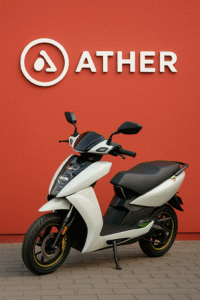
Ather Energy delivered a strong Q2 FY 2025-26 (July–Sept 2025), narrowing losses on the back of brisk scooter sales, improving margins, and a growing contribution from software, services and accessories. Headline numbers first: revenue from operations rose ~54% year-on-year to ₹898.9 crore while net loss narrowed to ₹154.1 crore from ₹197.2 crore in the year-ago quarter. Volumes jumped to 65,595 units, up 67% YoY, pushing adjusted gross margin to 22% as the company leaned into non-vehicle revenue streams (warranty programs, accessories, subscriptions) which now contribute roughly 12% of total revenue. Reuters+1
Operationally, Ather’s footprint has expanded rapidly. The company now operates over 524 Experience Centres and is targeting ~700 stores by March 2026, a retail build-out that management says will broaden reach beyond its southern India stronghold.
Quick-glance comparison table
| Metric | Q2 FY 2025-26 | Q1 FY 2025-26 | Q2 FY 2024-25 |
|---|---|---|---|
| Revenue from operations (₹ crore) | 898.9 | 673 | 583 |
| Net loss (₹ crore) | 154.1 | 178.2 | 197.2 |
| Units sold (scooters) | 65,595 | 46,078 | 39,305 |
| Adjusted gross margin | 22% | — | ~19% (YoY +300 bps implies ~19% last year) |
| Market share (E2W) | 17.4% | 14.3% | 12.1% |
Sources: Q2 FY26 revenue/loss, margin, non-vehicle mix, unit sales and store count from Reuters and Business Standard; Q1 FY26 revenue/loss from Financial Express; Q2 FY25 revenue/loss from Entrackr and Hindustan Times; market-share trail and unit comparatives from Business Standard.
What changed in Q2 — and why it matters
1) Demand tailwinds and product mix. Ather’s quarterly sales hit 65,595 units, helped by rising acceptance of family-focused models (notably the Rizta) and denser retail coverage. That 67% YoY jump compares with 46,078 units in Q1 FY26 and 39,305 in Q2 FY25, underscoring both sequential and annual momentum. The mix continues to skew toward higher-value variants, which supports margin improvement.
2) Margin trajectory is improving. Management highlighted an adjusted gross margin of 22%, up ~300 bps YoY, driven by value engineering and a rising share of non-vehicle revenue (software subscriptions, charging services, accessories, spares and maintenance). That non-vehicle bucket contributed ~12% of total revenue this quarter. Better operating leverage also tightened the EBITDA loss compared to last year.
3) Loss narrowed despite cost pressure. Ather reported a net loss of ₹154.1 crore, improving from ₹197.2 crore a year ago and ₹178.2 crore in Q1 FY26. Material costs still rose, but top-line growth and margin gains cushioned the P&L.
4) Share gains and distribution scale. Market share rose to 17.4% (vs 14.3% in Q1 FY26 and 12.1% in Q2 FY25), with Ather maintaining leadership in the South and growing faster in “Middle India” as store density increases. The company added 173 Experience Centres in H1 and 78 in Q2, taking the network to 524. Management targets ~700 by March 2026.
How Q2 stacks up vs Q1 FY 2025-26
Sequentially, revenue rose from ~₹673 crore in Q1 to ₹898.9 crore in Q2 — a ~33% QoQ lift, supported by seasonality, network expansion, and a fuller quarter for newer models. Net loss improved from ₹178.2 crore to ₹154.1 crore, reflecting scale benefits and stronger non-vehicle monetisation. Volumes climbed from 46,078 to 65,595 units (+42% QoQ).
Why that’s encouraging: Ather’s profitability path hinges on (a) volume scale, (b) component cost rationalisation, and (c) software/services ARPU. Q2 delivered progress on all three vectors, with management calling out cost discipline and improving operating leverage alongside rising subscription and warranty revenues.
How Q2 FY 2025-26 compares with Q2 FY 2024-25
On a year-on-year basis, Ather turned in revenue growth of ~54% (₹898.9 crore vs ₹583 crore a year earlier), reduced net loss (₹154.1 crore vs ₹197.2 crore), and 67% higher unit sales (65,595 vs 39,305). The margin story is also cleaner: adjusted gross margin hit 22%, roughly +300 bps YoY, aided by value engineering and a broader revenue mix.
Management guidance and strategic priorities
While Ather doesn’t issue formal profit guidance, management commentary this quarter points clearly to the levers they’re pulling:
Retail expansion & geographic diversification. From 265 centres in Dec 2024 to 524+ now and a plan to reach ~700 by March 2026 — the intent is to move from concentrated strength in the South to a more balanced national footprint. That mix shift is already visible in market-share gains in Middle India and “rest of India.”
Platform evolution and new products. Analysts expect growth to accelerate with scooters on new platforms that broaden the target audience beyond performance-centric buyers. This ties directly to scaling volumes and softening price sensitivity.
Software & services monetisation. With non-vehicle revenue at ~12%, Ather sees expanding attachment rates (warranty, subscriptions, charging) as a durable way to lift gross margin and reduce earnings volatility through the cycle.
Charging ecosystem and software stack. Rollout of AtherStack 7.0 and a denser Ather Grid fast-charging network (4,322 points across India and select neighbouring markets) are positioned as stickiness drivers and brand moat.
Bottom line of the guidance: Expect Ather to continue prioritising scale with improving unit economics, even as it remains loss-making for now. Management’s near-term ambition is to keep pushing volumes, grow non-vehicle income, and drive operating leverage — the combination that brought Q2 losses down and could move EBITDA closer to breakeven in coming quarters if execution holds.
What this means for FY 2025-26 at the half-way mark (H1)
At mid-year, the direction of travel is clear: H1 volumes and revenue are up sharply, losses are narrowing, and market share is rising. The risks to watch are input-cost swings, incentive/政策 changes that affect EV affordability, and competitive pricing from rivals. But Ather’s software-defined approach, subscription bundles, and retail density provide counterweights that didn’t exist a couple of years ago.
Editorial take: five investor-style takeaways
Scale is working. Q2 shows higher revenue per store and better throughput as the network scales. QoQ revenue +~33% with QoQ unit +42% suggests network productivity remains healthy. The Financial Express+1
Margins are on a credible path. Adjusted GM at 22% (up ~300 bps YoY) plus higher services attach rates is the right kind of improvement — relatively resilient to discount cycles. Business Standard
Losses are compressing, not vanished. ₹154.1 crore net loss still reflects scale-up costs and battery/material inflation, but the direction is favourable both YoY and QoQ. Reuters+1
Share gains matter. 17.4% market share in Q2, up meaningfully from 12.1% a year ago, signals that execution is translating to competitive wins, not just a rising market tide. Business Standard
Guidance: expansion first, profitability next. The push to ~700 stores by March 2026 keeps the flywheel turning; services/software monetisation is the margin safety-net as hardware volumes scale. Reuters