Assam Earthquake Explained: Why Zone V Remains India’s Biggest Seismic Risk in 2026
I. The Event: Real-Time Data Breakdown
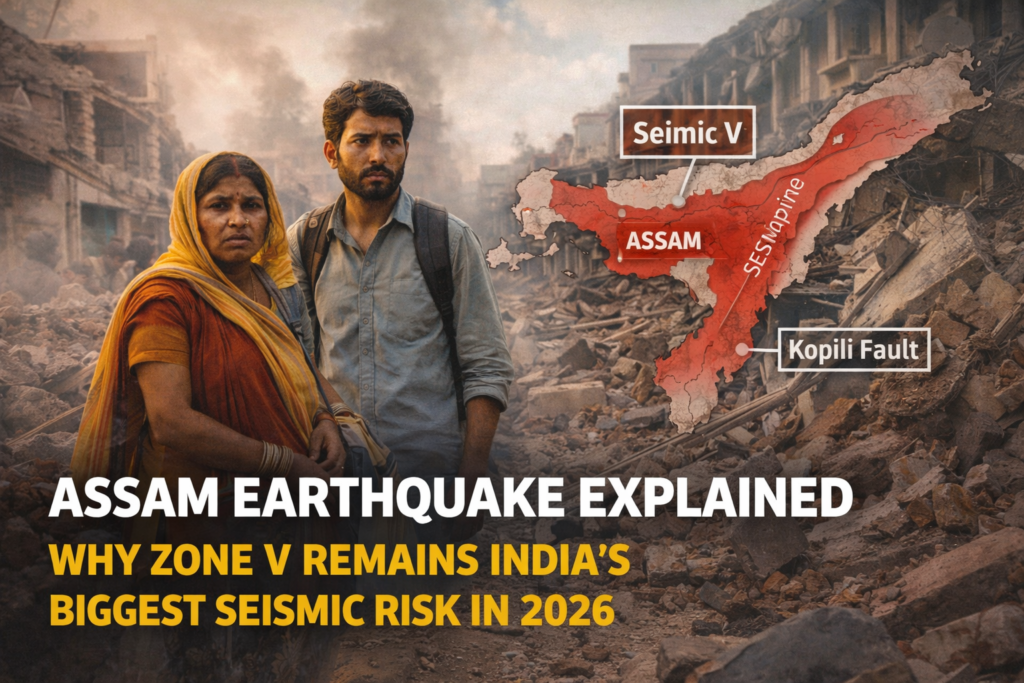
In the early hours of January 5, 2026, when most of Assam was asleep, the ground beneath Central Assam shook sharply. At 04:17:40 IST, a 5.1 magnitude earthquake struck the region, instantly reminding millions that the Northeast lives on one of India’s most fragile geological fault lines. According to official seismic readings, the epicenter was located in Morigaon district at coordinates 26.37°N, 92.29°E, with a focal depth of 50 kilometers.
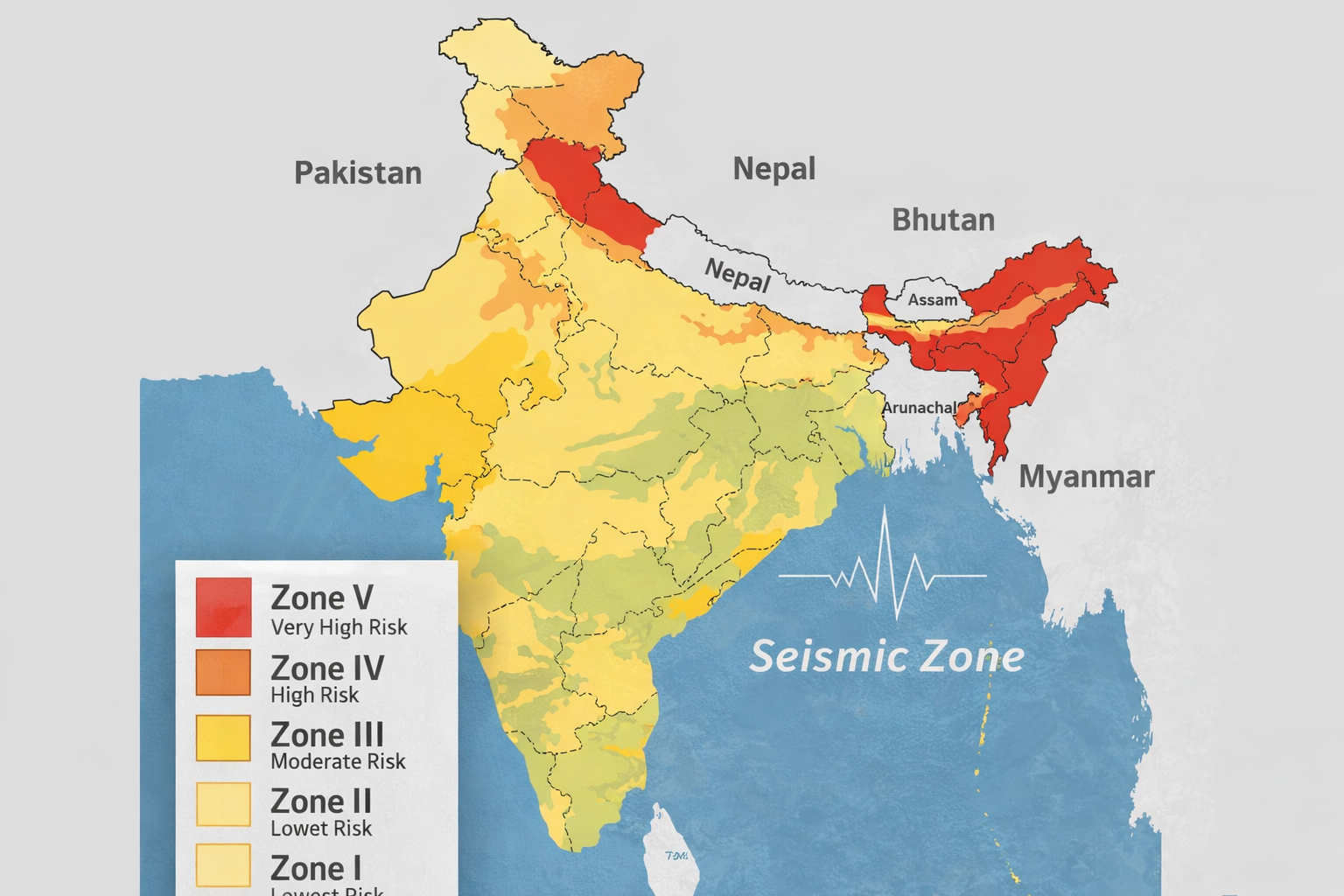
On the surface, the damage appeared limited. Two injuries were reported in Morigaon—Niraj Kumar and Joimati Deori—both treated for non-life-threatening trauma. In nearby Nagaon district, particularly in the Samaguri area, residents reported minor structural damage such as cracked walls and partial collapses of old boundary structures. Schools and offices remained shut for inspections, but no large-scale evacuations were needed.
What made the quake significant was its geographic reach. Tremors were felt across Meghalaya, Arunachal Pradesh, parts of Bangladesh, and even Bhutan. Social media filled with videos of swaying fans and startled residents running outdoors, while emergency helplines lit up across the region. For disaster managers, this was not a crisis—but it was a clear warning.
National Centre for Seismology
II. The Geologic Logic: India–Eurasia Plate Convergence
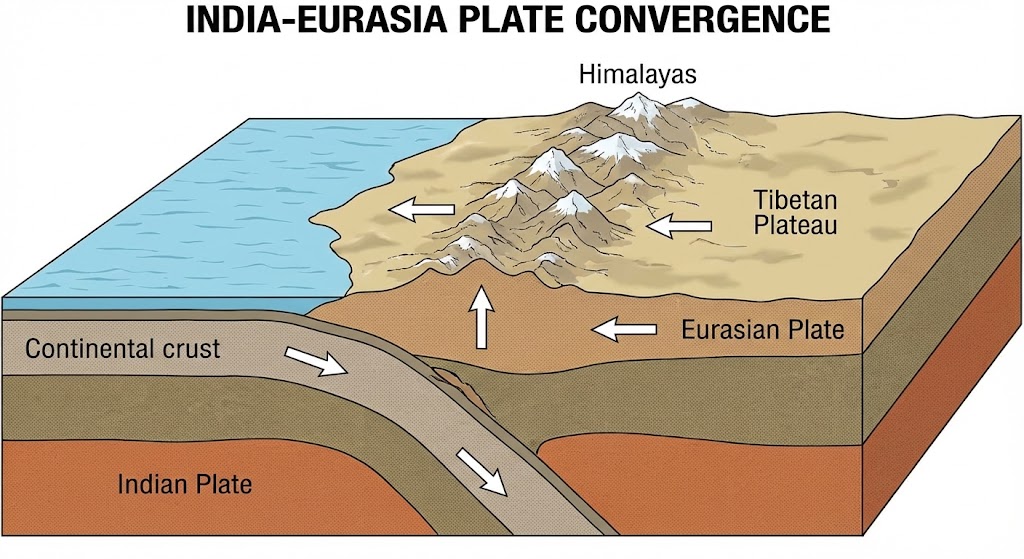
To understand why even a “moderate” quake like this matters, one must look beneath the surface—literally. Assam lies in Seismic Zone V, the highest risk category in India’s seismic zoning map. This is where the Indian tectonic plate pushes relentlessly beneath the Eurasian plate at a rate of roughly 40–50 millimeters per year. That pressure does not disappear; it accumulates.
One of the most dangerous fault systems in this region is the Kopili Fault, a nearly 300-kilometer-long fault zone running across Assam and parts of Meghalaya. Geological studies show that this fault is capable of producing earthquakes of magnitude 8.0 or higher. History offers a sobering reminder: the 1869 Cachar earthquake, linked to this fault system, caused widespread destruction across the Brahmaputra Valley.
The January 5 quake occurred close to the Kopili Fault zone, making it especially significant. Its 50 km depth meant that much of the seismic energy was released deep underground, reducing surface destruction. In seismic terms, this acted like a pressure release valve. However, experts caution against complacency. Deep earthquakes often indicate stress readjustment, not stress elimination.
Another critical factor is the alluvial soil of the Brahmaputra Valley. This loose, sediment-rich soil amplifies seismic waves, meaning even moderate earthquakes can feel much stronger at the surface. In a future shallow quake, the same region could experience far greater damage.
In short, this was not “just another tremor.” It was a geological reminder that Assam sits atop a ticking tectonic clock.
Geological Survey of India (GSI)
III. Geoeconomic Implications: Infrastructure vs. Instability
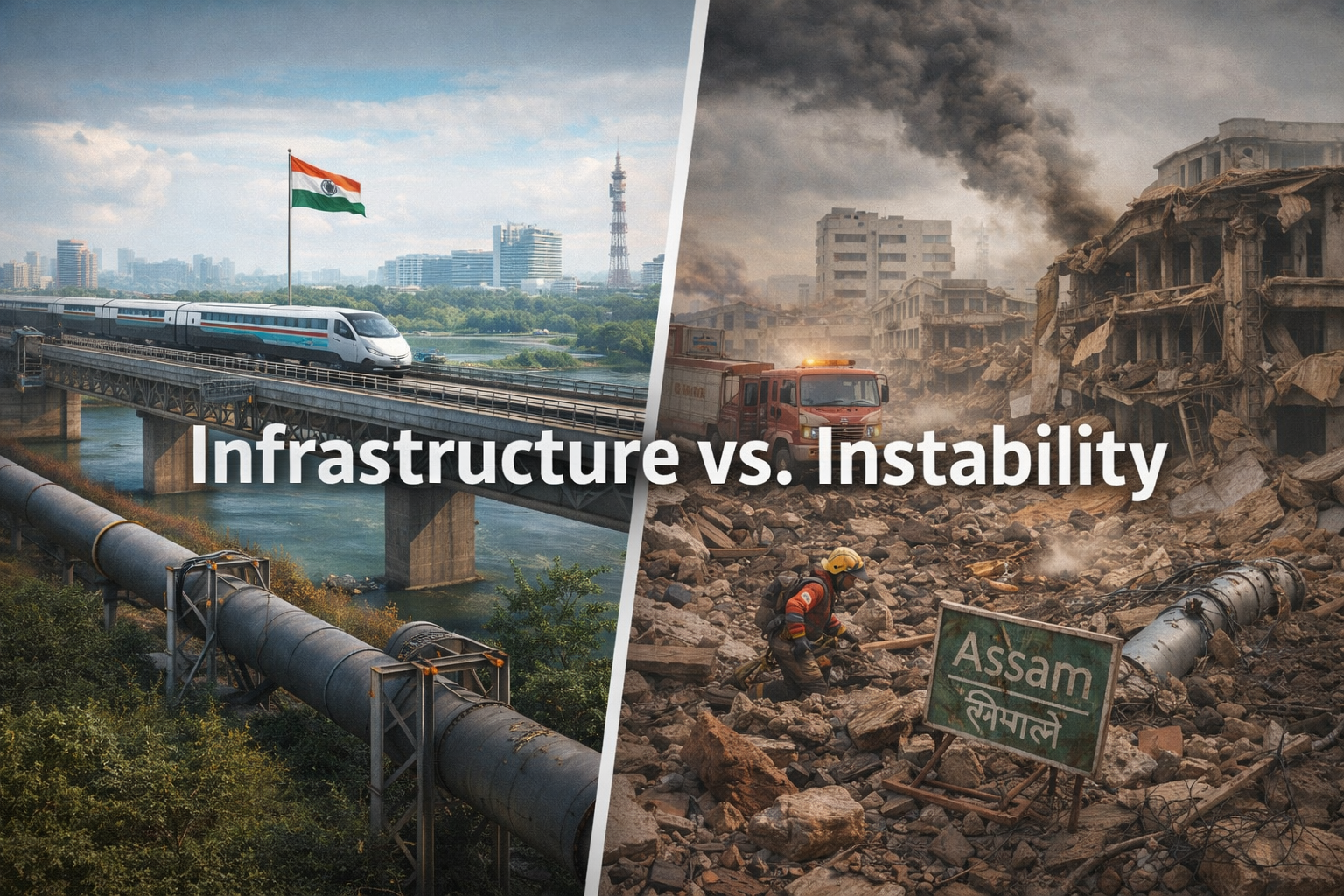
Earthquakes in Assam are not only natural events; they carry strategic and economic consequences. Central Assam is a vital corridor for India’s Northeast. Roads, railways, pipelines, and digital cables passing through this region connect the Northeast to the rest of the country—and beyond.
One of the most sensitive areas is India’s “Chicken’s Neck” corridor, the narrow Siliguri corridor that links the Northeast to mainland India. While the quake did not directly affect this stretch, any major seismic disruption in Assam could paralyze supply lines feeding into it. The North East Gas Grid, a multi-billion-rupee project aimed at integrating regional energy markets, also passes through seismic-sensitive terrain.
Beyond national concerns, the regional impact matters. Since tremors were felt in Bangladesh and Bhutan, the earthquake highlights the absence of a fully integrated cross-border seismic early warning system. Natural disasters do not respect political boundaries. Yet data sharing, early alerts, and coordinated drills remain limited in South Asia.
Platforms like BIMSTEC are often discussed in trade and security terms, but earthquakes make a strong case for disaster diplomacy. A shared seismic network could save lives across borders, especially in densely populated river basins.
India has taken steps domestically. By early 2026, the country is in the final phase of installing 100 new earthquake observatories, improving detection sensitivity to 2.5 magnitude events. This enhances early detection and modeling—but without regional integration, warning time remains limited.
BIMSTEC
IV. Policy Analysis: Beyond the National Disaster Response Force
When earthquakes strike, attention often turns to rescue teams like the National Disaster Response Force (NDRF). Their role is crucial, but disaster resilience begins long before rescue operations.
The uncomfortable truth is that building compliance in Assam’s urban centers remains weak. Cities like Guwahati and towns such as Morigaon have seen rapid, often unregulated construction over the last two decades. Multi-storey buildings frequently ignore seismic design norms, even in Zone V.
There is a paradox here. While institutions spend enormous energy verifying voter rolls, tax records, and digital IDs, structural safety enforcement remains lax. The real “purge” Assam needs is not administrative—it is the removal or retrofitting of non-compliant buildings.
Another gap is insurance penetration. In high-risk zones like Assam, earthquake insurance coverage is extremely low. For many families, a major quake would mean total financial ruin. Post-disaster health and sanitation challenges—often overlooked—can cause long-term suffering even when immediate casualties are limited.
Resilience is not just about response; it is about preparedness, enforcement, and recovery planning. Without these, even a moderate earthquake can become a social crisis.
National Disaster Management Authority (NDMA)
V. The Assam Earthquake of January 5, 2026: At a Glance
| Parameter | Data Point | Significance |
|---|---|---|
| Magnitude | 5.1 (Richter Scale) | Moderate; a “wake-up call” |
| Depth | 50 km | Reduced surface damage |
| Epicenter | Morigaon District | Near Kopili Fault |
| Key Risk Zone | Seismic Zone V | High future risk |
| Regional Impact | India, Bangladesh, Bhutan | Need for cross-border coordination |
This table captures why the event matters beyond immediate damage.
VI. Conclusion: The Strategic Imperative of Seismic Statecraft
The Assam earthquake of January 5, 2026, caused limited damage—but its implications are profound. In a region as geopolitically sensitive as the Northeast, natural disasters are strategic vulnerabilities. Infrastructure disruption, population displacement, and economic paralysis can quickly turn a geological event into a national security concern.
If India aspires to lead the Global South, it must master what can be called Seismic Statecraft. This means integrating AI-driven early warning systems, enforcing strict building codes, expanding insurance coverage, and building cross-border disaster cooperation mechanisms.
Earthquakes cannot be prevented. But their impact can be managed. The Assam tremor was a reminder—not of fear, but of responsibility. The question is whether policymakers will treat it as a brief headline, or as a signal to build a more resilient Northeast before the next, stronger quake arrives.
In Zone V, preparedness is not optional. It is the price of survival—and stability.
❓ Frequently Asked Questions (FAQ)
1. What was the magnitude of the Assam earthquake in January 2026?
The earthquake that struck Assam on January 5, 2026, had a magnitude of 5.1 on the Richter scale. It is considered a moderate earthquake but significant due to Assam’s high seismic risk zone.
2. Where was the epicenter of the Assam earthquake located?
The epicenter was located in Morigaon district, Central Assam, at a depth of about 50 kilometers, which helped reduce surface-level damage.
3. Why is Assam classified as Seismic Zone V?
Assam lies in Seismic Zone V, the highest-risk category in India, because it sits near active fault lines where the Indian tectonic plate collides with the Eurasian plate. This makes strong earthquakes more likely.
4. What is the Kopili Fault and why is it dangerous?
The Kopili Fault is a major geological fault running through Assam and Meghalaya. Scientists believe it can generate earthquakes of magnitude 8.0 or higher, making it one of the most dangerous fault zones in India.
5. Why did this earthquake cause limited damage despite being in Zone V?
The quake occurred at a depth of 50 km, which allowed seismic energy to dissipate before reaching the surface. Shallow earthquakes usually cause more destruction.
6. Can a bigger earthquake happen in Assam in the future?
Yes. Geological studies suggest that Assam remains under high seismic stress, and larger earthquakes are possible, especially near the Kopili Fault and Brahmaputra Valley.
7. Which regions felt the tremors of the Assam earthquake?
Apart from Assam, tremors were felt in Meghalaya, Arunachal Pradesh, Bangladesh, and Bhutan, highlighting the regional impact of seismic events.
8. How prepared is Assam for major earthquakes?
While emergency response systems have improved, building code enforcement, insurance coverage, and urban planning remain weak, especially in fast-growing cities like Guwahati.
9. Is India improving its earthquake monitoring systems?
Yes. By 2026, India is adding 100 new earthquake observatories nationwide to improve early detection and seismic data accuracy.
10. Why are earthquakes in Assam considered a geopolitical risk?
Assam is a strategic corridor connecting India’s Northeast. Major earthquakes can disrupt energy pipelines, transport routes, and regional connectivity, affecting national security and trade.
11. What is “Seismic Statecraft”?
Seismic Statecraft refers to integrating science, infrastructure planning, early warning systems, and regional cooperation to manage earthquake risks as a strategic priority.
12. Do earthquakes respect national borders?
No. Earthquakes affect entire regions. That’s why experts recommend cross-border early warning systems involving India, Bangladesh, Bhutan, and Myanmar.
13. What should residents in Zone V do to stay safe?
Residents should follow earthquake-resistant construction norms, keep emergency kits ready, identify safe spots at home, and stay informed through official alerts.
14. Is earthquake insurance important in Assam?
Yes. Insurance coverage in Assam is very low. In high-risk zones like Zone V, earthquake insurance can protect families from long-term financial loss.
15. What is the biggest lesson from the January 2026 Assam earthquake?
The key lesson is that preparedness matters more than reaction. Moderate earthquakes are warnings to strengthen infrastructure before a larger event occurs.
🔍 People Also Ask (PAA)
Why do earthquakes happen frequently in Assam?
Assam lies in India’s highest seismic risk zone because the Indian tectonic plate is constantly colliding with the Eurasian plate. This continuous pressure makes earthquakes frequent in the region.
What is Seismic Zone V in India?
Seismic Zone V is the highest earthquake risk category in India. Areas in this zone can experience very strong earthquakes and require strict building and safety standards.
Is a 5.1 magnitude earthquake considered dangerous?
A 5.1 magnitude earthquake is moderate. It may not cause major damage, but in high-risk zones like Assam, even moderate quakes are serious warning signs.
Why was damage limited in the January 2026 Assam earthquake?
The earthquake occurred at a depth of about 50 km. Deeper earthquakes usually cause less surface damage compared to shallow earthquakes.
What is the Kopili Fault and why is it important?
The Kopili Fault is a major geological fault in Assam and Meghalaya. Scientists believe it can generate earthquakes stronger than magnitude 8, making it a major risk zone.
Can Assam face a bigger earthquake in the future?
Yes. Geological studies suggest that the region remains under high stress, and stronger earthquakes are possible in the future.
Which countries felt the Assam earthquake tremors?
Tremors were felt in parts of India, Bangladesh, and Bhutan, showing that earthquakes in Assam have cross-border impact.
How prepared is India for major earthquakes in the Northeast?
India has improved monitoring and response systems, but gaps remain in building safety, urban planning, and insurance coverage in the Northeast.
What infrastructure is at risk during earthquakes in Assam?
Roads, railways, gas pipelines, bridges, and power networks are vulnerable, especially those connecting India’s Northeast to the rest of the country.
What is India doing to improve earthquake early warning?
India is expanding its earthquake observatory network and improving real-time monitoring to detect even small tremors faster.
Why are earthquakes in Assam a strategic concern?
Assam is a key gateway to India’s Northeast. Major earthquakes can disrupt connectivity, energy supply, and regional stability.
Do earthquakes follow patterns or predictions?
Exact prediction is not possible. Scientists focus on risk assessment, early warning, and preparedness rather than precise forecasting.
What should people in Zone V do during an earthquake?
They should stay calm, drop to the ground, take cover under sturdy furniture, and move to open areas once shaking stops.
Is earthquake insurance necessary in Assam?
Yes. Given the high risk, earthquake insurance can help families recover financially after a major disaster.
What is the main lesson from the Assam earthquake of 2026?
The earthquake shows that preparedness, strong infrastructure, and early warning systems are essential to reduce future losses.