1. Executive Summary: A Turning Point Quarter for Apollo Hospitals
The Q3 FY26 results of Apollo Hospitals Enterprise Ltd mark a defining moment in the company’s journey. For years, investors appreciated Apollo’s strong hospital business but worried about the heavy losses from its digital arm, Apollo 24/7. This quarter changes that narrative. Apollo reported a consolidated net profit of ₹502 crore, a solid 35% year-on-year jump and significantly above market expectations of around ₹372 crore. Revenue grew 17% to ₹6,477 crore despite Q3 traditionally being a softer quarter due to festivals and seasonal disruptions in cities like Chennai. The company also announced a ₹10 interim dividend, which boosted investor confidence and pushed the stock to a 52-week high. The biggest takeaway, however, is not just profit growth. It is the visible reduction in digital losses. For the first time, Apollo’s hospital profitability is clearly standing on its own, without being overshadowed by the digital cash burn.
Apollo Hospitals Enterprise Ltd
2. Financial Dashboard: Operating Leverage in Action
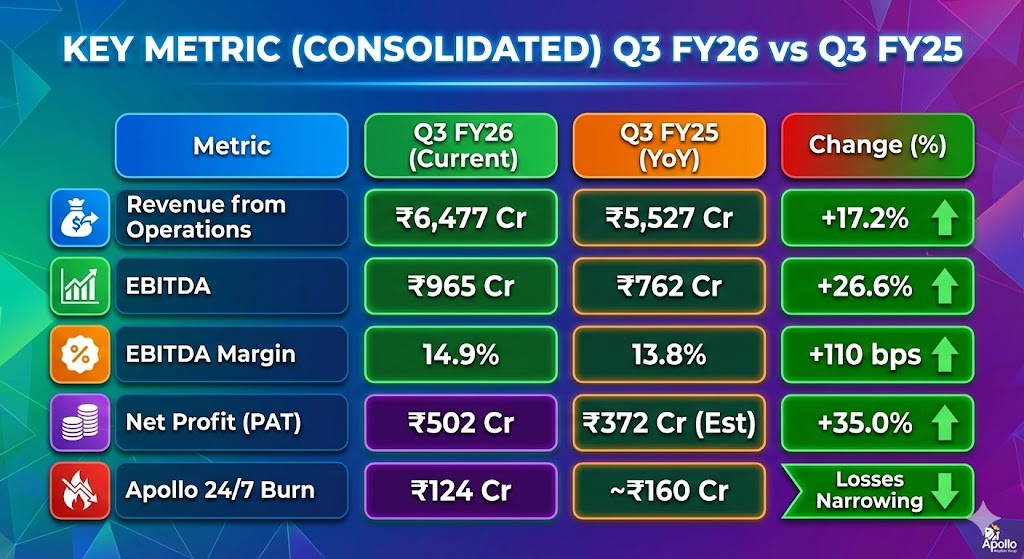
The numbers show clear operating leverage. Revenue rose from ₹5,527 crore last year to ₹6,477 crore, up 17.2%. EBITDA increased 26.6% to ₹965 crore, which is faster than revenue growth, showing improved efficiency. EBITDA margins expanded from 13.8% to 14.9%, a 110 basis point improvement. Net profit climbed to ₹502 crore. Importantly, losses in Apollo 24/7 narrowed to ₹124 crore compared to around ₹160 crore in previous comparable periods. This steady reduction in digital losses means that incremental revenue is now translating more directly into profits. When EBITDA grows faster than revenue, it signals strong cost discipline and better pricing power. In simple words, Apollo is earning more from each patient while keeping costs under control.
Apollo Hospitals Q3 FY26 results
3. Healthcare Services: The Core Hospital Engine Shows Pricing Power
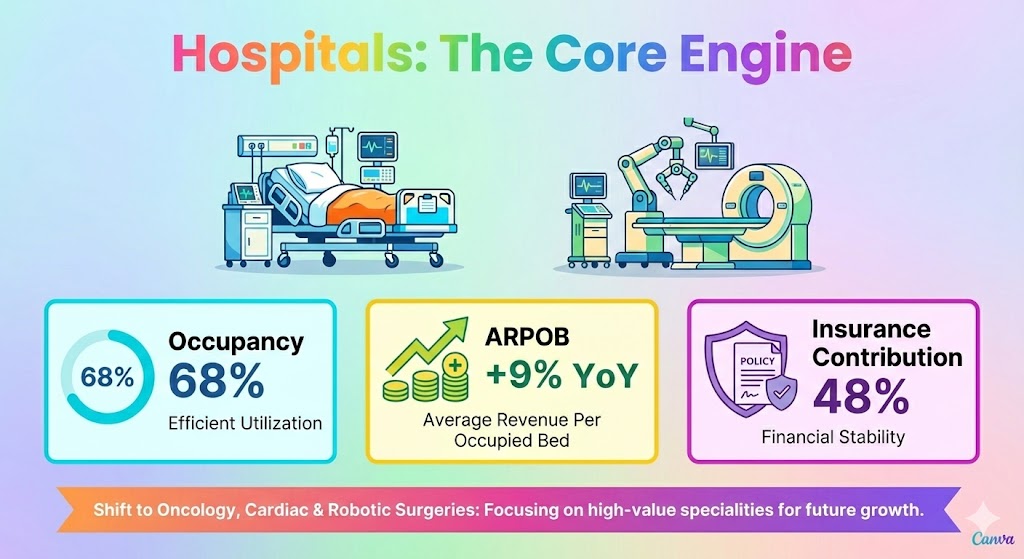
Apollo’s hospital segment remains its strongest pillar. Occupancy levels stayed around 68% even after adding capacity. That means beds are being utilized efficiently without overcrowding. More importantly, the Average Revenue Per Occupied Bed (ARPOB) grew 9% year-on-year. This is not just because more patients came in, but because the mix of treatments improved. Apollo is seeing higher demand for oncology, robotic surgeries, and advanced cardiac procedures. These treatments carry higher margins and require specialized expertise. Insurance coverage also plays a role. Insurance patients now contribute 48% of total revenue, compared to 45% last year. Insured patients often choose higher room categories and advanced procedures, which increases revenue without significantly raising operating costs. This shift in payor mix strengthens long-term profitability.
4. Apollo HealthCo: The Digital Business Nearing Stability
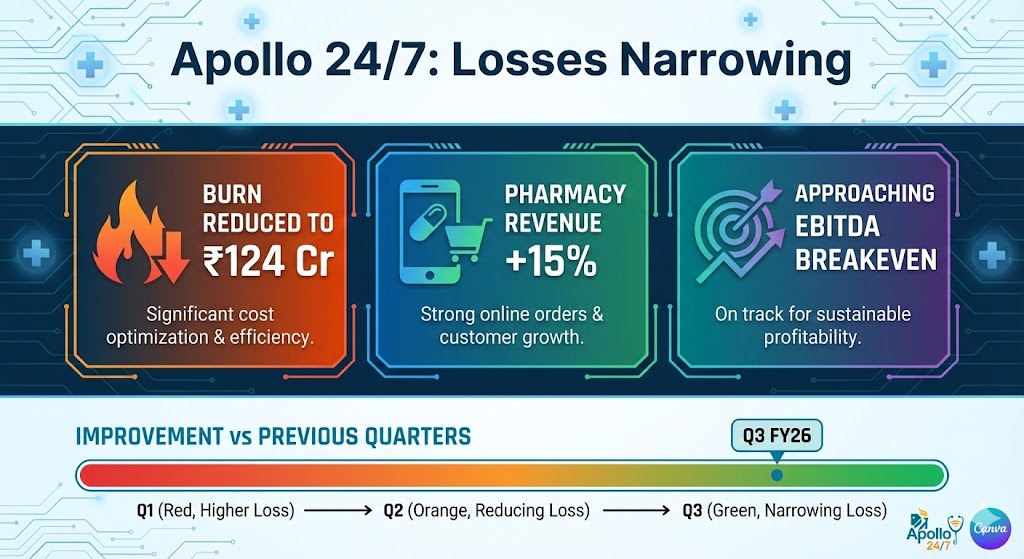
For several years, Apollo 24/7 was seen as a necessary but expensive digital bet. Investors were concerned about rising marketing expenses and technology investments. Q3 FY26 shows visible progress. The digital burn rate narrowed to ₹124 crore. Pharmacy distribution revenue grew 15%, driven by strong demand for chronic care medicines and online prescriptions. Apollo’s strategy is clear: integrate online consultations, pharmacy deliveries, and hospital services into one ecosystem. With talks of listing or restructuring Apollo HealthCo expected by FY27, this quarter provides confidence that the digital arm is approaching EBITDA breakeven. The market previously punished Apollo’s valuation due to digital drag. Now, as losses shrink, that discount may reduce.
health insurance penetration in India
5. Diagnostics and Clinics: Strengthening the Hub-and-Spoke Model
Apollo Health & Lifestyle Ltd (AHLL), which manages diagnostics and clinics, reported revenue growth of 16%. The Board’s decision to buy out the International Finance Corporation’s stake in AHLL is strategically important. Owning 100% of the diagnostics arm allows Apollo to integrate services more tightly. For example, a patient diagnosed at an Apollo clinic is likely to be referred to an Apollo hospital for surgery, and later use Apollo pharmacy services for follow-up care. This “hub-and-spoke” model increases patient retention within the Apollo ecosystem. It also improves margins because the company captures value at multiple points of the healthcare journey. Diagnostics is a high-frequency business and often acts as the first point of contact for patients.
6. Medical Tourism: The Global Tailwind
Medical tourism has emerged as a strong growth driver. International patient revenue grew 20% year-on-year. Hospitals in Chennai and Delhi are witnessing a rise in transplant and specialized surgery cases from Bangladesh, Africa, and parts of the Middle East. The 2026 visa reforms that streamlined medical visa processes have reduced paperwork and waiting times. India’s cost advantage remains compelling. A heart bypass surgery in India can cost one-third of what it costs in the US or Europe. Apollo’s global reputation for quality care makes it a preferred destination. Higher-value procedures from international patients contribute significantly to ARPOB growth and margin expansion.
7. Insurance Reforms: Improving Working Capital
A major structural change benefiting hospitals is the Insurance Regulatory and Development Authority of India’s “Cashless Everywhere” policy. Earlier, hospitals faced delays of up to 30 days for claim settlements. Now, many claims are settled within two days (T+2). This improves the working capital cycle significantly. Faster claim settlement reduces the need for short-term borrowing and lowers interest expenses. For a large hospital chain like Apollo, this change frees up substantial liquidity. Insurance reforms also encourage more patients to choose private hospitals, as the payment process becomes smoother and transparent.
8. Capital Expenditure: Growth Comes at a Cost
Apollo has committed ₹3,000 crore for new hospital projects in Pune and Kolkata. While expansion is essential to maintain market leadership, it increases capital intensity. Return on Capital Employed (ROCE) is expected to remain around 16% over the next two years due to these investments. Building hospitals is expensive and takes time before reaching optimal occupancy levels. Investors must understand that short-term ROCE pressure is part of long-term value creation. Once new hospitals stabilize, they typically generate strong cash flows.
9. Regulatory Risks: The Standardized Rate Debate
There are ongoing discussions about introducing standardized pricing for certain procedures under Universal Health Coverage initiatives. If implemented, this could cap ARPOB growth in the future. While no concrete regulation has been announced yet, it remains a policy risk. Apollo’s strength lies in offering complex and high-end treatments, which may not be fully covered under standardized rates. However, regulatory uncertainty always warrants monitoring.
10. Conclusion: The Blue Chip of Indian Healthcare
Apollo Hospitals today stands as one of India’s most trusted healthcare brands. The 35% profit growth in what is usually a weaker quarter signals strong operational momentum. More importantly, the narrowing digital losses show that the “digital detox” phase is working. Trading at around 65x earnings, Apollo is not cheap. But quality rarely is. Investors pay a premium for strong brand equity, pricing power, and an integrated healthcare ecosystem. If the digital arm reaches breakeven by FY27 and new hospitals scale up successfully, earnings could accelerate further. In many ways, Apollo resembles a blue-chip banking franchise in healthcare — steady, trusted, and structurally growing.
❓ FAQ
Q1. Why did Apollo Hospitals’ profit rise 35% in Q3 FY26?
The profit increase was driven by higher hospital revenue, improved EBITDA margins, better payor mix, and narrowing losses in the digital business Apollo 24/7.
Q2. What is ARPOB and why is it important?
ARPOB (Average Revenue Per Occupied Bed) measures how much revenue a hospital earns per occupied bed. A rising ARPOB indicates better pricing power and improved case mix.
Q3. Is Apollo 24/7 still losing money?
Yes, but losses have narrowed significantly to ₹124 crore in Q3 FY26, showing progress toward breakeven.
Q4. How does medical tourism benefit Apollo Hospitals?
International patients typically opt for high-value procedures, boosting revenue and margins while improving occupancy levels.
Q5. Is Apollo Hospitals stock expensive?
Apollo trades at a premium valuation (around 60–65x earnings), reflecting its strong brand, pricing power, and integrated healthcare ecosystem.