1. The Executive Summary: Why This Quarter Changes the Amber Story
After three decades of watching Indian manufacturing slowly move from screwdriver assembly to genuine engineering depth, Amber Enterprises India Ltd stands out as one of the clearest mirrors of India’s electronics manufacturing transition. Its Q3 FY26 results, reported in early February 2026, are not just about higher profit numbers. They represent a structural shift in how value is being created inside the company.
Amber reported a consolidated net profit of ₹35.87 crore, an 87% year-on-year jump, while revenue rose 26.6% to ₹2,133.33 crore. On the surface, these numbers look impressive. But the real significance lies beneath them. This was a quarter delivered despite seasonal weakness in the room air-conditioner (RAC) segment, which traditionally slows down in winter months. In other words, profit growth did not come from weather luck. It came from operating leverage and diversification.
Markets immediately sensed this shift. The stock moved nearly 5% intraday, touching close to ₹7,000, as investors began pricing in two powerful forces at once: Amber’s move into higher-margin electronics manufacturing services (EMS) and the ₹40,000 crore electronics-focused allocation in the Union Budget 2026. This quarter marks the point where Amber begins to be valued less as an “AC component supplier” and more as an electronics platform company.
Amber Enterprises – Official Financial Results (PRIMARY SOURCE)
2. Financial Dashboard: Reading the Numbers the Right Way
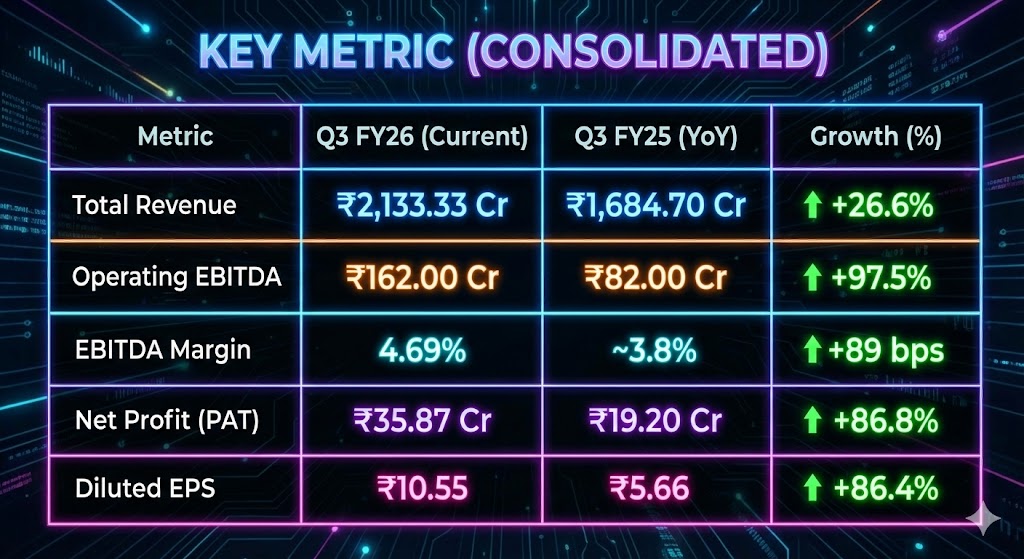
To understand why Q3 FY26 matters, it helps to look at the financial scorecard not as isolated figures, but as indicators of efficiency improvement.
Total revenue came in at ₹2,133.33 crore, compared with ₹1,684.70 crore in Q3 FY25. This 26.6% growth is healthy, but not extraordinary for a fast-growing manufacturer. What stands out is what happened below the revenue line. Operating EBITDA nearly doubled, rising from ₹82 crore to ₹162 crore, a jump of almost 98%. As a result, EBITDA margins expanded from roughly 3.8% to 4.69%, an increase of 89 basis points.
In manufacturing, especially electronics manufacturing, margin expansion of this magnitude in a single quarter is not accidental. It usually indicates a shift in product mix, better absorption of fixed costs, or both. Net profit followed the same trajectory, rising from ₹19.20 crore to ₹35.87 crore, while diluted EPS almost doubled to ₹10.55.
The takeaway here is simple: Amber is no longer growing profit only when volumes surge. It is now extracting more profit from each rupee of revenue, which is the hallmark of a company entering a more mature and defensible phase of growth.
3. Fundamental Breakdown: How Amber Is Reducing Cyclicality
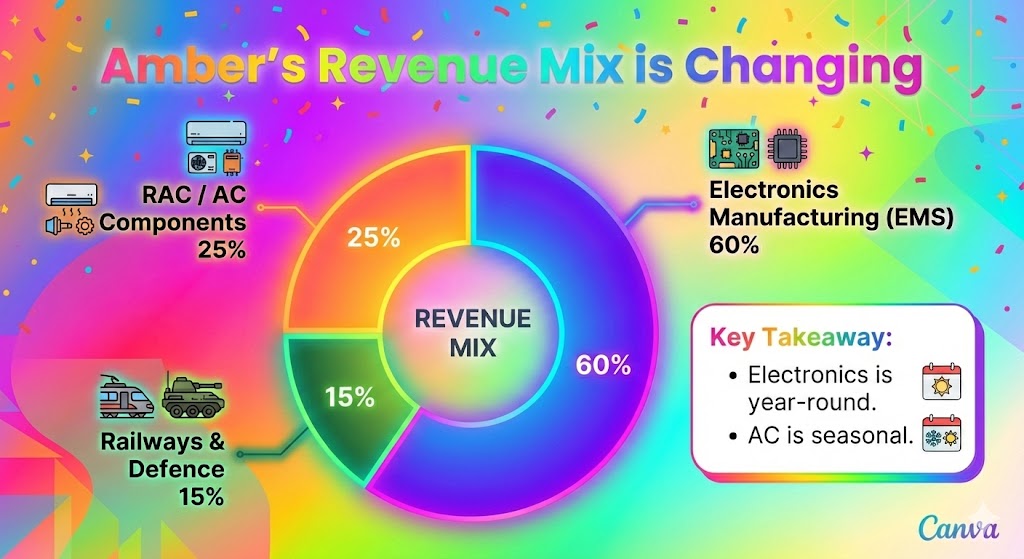
A fundamental analyst always looks for one thing beyond numbers: stability of earnings across cycles. Amber’s Q3 FY26 performance shows that the company is actively reducing its dependence on the highly seasonal RAC business by building three distinct, non-cyclical growth engines.
A. The Electronics Manufacturing Surge (EMS)
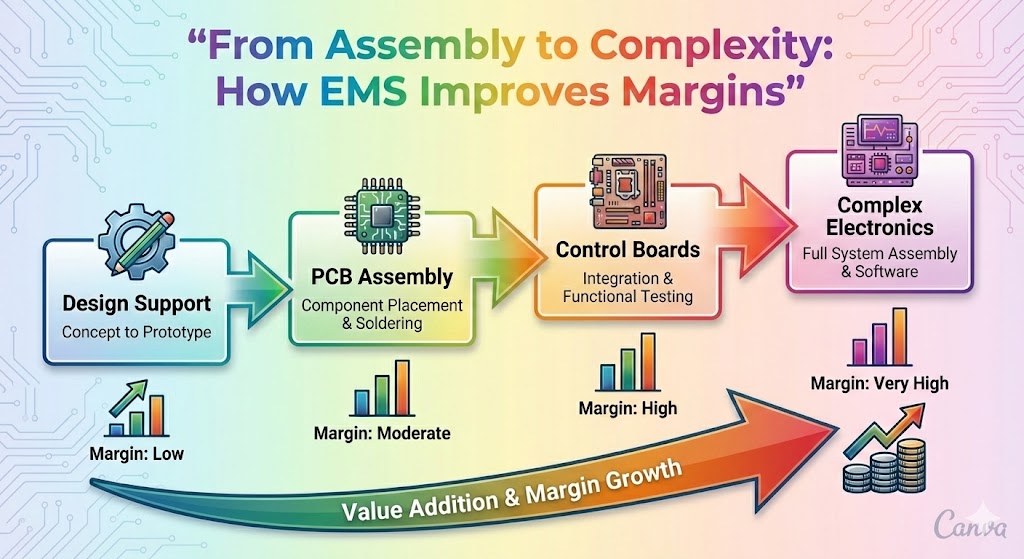
The most important driver of margin improvement this quarter was Amber’s electronics segment. Management guidance suggests that EMS revenues are on track to grow 35–40% year-on-year in FY26, far outpacing the legacy AC segment. Subsidiaries such as IL JIN Electronics and Shogini Technoarts are now focused on high-value components, including multilayer printed circuit boards, control boards, and precision electronics assemblies.
This shift matters because EMS is not just about assembling boxes. It involves tighter tolerances, design collaboration, and deeper integration into customers’ supply chains. These factors create pricing power. Unlike AC manufacturing, which peaks only a few months a year, electronics manufacturing runs through the calendar, smoothing cash flows and capacity utilization.
The expansion in EBITDA margin by nearly 90 basis points in Q3 is largely explained by this change in mix. Amber is earning more from complexity, not just from volume.
B. The Air-Conditioner Business: A Cleaner Base
The RAC segment, long seen as Amber’s core, went through inventory stress over the last year as dealers and OEMs adjusted to GST changes and uneven weather patterns. By Q3 FY26, that overhang had largely normalized. Channel inventory levels are now healthier, setting the stage for a more predictable summer season in FY27.
More importantly, policy direction is working in Amber’s favor. The Union Budget 2026’s focus on City Economic Regions and urban infrastructure is expected to drive higher appliance penetration in Tier-2 and Tier-3 cities. With an estimated 24–26% market share in the OEM/ODM AC space, Amber is structurally positioned to benefit from this next demand wave without aggressive price competition.
C. Railways and Defence: The Long-Cycle Hedge
Amber’s acquisition and integration of Sidwal Refrigeration has quietly opened a third pillar of growth. Sidwal supplies HVAC and refrigeration systems for Vande Bharat trains, metro coaches, and defence shelters. These are long-cycle government contracts with relatively stable margins and multi-year visibility.
This segment does not swing with consumer sentiment or weather. It acts as a stabilizer during weak consumer quarters, which is precisely what makes it strategically valuable. Over time, this vertical can meaningfully reduce earnings volatility, something markets reward with higher valuation multiples.
4. Geopolitics and Policy: Why the India–US Trade Deal Matters
One of the most underappreciated tailwinds for Amber comes from geopolitics rather than domestic demand. The February 2026 India–US Trade Deal sharply altered the export economics for Indian electronics manufacturers. US tariffs on several Indian electronic components have effectively dropped to 18%, compared with punitive levels that earlier approached 50%.
This shift gives India a clear edge over competing manufacturing hubs. Vietnam faces tariffs closer to 20%, while China remains burdened with combined tariff and compliance costs exceeding 45%. For Amber, this is not just theoretical. Management has confirmed active discussions with US buyers for exporting precision AC components, electronics sub-assemblies, and LED drivers starting late FY26.
In a world where global companies are actively de-risking supply chains away from China, Amber is emerging as a credible alternative supplier. This external demand optionality did not exist at scale three years ago. Today, it is becoming a realistic growth lever.
5. Valuation Debate: Expensive Stock or Early-Cycle Leader?
At around 88 times trailing earnings, Amber Enterprises clearly trades at a premium. There is no denying that this valuation leaves little room for operational missteps. However, premium valuations are often assigned not to current earnings, but to future earnings quality.
Supporters of the stock point to two key factors. First, the CFO-to-PAT ratio of over 5, which indicates strong cash conversion and conservative accounting. Second, the expanding net worth base, which has crossed ₹1.7 lakh crore, providing balance-sheet resilience for future capex.
Skeptics, on the other hand, flag elevated inventory levels and higher financing costs linked to recent acquisitions such as Power-One. These risks are real. Any delay in Q4 demand recovery or margin compression could trigger a short-term valuation reset.
For long-term investors, the decision boils down to belief in Amber’s strategy. If electronics and export-led manufacturing scale as planned, today’s valuation may look reasonable in hindsight. If execution falters, volatility will follow.
NSE India – Amber Enterprises Share & Valuation
6. Conclusion: Why Amber Is No Longer Just an AC Company
Amber Enterprises’ Q3 FY26 results are best understood not as a seasonal rebound, but as proof of strategic direction. The company is deliberately moving away from a narrow identity as an air-conditioner assembler toward becoming a diversified electronics manufacturing platform.
The 86–87% profit growth this quarter is only the visible outcome. The deeper story lies in what will unfold over the next three years: the deployment of capacity at Hosur and YEIDA, the impact of the ₹40,000 crore electronics budget, and Amber’s integration into global supply chains reshaped by geopolitics.
For readers of your news blog, the message is clear. Amber’s transformation is not finished, but Q3 FY26 marks the point where the market can no longer ignore it. The real compounding opportunity lies not in the next summer season, but in the structural localization of electronics manufacturing that India is finally beginning to execute at scale.