I. Introduction: The AI and ESG Market Convergence
If you had told a traditional fund manager ten years ago that satellite images and artificial intelligence would one day help decide which companies deserve investment capital, they might have laughed. But in 2026, this is no longer futuristic thinking. It is daily practice on Wall Street and in global financial hubs.
The scale of ESG investing today is massive. The global ESG investment market was valued at approximately $35.48 trillion in 2025. Analysts project that this number could grow to $191.22 trillion by 2035, expanding at a compound annual growth rate of more than 18%. These are not small numbers. This is not a niche segment. This is a structural shift in global capital allocation.
At the same time, institutional spending on AI in environmental sustainability reached around $20.52 billion in 2025. Forecasts suggest that this could rise to over $121 billion by 2035. In simple words, money flowing into green investing is being matched by money flowing into the technology that verifies it.
Why is this happening?
Because ESG has moved from marketing language to measurable financial risk.
Investors are no longer satisfied with glossy sustainability reports. They want proof. They want data. They want verification. And that is where artificial intelligence enters the picture.
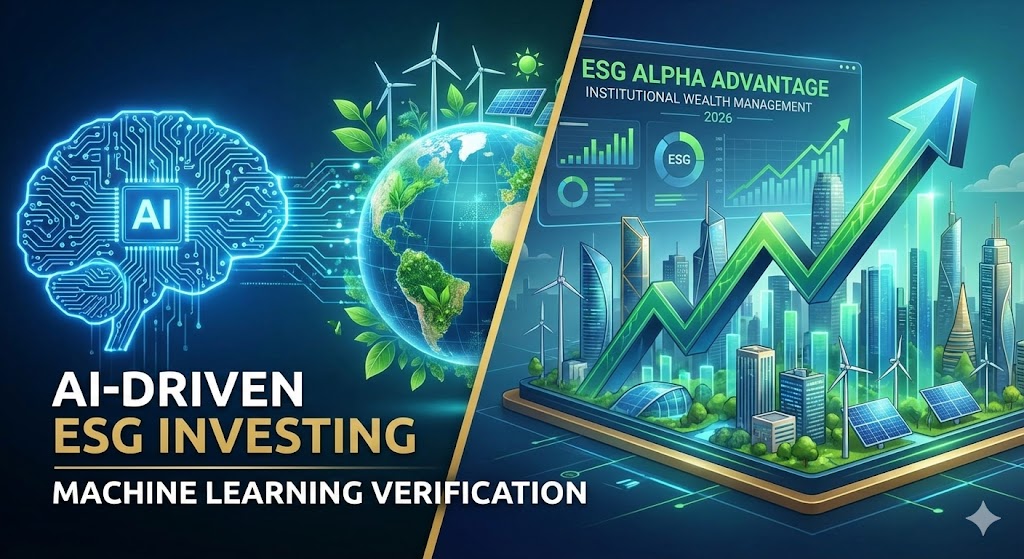
This combination of ESG capital and AI infrastructure is giving birth to what many now call “ESG Alpha.” Alpha, in finance, means outperforming the market. The big question in 2026 is whether machine learning can turn sustainability from a compliance cost into a performance advantage.
ESG Market Growth Data
II. The Historical Problem: Greenwashing and the “Data Gap”
To understand why AI is needed, we must understand the problem it is trying to solve.
For years, ESG investing relied heavily on self-reported company disclosures. Corporations would publish annual sustainability reports describing carbon reductions, labor standards, diversity initiatives, and governance practices. Analysts would review these documents and assign ESG scores.
The problem was inconsistency.
A well-known MIT Sloan study found that the correlation between ESG ratings from different major providers was only 0.61. Compare that with credit ratings, where correlations are close to 0.99. In simple language, ESG rating agencies often disagreed strongly with each other.
This created confusion. A company might receive a high ESG score from one provider and a mediocre rating from another. Institutional investors managing billions of dollars were forced to rely on fragmented and sometimes contradictory data.
This gap allowed greenwashing to thrive.
Greenwashing happens when companies exaggerate their environmental efforts or selectively highlight positive metrics while hiding negative impacts. Without real-time verification, it was easy for corporate PR departments to shape the narrative.
In 2026, regulators, investors, and even retail shareholders are less tolerant of such ambiguity. The data gap had to be closed. And traditional manual analysis simply could not keep up with the scale of information required.
MIT Sloan Study on ESG Rating Disagreement
III. How Machine Learning Verifies “Green” Data
Artificial intelligence solves one core problem: scale.
Large language models and natural language processing systems can scan thousands of pages of annual reports, proxy filings, and regulatory documents within seconds. Instead of a human analyst reading line by line, AI systems extract sustainability-related data points automatically.
For example, machine learning models can identify mentions of environmental penalties, labor disputes, or supply chain risks buried deep inside regulatory filings. These signals may not appear in glossy ESG brochures, but they matter for long-term risk assessment.
AI also ingests alternative data. This is where things become truly transformative.
Satellite imagery is now used to verify physical claims. If a mining company reports that it has reduced land disruption, satellite data can confirm whether deforestation has actually decreased. If a manufacturing firm claims emission reductions, IoT sensors and environmental monitoring systems can provide real-time pollution data.
Another key tool is anomaly detection.
AI systems build historical baselines for companies. If a firm suddenly reports dramatic improvements in emissions or water usage without corresponding operational changes, algorithms can flag inconsistencies. This reduces human bias and improves reliability.
The result is a shift from static, annual ESG scoring to continuous, data-driven monitoring.
In simple words, ESG is becoming measurable rather than promotional.
US SEC Climate Disclosure Rule
IV. Real-World Institutional Examples: Following the Smart Money
This is not theoretical research. The world’s largest asset managers are already deploying AI for ESG integration.
J.P. Morgan Asset Management uses machine learning models that process more than 50,000 distinct data signals. These include satellite data, transaction data, and traditional corporate disclosures. The goal is to construct portfolios based on measurable environmental and governance metrics rather than subjective narratives.
BlackRock integrates sustainability data directly into its Aladdin platform, which is widely used by institutional investors globally. Aladdin combines risk analytics with environmental data so that ESG risks are visible alongside traditional financial metrics.
RepRisk, a global ESG data provider, analyzes over 100,000 public sources daily across 23 languages using machine learning. It tracks controversies, regulatory fines, and environmental incidents affecting more than 190,000 companies worldwide.
One particularly interesting example is Amundi, Europe’s largest asset manager. Between 2015 and 2020, AI-driven ESG strategies tested across institutional portfolios outperformed traditional ESG approaches by approximately 2.2% annually. While past performance does not guarantee future returns, the data suggests that improved measurement can translate into financial benefit.
These examples show that AI in ESG is no longer experimental. It is operational.
V. Geoeconomics and Regulatory Triggers Driving Adoption
Technology adoption accelerates when regulation forces it.
In the United States, the Securities and Exchange Commission (SEC) has introduced rules requiring large companies to publish auditable greenhouse gas emissions data in 2026 filings. This means carbon disclosure must be verifiable, not estimated loosely.
Manual spreadsheets are not enough for this level of compliance. Automated carbon accounting software powered by AI is becoming necessary.
In Europe, the Corporate Sustainability Reporting Directive (CSRD) expands ESG disclosure requirements for thousands of companies. Firms must now report standardized sustainability metrics with third-party assurance.
India is also moving forward. As the country expands renewable energy and green hydrogen projects, it is developing a green taxonomy to classify sustainable investments. AI-powered validation systems, including satellite-backed land monitoring, are being used to ensure credibility. This strengthens India’s ability to attract international climate finance.
Regulation is turning ESG from optional marketing into mandatory reporting.
When compliance becomes mandatory, technology becomes essential.
European Commission – Sustainable Finance (CSRD)
VI. The Business Case: Why ESG Alpha Matters
Some investors still ask: does ESG really improve returns?
The answer depends on execution.
Poorly measured ESG strategies may dilute performance. However, data-driven ESG integration can identify hidden risks and opportunities.
For example, companies with poor environmental practices often face regulatory fines, litigation costs, and reputational damage. AI systems that detect early warning signs can help investors exit before financial damage becomes visible in quarterly earnings.
On the opportunity side, firms leading in energy efficiency or supply chain transparency may benefit from government incentives, lower capital costs, and improved brand trust.
In 2026, green bonds and sustainable debt instruments are expanding rapidly. Investors demand verification. AI-driven ESG analysis builds confidence and lowers uncertainty premiums.
Alpha does not come from labeling a fund “green.” It comes from reducing risk asymmetry and identifying structural advantages early.
VII. The Road Ahead: Challenges and Realism
Despite the optimism, challenges remain.
Data quality varies across emerging markets. Satellite data may not capture every operational nuance. AI systems can inherit bias if training data is flawed.
There is also a cost barrier. Smaller asset managers may struggle to build proprietary AI systems.
And ESG itself remains politically debated in some regions. Regulatory changes may create uncertainty.
However, the broader trend is clear.
As trillions of dollars shift toward sustainability-linked mandates, demand for objective verification will increase. AI provides that verification at scale.
Agentic AI in Finance 2026: How Autonomous Financial Agents Are Replacing Chatbots and Transforming Wall Street
VIII. Conclusion: From Narrative to Numbers
The convergence of AI and ESG represents more than a technology upgrade. It represents a philosophical shift in finance.
For decades, sustainability was discussed as a moral responsibility. In 2026, it is increasingly treated as a measurable financial variable.
When $35 trillion in capital seeks credible environmental data, and AI spending exceeds $20 billion annually in sustainability applications, we are witnessing structural integration.
The concept of “ESG Alpha” may not guarantee outperformance every year. But it highlights something important: transparency reduces risk, and risk-adjusted returns improve with better data.
Machine learning is turning ESG from storytelling into statistics.
And in global finance, numbers always matter more than narratives.
The $55 Billion SWIFT Alternative: How CBDCs Are Rewiring Global Trade and Cross-Border Payments in 2026
📌 Frequently Asked Questions (FAQ)
1️⃣ What is ESG Alpha?
ESG Alpha refers to excess returns generated by integrating high-quality environmental, social, and governance data into investment strategies. In 2026, artificial intelligence and machine learning are helping investors identify hidden sustainability risks and opportunities that traditional analysis often misses.
2️⃣ How does AI improve ESG investing?
AI improves ESG investing by analyzing massive amounts of structured and unstructured data, including annual reports, regulatory filings, satellite imagery, and news feeds. Machine learning models detect inconsistencies, measure emissions data, and flag sustainability risks in real time, reducing greenwashing exposure.
3️⃣ What is greenwashing in ESG investing?
Greenwashing occurs when companies exaggerate or misrepresent their environmental or sustainability performance. AI-driven ESG systems reduce greenwashing risk by verifying corporate disclosures against independent data sources like satellite imagery and third-party regulatory databases.
4️⃣ Can AI-driven ESG strategies outperform traditional methods?
Studies suggest that data-driven ESG strategies may improve risk-adjusted returns. For example, some institutional tests have shown AI-based ESG portfolios outperforming legacy ESG scoring approaches by identifying early environmental or governance risks.
5️⃣ Why is ESG regulation increasing in 2026?
Regulators such as the US SEC and European authorities are mandating more detailed and auditable sustainability disclosures. This ensures transparency and protects investors from misleading claims. Compliance requirements are accelerating the adoption of ESG data analytics software.
6️⃣ What role does satellite data play in ESG analysis?
Satellite data helps verify environmental claims such as land use, deforestation, and industrial emissions. Asset managers use satellite-backed intelligence to confirm whether companies are meeting sustainability commitments in real-world operations.
7️⃣ Which industries benefit most from AI-powered ESG systems?
Industries benefiting most include asset management firms, fintech companies, enterprise sustainability software providers, carbon accounting platforms, and regulatory compliance technology vendors.
8️⃣ Is ESG investing still growing in 2026?
Yes. ESG investing was valued at over $35 trillion in 2025 and is projected to grow significantly over the next decade. As institutional mandates expand, demand for reliable ESG verification tools continues to rise.
9️⃣ What is ESG compliance automation?
ESG compliance automation uses software and machine learning to collect, analyze, and report sustainability data according to regulatory standards. This reduces manual errors and ensures accurate disclosure reporting.
🔟 How can investors evaluate ESG credibility?
Investors should examine third-party verification, data transparency, regulatory filings, and independent ESG analytics. AI-powered platforms provide deeper analysis beyond corporate sustainability reports.
The $2.5 Trillion National Compute Race: How Sovereign AI Infrastructure Is Reshaping Global Power in 2026
🔎 People Also Ask (PAA)
❓ What is AI in ESG investing?
AI in ESG investing refers to the use of machine learning and data analytics to evaluate environmental, social, and governance risks. AI systems process large volumes of corporate disclosures, news reports, and alternative data sources to generate more accurate sustainability assessments.
❓ Can machine learning detect greenwashing?
Yes. Machine learning can detect greenwashing by comparing corporate sustainability claims with independent data sources such as satellite imagery, regulatory filings, and third-party reports. Algorithms identify inconsistencies and flag suspicious reporting patterns.
❓ How big is the ESG investment market in 2026?
The ESG investment market exceeded $35 trillion in 2025 and continues to expand rapidly. Projections suggest the market could approach $191 trillion by 2035 as sustainability mandates and regulatory requirements increase globally.
❓ Does ESG investing outperform traditional investing?
ESG investing does not automatically guarantee higher returns. However, data-driven ESG strategies can improve risk-adjusted performance by identifying hidden environmental, governance, and compliance risks early.
❓ What is ESG compliance automation?
ESG compliance automation uses software tools powered by AI to collect, verify, and report sustainability data in line with regulatory requirements. This reduces manual errors and improves audit transparency.
❓ How does satellite data improve ESG reporting?
Satellite data provides real-world verification of environmental claims. It can track land use changes, deforestation, industrial emissions, and infrastructure expansion to confirm whether corporate sustainability commitments are accurate.
❓ Why are regulators focusing more on ESG disclosures?
Regulators aim to protect investors from misleading sustainability claims. Mandatory ESG reporting ensures standardized, auditable data that improves transparency and reduces systemic financial risk.
❓ Which companies benefit from AI-powered ESG systems?
Asset managers, institutional investors, carbon accounting software providers, fintech platforms, and compliance technology firms benefit most from AI-driven ESG adoption.