The quarterly earnings season has always been a battleground of speed and information asymmetry. Historically, the advantage went to the hedge fund with the fastest human analysts and the most robust quantitative models. In 2026, the human element is being entirely engineered out of the initial trade execution.
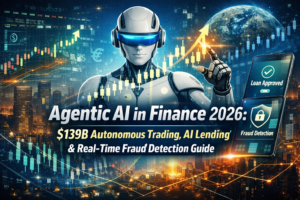
We are officially in the era of Agentic AI—autonomous systems capable of reasoning, planning, and executing complex workflows without human intervention. With the agentic AI market projected to reach up to $139 billion by 2034, quantitative funds and retail tech platforms are deploying specialized Large Language Models (LLMs) to trade earnings reports the exact millisecond they drop.
Here is a deep dive into how autonomous systems like FinGPT are reading earnings reports, parsing sentiment, and triggering trades, alongside a look at the escalating latency war between US and Indian stock exchanges.
The Mechanics of an Autonomous Earnings Play

When a major corporation releases its Q2 or Q3 financial results, the market reaction is driven by a mix of hard numbers (revenue, EPS) and unstructured qualitative data (forward-looking guidance, CEO tone on the earnings call). Traditional algorithmic trading excels at the former but struggles with the latter.
Agentic frameworks solve this by utilizing finance-specific LLMs. For instance, FinGPT, an open-source framework tailored specifically for financial data, has become a cornerstone for automated analysis. Unlike generic AI models that may hallucinate or fail to grasp financial jargon, specialized models are trained to accurately interpret financial contexts and numerical sensitivities.
Here is how an autonomous agent executes an earnings play:
Instant Ingestion: The moment a regulatory filing hits the SEC (US) or SEBI (India) databases, the AI agent fetches and structures the raw data into readable formats almost instantly.
Context-Enriched Sentiment Analysis: The agent does not just look for “positive” or “negative” words. Advanced iterations of FinGPT evaluate the breadth of news dissemination and contextual market data, which has been shown to improve the accuracy of short-term stock price movement predictions by 8% compared to older methods.
Confidence-Weighted Scoring: To prevent the AI from executing a massive trade based on a noisy or ambiguous sentence in an earnings call, systems utilize confidence-weighted scoring. This mechanism mathematically combines the model’s prediction confidence with the absolute strength of the detected sentiment to filter out unreliable trading signals.
Autonomous Execution: If the weighted score breaches a pre-defined threshold, the agent interfaces directly with brokerage APIs to execute buy or sell orders before human analysts have finished reading the first paragraph of the report.
Open-Source AI Authority
The Execution Battle: Wall Street vs. Dalal Street
An AI agent’s decision is only as valuable as the exchange’s ability to execute it. Once the trading signal is generated, the battle shifts from computational intelligence to raw network physics: Latency.
Latency is the time it takes for a trade order to travel from the trader’s server to the exchange’s matching engine. In the realm of high-frequency trading (HFT), milliseconds are considered archaic.
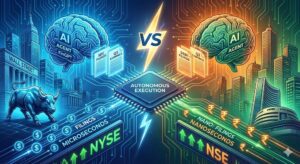
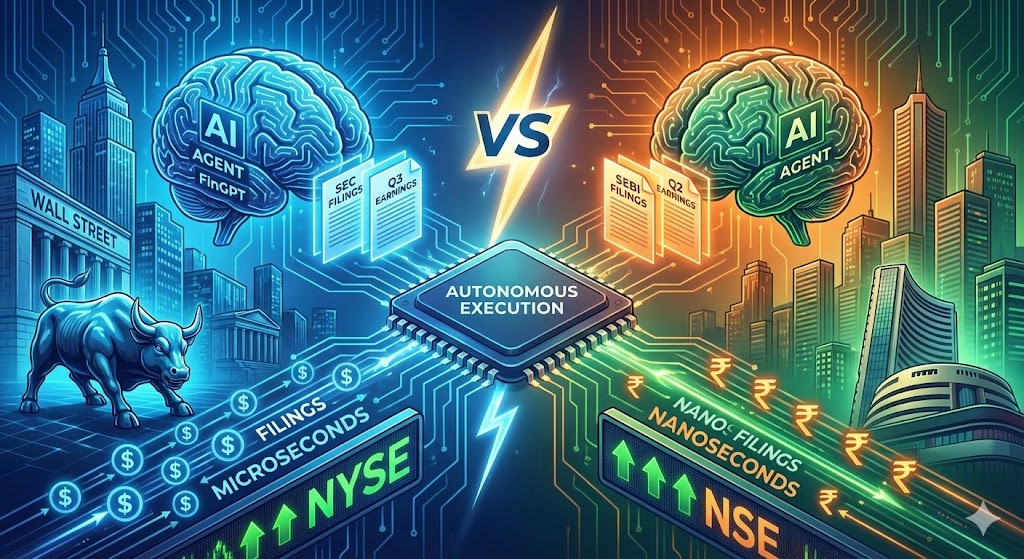
The US Market Baseline (Microseconds): Global giants like the NASDAQ and the New York Stock Exchange (NYSE) currently operate their core matching engines with microsecond-level latencies. Advanced trading firms co-locate their servers in the exact same data centers as these exchanges to minimize physical distance, battling over fractions of a microsecond to secure arbitrage opportunities.
The Indian Market Upgrade (Nanoseconds): The National Stock Exchange of India (NSE) is aggressively escalating the global speed race. Slated for April 11, 2026, the NSE is upgrading its infrastructure to achieve nanosecond-level response times for equities and equity derivatives.
Capacity and Infrastructure: To support this unprecedented speed, the NSE is scaling its order-handling capacity to a staggering 10 crore (100 million) transactions per second. Furthermore, the exchange is rapidly expanding its co-location infrastructure—even converting office spaces into data centers—to allow more trading firms to place their agentic AI servers as physically close to the matching engine as possible.
The Risks of Agentic High-Frequency Trading
While the profitability of executing an earnings play in nanoseconds is immense, it introduces severe systemic risks.
High-frequency algorithmic trading has historically been linked to increased market volatility and “flash crashes,” where cascading automated liquidations cause sudden, severe price drops. If an autonomous agent misinterprets the sentiment of a CEO’s statement during an earnings call and triggers a massive sell-off at nanosecond speeds, the market impact could be devastating before human circuit breakers can intervene.
Because of these risks, regulatory bodies are actively seeking ways to monitor and control ultra-fast algorithmic trading, attempting to maintain market integrity and protect retail investors who operate at a significant speed disadvantage.
The Bottom Line for Investors
The integration of agentic AI and ultra-low latency exchanges is fundamentally rewriting market mechanics. For institutional quant funds, securing co-location space and deploying models like FinGPT is no longer an edge—it is a baseline requirement for survival. For retail investors, understanding that initial post-earnings price volatility is largely driven by autonomous, sentiment-reading algorithms is crucial for navigating modern market conditions.
To understand the broader architecture behind these systems and how they are impacting other areas of finance like credit underwriting and portfolio management, read our complete master guide: [The Ultimate 2026 Guide to Agentic AI in Finance: How Autonomous Agents Are Rewiring the Market.]
Disclaimer: The information provided in this article is for educational and informational purposes only. It does not constitute financial advice, investment recommendations, or an endorsement of any specific trading strategy or platform. Algorithmic and high-frequency trading carry significant financial risk.
US Market Regulators
Frequently Asked Questions (FAQ)
Q: What is Agentic AI, and how does it differ from traditional algorithmic trading?
A: Traditional algorithms execute pre-programmed, rigid rules based purely on quantitative data (like price moving averages). Agentic AI, however, functions autonomously. It can ingest unstructured qualitative data (such as an executive’s tone during an earnings call), reason through the market sentiment, and execute complex, multi-step trading workflows without a human triggering the final order.
Q: What is FinGPT and how is it used in finance? A: FinGPT is an open-source Large Language Model (LLM) framework specifically trained on financial data. Unlike generic AI models (like standard ChatGPT), FinGPT understands complex financial jargon, SEC/SEBI regulatory contexts, and numerical sensitivities. Quant funds use it to accurately parse quarterly corporate earnings reports and generate high-confidence trading signals instantly.
Q: Why is latency (nanoseconds vs. microseconds) critical in AI trading?
A: In High-Frequency Trading (HFT), the first algorithm to execute a trade captures the maximum arbitrage profit. While major US exchanges currently operate at microsecond-level speeds, the National Stock Exchange of India (NSE) is upgrading to nanosecond-level execution in 2026. This ultra-low latency allows AI agents to capitalize on Q2 and Q3 earnings data fractions of a second before slower competitors.
Q: Can autonomous AI trigger a stock market crash?
A: Yes, there is a significant systemic risk. If an autonomous agent misinterprets market sentiment or encounters anomalous data, it could trigger massive, automated sell-offs at nanosecond speeds before human analysts can intervene. This phenomenon, known as a “flash crash,” is why global financial regulators strictly monitor high-frequency algorithmic trading.
Q: Can retail investors use Agentic AI for Q2 and Q3 earnings plays?
A: While institutional quant funds currently dominate ultra-low latency trading through expensive server co-location, retail investors are gaining access to the reasoning capabilities of Agentic AI. Modern fintech platforms are beginning to integrate models like FinGPT to provide retail traders with instant sentiment analysis of earnings reports, allowing for faster, data-driven decisions, even if their raw execution speeds lag behind institutional infrastructure.
Indian Market Regulators
People Also Ask (PAA)
Can AI trade stocks autonomously?
Yes, advanced systems known as Agentic AI can trade stocks autonomously. Unlike basic chatbots, these AI agents can ingest live financial data, analyze market sentiment from earnings calls, formulate a trading strategy, and execute buy or sell orders via broker APIs entirely without human intervention.
How do hedge funds use AI for trading?
Hedge funds use specialized Large Language Models (LLMs), such as FinGPT, to gain a speed advantage. These models instantly read unstructured data—like SEC filings, news alerts, and Q3 earnings reports—score the sentiment, and trigger high-frequency algorithmic trades milliseconds before human analysts can process the information.
Is algorithmic trading legal in India?
Yes, algorithmic and high-frequency trading (HFT) are legal in India, but they are strictly regulated by the Securities and Exchange Board of India (SEBI). Financial institutions and brokers must undergo rigorous audits and obtain exchange approvals to ensure their autonomous trading bots do not manipulate market stability.
What is the difference between algorithmic trading and AI trading?
Traditional algorithmic trading relies on rigid, pre-programmed mathematical rules (e.g., “buy if the 50-day moving average crosses the 200-day”). AI trading, specifically Agentic AI, is dynamic. It uses machine learning and natural language processing to understand context, adapt to sudden geopolitical news, and reason through qualitative data.
What is the latency of the Indian stock market?
As of 2026, the National Stock Exchange of India (NSE) is actively upgrading its core infrastructure to support ultra-low latency trading. While traditional systems operated in microseconds, the latest infrastructure pushes execution speeds to the nanosecond level, processing up to 10 crore (100 million) messages per second to support high-frequency AI bots.