I. Introduction: The End of the “Human-in-the-Loop” Bottleneck
For years, we believed Artificial Intelligence would “assist” humans. It would summarize reports, answer customer questions, and maybe draft a few emails. That was the era of generative AI. But in 2026, we are witnessing something far more powerful — Agentic AI.
Agentic AI does not just generate content. It sets goals, plans steps, calls APIs, analyzes data in real time, and executes financial actions autonomously. In simple words, it does the job — not just the thinking.
The global Agentic AI market is projected to cross $9.14 billion in 2026, and analysts estimate it could scale toward $139 billion by 2034 as enterprises shift from simple automation to full autonomy. This growth is not hype. It is driven by necessity.
Financial markets today move in milliseconds. With daily global forex turnover exceeding $7.5 trillion (according to the Bank for International Settlements) and India’s digital payment system processing billions of UPI transactions monthly, human decision-making alone simply cannot keep up.
For banks, hedge funds, NBFCs, and fintech startups, adopting Agentic AI is no longer about reducing costs. It is about survival in an environment where loan approvals, fraud detection, and trading signals must happen instantly.
We are moving from a “human-in-the-loop” model to a “human-on-the-loop” model — where humans supervise, but AI agents execute.
Bank for International Settlements (BIS)
II. The Architecture: Legacy AI vs. 2026 Agentic Frameworks
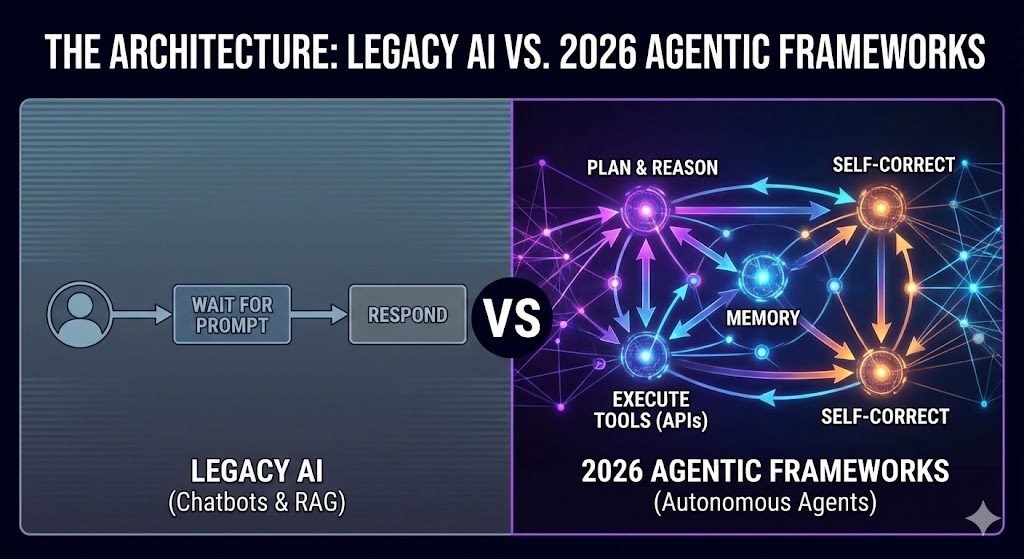
To understand why this shift is massive, we need to compare old AI systems with modern Agentic frameworks.
Legacy AI tools were reactive. They waited for human prompts. They answered questions. They summarized reports. They had limited memory and no independent execution ability.
Agentic AI systems are different. They are proactive, dynamic, and multi-step thinkers.
Core Function:
Legacy AI answers questions. Agentic AI plans, executes, self-corrects, and connects to live systems.
Workflow:
Old systems follow a linear path — Human asks → AI responds.
Agentic systems follow a dynamic path — Set goal → Break into steps → Execute → Monitor → Adjust.
Memory:
Legacy chatbots often forget context.
Agentic systems are stateful. They remember ongoing financial processes across days or weeks.
Financial Example:
A legacy AI might summarize a company’s Q3 earnings.
An agentic system reads the Q3 report, detects negative earnings surprise, checks social media sentiment, analyzes sector impact, and executes a short-sell order via broker API — all within seconds.
This architectural leap is what makes Agentic AI transformative for finance.
U.S. Securities and Exchange Commission (SEC)
III. Core Use Case 1: Autonomous Algorithmic Trading & Portfolio Management
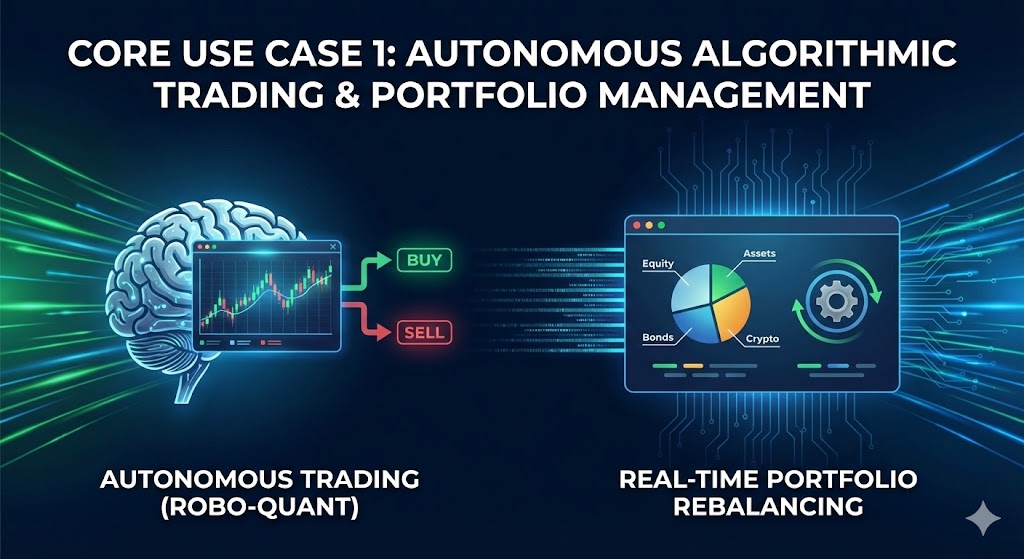
Algorithmic trading is not new. What is new is multi-agent orchestration.
In 2026, hedge funds are deploying “Robo-Quants” — networks of AI agents with specialized roles:
One agent monitors geopolitical news on platforms like X (formerly Twitter).
Another ingests regulatory filings from bodies such as the U.S. Securities and Exchange Commission.
In India, similar filings are tracked through the Securities and Exchange Board of India.
A third agent analyzes derivatives market volatility.
A fourth executes trades automatically.
This is happening in a world where India’s equity markets have seen record participation. With demat accounts crossing 15 crore in 2025, retail participation is at historic highs. That means volatility reacts faster to sentiment shifts.
In wealth management, portfolio rebalancing is also changing. Traditionally, advisors rebalanced quarterly. Now, AI agents continuously simulate shock scenarios — oil price spikes, currency fluctuations, trade wars — and adjust allocations in real time.
For example, if crude oil prices jump due to Middle East tensions, the agent might increase exposure to energy stocks while reducing airline stocks automatically.
This is not science fiction. It is already being piloted in institutional trading desks.
Securities and Exchange Board of India (SEBI)
IV. Core Use Case 2: The Future of Credit Underwriting & Lending
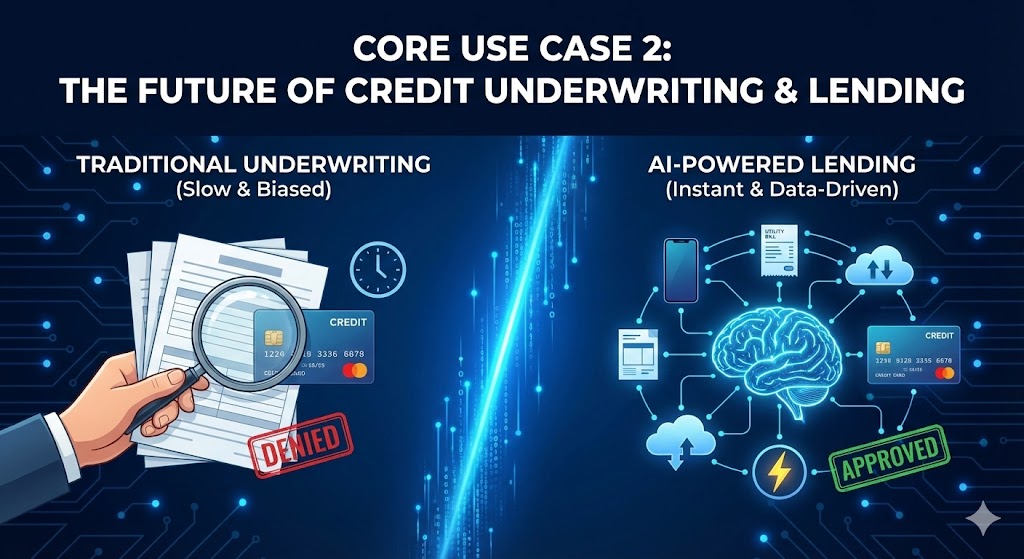
Traditional loan underwriting is slow. A human officer checks documents, verifies identity, reviews CIBIL or FICO scores, and manually evaluates risk.
In 2026, Agentic AI transforms this into a real-time workflow.
Let’s break down a multi-agent system:
Agent 1 (Extractor): Reads uploaded payslips and bank statements using OCR and NLP.
Agent 2 (Verifier): Cross-checks identity through national ID systems.
Agent 3 (Risk Assessor): Analyzes real-time cash flows, utility bill payments, and spending patterns.
Agent 4 (Decision Maker): Approves or rejects the loan and initiates digital transfer.
India’s fintech lending sector has grown rapidly, supported by digital public infrastructure like Aadhaar and UPI. This ecosystem enables AI agents to verify and sanction loans within minutes.
The biggest benefit? Reduced human bias.
AI systems can be trained on structured fairness metrics, whereas human officers may carry unconscious bias. However, this requires strict governance and ethical data handling.
For NBFCs, faster loan processing means higher customer acquisition and better risk pricing.
Reserve Bank of India (RBI) – Payment Statistics
V. Core Use Case 3: Continuous KYC and Real-Time Fraud Prevention
Compliance used to be periodic. Banks performed quarterly audits and periodic KYC updates.
That model no longer works.
According to the Reserve Bank of India, monthly credit card spending in India has crossed ₹2.12 lakh crore in recent tracking periods. Monitoring such massive transaction volume manually is impossible.
Agentic AI introduces continuous KYC. Instead of verifying customers once every few years, AI agents monitor behavior patterns continuously.
For example:
If a customer who normally spends ₹5,000 per transaction suddenly attempts ₹5 lakh overseas transfers, the agent flags it instantly.
If synthetic identities or deepfake documents are detected, transactions are blocked in milliseconds.
These systems operate as a “mixture of experts.” One agent specializes in transaction anomaly detection. Another specializes in identity verification. A third checks device fingerprints.
This reduces fraud losses and improves trust in digital finance.
World Economic Forum – AI Governance
VI. The Geopolitics of Agentic Finance: Localization vs. Hyperscalers
Financial data is not just business data. It is national security data.
Global payment giants like Mastercard are expanding Agentic Commerce solutions in emerging markets. But countries like India enforce strict data localization rules.
Under guidelines from the Reserve Bank of India, payment data must be stored locally. This means AI agents operating in finance cannot freely move sensitive financial data across borders.
This creates a geopolitical shift.
Western financial institutions often rely on hyperscalers such as Amazon Web Services and Microsoft Azure.
India, meanwhile, is pushing toward sovereign cloud infrastructure to ensure domestic financial data remains within national boundaries.
The battle is no longer just about AI models. It is about who controls the compute, the data, and the regulatory framework.
VII. The Regulatory Minefield: Who Is Liable?
Here is the uncomfortable question.
If an autonomous AI agent executes a massive losing trade due to misinterpreted data, who is responsible? The developer? The bank? The AI vendor?
This is called the “black box” problem.
Financial regulators worldwide are studying AI governance frameworks. Even in advanced markets, AI decisions must remain explainable.
That is why most enterprise deployments in 2026 use a hybrid model:
AI performs 95–99% of operational work.
High-value or high-risk decisions require human approval.
For example, trades exceeding a specific threshold or loan approvals above a risk band might require a human click.
This ensures accountability while maintaining efficiency.
Regulatory clarity will define how fast Agentic AI scales globally.
VIII. Conclusion: The Institutions That Adapt Will Lead
We are entering the Agentic Economy.
Financial institutions that cling to manual workflows will struggle to compete. Those that transition to agent-orchestrated ecosystems will operate faster, cheaper, and smarter.
Agentic AI is not about replacing humans. It is about amplifying decision-making speed and scale.
In a world where financial markets react in milliseconds, the winners will be those who combine:
Autonomous execution
Strong regulatory guardrails
Sovereign data infrastructure
Ethical AI governance
For fintech founders, investors, regulators, and banking leaders, the message is clear: the shift has already begun.
The question is not whether Agentic AI will dominate finance.
The question is — who will master it first?
Frequently Asked Questions (FAQs) About Agentic AI in Finance (2026)
1. What is Agentic AI in finance?
Agentic AI in finance refers to autonomous, goal-driven AI systems that can plan, reason, access APIs, and execute financial actions without continuous human input. Unlike generative AI, which only produces text or summaries, Agentic AI can perform tasks such as algorithmic trading, loan underwriting, portfolio rebalancing, and real-time fraud detection automatically.
2. How is Agentic AI different from traditional AI in banking?
Traditional AI systems in banking operate in a reactive manner. They wait for human prompts and provide responses. Agentic AI systems are proactive. They can set goals, break tasks into multiple steps, retrieve live financial data, and execute decisions independently. For example, instead of just summarizing an earnings report, an agentic system can analyze it and place a trade automatically.
3. Is Agentic AI already being used in financial markets?
Yes. Large hedge funds and fintech platforms are already deploying multi-agent AI systems for algorithmic trading, risk modeling, and portfolio optimization. Global regulators such as the U.S. Securities and Exchange Commission and India’s Securities and Exchange Board of India are also monitoring AI usage in capital markets to ensure transparency and accountability.
4. Can Agentic AI fully replace human financial analysts?
No. In 2026, most enterprise-grade systems operate under a “human-on-the-loop” model. AI agents perform 95–99% of operational tasks, but high-value decisions or risk-heavy transactions still require human approval. This hybrid approach ensures both speed and accountability.
5. How does Agentic AI improve credit underwriting?
Agentic AI automates the entire loan evaluation workflow. It can extract data from payslips, verify identity documents, analyze real-time transaction history, evaluate alternative credit signals, and approve or reject applications within minutes. This reduces bias, speeds up loan processing, and lowers operational costs for banks and NBFCs.
6. How does Agentic AI help in fraud detection and KYC compliance?
Agentic AI enables continuous KYC instead of periodic checks. It monitors transaction behavior in real time and detects anomalies instantly. With digital payment volumes rising rapidly under supervision of the Reserve Bank of India, AI agents are essential for identifying suspicious activity, synthetic identities, and deepfake fraud attempts within milliseconds.
7. What are the regulatory risks of Agentic AI in finance?
The biggest concern is the “black box” problem. If an AI system makes a wrong financial decision, regulators require clear accountability. Financial institutions must ensure model explainability, audit trails, bias monitoring, and human override mechanisms to stay compliant with global financial regulations.
8. What infrastructure is required to deploy Agentic AI in banks?
Agentic AI systems require:
High-performance cloud infrastructure
Secure API integrations
Real-time data pipelines
Regulatory-compliant data storage
Strong cybersecurity frameworks
Many institutions rely on cloud providers such as Amazon Web Services and Microsoft Azure, while countries like India push for sovereign cloud infrastructure to maintain financial data localization.
9. What is the market size of Agentic AI in finance?
The global Agentic AI market is projected to exceed $9 billion in 2026 and could scale toward $139 billion by 2034 as financial institutions shift from basic automation to autonomous execution systems. Growth is driven by demand for faster trading, instant lending, fraud prevention, and regulatory compliance automation.
10. Is Agentic AI suitable for small fintech startups?
Yes. Cloud-based AI platforms allow startups to integrate autonomous agents without building infrastructure from scratch. However, compliance, security, and explainability must be prioritized from day one to avoid regulatory penalties.
People Also Ask (PAA) – Agentic AI in Finance
What are autonomous AI agents in banking?
Autonomous AI agents in banking are goal-driven systems that can independently analyze financial data, verify customer information, detect fraud, and execute transactions without constant human supervision. Unlike traditional chatbots, these agents can plan multi-step workflows and interact with core banking APIs to complete complex tasks.
How does Agentic AI impact algorithmic trading?
Agentic AI enhances algorithmic trading by enabling multi-agent coordination. One agent may monitor real-time news sentiment, another may analyze market volatility, and a third may execute trades instantly. Regulators such as the U.S. Securities and Exchange Commission and India’s Securities and Exchange Board of India are closely observing these developments to ensure transparency and market stability.
Is Agentic AI safe for financial decision-making?
Agentic AI can be safe when deployed with proper governance frameworks. Financial institutions must implement audit logs, explainability models, human approval thresholds, and risk guardrails. Most enterprise deployments follow a hybrid model where AI performs the majority of tasks but humans approve high-risk decisions.
What is continuous KYC in 2026?
Continuous KYC is an always-on compliance system powered by AI agents. Instead of verifying customers periodically, AI monitors transaction patterns in real time and flags suspicious activity instantly. With digital payment volumes rising under supervision of the Reserve Bank of India, continuous KYC has become essential for fraud prevention and regulatory compliance.
Can Agentic AI reduce loan default rates?
Yes. Agentic AI can analyze alternative data sources such as real-time cash flow, bill payments, and behavioral patterns. This allows lenders to price risk more accurately and detect early warning signals of default. As a result, banks and NBFCs can reduce non-performing assets (NPAs) while improving loan approval speed.
What is the difference between Generative AI and Agentic AI in finance?
Generative AI focuses on producing content such as summaries, reports, or chatbot responses. Agentic AI goes further by executing tasks autonomously. For example, generative AI may summarize a company’s earnings report, while Agentic AI can analyze that report and automatically rebalance a portfolio.
How does data localization affect Agentic AI in India?
India requires financial data to be stored domestically under guidelines from the Reserve Bank of India. This means AI agents operating in finance must process and store sensitive data within the country. As a result, banks often rely on localized cloud infrastructure or sovereign data centers to remain compliant.
What industries benefit most from Agentic AI in finance?
The industries that benefit most include:
Investment banking
Hedge funds
Retail banking
NBFC lending platforms
Digital payment companies
InsurTech firms
These sectors handle large volumes of real-time financial decisions where speed, accuracy, and automation directly impact profitability.