Agentic AI in Banking: Why Traditional Credit Scores Like CIBIL and FICO Are Becoming Obsolete in 2026

I. What Is Agentic AI in Banking and Why It Matters in 2026
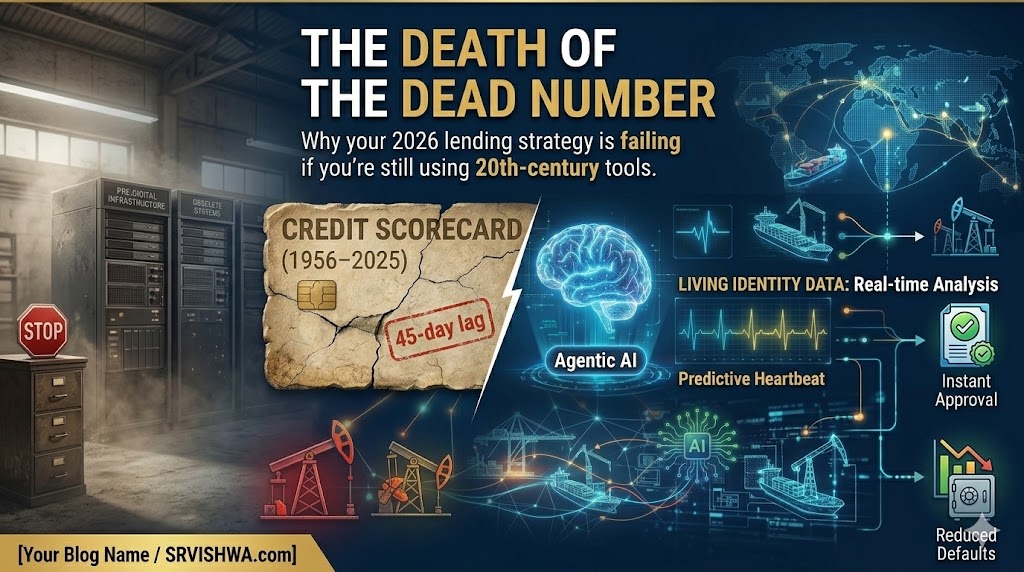
For decades, banks and financial institutions have relied on one simple number to judge a borrower: the credit score. In India, this number is usually associated with the system maintained by TransUnion CIBIL, while globally it is represented by the well-known FICO scoring model. For years, lenders believed that this number could predict whether a person would repay a loan or default. But in 2026, the financial world is slowly realizing something important: a credit score is not a real-time indicator of financial health. It is simply a record of past behavior.
Think of it like this. A traditional credit score is similar to a medical autopsy. It tells you what happened in the past and why something went wrong. But it cannot tell you what will happen next. On the other hand, Agentic AI works like predictive medicine. It continuously monitors signals, behaviors, and financial patterns in real time. Instead of asking, “Did this person default three years ago?” it asks, “What is this person’s financial health right now?”
This shift is not just theoretical. It is supported by massive industry investment. According to recent fintech industry reports, the global AI-powered fintech market has reached approximately $26.67 billion in 2026, and it is growing at a compound annual growth rate (CAGR) of around 23%. This level of growth shows that financial institutions are no longer experimenting with AI; they are integrating it directly into their core operations.
The adoption numbers tell an even clearer story. In 2023, only about 37% of global financial institutions used AI in core decision-making systems. But by 2026, that number has climbed to nearly 59%. This means that more than half of banks, fintech firms, and lending platforms now rely on AI systems for tasks like fraud detection, underwriting, and credit risk analysis.
The biggest transformation is happening in the way lenders evaluate creditworthiness. Traditionally, creditworthiness was represented by a static number—usually updated once every few weeks. But in 2026, financial institutions are increasingly treating creditworthiness as something dynamic. Instead of being a fixed number, it becomes a continuously evolving digital profile that reflects a person’s real-time financial behavior.
This is where Agentic AI enters the picture. Unlike traditional machine learning models that simply generate predictions, Agentic AI systems can autonomously collect information, analyze patterns, and take action. These systems function almost like financial decision-making agents that constantly evaluate risk and opportunity.
In simple terms, the old model looked backward. The new model looks forward.
And this shift is beginning to reshape the entire global banking industry.
Global AI Fintech Market Data
II. Why Traditional Credit Scores Are Becoming Obsolete in the Digital Economy
To understand why Agentic AI is gaining momentum so quickly, we must first understand the limitations of traditional credit scoring systems.
The biggest problem is what experts call the “credit invisible” population.
India has a population of around 1.4 billion people, yet a large portion of adults do not have sufficient credit history to generate a meaningful credit score. According to financial inclusion studies and data from institutions such as World Bank and Reserve Bank of India, nearly 350 million adults in India remain “thin-file” or credit invisible.
This means these individuals may have stable income, regular payments, and healthy financial habits—but because they have never taken formal loans or credit cards, traditional credit bureaus have little or no data about them.
As a result, millions of responsible borrowers are automatically rejected by traditional lending systems.
Another major limitation is the time lag in credit score updates. Traditional credit scores typically update every 30 to 45 days, depending on when lenders report information to credit bureaus. In a stable economy, this delay might not be a major problem. But in the fast-moving economic environment of 2026, this delay can make the data almost useless.
Consider a small business owner whose revenue increased significantly in the last two weeks due to strong sales through digital platforms. Their credit score will not reflect this improvement immediately. The system will still judge them based on older financial behavior.
For lenders, this delay creates a serious problem. They are making decisions based on outdated information.
This issue becomes even more important when we look at the rapidly expanding embedded finance market. Analysts estimate that the global embedded finance ecosystem could reach $7.2 trillion in value within the next decade. Embedded finance allows financial services like loans, insurance, and payments to be integrated directly into digital platforms such as e-commerce apps, ride-hailing services, and gig economy platforms.
However, traditional credit scoring models are too slow and rigid to operate effectively in such environments. When lending decisions must be made instantly within an app or digital platform, waiting days or weeks for credit data is simply not practical.
For mid-sized banks and NBFCs, this creates a painful dilemma. If they rely only on legacy credit scores, they miss millions of potential borrowers. But if they lend without proper risk assessment, they increase default risk.
This is exactly the gap that Agentic AI is designed to solve.
Financial Inclusion & Credit Invisible Population
III. Enter Agentic AI: Beyond the Algorithm
Agentic AI represents a new generation of financial intelligence systems. While traditional AI models mainly produce predictions or risk scores, Agentic AI systems are designed to perform tasks autonomously.
Instead of waiting for human instructions, these systems can collect information, verify data, analyze patterns, and even trigger lending decisions automatically.
In simple terms, Agentic AI behaves less like a calculator and more like a financial analyst that works continuously.
One of the most powerful features of Agentic AI is its ability to analyze alternative data. Traditional credit systems rely mainly on bank loans, credit cards, and repayment history. But modern digital economies produce many other signals that reveal financial behavior.
One of the most important signals is real-time cash flow data. In India, digital payments through National Payments Corporation of India infrastructure such as Unified Payments Interface have exploded in recent years. UPI now processes billions of transactions every month, creating a rich stream of financial activity data.
For small businesses and MSMEs, Agentic AI can analyze GST filings, UPI transaction velocity, and digital sales patterns to evaluate financial stability. This provides a much clearer picture of business health than a traditional credit score.
Another valuable data source is utility payment behavior. Regular payment of electricity bills, internet subscriptions, software services, or mobile recharges can reveal financial discipline. These small but consistent signals can help lenders understand whether a borrower manages money responsibly.
A third area of innovation is behavioral biometrics. When a person interacts with a loan application on a smartphone, the way they type, scroll, or respond to questions can provide clues about authenticity and fraud risk. AI systems can analyze typing speed, hesitation patterns, and interaction behavior to detect suspicious activity.
While this may sound futuristic, such technologies are already being deployed by advanced fintech companies.
The result is a much richer and more accurate understanding of borrower behavior. Instead of relying on a single number, lenders can evaluate hundreds of real-time signals.
In other words, the system no longer asks, “What is your credit score?”
Instead, it asks, “How do you actually manage your financial life every day?”
RBI Digital Lending Guidelines
IV. The Ferocious Impact on the Bottom Line
For financial institutions, the shift toward Agentic AI is not just about technology. It is about profitability.
Early adopters in the NBFC and fintech sectors are already seeing significant improvements in risk management. Industry data suggests that AI-driven underwriting models can reduce loan default rates by more than 30% compared with traditional credit evaluation methods.
This improvement happens because AI systems analyze a much broader set of signals. Instead of relying only on past loan behavior, they consider current income patterns, spending habits, and digital transaction activity.
Another major advantage is speed.
In traditional banking systems, loan approval can take several days. A borrower submits documents, a human underwriter reviews them, and additional verification steps follow.
But Agentic AI compresses this process dramatically.
In many modern fintech platforms, the apply-to-disburse process now takes less than 180 seconds. Data is collected automatically, risk analysis happens instantly, and funds can be transferred almost immediately.
This speed is particularly valuable in the growing gig economy.
Consider delivery partners working for platforms like Zomato, Swiggy, or ride-sharing services such as Uber. Many of these workers earn steady income but lack formal credit histories. Traditional banks often reject their loan applications.
However, Agentic AI can analyze platform earnings, trip frequency, ratings, and income consistency. This allows lenders to offer credit products tailored to gig workers.
Some NBFCs are already experimenting with such models, approving loans for tens of thousands of gig workers based on real-time earnings data rather than credit bureau scores.
The financial impact is significant. Lenders gain access to millions of new borrowers, while borrowers gain access to credit that was previously unavailable.
This creates a powerful win-win scenario.
UPI Digital Payments Growth
V. The Executive Roadmap: Adapt or Atrophy
Despite its benefits, the adoption of Agentic AI also raises important governance questions.
One of the most common concerns among regulators and financial executives is the “black box” problem. Many AI models produce predictions without clearly explaining how they reached those conclusions. For lending decisions, this lack of transparency can create regulatory risks.
To address this issue, regulators and institutions are increasingly focusing on Explainable AI (XAI). Explainable AI systems provide clear reasoning behind their decisions, allowing lenders to understand and justify credit approvals or rejections.
In India, the regulatory environment is evolving under the supervision of the Reserve Bank of India. The RBI has emphasized responsible use of AI in financial services, encouraging institutions to ensure fairness, transparency, and accountability in automated decision systems.
Another major benefit of AI adoption is cost reduction.
Traditional loan underwriting requires teams of analysts, compliance officers, and verification agents. Many of these processes involve manual data entry and document verification.
Agentic AI automates a large portion of these tasks. Digital verification, automated KYC processes, and intelligent fraud detection significantly reduce operational overhead.
Industry estimates suggest that banks and NBFCs can reduce operational costs by 30–50% when they transition from manual underwriting to AI-driven systems.
For executives, the strategic message is simple.
If a bank in 2026 is still asking customers to submit printed bank statements, physical documents, and long verification forms, it risks becoming irrelevant in a rapidly digitizing financial ecosystem.
In a world where financial decisions can be made in seconds, slow processes are no longer competitive advantages.
They are liabilities.
AI in Financial Services Report
VI. The Bottom Line: Recognition Over Regulation
The transformation happening in lending is deeper than a technological upgrade. It represents a fundamental shift in how financial identity is defined.
For decades, financial identity was summarized by a single number—the credit score. That number acted as a gatekeeper for loans, credit cards, and financial opportunities.
But the digital economy has changed how people earn, spend, and save money. Millions of individuals now participate in gig work, digital commerce, and platform-based income streams. These activities generate valuable financial signals that traditional credit systems cannot capture.
Agentic AI makes it possible to recognize these signals.
Instead of relying only on historical credit records, lenders can build dynamic financial identities that reflect real-time behavior. This approach expands access to credit while also improving risk assessment.
In many ways, the future of lending will be based less on regulation and more on recognition. The goal will not simply be to follow rigid credit rules but to understand the real financial lives of borrowers.
For banks and NBFCs, the strategic decision is becoming increasingly clear.
They can continue relying on traditional credit scores and risk missing millions of potential customers.
Or they can adopt Agentic AI systems that understand borrowers more deeply and respond faster to economic changes.
The institutions that embrace this transformation will capture new markets and operate more efficiently.
Those that ignore it may find themselves left behind.
The era of the static credit score is slowly ending.
The era of financial identity powered by intelligent agents has already begun.

Anant Jha
Anant Jha is the Editor-in-Chief of SRVISHWA.com, where he writes on geopolitics, geoeconomics, and global financial trends. As a geopolitical and geoeconomic analyst (and continuous learner), he focuses on decoding global power shifts, currency dynamics, and economic strategies shaping the modern world.He is also a stock market fundamental analyst and learner, exploring how macroeconomic events influence businesses and long-term investment opportunities. Through his work, he aims to simplify complex global issues and connect them with real-world economic impact for readers.
View all posts →Related Articles