Introduction
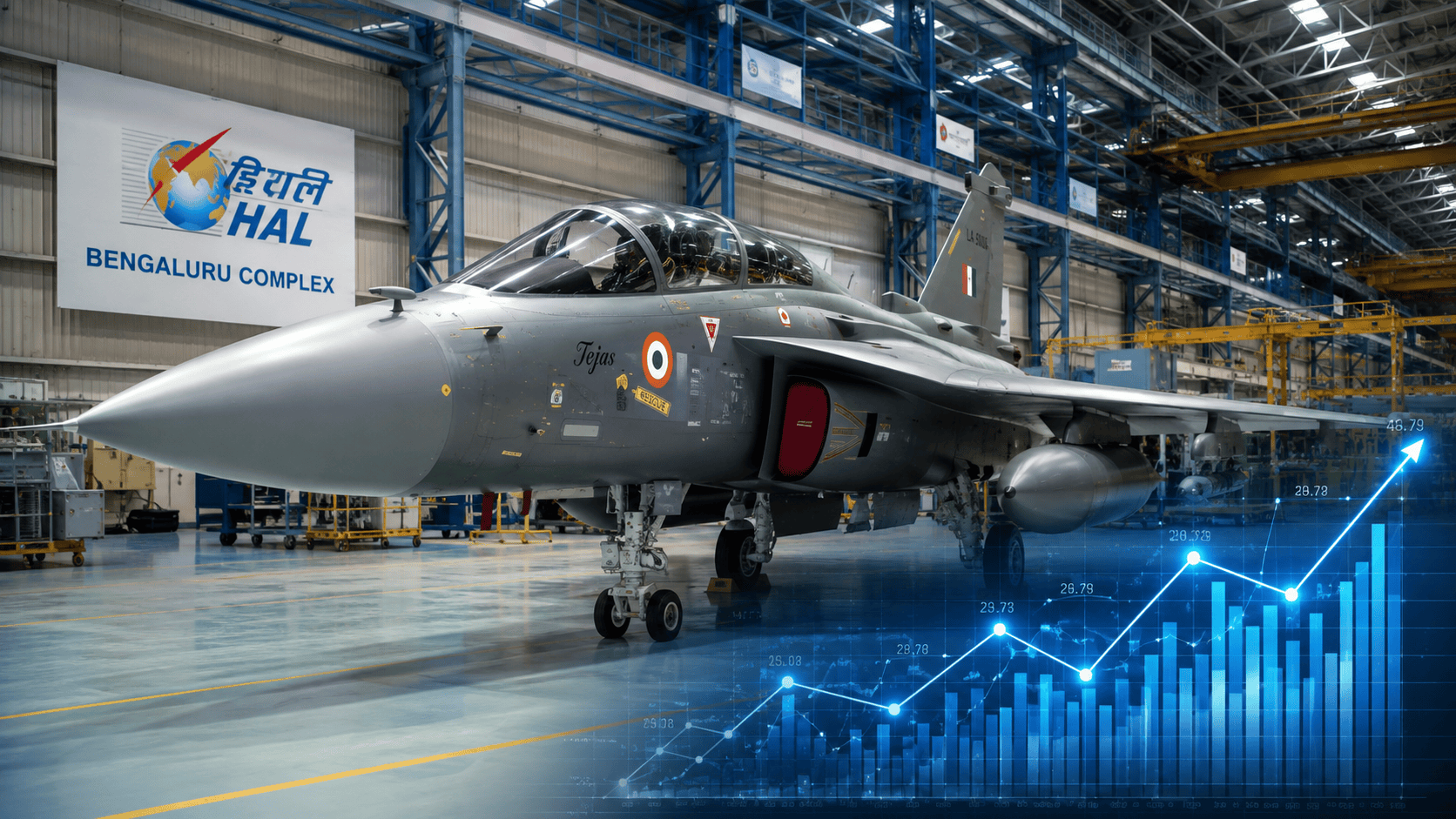
Defence PSU major Hindustan Aeronautics Limited (HAL) officially released its audited financial results for the first quarter of FY27 (Q1 FY27) on August 12, 2026. The aerospace pioneer reported a robust year-on-year (YoY) operational performance, driven by steady execution across core platform manufacturing and maintenance, repair, and overhaul (MRO) contracts.
On a consolidated basis, HAL reported a revenue from operations of ₹5,515.17 crore for Q1 FY27, representing a 14.45% increase compared to ₹4,819.01 crore reported in Q1 FY26. Consolidated net profit for the quarter rose 14.88% YoY to ₹1,589.66 crore, compared to ₹1,383.77 crore in the corresponding period of the previous fiscal year.
As the primary platform supplier to the Indian Armed Forces, HAL occupies a monopolistic position within the nation’s military aviation ecosystem. Backed by a massive order pipeline of ₹2,54,538 crore, market participants are closely monitoring how the company handles supply-chain hurdles, engine delivery schedules, and platform execution timelines.
Quick Result Snapshot
| Metric | Q1 FY27 (Consolidated) | Q1 FY26 (Consolidated) | YoY Change (%) |
| Revenue from Operations | ₹5,515.17 crore | ₹4,819.01 crore | +14.45% |
| Other Income | ₹900.24 crore | ₹747.09 crore | +20.50% |
| Total Income | ₹6,415.41 crore | ₹5,566.10 crore | +15.26% |
| Operating EBITDA (Calculated) | ₹1,525.02 crore | ₹1,282.42 crore | +18.92% |
| EBITDA Margin (Operating) | 27.65% | 26.61% | +104 bps |
| Profit Before Tax (PBT) | ₹2,134.33 crore | ₹1,854.31 crore | +15.10% |
| Net Profit (PAT) | ₹1,589.66 crore | ₹1,383.77 crore | +14.88% |
| Basic EPS (₹) | ₹23.77 | ₹20.69 | +14.89% |
| Order Book | ₹2,54,538 crore | Not Applicable | ~7-8 Years Visibility |
Note: Operating EBITDA is calculated as Operating Revenue minus raw material costs, stock changes, employee costs, depreciation, and other operating expenses, excluding finance costs and other income.
HAL Q1 FY27 Results: Key Numbers Explained
Hindustan Aeronautics Limited’s Q1 FY27 financial statements showcase consistent operational expansion. On a standalone basis, HAL registered revenue from operations of ₹5,515.28 crore in Q1 FY27, up 14.45% YoY from ₹4,819.14 crore in Q1 FY26. Standalone net profit climbed 14.77% YoY to ₹1,580.61 crore against ₹1,377.15 crore in the prior year period.
Consolidated Q1 FY27 Snapshot:
├── Operational Revenue: ₹5,515.17 Cr (+14.45% YoY)
├── Other Income:        ₹900.24 Cr   (+20.50% YoY)
├── Operating EBITDA:    ₹1,525.02 Cr (+18.92% YoY)
└── Net Profit (PAT):    ₹1,589.66 Cr (+14.88% YoY)
Consolidated operational earnings were bolstered by a steady flow of Other Income, which came in at ₹900.24 crore compared to ₹747.09 crore in Q1 FY26, largely reflecting treasury yields on cash balances and milestone advance collections.
Basic Earnings Per Share (EPS) for the quarter rose to ₹23.77 on a consolidated basis (face value ₹5 per share), up from ₹20.69 in Q1 FY26. The growth in EPS closely mirrors the bottom-line expansion, reaffirming that diluted equity dilution remains non-existent.
Revenue Analysis: Execution and Platform Deliveries
Revenue growth of 14.45% in Q1 FY27 reflects sustained execution across HAL’s two principal operational streams: platform manufacturing and MRO services. Historically, HAL experiences seasonality where Q1 contributes a smaller proportion of annual revenues, while Q4 witnesses significant milestone invoicing.
The operational revenue expansion during Q1 FY27 was largely execution-driven:
MRO & Overhaul Activities: High operational fleet usage by the Indian Air Force (IAF) and Indian Navy drove steady billings for scheduled overhauls of Su-30MKI fighters, Mirage 2000s, and RD-33/AL-31FP engines.
Helicopter Deliveries: Ramped-up production of Advanced Light Helicopters (ALH Dhruv) and Light Combat Helicopters (LCH Prachand) contributed positively to the top-line.
Avionics & Accessories: Increased supply of indigenous spares and structural components across defense divisions maintained steady flow-through revenue.
Profit and Margin Analysis
HAL’s profitability profile in Q1 FY27 demonstrated operational leverage and disciplined cost management.
Cost Distribution as % of Operational Revenue (Q1 FY27 Consolidated):
├── Material Costs & WIP: 34.93% (₹1,926.10 Cr Net)
├── Employee Expenses:    27.63% (₹1,523.93 Cr)
├── Depreciation:          5.51% (₹303.94 Cr)
└── Other Expenses:        8.26% (₹455.73 Cr)
Material Expenses: Cost of materials consumed stood at ₹2,777.21 crore, complemented by an inventory build-up (WIP/Finished Goods) adjustment of -₹1,029.75 crore. Net material expenditure represented 34.93% of operational revenue.
Employee Costs: Employee benefits expense rose to ₹1,523.93 crore in Q1 FY27 from ₹1,382.52 crore in Q1 FY26. Note 8 of the financial report highlights an additional liability of ₹2.37 crore during the quarter due to the revision of the gratuity ceiling from ₹20 lakh to ₹25 lakh (effective October 2025).
EBITDA Margins: Consolidated operating EBITDA margin expanded by approximately 104 basis points YoY to 27.65%. Operating efficiency and higher absorption of fixed overheads supported the margin profile.
Net Profit Margins: Consolidated PAT margin stood firm at 28.82% in Q1 FY27 (inclusive of Other Income) compared to 28.71% in Q1 FY26.
Q1 FY27 vs Q1 FY26 Performance Comparison
A direct comparison reveals structural improvements across key operational indicators.
| Financial Parameter | Q1 FY27 (Consolidated) | Q1 FY26 (Consolidated) | Key Variance Drivers |
| Operational Revenue | ₹5,515.17 Cr | ₹4,819.01 Cr | Higher overhaul billings & helicopter handovers |
| Total Expenditure | ₹4,292.69 Cr | ₹3,722.07 Cr | Increased volume-linked material intake |
| Employee Expenses | ₹1,523.93 Cr | ₹1,382.52 Cr | Wage escalations & gratuity revision provisions |
| Other Income | ₹900.24 Cr | ₹747.09 Cr | Treasury income on cash reserves |
| Tax Expenses | ₹544.67 Cr | ₹470.54 Cr | Effective tax rate stable at ~25.5% |
| Consolidated PAT | ₹1,589.66 Cr | ₹1,383.77 Cr | Stronger core operational performance |
Key Takeaways:
What Improved: Revenue grew by double digits, operating EBITDA expanded, and treasury yields provided strong net income support.
What Weakened: Employee overheads scaled up due to statutory gratuity ceiling adjustments.
What Remained Stable: Tax provisions remained steady near the ~25.5% mark.
Order Book Analysis: Multi-Year Revenue Visibility
HAL entered FY27 backed by an outstanding order book valued at ₹2,54,538 crore as of March 31, 2026. This backlog equates to approximately 7.7 times its FY26 full-year revenue, providing exceptional operational visibility over the next 7 to 8 years.
HAL Order Book Structure (~₹2.55 Lakh Crore Backlog):
├── Fighter Aircraft Contracts (LCA Tejas Mk1A, Su-30MKI Upgrades)
├── Helicopter Programs (156 LCH Prachand, ALH Dhruv, LUH)
├── Engine Overhaul & Manufacturing (AL-31FP, RD-33, Shakti)
└── Trainer Aircraft & Utility Platforms (HTT-40, Do-228)
Major Order Pillars:
LCA Tejas Mk1A: Large-scale order for 83 aircraft supplemented by the approval for 97 additional units (valued at ₹62,370 crore).
Light Combat Helicopter (LCH): Mega order for 156 LCH units split across the Indian Army and IAF.
Engine Contracts: Manufacturing order for 240 AL-31FP engines for the Su-30MKI fleet.
Trainer Aircraft: Execution of the HTT-40 basic trainer aircraft series production.
HAL Defence and Aerospace Growth Story
HAL sits at the heart of India’s strategic defense indigenization initiative (Atmanirbhar Bharat). Beyond immediate execution schedules, the long-term growth story rests on structural shifts:
Tejas Mk1A & Mk2 Transition: HAL is establishing a third production line to scale Tejas production capacity to over 24 aircraft per year.
Civil Aviation & Exports: Commercial manufacturing of the Dornier Do-228 and strategic international bids for ALH/LCH platforms in South Asia, South America, and the Middle East offer new export dimensions.
Aerospace Engine Partnerships: Long-term agreements, such as manufacturing turbine ring forgings for Safran’s CFM LEAP engines and co-developing the SAFHAL helicopter engine, deepen HAL’s role in global supply chains.
Top Growth Drivers for HAL
Unprecedented Order Backlog: Outstanding orders of ₹2,54,538 crore eliminate near-term demand risks.
Ramping Production Capacity: Operationalization of new manufacturing lines in Nashik and Bengaluru allows higher annual aircraft rollouts.
High-Margin MRO Revenue: A growing active fleet of indigenous and imported aircraft creates a high-margin recurring MRO revenue stream.
Rising Indigenization Levels: Target indigenization of 65%–75% across key platforms reduces foreign exchange volatility and import dependencies.
Government Capital Outlay: Consistently high capital expenditure allocation for defence modernization in the Union Budget.
Export Footprint Expansion: Targeted international marketing of helicopters, light fighters, and overhaul services.
Key Risks for Investors
Global Engine Supply Chain Bottlenecks: Delays in GE F404 engine deliveries from General Electric have previously affected Tejas Mk1A handover timelines. Resolution by late 2026 remains a key milestone.
Execution Delays: Given the technical complexity of modern fighter jets, delays in testing, flight certifications, or component integration can push revenue recognition into later quarters.
Single-Client Concentration: The Indian Armed Forces (Ministry of Defence) account for over 90% of revenue.
Audit and Price Finalization Notes: Financial Note 7 indicates that Fair Price Quotation (FPQ) sales from FY24 onwards are provisionally recognized, pending the finalization of the 4th Price Performance Review Committee (PPRC) report.
HAL Share Price and Valuation Analysis
As of August 12, 2026, HAL traded on the National Stock Exchange (NSE) and BSE.
Live Market Snapshot (August 12, 2026):
Current Share Price: ₹4,911.00
Day Change: +₹11.00 (+0.22%)
Intraday Range: ₹4,801.50 – ₹4,981.00 (New 52-Week High)
52-Week Range: ₹3,479.00 – ₹4,981.00
Market Capitalization: ₹3,29,037 crore
Valuation Multiples: Trailing P/E of ~36.1x; P/B ratio of ~8.01x
Return Metrics: ROCE ~32.0%, ROE ~24.0%
Balance Sheet Health: Debt-free with healthy cash reserves
Peer Comparison (Defence & Aerospace Sector)
| Company | Market Cap (₹ Cr) | Trailing P/E | ROCE (%) | ROE (%) | Order Book Context |
| HAL | ₹3,29,037 | ~36.1x | 32.0% | 24.0% | ₹2.55 Lakh Cr (7-8 yrs visibility) |
| Bharat Electronics (BEL) | Large Cap | ~45-50x | ~30.0% | ~25.0% | Strong radar/electronics backlog |
| Bharat Dynamics (BDL) | Mid Cap | ~55-60x | ~21.0% | ~17.0% | Missile systems backlog |
| Mazagon Dock | Mid-Large Cap | ~35-40x | ~38.0% | ~30.0% | Naval shipbuilding pipeline |
Note: Direct valuation comparisons must account for differences in working capital cycles, platform complexity, and business mix (MRO vs. shipbuilding vs. electronics).
Scenario Analysis: Is HAL Stock Expensive or Attractive?
This section presents hypothetical operational scenarios and does not constitute financial advice.
Operational Scenarios for FY27–FY28:
├── Bull Case: Engine bottlenecks resolved; execution exceeds +15% YoY guidance.
├── Base Case: Execution aligns with 10–12% growth guidance; steady ~30% OPM.
└── Bear Case: Supply chain friction delays jet deliveries; margins tighten.
1. Bull Case
Assumptions: GE F404 engine deliveries normalize by Q2 FY27; Tejas Mk1A production scales smoothly beyond 16 units per year; export orders materialize.
Financial Impact: Operational revenue growth accelerates to 15%+ YoY, operating margins hold firm near 30–31%. Premium valuation multiples persist supported by earnings surprises.
2. Base Case
Assumptions: Revenue growth aligns with management’s guidance of 10%–12% for FY27; EBITDA margins remain stable at 29%–31%.
Financial Impact: Steady earnings growth justifies current trading multiples, with stock performance compounding in line with mid-teens bottom-line growth.
3. Bear Case
Assumptions: Engine delivery disruptions persist; input cost inflation compresses operating margins.
Financial Impact: Execution delays lead to quarterly revenue misses, triggering valuation multiple de-rating toward lower historical averages.
Management Commentary Highlights
Based on recent filings and annual statements, key management priorities include:
FY27 Financial Guidance: Management projects double-digit revenue growth of 10% to 12% for FY27, backed by operating EBITDA margins of 30% to 31%.
Platform Delivery Targets: Focus remains centered on delivering the HTT-40 basic trainers, scaling ALH/LCH manufacturing, and fulfilling Su-30MKI overhaul commitments.
Addressing Engine Constraints: Active coordination with international vendors (GE Aviation, Honeywell, Safran) to clear engine delivery backlogs and streamline sub-assembly inputs.
Indigenization Outlay: Driving local supply chain development to achieve 65%–75% indigenous content across major combat platforms.
Investor Checklist: What to Watch Next
[ ] Quarterly Tejas Mk1A delivery counts
[ ] Arrival timeline of GE F404 engines
[ ] Progress on 4th PPRC final price quotation approval (Note 7)
[ ] Margin trajectory across upcoming quarters (target 30%–31%)
[ ] Fresh order inflows from defence acquisition councils
[ ] Execution milestone updates on HTT-40 trainer aircraft
[ ] Progress on export discussions for ALH and LCH platforms
[ ] Expansion progress of the third aircraft production line
[ ] Resolution of independent director appointments on the Board (Auditor Note II)
[ ] Working capital days and cash flow conversion ratio
Realistic Investor Scenario
Hypothetical Example — Illustrative Purposes Only
Suppose an investor holds 100 shares of HAL purchased at an average price of ₹3,500 (Total Investment: ₹3,50,000).
Hypothetical Portfolio Scenario:
├── Initial Purchase: 100 shares @ ₹3,500 = ₹3,50,000
├── Market Value @ ₹4,911:                  ₹4,91,100 (+40.3% Capital Gain)
└── Dividends Recieved (FY26):            ₹4,500 (₹35 Interim + ₹10 Final)
Capital Appreciation: At the current market price of ₹4,911, the portfolio value is ₹4,91,100, representing an unrealized gain of ₹1,41,100 (+40.3%).
Dividend Yield Contribution: HAL paid an interim dividend of ₹35 per share in FY26 and recommended a final dividend of ₹10 per share (Total: ₹45/share). The investor receives ₹4,500 in total dividend payouts.
Key Takeaway: While capital gains have been strong due to re-rating, future total returns will depend on whether HAL achieves its target 10%–12% operational revenue growth and preserves its margin profile.
Financial Editor’s Verdict
Hindustan Aeronautics Limited delivered a fundamentally sound performance in Q1 FY27. Operational revenue growth of 14.45% and net profit expansion of 14.88% show that core execution momentum remains active during a traditionally slower quarter.
The primary strength of HAL lies in its monopoly-like positioning and an order backlog of ₹2.55 lakh crore that guarantees multi-year top-line visibility. However, the key operational variable remains supply-chain execution—specifically the timely delivery of international jet engines. Investors evaluating HAL at current price levels should distinguish between long-term strategic visibility and short-term valuation multiples, keeping a close tab on delivery milestones over the next few quarters.
Important Investor Disclaimer
This article is for informational and educational purposes only and should not be considered investment advice, a recommendation, or a guarantee of future returns. Investors should conduct their own research and consult a SEBI-registered investment adviser before making investm