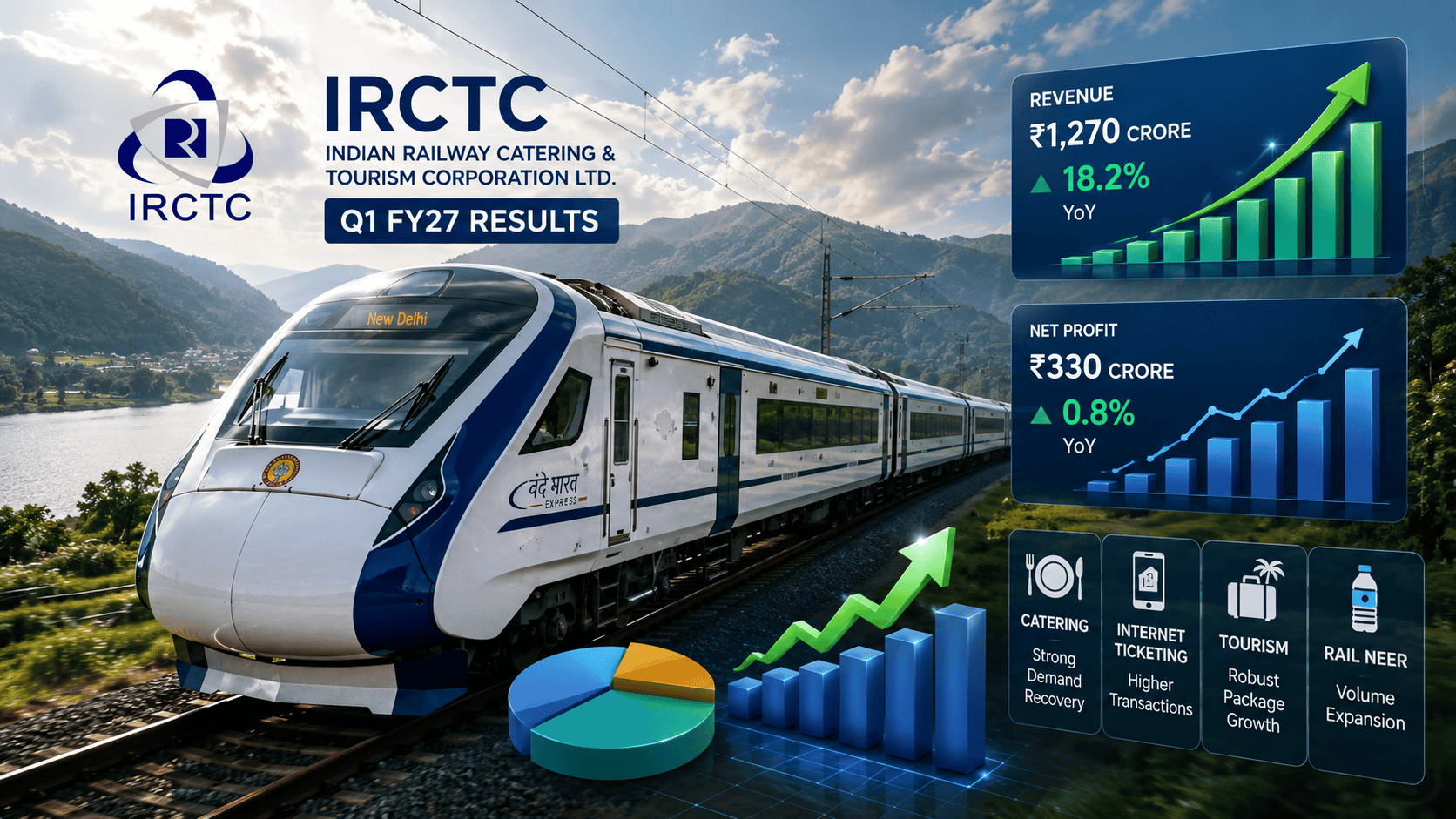
Ujjivan Small Finance Bank (USFB) announced an impressive financial performance for the first quarter ended June 30, 2026 (Q1 FY27). The bank recorded a 206.67% year-on-year surge in standalone Net Profit to ₹316.54 crore, up from ₹103.22 crore in Q1 FY26. Driven by healthy credit growth, stable margins, lower credit costs, and a steady reduction in non-performing assets (NPAs), Ujjivan SFB demonstrated strong operational resilience and enhanced earnings power across its retail and micro-banking segments.
Key Highlights Box
Ujjivan SFB Q1 FY27 Operational & Financial Snapshot
Net Profit (PAT): ₹316.54 crore, up 206.67% YoY vs ₹103.22 crore in Q1 FY26.
Total Income: ₹2,280.93 crore, representing a 22.11% YoY growth.
Net Interest Income (NII): Scaled to ₹1,187.35 crore, growing 43.76% YoY.
Operating Profit (PPOP): Surged 52.04% YoY to ₹548.06 crore.
Gross NPA: Asset quality strengthened as GNPA dropped 36 bps YoY to 2.16%.
Net NPA: Reduced significantly to 0.34% compared to 0.70% in Q1 FY26.
Provisions & Contingencies: Declined to ₹127.32 crore from ₹224.94 crore in Q1 FY26.
Capital Adequacy Ratio (CRAR): Maintained a robust capital cushion at 20.36%.
Quick Snapshot Table
| Financial / Operational Parameter | Q1 FY27 (Quarter Ended June 30, 2026) | Q1 FY26 (Quarter Ended June 30, 2025) | YoY Change (%) / Trend |
| Total Income | ₹2,280.93 Cr | ₹1,867.83 Cr | +22.11% |
| Interest Earned | ₹2,024.92 Cr | ₹1,618.84 Cr | +25.08% |
| Interest Expended | ₹837.57 Cr | ₹762.89 Cr | +9.79% |
| Net Interest Income (NII) | ₹1,187.35 Cr | ₹855.95 Cr | +43.76% |
| Other Income | ₹256.01 Cr | ₹248.99 Cr | +2.82% |
| Operating Expenses | ₹895.30 Cr | ₹744.46 Cr | +20.26% |
| Operating Profit (PPOP) | ₹548.06 Cr | ₹360.48 Cr | +52.04% |
| Provisions & Contingencies | ₹127.32 Cr | ₹224.94 Cr | -43.40% |
| Profit Before Tax (PBT) | ₹420.74 Cr | ₹135.54 Cr | +210.42% |
| Net Profit (PAT) | ₹316.54 Cr | ₹103.22 Cr | +206.67% |
| Basic EPS (₹) | ₹1.63 | ₹0.53 | +207.55% |
| Gross NPA Ratio (%) | 2.16% | 2.52% | -36 bps |
| Net NPA Ratio (%) | 0.34% | 0.70% | -36 bps |
| Return on Assets (RoA) (Annualized) | ~2.10% | 0.84% | +126 bps |
| Capital Adequacy Ratio (CRAR) | 20.36% | 22.77% | -241 bps |
| Current Market Price (CMP) | ₹68.78 | — | — |
| Market Capitalization | ~₹13,393 Cr | — | — |
| 52-Week High / Low | ₹72.24 / ₹41.32 | — | — |
| Book Value per Share | ₹35.10 | — | — |
| Face Value | ₹10.00 | ₹10.00 | — |
Q1 FY27 Performance Overview
Ujjivan Small Finance Bank started the financial year 2026–27 on an exceptionally high note, delivering a sharp rebound in profitability and operational strength. For the quarter ended June 30, 2026, the bank posted a net profit of ₹316.54 crore, marking a more than three-fold increase over the ₹103.22 crore reported in the corresponding quarter of the previous fiscal year.
The performance beat street estimates on multiple operational parameters. Credit growth remained brisk, powered by strong disbursements across both micro-banking and expanding secured retail portfolios such as affordable housing, MSME, and vehicle loans. Concurrently, cost-of-funds tailwinds, disciplined operating costs, and normalized credit costs created a strong operational tailwind.
A standout feature of Ujjivan SFB’s performance was the continuous improvement in asset quality. With over-dues stabilizing across core states in the microfinance segment, slippages moderated significantly, enabling the bank to trim provisioning requirements by over 43% year-on-year. Consequently, the return profile expanded sharply, with the annualized Return on Assets (RoA) moving above 2%, placing Ujjivan SFB among the top-performing small finance banks in India.
Financial Performance Analysis
To understand the mechanics behind Ujjivan SFB’s quarterly performance, it is vital to break down the income statement into its primary engines: top-line interest income, expense discipline, and bottom-line profit drivers.
                     ┌────────────────────────────────────────┐
                     │    Ujjivan SFB Operating Engine        │
                     └───────────────────┬────────────────────┘
                                         │
         ┌───────────────────────────────┴───────────────────────────────┐
         │                                                               │
┌────────▼────────────────┐                                   ┌──────────▼───────────────┐
│ Net Interest Income     │                                   │ Operating Expenses       │
│ ₹1,187.35 Cr (+43.76%)  │                                   │ ₹895.30 Cr (+20.26%)     │
└────────┬────────────────┘                                   └──────────┬───────────────┘
         │                                                               │
         └───────────────────────────────┬───────────────────────────────┘
                                         │
                             ┌───────────▼───────────┐
                             │ Pre-Provision Profit  │
                             │ ₹548.06 Cr (+52.04%)  │
                             └───────────┬───────────┘
                                         │
                             ┌───────────▼───────────┐
                             │ Provisions & Risk     │
                             │ ₹127.32 Cr (-43.40%)  │
                             └───────────┬───────────┘
                                         │
                             ┌───────────▼───────────┐
                             │ Net Profit (PAT)      │
                             │ ₹316.54 Cr (+206.67%) │
                             └───────────────────────┘
The bank earned ₹2,024.92 crore in interest income during Q1 FY27, compared to ₹1,618.84 crore in Q1 FY26, representing a solid 25.08% expansion. This top-line momentum was supported by expanding loan yields and steady volume growth in advances. On the capital side, interest expenses rose at a much slower pace of 9.79% YoY to ₹837.57 crore, highlighting effective liability management and stable cost of deposits.
Other income—comprising loan processing fees, priority sector lending certificate (PSLC) sales, bad debt recoveries, and distribution of third-party products—stood at ₹256.01 crore. Although non-interest income recorded modest YoY growth of 2.82%, the core banking operations did the heavy lifting, expanding overall operating profitability.
Quarter-on-Quarter Comparison Table
The sequential metrics emphasize how Ujjivan SFB built upon the momentum established in the closing quarter of FY26:
| Parameter (₹ in Lakhs) | Q1 FY27 (June 30, 2026) | Q4 FY26 (March 31, 2026) | QoQ Growth / Change |
| Interest Earned | 2,02,492 | 1,87,836 | +7.80% |
| Interest Expended | 83,757 | 78,547 | +6.63% |
| Net Interest Income | 1,18,735 | 1,09,289 | +8.64% |
| Other Income | 25,601 | 30,670 | -16.53% |
| Total Income | 2,28,093 | 2,18,506 | +4.39% |
| Operating Expenses | 89,530 | 88,499 | +1.17% |
| Pre-Provision Profit | 54,806 | 51,460 | +6.50% |
| Provisions (Other than Tax) | 12,732 | 14,385 | -11.49% |
| Profit Before Tax | 42,074 | 37,075 | +13.48% |
| Net Profit (PAT) | 31,654 | 28,197 | +12.26% |
| Gross NPA Ratio (%) | 2.16% | 2.26% | -10 bps |
| Net NPA Ratio (%) | 0.34% | 0.43% | -9 bps |
Year-on-Year Comparison Table
Comparing Q1 FY27 against Q1 FY26 highlights the structural turnaround in earnings power over the past four quarters:
| Parameter (₹ in Lakhs) | Q1 FY27 (June 30, 2026) | Q1 FY26 (June 30, 2025) | YoY Growth / Change |
| Interest Earned | 2,02,492 | 1,61,884 | +25.08% |
| Interest Expended | 83,757 | 76,289 | +9.79% |
| Net Interest Income | 1,18,735 | 85,595 | +43.76% |
| Other Income | 25,601 | 24,899 | +2.82% |
| Total Income | 2,28,093 | 1,86,783 | +22.11% |
| Operating Expenses | 89,530 | 74,446 | +20.26% |
| Pre-Provision Profit | 54,806 | 36,048 | +52.04% |
| Provisions & Contingencies | 12,732 | 22,494 | -43.40% |
| Profit Before Tax | 42,074 | 13,554 | +210.42% |
| Net Profit (PAT) | 31,654 | 10,322 | +206.67% |
| Gross NPA Ratio (%) | 2.16% | 2.52% | -36 bps |
| Net NPA Ratio (%) | 0.34% | 0.70% | -36 bps |
Revenue Analysis
Revenue growth at Ujjivan SFB was driven by the core retail banking segment, which generated ₹1,980.10 crore in revenue during Q1 FY27 compared to ₹1,539.72 crore in Q1 FY26—a growth of 28.60% YoY.
The wholesale banking segment contributed ₹63.46 crore, while treasury operations brought in ₹237.37 crore. The strong traction in retail revenues illustrates the success of the bank’s strategy to scale up its product suite, extending from micro-banking group loans into individual personal loans, micro-business loans, and two-wheeler financing.
                ┌──────────────────────────────────────────────┐
                │        Q1 FY27 Revenue Breakdown             │
                └──────────────────────┬───────────────────────┘
                                       │
         ┌─────────────────────────────┼─────────────────────────────┐
         │                             │                             │
┌────────▼────────────────┐   ┌────────▼────────────────┐   ┌────────▼────────────────┐
│ Retail Banking          │   │ Treasury Operations     │   │ Wholesale Banking       │
│ ₹1,980.10 Cr (86.81%)   │   │ ₹237.37 Cr (10.41%)     │   │ ₹63.46 Cr (2.78%)       │
└─────────────────────────┘   └─────────────────────────┘   └─────────────────────────┘
Furthermore, the bank’s non-interest revenue streams, such as bancassurance fees and PSLC sales, provided a steady buffer, supporting overall total income at ₹2,280.93 crore.
Profit Analysis
The bank’s net profit of ₹316.54 crore for the quarter reflects significant operating leverage. To put this in perspective, Ujjivan SFB generated nearly 45% of its total FY26 full-year profit (₹692.63 crore) in a single quarter.
This profit surge was made possible by three reinforcing factors:
Core Margin Expansion: Expanding the difference between interest yield on loans and interest cost on deposits.
Controlled Cost Inflation: Keeping operating expenses flat on a sequential basis (+1.17% QoQ) despite ongoing branch network expansions.
Plummeting Credit Costs: A sharp 43.40% YoY decline in provisioning requirements as legacy non-performing accounts were resolved or written off.
Net Interest Income Analysis
Net Interest Income (NII)—the fundamental measure of a bank’s core lending business—grew to ₹1,187.35 crore in Q1 FY27, up from ₹855.95 crore in Q1 FY26.
Understanding NII in Simple Terms:
Think of a bank like a trader of money. If the bank borrows funds from depositors at an average interest rate of 7% and lends those funds out to small business owners and home buyers at an average interest rate of 15%, the 8% difference represents the bank’s gross lending margin. Multiplying this margin across the entire loan book yields the Net Interest Income.
The 43.76% YoY growth in NII highlights that Ujjivan SFB increased its loan book while simultaneously protecting its yield structure. The shift toward secured products did not lead to a sharp compression in overall lending yields, a key factor highlighted positively by institutional analysts.
Net Interest Margin Analysis
Net Interest Margin (NIM) for Q1 FY27 remained strong at approximately 8.5%. For a small finance bank transitioning its portfolio balance toward lower-yielding secured loans, maintaining an 8.5% NIM is a notable operational achievement.
Why NIM Matters to Investors:
NIM measures how efficiently a financial institution deploys its income-earning assets. While commercial banks like HDFC Bank or ICICI Bank typically operate with NIMs between 3.5% and 4.5%, small finance banks maintain higher margins (often 7% to 9%) to compensate for the higher operational costs and credit risk associated with micro-lending and unbanked borrower segments.
Ujjivan SFB maintained its NIM profile through steady interest collection efficiency, selective pricing power in micro-banking, and an increasing pool of lower-cost retail deposits.
Operating Profit Analysis
Pre-Provision Operating Profit (PPOP) rose 52.04% YoY to ₹548.06 crore. Operating income grew 22.11% while operating expenses grew 20.26%, creating a positive operational jaws ratio.
Sequentially, operating profit increased by 6.50% from ₹514.60 crore in Q4 FY26. This sequential growth demonstrates that the bank’s earnings expansion was driven by structural business growth rather than one-time gain accounting.
Provision Analysis
Total provisions and contingencies (excluding tax) fell sharply to ₹127.32 crore in Q1 FY27, down from ₹224.94 crore in Q1 FY26 and ₹143.85 crore in Q4 FY26.
Provisions & Contingencies Trend (₹ in Crore)
─────────────────────────────────────────────
Q1 FY26  ████████████████████████ 224.94
Q4 FY26  █████████████ 143.85
Q1 FY27  ███████████ 127.32
The reduction in provisioning was made possible by improved collection efficiency across the micro-banking book. Furthermore, Ujjivan SFB maintains a substantial floating provision reserve of ₹180.67 crore. Of this, ₹130.00 crore is utilized for calculating Net NPA and Provision Coverage Ratio (PCR), ₹30.00 crore is counted toward Tier-II capital, and ₹20.67 crore remains completely unutilized as an extra balance sheet buffer.
Cost-to-Income Ratio
The bank’s Cost-to-Income ratio for Q1 FY27 improved to approximately 39.25% at the gross operating level, down from nearly 40.0% in the year-ago period.
Maintaining cost discipline is essential as small finance banks expand their physical presence. Ujjivan SFB managed its cost structure through technology-led loan origination, automated underwriting workflows, and higher productivity per branch. Employee benefit costs stood at ₹503.56 crore, while other administrative and operating expenses were capped at ₹391.74 crore.
Asset Quality Analysis
Asset quality improvements were a key highlight of Ujjivan SFB’s Q1 FY27 financial report.
                     ┌────────────────────────────────────────┐
                     │   Asset Quality Metrics Trend (YoY)    │
                     └───────────────────┬────────────────────┘
                                         │
         ┌───────────────────────────────┴───────────────────────────────┐
         │                                                               │
┌────────▼────────────────┐                                   ┌──────────▼───────────────┐
│ Gross NPA               │                                   │ Net NPA                  │
│ 2.16% (vs 2.52%)        │                                   │ 0.34% (vs 0.70%)         │
└─────────────────────────┘                                   └──────────────────────────┘
Gross NPA (GNPA): Absolute Gross NPAs stood at ₹923.65 crore, translating to a GNPA ratio of 2.16%—a 36 bps YoY improvement compared to 2.52% in Q1 FY26 and down 10 bps sequentially from 2.26% in Q4 FY26.
Net NPA (NNPA): Net NPAs dropped to ₹141.66 crore, bringing the NNPA ratio down to 0.34% compared to 0.70% in Q1 FY26.
Provision Coverage Ratio (PCR): The bank maintained a strong Provision Coverage Ratio of 84.66%. If the remaining unutilized floating provision of ₹20.67 crore were factored into the calculation, the PCR would stand at 86.90%, while Net NPA would fall further to 0.29%.
Real-Life Example of NPA & Provisioning:
Imagine a bank lends ₹10,000 to 100 small shopkeepers. If 2 shopkeepers stop paying their monthly EMIs for over 90 days, those two loans totaling ₹200 become Gross NPAs (a 2% GNPA ratio). To protect itself from potential defaults, the bank sets aside ₹160 from its profits into a reserve fund (PCR of 80%). The remaining un-provisioned risk of ₹40 represents the Net NPA (0.4% NNPA ratio). Higher coverage shields the bank’s equity if bad loans must be written off.
Loan Book Analysis
Ujjivan SFB’s gross loan book maintained a upward growth trajectory, driven by robust quarterly disbursements. Total gross advances expanded over 25% YoY, crossing ₹40,000 crore.
The bank’s active portfolio strategy centers on diversifying away from monoline microfinance toward a balanced mix of secured retail loans.
                ┌──────────────────────────────────────────────┐
                │          Loan Book Composition Shift         │
                └──────────────────────┬───────────────────────┘
                                       │
         ┌─────────────────────────────┴─────────────────────────────┐
         │                                                           │
┌────────▼────────────────┐                         ┌────────────────▼────────┐
│ Micro-Banking (MFI)     │                         │ Secured Retail Loans    │
│ Unsecured Group Loans   │                         │ Affordable Housing,     │
│ ~50% Portfolio Share    │                         │ MSME, Vehicle Loans     │
└─────────────────────────┘                         │ >50% Portfolio Share    │
                                                    └─────────────────────────┘
The share of secured loans crossed the 50% milestone during the quarter. This structural shift reduces overall portfolio volatility and lowers credit loss risks during regional economic disruptions.
Deposit Growth Analysis
Total deposits grew steadily, supporting the bank’s expanded lending activities. Total assets reached ₹60,657.22 crore as of June 30, 2026, up from ₹49,110.51 crore a year earlier—a growth of 23.51% YoY.
Retail term deposits and institutional deposits provided liquidity support, keeping the bank’s Liquidity Coverage Ratio (LCR) well above the regulatory requirement prescribed by the Reserve Bank of India.
CASA Analysis
Current Account and Savings Account (CASA) deposits remain a primary focus for Ujjivan SFB’s management team. Building a granular, low-cost retail deposit franchise is critical for small finance banks to protect margins as they scale secured lending.
Through targeted customer acquisition campaigns, digital savings account onboarding, and specialized product offerings for women and senior citizens, the bank sustained its CASA ratio in the 24%–26% range. This deposit base helped limit cost-of-funds inflation despite competitive interest rate conditions across the Indian banking sector.
Segment-wise Business Performance
Per RBI segment reporting guidelines (AS-17), Ujjivan SFB operates across three major reporting segments:
                     ┌────────────────────────────────────────┐
                     │     Segment Profitability Breakdown    │
                     └───────────────────┬────────────────────┘
                                         │
         ┌───────────────────────────────┼───────────────────────────────┐
         │                               │                               │
┌────────▼────────────────┐   ┌──────────▼──────────────┐   ┌────────────▼──────────────┐
│ Retail Banking          │   │ Treasury Operations     │   │ Wholesale Banking         │
│ Revenue: ₹1,980.10 Cr   │   │ Revenue: ₹237.37 Cr     │   │ Revenue: ₹63.46 Cr        │
│ Result: ₹413.78 Cr      │   │ Result: ₹16.56 Cr       │   │ Result: ₹6.84 Cr          │
└─────────────────────────┘   └─────────────────────────┘   └───────────────────────────┘
1. Retail Banking
Retail banking remains the engine of the bank, generating ₹1,980.10 crore in revenue and an operating profit of ₹413.78 crore in Q1 FY27, compared to ₹86.86 crore in Q1 FY26. This notable segment rebound reflects lower credit costs and higher collection yields in the retail portfolio.
2. Treasury Operations
Treasury segment revenue came in at ₹237.37 crore, with segment profit standing at ₹16.56 crore. Treasury operations manage the bank’s statutory liquidity ratio (SLR) investments, money market operations, and liquidity buffers.
3. Wholesale Banking
Wholesale banking contributed ₹63.46 crore in revenue and ₹6.84 crore in segment profit. This segment focuses selectively on financial institutions and institutional corporate credits.
Management Commentary
Following the approval of the quarterly results by the Board of Directors on July 23, 2026, Ujjivan SFB’s leadership highlighted key strategic takeaways:
Upward Guidance Revision: Bolstered by the strong Q1 beat, management revised its full-year FY27 Return on Assets (RoA) guidance upward to 1.8% – 2.0% (from the earlier band of 1.6%).
Credit Cost Normalization: Executive commentary emphasized that credit costs have normalized faster than expected due to steady collection efficiencies across micro-banking centers.
Secured Portfolio Scaling: Management expressed confidence in scaling up non-MFI products, noting that crossing 50% secured book share marks a milestone in building a multi-product retail bank.
Important Announcements
Along with the financial results, the bank made several key disclosures:
Board Meeting Outcome: The Board officially approved the unaudited financial statements for Q1 FY27, backed by an unmodified limited review report from Joint Statutory Auditors Deloitte Haskins & Sells and Abarna & Ananthan.
ESOP Allotments: During Q1 FY27, the bank allotted 25,41,377 equity shares under its Employee Stock Option Plan (ESOP 2019), increasing the paid-up equity share capital to ₹194.53 crore.
Floating Provision Position: The bank continues to hold an unutilized floating provision of ₹20.67 crore over and above regulatory requirements.
Business Strategy
Ujjivan SFB’s long-term business strategy relies on three pillars:
┌────────────────────────────────────────────────────────────────────────┐
│                      Ujjivan SFB Growth Strategy                       │
└───────────────────────────────────┬────────────────────────────────────┘
                                    │
       ┌────────────────────────────┼────────────────────────────┐
       │                            │                            │
┌──────▼──────────────┐      ┌──────▼──────────────┐      ┌──────▼──────────────┐
│ Portfolio           │      │ Granular Liability  │      │ Universal Banking   │
│ Diversification     │      │ Building            │      │ Readiness           │
│ Microfinance < 50%  │      │ Retail CASA & FDs   │      │ SFB to Commercial   │
└─────────────────────┘      └─────────────────────┘      └─────────────────────┘
De-risking the Asset Side: Systematically reducing dependence on unsecured group loans by expanding secured offerings like affordable housing, MSME financing, and vehicle loans.
Strengthening Retail Liabilities: Deepening customer relationships in Tier-2 and Tier-3 cities to secure granular, low-cost deposit pools.
Preparing for Universal Bank License: Enhancing governance, risk management frameworks, and IT systems to meet RBI criteria for applying for a Universal Banking License.
Growth Drivers
Under-banked Market Potential: High demand for formal credit across semi-urban and rural markets in India.
Cross-Selling Opportunities: Ability to cross-sell housing and micro-business loans to an existing customer base of over 8 million micro-banking clients.
Expanding Branch Distribution: A physical network of over 700 branches across 26 states and union territories driving loan originations and deposit collection.
Macroeconomic Support: Stable economic growth, moderate inflation, and supportive rural policy measures in India driving credit demand.
Future Guidance
| Key Metric | Management FY27 Guidance | Q1 FY27 Actual Trend |
| Gross Credit Growth | 20% – 25% YoY | ~25%+ YoY |
| Return on Assets (RoA) | 1.8% – 2.0% (Upgraded) | ~2.10% |
| Secured Loan Mix | > 50% of total loan book | ~50%+ achieved |
| Credit Costs | < 1.5% annualized | ~1.2% annualized |
Expansion Plans
Ujjivan SFB plans to open 40 to 50 new branches in FY27, focusing on under-banked regions in Central and Eastern India. By converting customer touchpoints into full-service digital-enabled branches, the bank aims to boost deposit collection while expanding its micro-MSME lending footprint.
Digital Banking Strategy
Digital adoption remains a strategic focus for Ujjivan SFB. The bank offers end-to-end digital onboarding for savings accounts, instant personal loans for existing clients, and digital collection channels through UPI and QR-code networks.
Per RBI guidelines on Digital Banking Units (DBUs), the bank continues to upgrade its digital technology stack, simplifying banking services for semi-urban and rural customers.
Technology Initiatives
Automated Credit Decisioning: Deploying machine-learning algorithms to evaluate credit scores for first-time borrowers.
Core Banking Modernization: Upgrading technology infrastructure to support higher transaction volumes via mobile and internet banking platforms.
Biometric Authentication: Utilizing Aadhaar-based handheld devices for field agents, enabling real-time loan processing and deposit collections at the customer’s doorstep.
Risk Factors
Unsecured Microfinance Risk: Although decreasing, microfinance loans still represent nearly half of the loan book, leaving earnings exposed to unexpected rural stress or climate events.
Deposit Competition: Intense competition from commercial banks and other small finance banks could push up interest rates paid on deposits, pressuring cost-of-funds.
Regulatory Changes: Revisions to RBI priority sector lending norms, interest rate caps, or microfinance guidelines could impact operational flexibility.
Challenges
Operating Expense Overhead: Expanding branch infrastructure and technology systems requires continuous investment, which limits short-term operating leverage.
Attriting Field Staff: Managing frontline field-staff attrition in rural micro-banking operations requires constant training and recruitment efforts.
Opportunities
Universal Bank Transition: Obtaining a Universal Banking license would lower regulatory compliance costs, improve institutional credibility, and lower overall cost of capital.
Third-Party Product Distribution: Expanding wealth management, mutual fund, and insurance distribution to generate fee income.
Peer Comparison
The following table contextualizes Ujjivan SFB’s performance relative to its key listed peers in the Indian Small Finance Bank sector:
| Parameter | Ujjivan SFB | AU Small Finance Bank | Equitas SFB | Jana SFB |
| Gross Advances Growth (YoY) | ~25% | ~22% | ~18% | ~20% |
| NIM (%) | ~8.5% | ~5.8% | ~8.0% | ~7.8% |
| Gross NPA (%) | 2.16% | ~1.75% | ~2.50% | ~2.40% |
| Net NPA (%) | 0.34% | ~0.60% | ~1.10% | ~0.80% |
| Return on Assets (RoA) | ~2.1% | ~1.6% | ~1.3% | ~1.5% |
| P/B Multiple (TTM) | ~1.95x | ~3.20x | ~1.80x | ~1.50x |
Valuation Discussion
Following the Q1 FY27 result beat, Ujjivan SFB traded at a Current Market Price (CMP) of ₹68.78 on the NSE, corresponding to a market capitalization of approximately ₹13,393 crore.
At this price point, the stock trades at roughly 1.95x Book Value (Book Value per share of ₹35.10). Given that the bank is delivering an annualized RoA above 2% and an RoE near 18%, institutional analysts consider the valuation attractive relative to historical averages and industry peers.
Brokerage Views
Brokerage coverage following the Q1 FY27 results was overwhelmingly positive, with multiple upgrades to target prices:
Consensus Rating: 13 out of 13 analyst calls maintained “BUY” or “OUTPERFORM” ratings, with zero Hold or Sell recommendations.
Nuvama Institutional Equities: Maintained ‘BUY’ and raised its target price to ₹90 (from ₹72), citing strong credit growth, high NIMs, and the upgraded RoA guidance.
Investec & ICICI Securities: Assigned a target price of ₹90, representing an upside potential of ~31% over the current market price.
JM Financial: Retained ‘BUY’ with a revised target price of ₹82 (valuing the bank at 1.6x FY28E P/BV), calling the guidance upgrade in the very first quarter credible and well-supported by credit cost trends.
Share Price Performance
Ujjivan SFB’s share price has demonstrated strong positive momentum:
52-Week Range: High of ₹72.24 and Low of ₹41.32.
1-Year Return: Up over 35%, significantly outperforming the Nifty Bank and Nifty Smallcap 250 broad indices.
Immediate Reaction: Following the Q1 disclosure on July 23, 2026, the stock rallied over 5.7% in high-volume trading.
Technical Outlook
On the technical charts, Ujjivan SFB exhibits a strong bullish structure across daily and weekly timeframes:
Technical Chart Levels (NSE: UJJIVANSFB)
────────────────────────────────────────
Resistance 3 : ₹72.24 (52-Week High Zone)
Resistance 2 : ₹69.50
Resistance 1 : ₹68.80
CMP          : ₹68.78
Support 1    : ₹64.80
Support 2    : ₹62.20 (20-Day Moving Average)
Support 3    : ₹57.65 (100-Day Moving Average)
The stock is trading above its key 20-day, 50-day, 100-day, and 200-day simple moving averages (SMA), signaling sustained buying interest. A breakout above the ₹72.24 double-top zone could clear the path toward the ₹78–₹82 level.
Fundamental Outlook
Fundamentally, Ujjivan SFB enters FY27 with a clean balance sheet, strong capital buffers (CRAR at 20.36%), high coverage on non-performing assets (PCR > 84%), and an expanding secured asset book.
If the bank maintains its asset quality across micro-banking and successfully scales its affordable housing and MSME verticals, its return metrics (RoA of ~2.0% and RoE > 17%) support a structural valuation re-rating.
Long-term Investment View
For long-term investors with a horizon of 3 to 5 years, Ujjivan SFB offers a compound growth play on India’s financial inclusion sector. The systematic shift toward secured lending reduces earnings volatility, while the long-term potential of transitioning into a Universal Bank provides a clear corporate re-rating catalyst.
Short-term Trading View
In the short term, swing traders should monitor key support near the 20-day moving average at ₹62.20. Buying on minor dips toward ₹64–₹65 with a trailing stop-loss below ₹61 offers a favorable risk-reward profile, targeting immediate upside resistance levels of ₹72 and ₹78.
SWOT Analysis Table
| Strengths | Weaknesses |
• Industry-leading NIM (~8.5%) and strong RoA (~2.1%). • Asset quality: Net NPA at 0.34% with 84.66% PCR. • Robust Capital Adequacy Ratio (CRAR) at 20.36%. | • Microfinance loans still form ~50% of the loan book. • Higher operating costs relative to large commercial banks. |
| Opportunities | Threats |
• Upward guidance revision for FY27 RoA (1.8%–2.0%). • Potential transition toward a Universal Banking License. • Expansion of MSME and affordable housing loan portfolios. | • Macroeconomic shocks impacting rural borrower cash flows. • Intense deposit interest rate competition from systemic banks. |
Pros & Cons Table
| Pros (Why Buy) | Cons (Key Risks) |
✔ Exceptional PAT growth (+206.67% YoY) in Q1 FY27. ✔ Upward revision of management RoA guidance. ✔ Unanimous ‘BUY’ ratings across major brokerages. ✔ Secured loan mix crossed the 50% threshold. | ✖ Potential rural stress impacting microfinance asset quality. ✖ Elevated cost of funds if deposit competition intensifies. |
Financial Ratios Table
| Ratio / Metric | Q1 FY27 | Q1 FY26 | Status / Assessment |
| Return on Assets (RoA – Annualized) | ~2.10% | 0.84% | Significantly Improved |
| Return on Equity (RoE – Annualized) | ~17.70% | 6.67% | Significantly Improved |
| Net Interest Margin (NIM) | ~8.50% | ~8.10% | Strong & Stable |
| Cost to Income Ratio | ~39.25% | ~39.86% | Efficient |
| Provision Coverage Ratio (PCR) | 84.66% | 72.89% | Robust Protection |
| Capital Adequacy Ratio (CRAR) | 20.36% | 22.77% | Well Above Regulatory Minimum |
| Gross NPA Ratio | 2.16% | 2.52% | Healthy Trend |
| Net NPA Ratio | 0.34% | 0.70% | Pristine Asset Quality |
Key Takeaways
Ujjivan Small Finance Bank reported a net profit of ₹316.54 crore for Q1 FY27, up 206.67% YoY.
Net Interest Income (NII) surged 43.76% YoY to ₹1,187.35 crore.
Asset quality improved significantly, with Gross NPA dropping to 2.16% and Net NPA falling to 0.34%.
Management upgraded its full-year FY27 RoA guidance to 1.8% – 2.0%.
Secured retail loans crossed 50% of the total loan book, achieving a key de-risking milestone.
Institutional brokerages maintain an unanimous ‘BUY’ consensus with price targets ranging up to ₹90.
Final Verdict
Ujjivan Small Finance Bank’s Q1 FY27 financial results demonstrate strong execution capabilities across its core banking business. By combining rapid profit growth (+206.67% YoY), improving asset quality (Net NPA at 0.34%), an upgraded return profile (RoA guidance raised to 1.8%–2.0%), and a de-risked loan book (>50% secured mix), the bank has built a strong fundamental foundation.
Trading at ~1.95x Book Value with an unanimous ‘BUY’ consensus from institutional research desks, Ujjivan SFB represents a compelling financial inclusion and retail banking play for investors seeking quality growth in the Indian banking landscape.