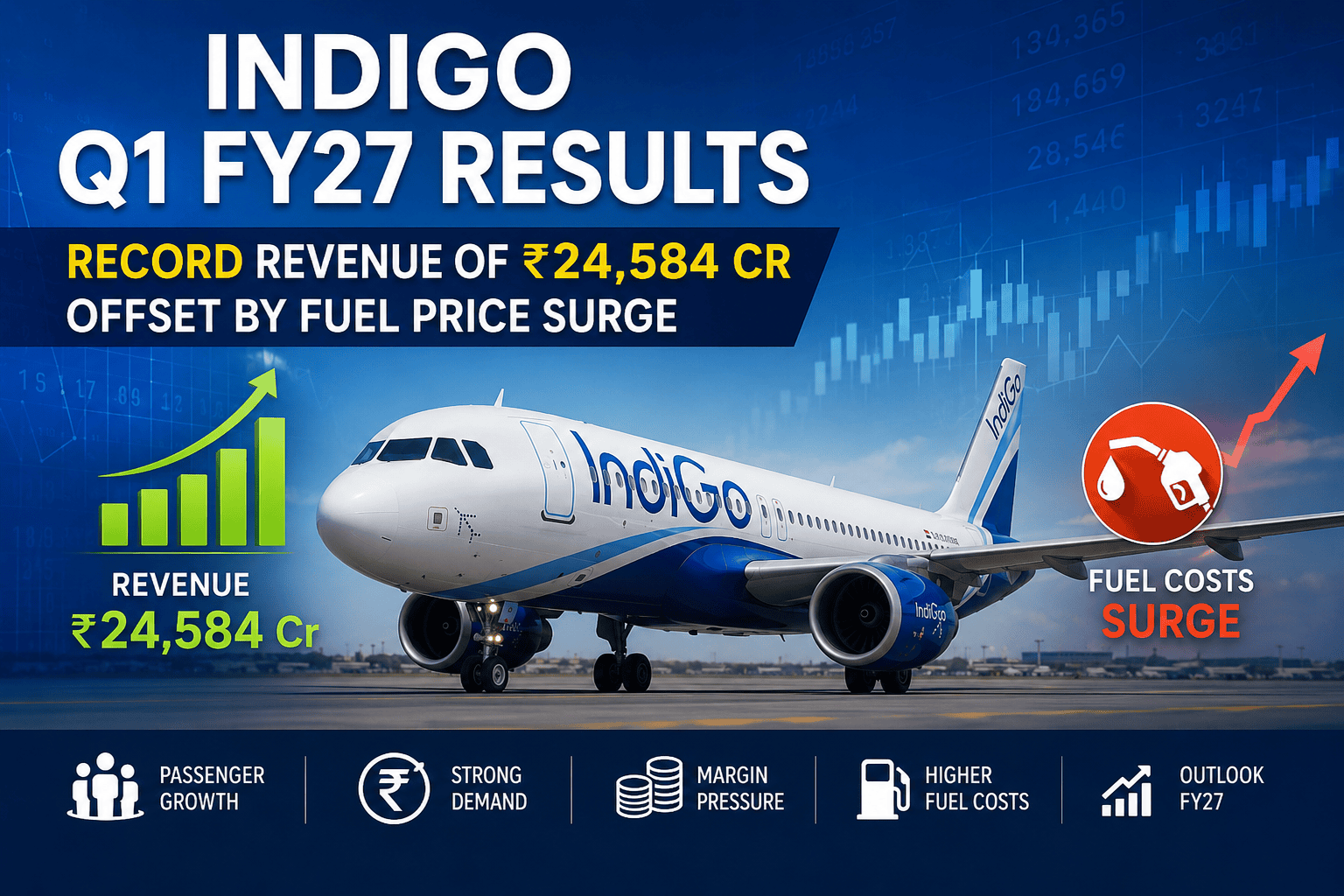
In a quarter defined by unprecedented global energy volatility, India’s aviation giant InterGlobe Aviation Ltd. (IndiGo) demonstrated exceptional top-line expansion alongside deep operational margin compression. Reporting its Q1 FY27 financial results on July 23, 2026, IndiGo achieved its highest-ever quarterly revenue from operations at ₹24,584.1 crore—a remarkable 19.94% YoY increase compared to ₹20,496.3 crore in Q1 FY26.
However, the headline story lies in profitability: the aviation giant swung from a robust net profit of ₹2,176.3 crore in Q1 FY26 to a net loss of ₹238.0 crore in Q1 FY27. The primary catalyst for this shift was a massive surge in Aviation Turbine Fuel (ATF) expenses, which rose 85.73% YoY to ₹10,832.9 crore (from ₹5,832.6 crore in Q1 FY26) due to geopolitical conflicts in West Asia. Although government price caps between April and June mitigated an even sharper escalation, total consolidated expenses surged 34.43% YoY to ₹25,852.5 crore, temporarily outpacing revenue gains.
Executive Summary
Record Revenue: Consolidated revenue from operations reached ₹24,584.1 crore, up 19.94% YoY (from ₹20,496.3 crore in Q1 FY26) and 9.56% QoQ (from ₹22,438.4 crore in Q4 FY26).
Profitability Pressure: Consolidated Net Profit swung to a loss of ₹238.0 crore, compared to a profit of ₹2,176.3 crore in Q1 FY26. Sequentially, this represents a substantial reduction in losses from the ₹2,536.9 crore loss recorded in Q4 FY26.
Fuel Cost Surge: Aircraft fuel expenses climbed to ₹10,832.9 crore, up 85.73% YoY, accounting for 41.90% of total operating costs.
Total Expenses: Consolidated expenses stood at ₹25,852.5 crore, expanding by 34.43% YoY primarily due to fuel price spikes.
Government Price Support: Fuel cost growth was partially mitigated by the Ministry of Petroleum and Natural Gas (MoPNG) price capping mechanism on ATF between April 1 and June 8, 2026.
Foreign Exchange Loss: Forex losses decreased sharply to ₹82.5 crore in Q1 FY27, down from ₹4,822.9 crore in Q4 FY26 and ₹147.3 crore in Q1 FY26.
Earnings Per Share: Basic and Diluted EPS dropped to ₹(6.15) per share from ₹56.31 in Q1 FY26.
Regulatory Developments: Contingent disclosures include an ongoing CCI investigation into domestic operations following December 2025 flight cancellations and ₹500 million in bank guarantees submitted to the DGCA.
Tax Recoverables Under Protest: Cumulative Integrated Goods and Services Tax (IGST) paid under protest on re-imported repaired aircraft parts reached ₹2,293.2 crore as of June 30, 2026.
Company Snapshot
InterGlobe Aviation Limited (IndiGo) is India’s largest passenger airline, operating on a Low-Cost Carrier (LCC) model focused on high aircraft utilization, point-to-point routes, and operational efficiency.
IndiGo Market & Operational Footprint
┌──────────────────────────────┬──────────────────────────────────┐
│ Parameter                    │ Detail                           │
├──────────────────────────────┼──────────────────────────────────┤
│ Domestic Market Share        │ ~60%–62% (Dominant Leader)       │
│ Business Model               │ Low-Cost Carrier (LCC)           │
│ Key Competitors              │ Air India Group, Akasa Air,      │
│                              │ SpiceJet                         │
│ Revenue Sources              │ Passenger Fares, Ancillary Services│
│                              │ Cargo (IndiGo CarGo)             │
└──────────────────────────────┴──────────────────────────────────┘
Q1 FY27 Results Snapshot
The table below summarizes the consolidated financial results of InterGlobe Aviation Limited for the quarter ended June 30, 2026 (Q1 FY27).
| Metric (in ₹ Millions, except EPS) | Q1 FY27 (Unaudited) | Q4 FY26 (Audited) | Q1 FY26 (Unaudited) | YoY Growth (%) | QoQ Growth (%) |
Revenue from Operations | 2,45,841 | 2,24,384 | 2,04,963 | +19.94% | +9.56% |
Other Income | 10,300 | 13,923 | 10,463 | -1.56% | -26.02% |
Total Income | 2,56,141 | 2,38,307 | 2,15,426 | +18.90% | +7.48% |
Aircraft Fuel Expenses | 1,08,329 | 66,503 | 58,326 | +85.73% | +62.89% |
Aircraft & Engine Rentals | 5,397 | 7,629 | 4,925 | +9.58% | -29.25% |
Maintenance & Supplementary Rentals | 34,975 | 31,933 | 30,705 | +13.91% | +9.53% |
Airport Fees & Charges | 16,383 | 16,878 | 16,269 | +0.70% | -2.93% |
Employee Benefits Expense | 22,793 | 20,748 | 20,499 | +11.19% | +9.86% |
Finance Costs | 15,653 | 14,846 | 13,961 | +12.12% | +5.44% |
Depreciation & Amortization | 29,702 | 28,195 | 25,660 | +15.75% | +5.35% |
Foreign Exchange Loss (Net) | 825 | 48,229 | 1,473 | -44.00% | -98.29% |
Other Expenses | 23,003 | 22,946 | 19,458 | +18.22% | +0.25% |
Total Expenses | 2,58,525 | 2,59,325 | 1,92,319 | +34.43% | -0.31% |
Profit / (Loss) Before Tax | (2,384) | (23,517) | 23,107 | N/A | -89.86% |
Total Tax Expense / (Credit) | (4) | 1,852 | 1,344 | N/A | N/A |
Net Profit / (Loss) After Tax | (2,380) | (25,369) | 21,763 | N/A | -90.62% |
Basic & Diluted EPS (₹) | (6.15) | (65.62) | 56.31 | N/A | -90.63% |
Key Highlights
The Positives
Robust Top-Line Momentum: Revenue from operations grew 19.94% YoY to ₹24,584.1 crore, supported by sustained domestic travel demand and network expansion.
Foreign Exchange Stabilization: Net foreign exchange losses dropped sharply to ₹82.5 crore in Q1 FY27, compared to a massive ₹4,822.9 crore loss in Q4 FY26, bringing stability to non-operating items.
Sequential Loss Reduction: Net losses contracted significantly from ₹2,536.9 crore in Q4 FY26 to ₹238.0 crore in Q1 FY27.
The Negatives
Severe Fuel Inflation: Aircraft fuel expenses climbed by ₹5,000.3 crore YoY (+85.73%).
EBITDA Margin Compression: Sharp rise in operating costs led to a temporary swing into negative territory at the PBT level.
Cost Composition - Q1 FY27 (Total Expenses: ₹25,852.5 Cr)
┌─────────────────────────────────┬──────────┐
│ Expense Head                    │ Share %  │
├─────────────────────────────────┼──────────┤
│ Aircraft Fuel Expenses          │ 41.90%   │
│ Maintenance & Repair (Net)     │ 13.53%   │
│ Depreciation & Amortization     │ 11.49%   │
│ Other Expenses                  │  8.90%   │
│ Employee Benefits               │  8.82%   │
│ Airport Fees & Charges          │  6.34%   │
│ Finance Costs                   │  6.05%   │
│ Aircraft Rentals & FX Loss      │  2.97%   │
└─────────────────────────────────┴──────────┘
Revenue Analysis
Top-line performance was driven by continuous capacity additions, higher passenger volumes, and steady passenger yields.
Revenue Trajectory (in ₹ Crores)
25,000 |-------------------------------------- ₹24,584.1 Cr
20,000 |------------------ ₹20,496.3 Cr
15,000 |
10,000 |
       +--------------------------------------
                   Q1 FY26              Q1 FY27
Passenger Revenue: Maintained strong expansion across core domestic trunks and expanding international routes.
Ancillary & Cargo Revenue: Ancillary services (seat selection, baggage, in-flight catering) and cargo operations provided steady income support.
Profitability Analysis
Fuel Expense & Government Interventions
Fuel costs represented the primary operational challenge during the quarter:
    [ YoY Cost Bridge ]

    Q1 FY26 Fuel Expense:           ₹5,832.6 Cr
    (+) Geopolitical West Asia Spike: ₹5,000.3 Cr
    -------------------------------------------------
    (=) Q1 FY27 Fuel Expense:       ₹10,832.9 Cr (+85.73% YoY)
MoPNG Price Cap Support: The Ministry of Petroleum and Natural Gas implemented a price cap (capping ATF at 25% over March 2026 declared prices) from April 1 to June 8, 2026, protecting domestic carriers from global price volatility.
Price Stabilisation Fund: Effective June 9, 2026, MoPNG announced a Price Stabilisation Fund. IndiGo is evaluating guidelines before taking a formal decision on participation, accounting for fuel costs at market rates since June 9, 2026.
Operational & Regulatory Performance
Legal & Regulatory Updates
┌────────────────────────────────────────────────────────────────────────┐
│                      KEY REGULATORY & LEGAL MATTERS                    │
├────────────────────────────────────────────────────────────────────────┤
│ 1. IGST Paid Under Protest: Cumulative ₹2,293.2 Cr paid on re-imported │
│    repaired aircraft parts. Management expects full recovery.          │
│ 2. DGCA Order: Bank guarantees of ₹500 Million submitted following     │
│    December 2025 operational disruptions.                              │
│ 3. CCI Investigation: Investigation ordered in Feb 2026 regarding     │
│    cancellations; no financial provision made as outcome is pending.   │
└────────────────────────────────────────────────────────────────────────┘
IGST on Repaired Imports: Cumulative IGST paid under protest stands at ₹2,293.2 crore as of June 30, 2026. Based on favorable High Court of Delhi and Supreme Court rulings, IndiGo treats these amounts as fully recoverable.
Senior Leadership Transitions:
Mr. Vinay Malhotra resigned as Head of Global Sales (effective July 3, 2026).
Mr. Sukhjit S. Pasricha resigned as CHRO (effective July 19, 2026).
Mr. Kanwal Jeet Singh Bakshi was appointed as Chief Human Resources Officer (effective July 20, 2026).
Balance Sheet & Liquidity Analysis
IndiGo maintains a strong financial cushion to navigate cost volatility:
Liquidity: Significant free and restricted cash reserves protect operations against short-term fuel shocks.
Lease Liabilities: Capitalized aircraft lease obligations remain the principal balance sheet liability under Ind AS 116.
Share Capital: Equity share capital rose slightly to ₹386.7 crore following ESOP allotments.
Industry Analysis & Competitive Landscape
The Indian aviation market continues to experience strong passenger traffic growth, though airline profitability remains closely linked to global ATF pricing and currency fluctuations.
┌─────────────────────────────────┬─────────────────────────────────┐
│ Tailwinds                       │ Headwinds                       │
├─────────────────────────────────┼─────────────────────────────────┤
│ • Strong domestic demand        │ • High ATF volatility           │
│ • International route expansion │ • Supply chain delays for parts │
│ • Fleet modernizations          │ • FX translation risks          │
└─────────────────────────────────┴─────────────────────────────────┘
SWOT Analysis
                       SWOT ANALYSIS - INDIGO
 ┌──────────────────────────────────┬──────────────────────────────────┐
 │ STRENGTHS                        │ WEAKNESSES                       │
 │ • Domestic market share (~60%)   │ • High vulnerability to ATF      │
 │ • Low-cost operating structure   │   price fluctuations             │
 │ • Substantial cash reserves      │ • Dependency on single-type fleet│
 ├──────────────────────────────────┼──────────────────────────────────┤
 │ OPPORTUNITIES                    │ THREATS                          │
 │ • Long-haul international expansion│ • Geopolitical fuel spikes       │
 │ • Cargo business growth          │ • Intense domestic competition   │
 └──────────────────────────────────┴──────────────────────────────────┘
Management Commentary
Managing Director Rahul Bhatia and the leadership team emphasized operational resilience in their quarterly disclosures:
Key Operational Focus: “Despite significant fuel cost increases stemming from geopolitical factors in West Asia, our strong top-line growth of nearly 20% highlights sustained demand across our network. We continue to execute on our long-term strategy of network expansion and fleet modernization while evaluating new regulatory mechanisms like the Price Stabilisation Fund.”
What Investors Should Watch Next
Participation in Price Stabilisation Fund: Final decision regarding participation in MoPNG’s fund.
ATF Price Trajectory: Global crude oil movements following West Asia developments.
Capacity Additions: Pace of new aircraft deliveries and fleet deployment on international routes.
CCI & Regulatory Outcomes: Further updates regarding ongoing regulatory reviews.
Editorial View
IndiGo’s Q1 FY27 results highlight both top-line strength and cost vulnerabilities. A 19.94% YoY top-line growth underscores the airline’s strong market position and passenger demand. However, the 85.73% increase in fuel costs demonstrates how rapidly external energy shocks can impact operating margins. With a strong market share, solid liquidity, and stabilizing foreign exchange movements, IndiGo remains well-positioned to navigate near-term industry challenges as fuel prices normalize.