

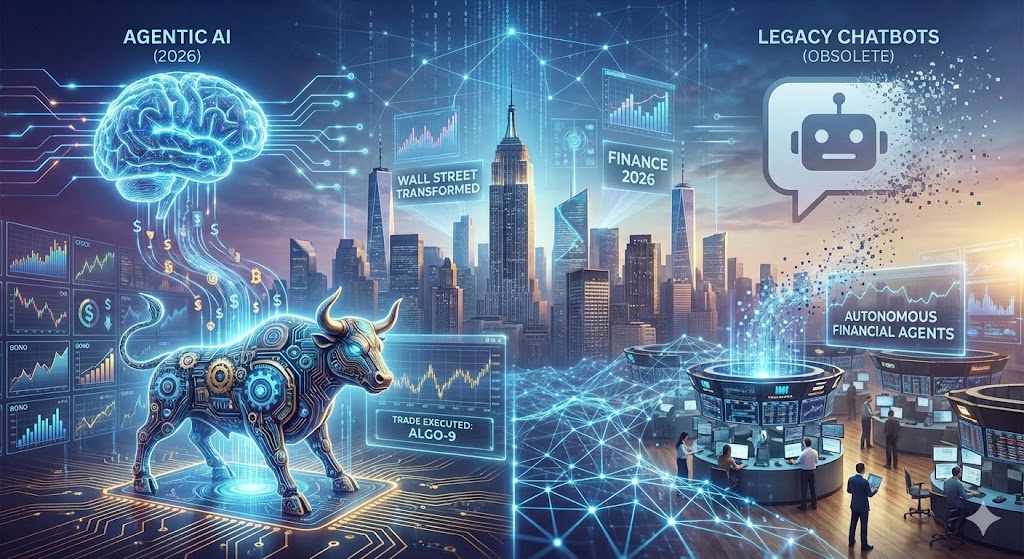
I. Introduction: The Shift from “Reactive” to “Agentic”
For the past decade, most financial institutions have proudly showcased their AI capabilities. Chatbots answered customer queries. Algorithms executed trades. Fraud detection systems flagged suspicious activity. But in 2026, something bigger is happening. The industry is moving from “reactive AI” to “agentic AI.”
What does that mean in simple terms?
Traditional AI systems respond to instructions. You ask a chatbot about your balance, it answers. You program an algorithm to sell when a stock drops 5%, it sells. These systems follow rules. They react.
Agentic AI, however, is different. It sets goals and executes multi-step actions on its own. It can analyze data, plan decisions, adapt to new information, and complete tasks without constant human supervision. It does not just answer questions. It acts.
The timing of this shift is not accidental. The global AI in fintech market is projected to reach around $36.6 billion in 2026, with the generative and agentic AI segment growing at an estimated 35% compound annual growth rate (CAGR). Financial institutions are no longer experimenting. They are integrating AI into core infrastructure.
Speed is no longer the competitive advantage. Autonomous reasoning is.
Banks, hedge funds, and fintech platforms are asking a serious question: if markets move in milliseconds and data flows nonstop, can human decision-making alone keep up?
The answer increasingly points toward autonomous agents.
AI Market Size & Growth Data
II. The Evolution of Algorithmic Trading: From Flash Crashes to Reasoning Agents
To understand why agentic AI matters, we need to look back at the history of algorithmic trading.
In the 1990s and early 2000s, High-Frequency Trading (HFT) transformed markets. Algorithms could execute thousands of trades per second. The logic was simple: faster execution meant better profits.
But speed without understanding can be dangerous.
On May 6, 2010, the US stock market experienced what is now known as the Flash Crash. The Dow Jones Industrial Average plunged nearly 1,000 points in minutes, wiping out almost $1 trillion in market value before partially recovering. Investigations later showed that a large automated sell order in E-Mini S&P contracts triggered cascading reactions among trading algorithms. These systems reacted to price drops without understanding the broader context. There was no reasoning layer. Just mechanical response.
A similar pattern appeared during the March 2020 COVID-19 crash. In India, the Sensex dropped nearly 4,000 points in a single day. Stop-loss algorithms accelerated selling. Programs designed to protect portfolios ended up amplifying panic because they were reacting to volatility rather than evaluating macroeconomic signals.
Traditional algorithms follow rules. They do not ask why something is happening.
This is where agentic AI enters the picture.
In 2026, autonomous financial agents are designed with reasoning capabilities. Instead of reacting only to price changes, they analyze multiple data sources simultaneously. They read corporate earnings transcripts. They monitor geopolitical developments. They assess supply chain disruptions. They evaluate interest rate announcements. Then they decide whether a market move reflects temporary noise or structural risk.
For example, if oil prices spike due to geopolitical tension, a reactive algorithm might simply sell airline stocks. An agentic system might analyze inventory levels, hedging strategies, and historical price resilience before making a decision.
The difference is context.
Markets today are influenced by global supply chains, central bank policies, and digital sentiment. A reasoning agent processes all of that in seconds.
That is not replacing human traders. It is extending their cognitive reach.
Flash Crash Reference (Historical Context)
III. The Hidden Goldmine: Autonomous Credit Underwriting
While trading grabs headlines, one of the biggest opportunities for agentic AI lies in credit underwriting.
Commercial lending is traditionally slow. A typical loan application can include over 100 pages of financial statements, tax returns, contracts, and projections. Human underwriters review documents line by line. It can take days or even weeks to approve a loan.
Now imagine an AI agent that can read, interpret, and reconcile all of that data in minutes.
Here is how it works.
First, a data extraction agent ingests documents in multiple formats — scanned PDFs, Excel sheets, email attachments. It converts them into structured financial data. It can reconcile differences between GAAP and IFRS accounting standards.
Second, a risk evaluation agent compares this data against historical financial trends and macroeconomic indicators. It calculates debt-service coverage ratios, liquidity positions, and stress-test scenarios.
Third, a writer agent drafts a credit memo. It explains the reasoning behind approval or rejection, cites data sources, and generates an audit-ready document.
The result?
Loan processing times shrink from days to minutes. Operational costs drop by 40–60% in many fintech case studies. Compliance improves because every decision has a documented reasoning trail.
In a competitive lending environment, speed and accuracy determine market share. Agentic AI offers both.
For small businesses waiting for capital, faster underwriting means quicker growth. For banks, it means reduced overhead and fewer manual errors.
This is not futuristic. It is happening now.
IV. The ROI of Autonomous Agents
Financial institutions do not adopt technology for fun. They adopt it for return on investment (ROI).
Let us look at specific examples.
In corporate earnings analysis, analysts traditionally spend hours building financial models. They manually extract numbers from quarterly reports. An agentic system can parse earnings call transcripts instantly, update models, and highlight deviations from expectations. Analysts then focus on strategic interpretation instead of data entry.
In regulatory compliance, Anti-Money Laundering (AML) systems often generate high false positives. Compliance teams manually review flagged accounts. Agentic AI continuously monitors transactions in real time, reducing false alerts and automatically generating regulatory reports. This lowers compliance costs and reduces the risk of fines.
In geoeconomic risk management, traditional models update quarterly. But supply chain disruptions can happen overnight. Autonomous agents continuously monitor trade tariffs, shipping data, and commodity flows. If geopolitical tension rises, the system can proactively rebalance exposure before losses accumulate.
The business value is clear: reduced cost, improved accuracy, faster execution.
Enterprise SaaS companies and B2B cloud providers see this as a massive opportunity. Financial institutions are shifting budgets from experimental AI projects to full-scale deployment.
V. Beyond Wall Street: Impact on Dalal Street and Emerging Markets
This transformation is not limited to Wall Street. Indian financial markets are also integrating advanced AI systems.
With retail participation rising sharply in India and millions of new demat accounts opened in recent years, brokerage platforms are using AI agents for portfolio suggestions, fraud detection, and automated advisory services.
In India’s growing digital lending ecosystem, agentic underwriting is especially relevant. Micro, small, and medium enterprises (MSMEs) often lack standardized documentation. AI agents can interpret alternative data such as GST filings, digital payment histories, and invoice records to assess creditworthiness.
For emerging markets, where manual processes can be slow and fragmented, autonomous systems create efficiency gains that leapfrog traditional infrastructure.
“AI in banking supervision” reports
VI. Risks and Ethical Considerations
Of course, agentic AI is not risk-free.
Autonomous systems must operate within strict regulatory boundaries. Financial decisions affect livelihoods. Transparency is critical.
Regulators are increasingly focusing on explainability. An AI agent must justify its decisions clearly. Black-box models are unacceptable in credit approval or trading risk management.
Cybersecurity is another concern. If autonomous systems are compromised, the consequences could be severe.
The goal is not to remove humans entirely. It is to build human-supervised agent networks. AI executes, humans oversee.
Responsible deployment will define the winners.
VII. The Future of the Financial Workforce
There is often fear that AI will eliminate jobs. In reality, agentic AI changes roles rather than removes them.
Analysts move from manual processing to strategic interpretation. Compliance officers focus on policy oversight instead of repetitive review. Portfolio managers use AI insights to refine strategy.
The financial institutions that successfully integrate autonomous agents into secure workflows will gain competitive advantage.
Those that rely purely on outdated manual systems may struggle to keep up.
The shift from reactive AI to agentic AI marks a structural evolution in finance. Just as algorithmic trading once replaced manual floor trading, autonomous agents are now redefining decision-making infrastructure.
Conclusion: Building for the Next Decade
Agentic AI is not hype. It is a practical response to growing data complexity, faster markets, and tighter regulatory demands.
The fintech AI market is expanding rapidly. Institutions are moving from pilot projects to enterprise-wide integration. Trading systems are adding reasoning layers. Credit underwriting is becoming autonomous. Compliance monitoring is shifting to real-time intelligence.
The institutions that scale secure, transparent autonomous systems will likely dominate the next decade of finance.
The real question for leaders in 2026 is simple:
Are you building with reactive tools from yesterday…
or are you preparing your infrastructure for autonomous intelligence?
Because in finance, adaptation is not optional. It is survival.
📌 Frequently Asked Questions (FAQ)
1. What is Agentic AI in finance?
Agentic AI in finance refers to autonomous AI systems that can plan, reason, and execute multi-step financial tasks without constant human supervision.
Unlike traditional chatbots that only respond to queries, agentic systems can:
Analyze earnings reports
Monitor market conditions
Execute trades
Rebalance portfolios
Generate credit risk reports
In 2026, large financial institutions are using agentic AI as a core decision-support engine rather than just a customer service tool.
2. How is Agentic AI different from fintech chatbots?
The difference is execution power.
| Feature | Chatbots | Agentic AI |
|---|---|---|
| Answers Questions | ✅ | ✅ |
| Executes Multi-Step Tasks | ❌ | ✅ |
| Portfolio Rebalancing | ❌ | ✅ |
| Autonomous Credit Analysis | ❌ | ✅ |
| Continuous Risk Monitoring | ❌ | ✅ |
Chatbots are reactive.
Agentic AI is proactive and goal-oriented.
3. How is Agentic AI used in algorithmic trading?
Modern autonomous trading agents:
Read financial statements in real time
Analyze macroeconomic news
Monitor bond yields and geopolitical risk
Adjust exposure automatically
Unlike older high-frequency trading systems that triggered flash crashes (like the 2010 Dow crash), agentic systems incorporate contextual reasoning before executing trades.
This reduces blind, panic-driven automation.
4. Can Agentic AI replace financial analysts?
No — it enhances them.
Agentic AI handles:
Data ingestion
Model building
Risk scoring
Compliance documentation
Human analysts focus on:
Strategy
Final decision-making
Client communication
Ethical oversight
The future is human + autonomous systems, not replacement.
5. What is autonomous credit underwriting?
Autonomous credit underwriting uses AI agents to:
Extract financial data from PDFs and balance sheets
Normalize accounting standards (GAAP/IFRS)
Evaluate borrower risk
Generate compliance-ready credit memos
In 2026, fintech firms report:
40–60% operational cost reduction
Loan processing time cut from days to minutes
This is one of the fastest-growing segments of AI in fintech.
6. Is Agentic AI safe for financial institutions?
Safety depends on:
Governance controls
Audit trails
Regulatory alignment
Human override systems
Leading banks deploy agentic AI within sandboxed, supervised environments with full compliance monitoring.
Regulators are increasingly demanding explainability in autonomous systems.
7. How big is the AI in fintech market in 2026?
The global AI in fintech market is projected to reach approximately $36+ billion in 2026, growing at a strong compound annual growth rate (CAGR).
The fastest-growing segment:
Autonomous agents in trading, underwriting, and compliance automation.
8. How does Agentic AI impact Wall Street and Dalal Street?
On Wall Street:
Speeds up institutional trading
Automates hedge fund risk management
Enhances derivatives pricing
On Dalal Street:
Improves brokerage risk models
Supports portfolio management services
Strengthens compliance systems
Capital markets are becoming automation-first environments.
9. Will Agentic AI reduce financial market volatility?
Potentially — yes.
Because reasoning agents:
Avoid blind stop-loss cascades
Factor macro context before reacting
Adjust gradually instead of triggering panic trades
However, poor implementation could still amplify volatility.
Technology discipline matters.
10. How can investors benefit from the rise of Agentic AI?
Investors can benefit by:
Tracking fintech infrastructure companies
Investing in enterprise AI SaaS providers
Monitoring brokerage firms adopting automation
Evaluating tech-enabled portfolio management services
The real opportunity is not just AI tools —
It’s the companies embedding AI deeply into financial infrastructure.
🔎 People Also Ask (PAA)
1. What is Agentic AI in finance?
Agentic AI in finance refers to autonomous AI systems that can independently plan, analyze, and execute complex financial tasks. Unlike traditional chatbots, agentic AI can manage portfolios, evaluate credit risk, monitor compliance, and respond dynamically to market changes without waiting for human prompts.
2. How are autonomous financial agents different from algorithmic trading bots?
Traditional algorithmic trading bots follow predefined rules based on price signals. Autonomous financial agents go further by incorporating reasoning. They analyze earnings reports, geopolitical news, bond yields, and macroeconomic trends before making decisions, reducing blind or panic-driven execution.
3. Is Agentic AI replacing human financial analysts?
No. Agentic AI enhances analysts rather than replacing them. It automates data-heavy processes such as financial modeling, risk scoring, and compliance reporting. Human professionals still provide judgment, oversight, and strategic direction.
4. How is Agentic AI used in credit underwriting?
Agentic AI automates the entire underwriting workflow:
Extracts financial data from documents
Standardizes accounting formats
Calculates risk metrics
Generates audit-ready credit memos
This reduces loan processing time from days to minutes and lowers operational costs significantly.
5. What is the market size of AI in fintech in 2026?
The global AI in fintech market is projected to exceed $36 billion in 2026, with autonomous AI systems growing at one of the fastest rates in the sector. Financial institutions are moving from experimental AI pilots to full-scale deployment.
6. Can Agentic AI reduce financial market crashes?
Agentic AI can potentially reduce volatility because it adds contextual reasoning. Instead of reacting only to price changes, it evaluates macroeconomic conditions and liquidity factors before executing trades. However, improper deployment can still create systemic risks.
7. How does Agentic AI impact Wall Street and Dalal Street?
On Wall Street, it enhances hedge fund automation, compliance monitoring, and AI-driven trading strategies. On Dalal Street, it supports brokerage risk management, portfolio advisory systems, and faster credit processing in NBFCs and fintech platforms.
8. Is Agentic AI secure for banks and financial institutions?
Security depends on governance frameworks. Leading institutions implement:
Human override controls
Explainable AI models
Regulatory audit trails
Real-time compliance monitoring
Properly managed systems can enhance financial stability rather than threaten it.
9. What industries benefit most from Agentic AI in finance?
Key beneficiaries include:
Investment banks
Hedge funds
NBFCs and lending platforms
Portfolio management services
Enterprise fintech SaaS providers
The biggest gains come from cost reduction and faster decision-making.
10. Should investors consider companies building autonomous AI systems?
Investors should monitor fintech infrastructure providers integrating autonomous AI into trading, lending, and compliance systems. The real value lies in scalable enterprise adoption rather than standalone chatbot tools.


2 thoughts on “Agentic AI in Finance 2026: How Autonomous Financial Agents Are Replacing Chatbots and Transforming Wall Street”