

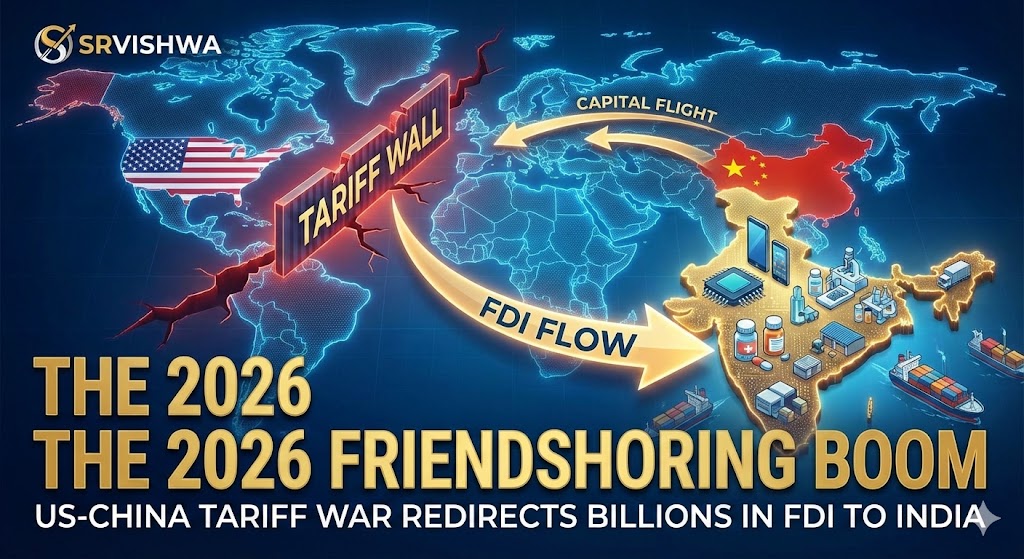
For over thirty years of tracking global capital flows, I have seen supply chains shift due to labor costs, currency devaluations, and technological leaps. However, what we are witnessing in 2026 is fundamentally different. Capital is no longer just chasing cheap labor; it is chasing geopolitical security.
The escalating US-China tariff war has permanently fractured the old globalization model. In its place, a new doctrine has emerged: “Friendshoring.” For multinational corporations, moving manufacturing to allied or neutral nations is no longer optional—it is a survival imperative. And the primary beneficiary of this seismic shift is India.
Here is a fundamental analysis of how this geoeconomic pivot is driving a historic wave of capital into Indian markets, and which sectors are poised for explosive growth.
The Catalyst: The 2026 Tariff Wall
The restructuring of global trade did not happen overnight, but recent policy shifts in Washington and Brussels have accelerated the timeline. With aggressive tariffs now targeting Chinese EVs, semiconductors, and legacy legacy technology components, Western multinationals are facing squeezed margins.
The risk of relying on a single manufacturing hub has simply become too expensive. Boardrooms across the Fortune 500 are aggressively seeking global supply chain solutions that offer both scale and political neutrality.
Follow the Capital: The Surge in Foreign Direct Investment India
As capital exits Beijing and Shanghai, it is finding a welcoming harbor in Mumbai, Chennai, and Gujarat. India’s strategic neutrality, coupled with aggressive Production-Linked Incentive (PLI) schemes, has created a fertile ground for institutional capital.
Foreign Direct Investment India is seeing a structural re-rating. We are no longer just attracting “hot money” into our equity markets; we are securing long-term, sticky capital in hard assets, factories, and infrastructure.
The Apple Effect: The blueprint has already been laid out by tech giants relocating significant portions of their smartphone assembly to India. This creates a downstream multiplier effect, forcing mid-tier component suppliers to follow suit.
Logistics Real Estate: To support this manufacturing boom, industrial warehousing and logistics parks are seeing record private equity investments, offering lucrative yields for commercial real estate funds.
The Sectoral Winners: Where the Smart Money is Hiding
From a fundamental analysis standpoint, two sectors are capturing the lion’s share of this Friendshoring boom:
Electronics Manufacturing Services (EMS): Indian EMS players are seeing order books swell as global brands look to de-risk. Companies that have successfully secured PLI approvals are demonstrating massive year-over-year revenue growth.
Pharmaceuticals (Active Pharmaceutical Ingredients – APIs): The pandemic exposed the West’s dangerous reliance on China for APIs. In 2026, the push for drug security has led to massive investments in the Indian pharma sector, specifically targeting the domestic production of critical bulk drugs.
The Hidden Beneficiaries: Legal and Financial Services
Moving a multi-billion-dollar supply chain across borders is not just a logistical challenge; it is a financial and legal labyrinth.
As factories shift, so does corporate governance. The influx of multinational corporations into India has created a massive demand for elite B2B services. Firms specializing in cross-border corporate tax planning, compliance, and intellectual property law are seeing unprecedented billing growth. Navigating the complex tax treaties between the US, Europe, and India is critical for these corporations to maintain profitability during the transition.
The Bottom Line for Investors
The Friendshoring boom is not a cyclical trend; it is a secular, multi-decade structural shift. While retail investors often focus on daily market noise, fundamental analysts know that watching physical capital flows is the key to identifying long-term wealth creation.
The companies—and countries—that position themselves as reliable nodes in these new, secure supply chains will define the economic hierarchy of the next twenty years.

Anyone else tried 888phpbet? I’m looking for a good new spot to play. Is it legit? Let me know! 888phpbet