1. The Executive Summary (The News Hook)
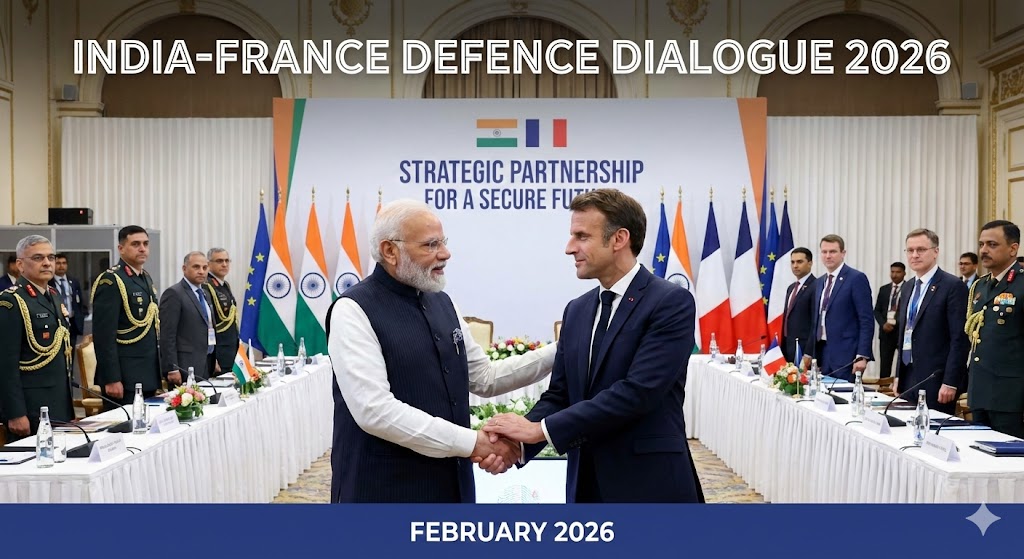
Tomorrow, February 17, 2026, India’s Defence Minister Rajnath Singh will meet French Minister Catherine Vautrin in Bengaluru for the 6th India-France Defence Dialogue. On paper, it looks like a routine diplomatic engagement. In reality, it may be one of the most important defense-finance events of FY26.
This meeting comes at a time when global geopolitics is unstable. Russia remains deeply tied up in its prolonged war commitments. The United States is facing election-year political uncertainty. Europe is recalibrating its strategic posture. In this shifting environment, France has quietly become India’s most stable and technology-friendly defense partner.
The agenda is not symbolic. It includes discussions around the 114 Multi-Role Fighter Aircraft (MRFA) deal, additional Scorpene submarines, and long-term jet engine collaboration between Safran and Indian companies. These are not small announcements. Together, they represent potential contracts worth over ₹1.5 lakh crore in the coming years.
For investors, this is not just diplomacy. It is an order book catalyst. The Indian defense sector already has record backlogs stretching beyond 2030. Any confirmation of co-production or technology transfer tomorrow could trigger a fresh re-rating in key stocks.
Suggestion: Ministry of Defence India official statement
2. The “Deal Sheet”: Real-Time Data for Investors
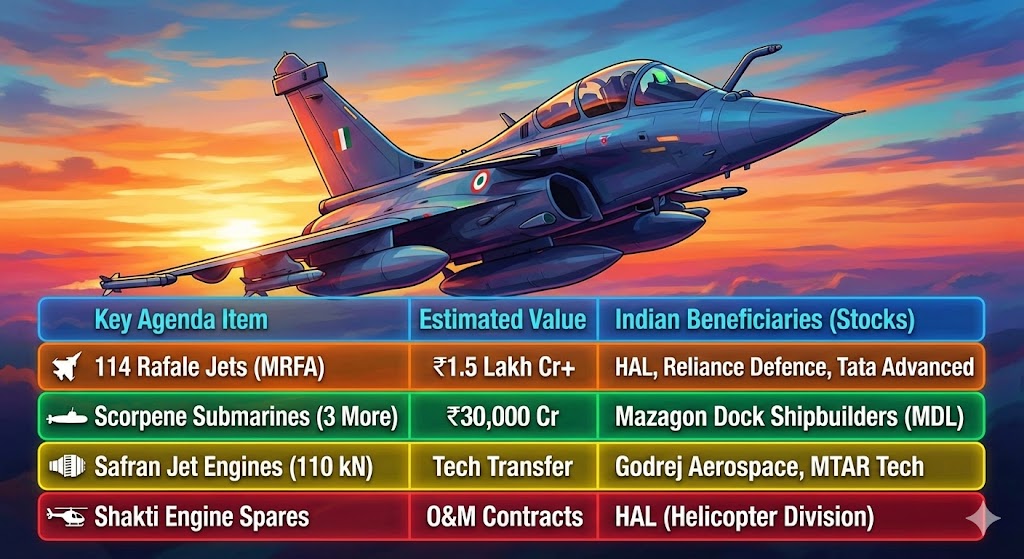
When we strip away the diplomatic language, what remains is a massive financial pipeline.
The 114 MRFA (Multi-Role Fighter Aircraft) deal alone is estimated to be worth over ₹1.5 lakh crore. If Rafale Marine variants are selected for the Indian Navy and Air Force expansion, this becomes one of the largest fighter jet contracts in the world. Indian partners such as Hindustan Aeronautics Limited (HAL), Tata Advanced Systems, and private defense suppliers would benefit from local assembly and component manufacturing.
The extension of the Scorpene submarine program, potentially adding three more submarines, is estimated at around ₹30,000 crore. Mazagon Dock Shipbuilders (MDL), which built the earlier Scorpene submarines under technology transfer, stands directly in line for this work.
Then comes the jet engine discussion with Safran. This is arguably more important than the aircraft deal itself. India’s Advanced Medium Combat Aircraft (AMCA) program requires a 110 kN thrust engine. Full or near-full technology transfer in this area would transform India’s aerospace capabilities. Companies like HAL, Godrej Aerospace, MTAR Technologies, and Mishra Dhatu Nigam (Midhani) could become structural beneficiaries.
When investors evaluate defense stocks, they look for long visibility. These discussions suggest multi-year manufacturing pipelines, not one-time contracts.
Dassault Rafale fighter program
3. Fundamental Analysis: The “Tech-Transfer” Premium
A. The “Engine” Holy Grail (Safran + HAL)
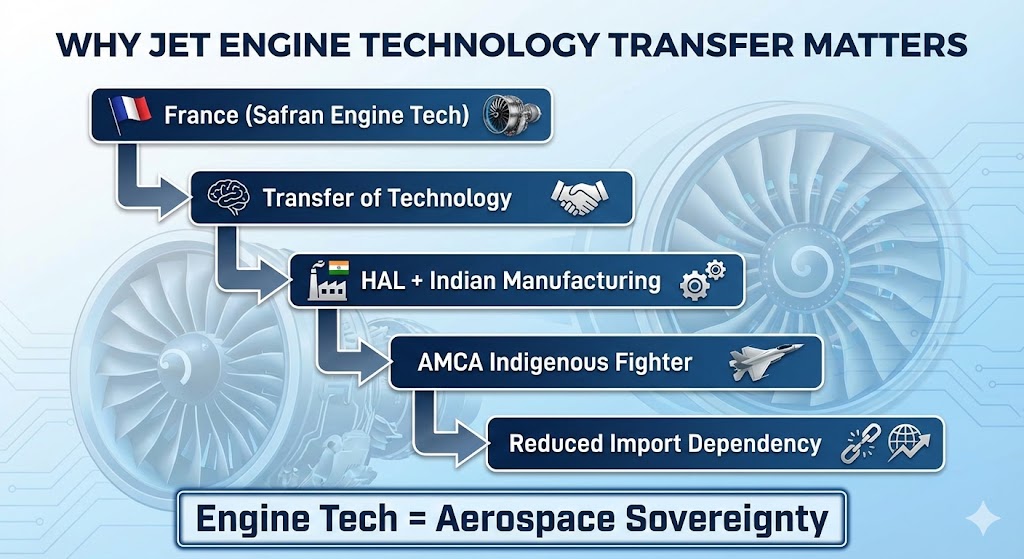
If there is one area where China still faces challenges, it is reliable high-performance jet engines. India understands that without engine technology, true aerospace independence is impossible. That is why Safran’s role in this dialogue is critical.
The focus is on meaningful technology transfer, not screwdriver assembly. If Safran agrees to deeper co-development of engines for AMCA or even upgrades for Tejas variants, it reduces India’s dependence on foreign suppliers in the long run.
For investors, technology transfer carries a premium. It changes valuation logic. Instead of being seen as a contract assembler, HAL could be viewed as a long-term aerospace OEM with intellectual property depth. Midhani, which produces specialized superalloys used in engines, could see structural demand growth.
This is not about one earnings quarter. It is about reshaping India’s defense manufacturing base for decades.
Safran jet engine technology
B. The Indo-Pacific Pivot
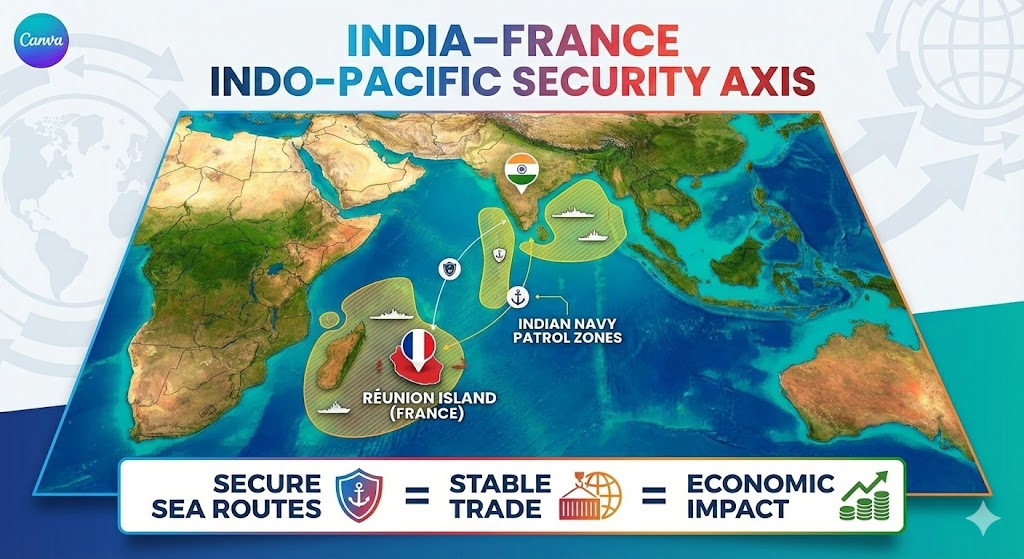
France is not just a European power. It is a resident Indo-Pacific nation with territories like Réunion Island in the Indian Ocean. This gives it strategic relevance in maritime security.
Joint patrols, surveillance cooperation, and naval exercises between India and France strengthen trade route protection. Around 90% of India’s trade by volume moves through sea routes. Secure maritime corridors reduce insurance risk premiums and enhance shipping stability.
This indirectly benefits shipping companies and port infrastructure players. A stable Indo-Pacific reduces volatility in logistics costs, which is positive for the broader economy.
4. Geopolitical “Alpha”: The Russia Hedge
In 2020, nearly 60% of India’s defense inventory had Russian origins. However, supply chain disruptions and geopolitical complications have accelerated diversification.
France offers a unique advantage. Unlike the United States, it has not pressured India over Russian oil imports or S-400 purchases. France has historically supported India at the United Nations and avoided sanction-driven disruptions.
For investors, geopolitical predictability reduces risk. Stocks tied to Russian supply chains carry uncertainty due to parts availability and global restrictions. French-linked projects are seen as more stable.
This “sanction-proof” perception creates a safety premium in companies like Mazagon Dock and HAL, especially when their order books are aligned with Western or French technology partners.
French Ministry of Armed Forces
5. The Stock Market Angle: Why This Matters Now
India’s defense sector has already delivered strong returns over the past three years. Companies like HAL, Bharat Electronics Limited (BEL), and Mazagon Dock have seen order books expand sharply due to government capital expenditure.
But markets move on fresh triggers. The Bengaluru dialogue provides exactly that.
If tomorrow’s press conference includes phrases like “co-production,” “technology transfer,” or “indigenous manufacturing expansion,” traders will interpret this as confirmation of sustained order inflows.
Defense stocks often move before formal contract signing. The signaling effect is enough. That is why pre-event positioning matters.
With India’s defense budget now above ₹6 lakh crore and capital outlay rising steadily, the structural trend remains intact.
6. The Private Sector Multiplier
Earlier, defense manufacturing was almost entirely PSU-dominated. That is changing.
Private companies like Tata Advanced Systems, Bharat Forge, L&T Defense, and Adani Defense have become key suppliers in aerospace and naval components. If the dialogue emphasizes joint ventures and local supply chain deepening, these firms stand to benefit.
The multiplier effect is important. Every ₹1 lakh crore defense deal spreads across dozens of Tier-2 and Tier-3 suppliers. Electronics, alloys, software systems, avionics, and precision engineering firms gain indirect exposure.
This creates a broader investment universe beyond just one or two headline stocks.
7. Risk Factors: What Could Go Wrong?
No investment theme is risk-free.
Defense deals are complex. Negotiations over pricing, offsets, and technology depth can take years. If tomorrow’s meeting results in only broad statements without timelines, markets may react cautiously.
Budget allocation is another factor. While capital expenditure remains strong, fiscal pressures could slow disbursement schedules.
There is also valuation risk. Many defense stocks are trading at elevated price-to-earnings multiples. Any delay in execution or margin compression could trigger temporary corrections.
Long-term investors must separate structural opportunity from short-term volatility.
8. Conclusion: The Watchlist for Tomorrow
Tomorrow’s India-France Defence Dialogue is more than diplomatic theater. It is a signal event for investors tracking the defense manufacturing ecosystem.
If the meeting confirms deeper co-production frameworks, jet engine collaboration, and submarine expansion timelines, it strengthens the thesis that India’s defense order book visibility extends to 2032 and beyond.
For conservative investors, defense remains a government-backed growth story. For aggressive investors, tomorrow’s statements may offer trading momentum.
The key is not to chase headlines blindly. Watch for specifics: timelines, percentages of localization, and formal commitments.
The broader trend is clear. India is diversifying suppliers, strengthening technology access, and aligning defense manufacturing with economic growth.
Beyond Rafale, the real story is structural capability building.
And for markets, structural stories are the ones that compound.
✅ FAQ
1. What is the India-France Defence Dialogue 2026?
It is the 6th strategic defense meeting between India and France focusing on fighter jets, submarines, and technology cooperation.
2. What is the value of the MRFA 114 fighter jet deal?
The MRFA deal is estimated to be worth over ₹1.5 lakh crore, making it one of India’s largest defense contracts.
3. How does the Safran engine deal impact India?
Technology transfer from Safran could help India develop advanced jet engines for AMCA, reducing foreign dependency.
4. Which Indian companies may benefit?
HAL, Mazagon Dock, Bharat Electronics, Tata Advanced Systems, and aerospace component manufacturers may benefit.
5. Why is France a key defense partner for India?
France offers advanced technology, supports co-production, and has historically maintained strategic autonomy in its defense policy.
6. Are defense stocks a good investment in 2026?
Defense stocks have strong order book visibility due to rising government capital expenditure, but valuations must be evaluated carefully.
7. What is Rafale Marine?
Rafale Marine is the naval version of the Rafale fighter jet designed for aircraft carrier operations.