

1. The Executive Summary (The Macro Hook)
Inox Wind’s Q3 FY26 results, released on February 14, 2026, mark an important shift in the company’s journey. For years, investors viewed Inox Wind as a turnaround story. The focus was on potential, restructuring, and survival. Now, the conversation is changing. The company is delivering consistent execution at scale.
In Q3 FY26, Inox Wind reported a consolidated net profit of ₹126.65 crore, reflecting a steady 14% year-on-year growth compared to ₹111 crore in Q3 FY25. At first glance, 14% may not look extraordinary. But context matters. Last year’s quarter already had a strong base due to the company’s revival phase. Growing from that higher base signals stability rather than volatility.
The real headline number is execution volume. Inox Wind executed 252 megawatts (MW) of wind capacity in a single quarter. That is a 33% jump from 189 MW executed in the same quarter last year. For a capital-intensive business like wind energy, execution volume is the ultimate proof of operational strength.
The key takeaway is simple: the turnaround phase appears over. The scale-up phase has begun.
Inox Wind Q3 FY26 earnings release
2. Financial Dashboard: Volume-Led Growth
Let us break down the numbers in detail.
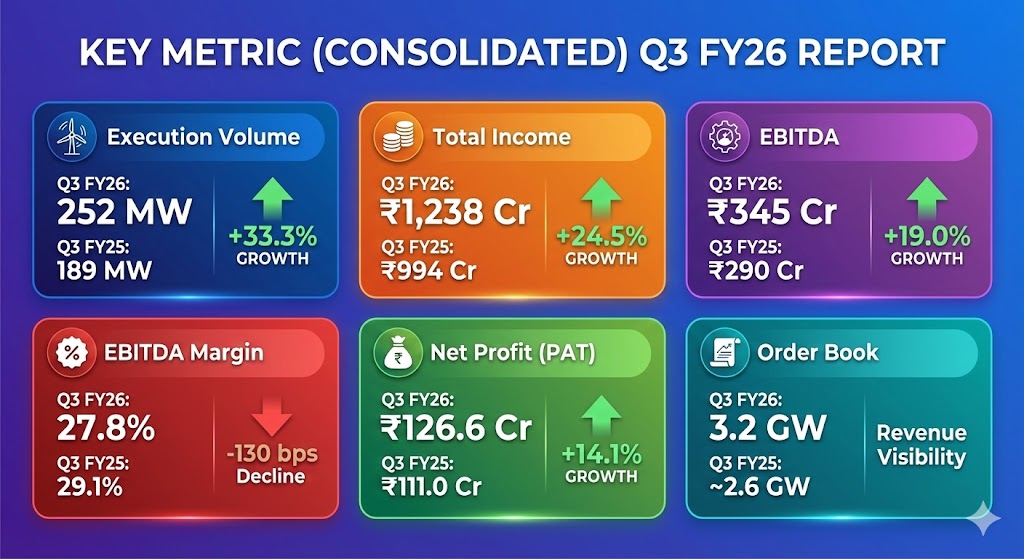
Total income rose to ₹1,238 crore, up 24.5% from ₹994 crore last year. EBITDA increased to ₹345 crore, a 19% growth from ₹290 crore. However, EBITDA margin slightly declined to 27.8% from 29.1%, a drop of 130 basis points.
Net profit stood at ₹126.6 crore, up 14.1% year-on-year. While margin compression may concern some investors, the broader picture shows volume-led expansion driving higher absolute cash flows.
The order book now stands at 3.2 gigawatts (GW), compared to roughly 2.6 GW last year. This indicates strong future revenue visibility.
In simple terms, Inox Wind is selling and installing more turbines. Even if margins fluctuate slightly due to product mix, the growth in installed capacity strengthens long-term positioning.
Inox Wind quarterly results filing
3. Fundamental Breakdown: The Three Growth Pillars
A. The 3 MW Platform Success
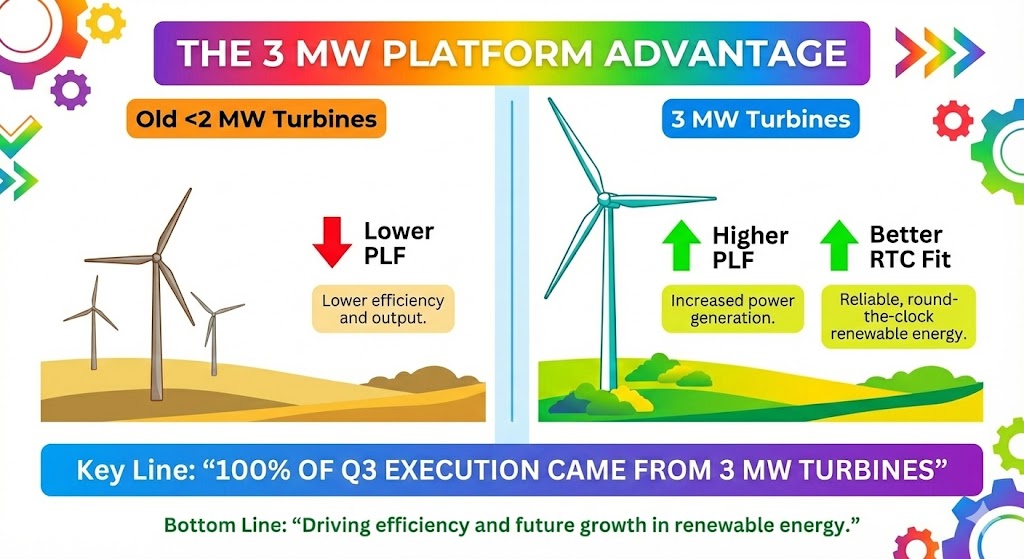
The biggest structural shift in Inox Wind’s business model is its focus on the 3 MW Wind Turbine Generator (WTG) platform. In Q3 FY26, 100% of execution came from this new-generation turbine.
Why does this matter? Larger turbines produce more electricity per unit and improve Plant Load Factor (PLF). In India, renewable developers are increasingly bidding for “Round-The-Clock” (RTC) tenders. These require steady power output across the day.
Wind and solar complement each other. Solar generates maximum power during noon hours. Wind generation typically peaks in the evening and night. The 3 MW turbines enhance output during high-demand periods.
Although EBITDA margins dipped slightly due to the shift in product mix, higher volumes from the 3 MW platform increased overall cash generation. That is a positive sign.
B. The Balance Sheet: Net Debt-Free Position
One of the most important changes in Inox Wind’s story is its improved balance sheet. Management confirmed that the company remains net debt-free at the interest-bearing level. This was made possible after a promoter fund infusion in FY25.
In a high-interest rate environment, this is a major advantage. Renewable energy projects often depend heavily on borrowed capital. A debt-free manufacturer can bid aggressively for contracts without worrying about interest burden.
It also reduces financial risk. Investors remember the stress phase when debt levels were a concern. Today, the company has stronger financial flexibility.
C. Order Book Visibility
The order book at 3.2 GW provides clear visibility for the next two to three years. At the current execution run-rate of around 1 GW per year, the company has solid pipeline strength.
The composition of the order book is also healthy. It includes both PSU clients such as NTPC and NHPC, as well as Commercial & Industrial (C&I) customers.
PSU orders bring stability and credibility. C&I customers, including large corporates seeking renewable power for sustainability targets, offer growth potential.
In renewable energy, order visibility is critical. It reduces uncertainty and supports valuation re-rating.
India installed renewable capacity data
4. Policy & Sector Context: The Hybrid Supercycle
India’s renewable energy ambition is expanding rapidly. The government has set a target of achieving 500 GW of non-fossil fuel capacity by 2030. As of early 2026, India has already crossed 180 GW of installed renewable capacity, including wind, solar, and hydro.
The Ministry of Power’s new bidding trajectory focuses heavily on wind-solar hybrid projects. These projects combine solar and wind generation to provide more stable output.
This is where wind becomes essential. Solar alone cannot provide power after sunset. Wind turbines fill that gap. Without wind, hybrid projects lose balancing efficiency.
Inox Wind benefits directly from this shift. Every hybrid project developer needs a wind partner.
Additionally, the government’s repowering policy is gaining attention. India has many old wind turbines below 1 MW capacity installed in the early 2000s. These can be replaced with modern 3 MW turbines to increase output from the same land.
This “repowering” opportunity acts as a shadow order book that has not yet fully materialized. If policy implementation accelerates in states like Tamil Nadu and Gujarat, execution volumes could rise further.
5. Risk Factors: Grid & Land Constraints
No renewable company operates without challenges.
One major risk is grid infrastructure. While Inox can manufacture and install turbines, electricity evacuation depends on substations and transmission lines. In states like Gujarat and Rajasthan, transmission infrastructure sometimes lags behind generation capacity.
If the grid is not ready, commissioned projects cannot feed power into the system. This may delay revenue recognition.
Land acquisition also poses operational risks. Modern 3 MW turbines require larger land parcels and better road connectivity to transport large blades. In some southern states, land disputes and regulatory clearances can slow installation.
Investors must monitor execution consistency across upcoming quarters.
6. Conclusion: From Turnaround to Compounder
Inox Wind’s Q3 FY26 performance signals a structural shift.
The company is no longer fighting for survival. It is executing at scale. A 33% increase in quarterly execution volume is the strongest indicator of operational maturity.
The stock has corrected nearly 15% from recent highs due to concerns of slower growth. However, this quarter shows growth momentum remains intact.
At around ₹106, valuation appears reasonable compared to the long-term renewable opportunity. India’s 500 GW target and hybrid bidding pipeline create sustained demand.
Wind energy is not a crowded space. In India, only two major pure-play wind manufacturers operate at scale. That limits competitive pressure compared to the highly fragmented solar market.
For long-term investors, Inox Wind is transitioning from a volatile turnaround play to a potential renewable compounder.
The key number to watch is execution volume. If the company maintains a 1 GW annual run-rate or higher, valuation re-rating could follow.
In renewable energy, delivery matters more than projections.
And right now, Inox Wind is delivering.
✅ FAQ
1. How much profit did Inox Wind report in Q3 FY26?
Inox Wind reported a net profit of ₹126.65 crore, up 14% year-on-year.
2. How much capacity did Inox Wind execute in Q3 FY26?
The company executed 252 MW of wind capacity, a 33% increase from last year.
3. What is Inox Wind’s current order book?
The order book stands at approximately 3.2 GW, providing strong revenue visibility.
4. Is Inox Wind debt-free?
Yes, the company confirmed it remains net debt-free at the interest-bearing level.
5. Why is the 3 MW platform important?
The 3 MW turbines offer higher plant load factors and are preferred for hybrid renewable projects.
6. What are risks for Inox Wind?
Transmission delays and land acquisition challenges remain key operational risks.
7. Is Inox Wind a good long-term renewable stock?
The company’s strong order book, debt-free status, and execution growth make it a strong renewable sector candidate, subject to policy and grid readiness.



Shahspingame is my new addiction! Seriously, the graphics are awesome, and the gameplay is super engaging. Highly recommend giving it a whirl! Shahspin shahspingame