1. The Executive Summary: A Reality Check for Consumer Durables
The Q3 FY26 results of LG Electronics India, released on February 11, 2026, have delivered a sharp reality check to the consumer durables sector.
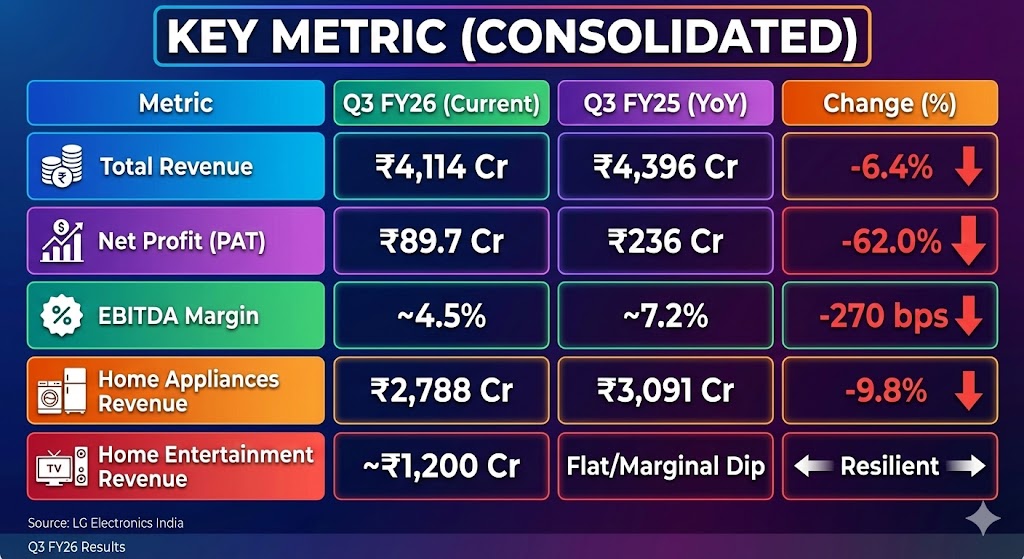
The company reported a consolidated net profit of ₹89.67 crore, down 62% year-on-year from ₹236 crore in Q3 FY25. Revenue from operations slipped 6.4% to ₹4,114 crore compared to ₹4,396 crore last year.
On the surface, this looks alarming. A 62% drop in profit is not something investors like to see. But numbers rarely tell the full story without context.
This quarter represents what analysts call a “cyclical trough.” After a strong festive quarter in Q2—driven by Diwali sales, wedding season demand, and aggressive retail financing—the consumer simply paused. Q3, which typically includes the post-festive period, saw weaker demand than expected.
The profit crash is largely a case of negative operating leverage. Fixed costs such as factory overheads, salaries, and marketing expenses remained steady. But when volumes decline, those fixed costs get spread over fewer units. That compresses margins sharply.
This is not a structural problem. It is a demand slowdown linked to seasonality and middle-class spending pressure.
LG Electronics India official website
2. Financial Dashboard: Margin Compression Explained
Let’s break down the key numbers clearly.
Total revenue fell 6.4% to ₹4,114 crore. Net profit declined 62% to ₹89.7 crore. EBITDA margin compressed from around 7.2% to approximately 4.5%, a drop of 270 basis points.
The Home Appliances segment reported revenue of ₹2,788 crore, down 9.8% year-on-year. Home Entertainment revenue was roughly ₹1,200 crore and remained relatively stable.
The sharp profit decline compared to a modest revenue fall shows how sensitive this business is to volume movement. When sales decline even slightly, profit can fall disproportionately.
This is textbook margin compression.
To understand why, imagine a factory that produces 1 million washing machines. If production drops to 900,000 units, electricity bills and salaries remain largely unchanged. So cost per unit increases. That directly impacts profitability.
This quarter’s results show exactly that dynamic.
LG Electronics India Q3 FY26 results filing
3. Segmental Deep Dive: Where Demand Slowed
A. Home Appliances: The Volume Drag
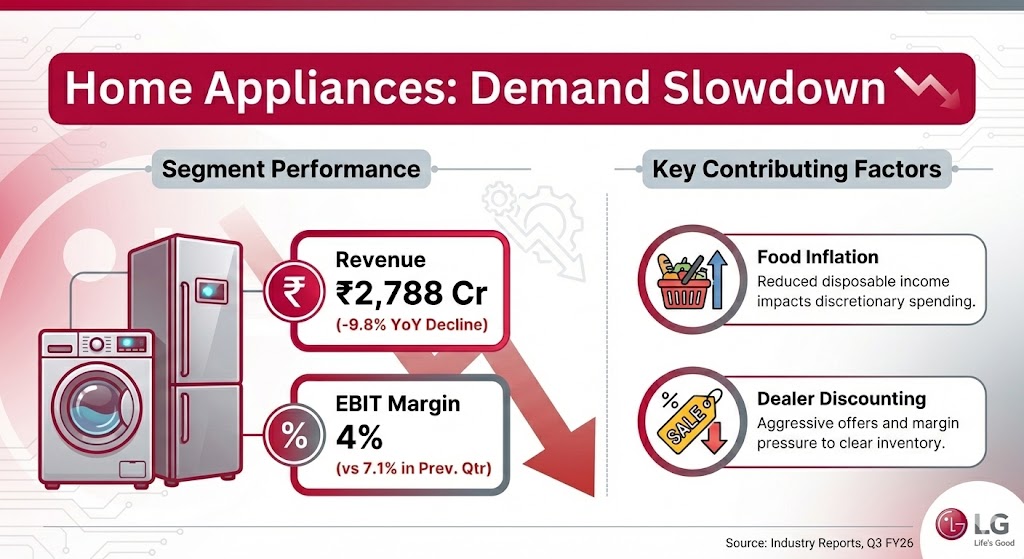
The Home Appliances segment includes refrigerators, washing machines, and air conditioners. Revenue here fell nearly 10%, and EBIT margins dropped from 7.1% to 4.0%.
This segment is highly dependent on the aspirational middle class—the “mass premium” buyer who upgrades from semi-automatic washing machines to fully automatic models, or from single-door refrigerators to double-door ones.
Recent food inflation has squeezed household budgets. Grocery prices have remained elevated. When food bills rise, discretionary spending gets postponed.
Premium models like high-end side-by-side refrigerators continued to sell, indicating that affluent consumers are still spending. But entry-level and mid-range models saw weaker traction.
Dealer checks suggest inventory levels remained high after the festive season. Retailers had stocked aggressively in Q2 expecting sustained demand. When Q3 demand slowed, they offered discounts to clear inventory. Higher discounting eats directly into margins.
This is not a brand issue. It is a demand timing issue.
India consumer durables industry report
B. Home Entertainment: The OLED Cushion
The Home Entertainment division performed relatively better.
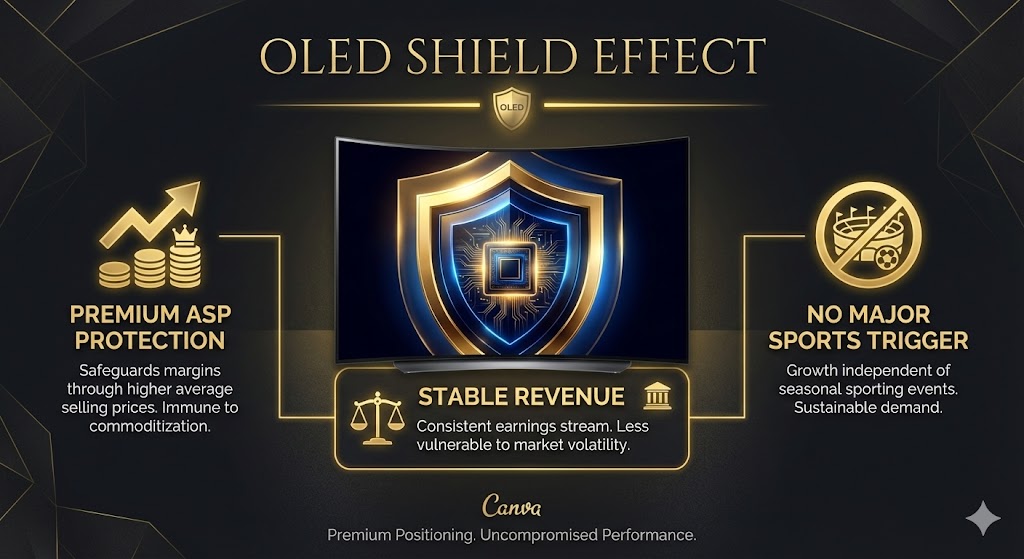
LG dominates the OLED TV market in India. OLED televisions carry higher average selling prices (ASP) and better margins compared to LED TVs.
Even if volumes decline slightly, revenue impact remains cushioned because the product mix is premium.
However, Q3 lacked a major sporting event. Historically, cricket tournaments like the IPL or World Cup boost TV sales significantly. Without such triggers, volume growth was limited.
Still, OLED leadership acted as a margin shield. It shows how premium positioning helps protect profitability during slow cycles.
C. IPO Context and Market Reaction
Since listing, LG Electronics India’s stock has faced volatility. The anchor investor lock-in expiry in January 2026 led to institutional selling.
The weak Q3 results validated short-term concerns among some investors. The stock now trades at a discount to its listing price.
At current levels, valuation is closer to 35x earnings—much more reasonable compared to earlier premiums.
For long-term investors, this correction may offer better entry points. Cyclical sectors often look weakest near the bottom of the cycle.
4. Geopolitics & Policy: The Make in India Advantage
While Q3 numbers are soft, structural positives remain intact.
LG continues to invest under the Production Linked Incentive (PLI) scheme for white goods. The scheme incentivizes local manufacturing of air conditioners and LED components.
Under PLI, companies receive incentives based on incremental production. These benefits are expected to reflect meaningfully in margins from FY27 onward.
This could structurally improve cost competitiveness.
Additionally, LG India is positioning itself as an export hub for the Middle East and Africa (MEA). Diversifying into export markets reduces dependence on domestic seasonality.
India’s manufacturing ecosystem is improving steadily. Local sourcing lowers import dependency and currency risk.
This strategic pivot provides long-term resilience.
Production Linked Incentive (PLI) scheme for white goods
5. The Summer Gamble: Weather Matters
For appliance companies, summer is critical.
Air conditioner and refrigerator sales surge during high-temperature months. Q4 (Jan–March) and Q1 (April–June) performance depends heavily on heat intensity.
Forecasts from the India Meteorological Department influence industry expectations.
If summer temperatures are above normal, sales can rebound sharply. If rains arrive early or temperatures stay moderate, inventory may pile up.
Climate patterns such as El Niño and La Niña influence weather conditions. A mild summer would lead to slower AC sales and further pricing pressure.
Competition from brands like Voltas, Daikin, and Samsung remains intense. In weak demand scenarios, price wars become common.
This makes Q4 and Q1 crucial quarters.
India Meteorological Department (IMD) forecasts
6. Input Cost Pressures: Metals and Margins

Copper and aluminum prices have increased by 5–7% over the last three months. These are key raw materials in compressors and cooling systems.
If demand remains weak, passing on higher costs becomes difficult.
When pricing power is limited and input costs rise, margins stay compressed.
This is another reason why Q3 margins were under pressure.
However, if demand revives in summer, companies typically regain pricing power.
7. The Bigger Consumption Story
Does this quarter mean India’s consumption story is broken? No.
What we are witnessing is normalization after a strong festive quarter.
Q2 saw heavy buying. Q3 saw cooling.
Urban consumers are cautious but not collapsing. Rural demand remains mixed but stable.
Inflation trends matter. If food inflation stabilizes, discretionary spending improves.
India’s middle class is still growing structurally. Temporary pauses do not reverse long-term consumption growth.
8. Balance Sheet Strength: A Major Advantage
One major comfort is LG’s balance sheet strength.
The company operates with minimal or zero debt. That provides financial flexibility.
Companies with high debt struggle during downturns. LG does not face that stress.
Strong brand equity and cash reserves allow continued investment in marketing and manufacturing even during slow quarters.
This is a structural strength.
9. Valuation: Cyclical Opportunity?
At around 35x P/E, valuation appears more reasonable compared to listing levels.
If summer demand rebounds strongly, earnings could recover sharply.
Consumer durables is a cyclical business. Investors who understand seasonality often benefit from buying during troughs.
This quarter may represent such a trough.
10. Conclusion: Seasonality, Not Structural Weakness
The 62% profit drop looks dramatic.
But deeper analysis shows it is largely due to seasonal weakness and operating leverage.
Revenue declined modestly. Fixed costs amplified the profit impact. Inventory correction pressured margins.
The brand remains strong. Market leadership remains intact. Manufacturing investments continue. Export strategy provides diversification.
The real test will be summer demand.
If temperatures rise and AC sales surge, earnings can recover quickly.
For long-term investors, this is not a panic situation. It is a reminder that consumer durables move in cycles.
In this industry, cooling periods are temporary.
Heat eventually returns.
And when it does, profits follow.
❓ FAQ
Q1. Why did LG Electronics India’s profit fall in Q3 FY26?
Profit declined mainly due to post-festive demand slowdown, lower appliance sales, and negative operating leverage impacting margins.
Q2. How much did LG India’s revenue decline in Q3 FY26?
Revenue fell 6.4% year-on-year to ₹4,114 crore.
Q3. What is negative operating leverage?
Negative operating leverage occurs when fixed costs remain high while sales volumes decline, leading to sharper profit contraction.
Q4. How important is summer for LG India?
Summer is critical because AC and refrigerator sales surge during high temperatures, directly boosting revenue and margins.
Q5. Does the PLI scheme benefit LG India?
Yes. The Production Linked Incentive scheme for white goods is expected to improve manufacturing efficiency and margins from FY27 onward.
Q6. Is LG India stock undervalued after Q3 results?
At around 35x P/E, valuation appears more reasonable compared to earlier levels, but recovery depends on summer demand.