Scope Outline
1. Executive Summary: The Analyst’s Hook
After three decades of working around India’s financial policy and market infrastructure, I have seen few institutions reinvent themselves as sharply as BSE Ltd. What was once a member-driven, low-growth legacy exchange has steadily transformed into a technology-led, volume-hungry trading platform with ambitions far beyond cash equities.
The Q3 FY26 results, released on February 9, 2026, capture this transition in a very honest way. On paper, the numbers look mixed. Total income rose to ₹831.74 crore, showing a 3.15% sequential growth, but profit after tax (PAT) fell sharply by 36.6% quarter-on-quarter to ₹219.67 crore. For anyone trained to judge companies purely on quarterly profit momentum, this looks like a red flag.
But markets are not naïve anymore. On the very day these results were announced, BSE’s share price jumped 7.5% to ₹2,986. This reaction tells us something important: investors are looking past the temporary profit dip and focusing on what BSE is becoming, not just what it earned this quarter.
The fundamental reality is simple. The profit decline is largely due to higher operational and regulatory costs, especially contributions to the Settlement Guarantee Fund (SGF) and increased clearing charges. These costs are not signs of stress; they are the price of explosive growth in derivatives volumes. In other words, BSE is spending today to build a much larger earnings engine for tomorrow.
This quarter reinforces a crucial point for readers: BSE is no longer just a stock exchange. It is a financial market platform in investment mode.
BSE Annual & Investor Presentations
2. Financial Scorecard: Q3 FY26 in Context
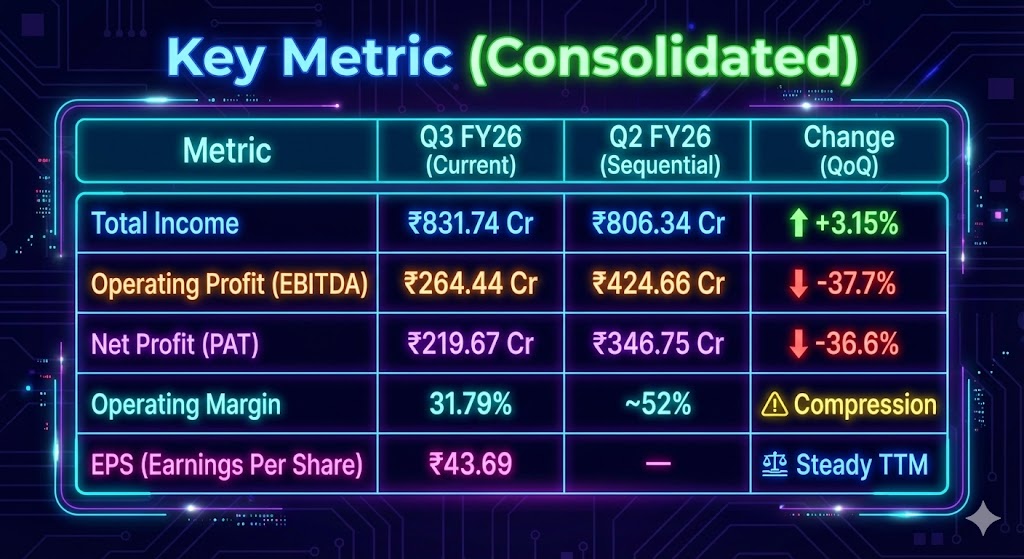
To understand why profits fell even as the business strengthened, we need to look carefully at the numbers.
In Q3 FY26, BSE reported total income of ₹831.74 crore, compared to ₹806.34 crore in Q2 FY26, a steady 3.15% quarter-on-quarter growth. This growth may look modest, but it comes on a much larger base than in previous years, reflecting BSE’s expanding scale.
The pressure shows up at the operating level. EBITDA declined to ₹264.44 crore, down from ₹424.66 crore in the previous quarter, a drop of nearly 37.7%. Consequently, operating margins compressed to around 31.8%, from an unusually high level of about 52% in Q2.
At the bottom line, net profit fell to ₹219.67 crore, compared to ₹346.75 crore in Q2 FY26. Importantly, earnings per share (EPS) on a trailing twelve-month basis remained healthy at ₹43.69, indicating that this quarter did not break the longer-term earnings trend.
The key takeaway from this scorecard is not that BSE’s business weakened. It is that costs grew faster than revenue, and those costs are tightly linked to derivatives market expansion, not to inefficiency or loss of pricing power.
BSE Official Financial Results
3. Fundamental Breakdown: Understanding the Core Drivers
A serious fundamental analysis always asks why numbers moved, not just how much they moved. In BSE’s case, three drivers define Q3 FY26.
A. The Derivatives Market Share Pivot
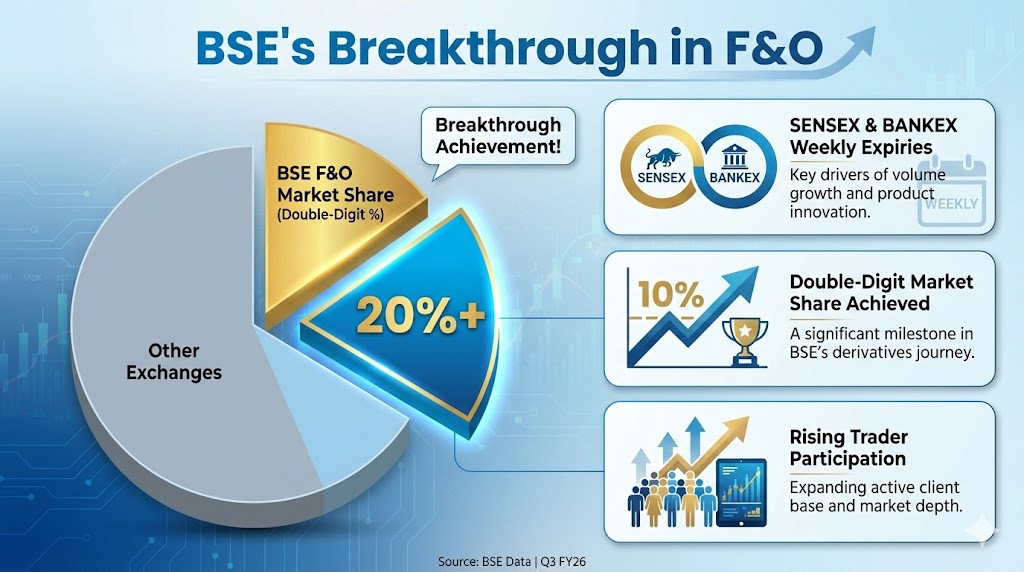
For years, India’s derivatives market—especially Futures & Options (F&O)—was effectively a monopoly. That monopoly is now being challenged.
BSE has successfully leveraged its flagship indices, SENSEX and BANKEX, to build weekly expiry contracts that are attracting serious trader interest. As of early 2026, BSE has captured a double-digit market share in certain index derivatives, a milestone that would have sounded unrealistic just a few years ago.
Why does this matter so much? Because derivatives are high-quality revenue. Unlike cash equities, where pricing is fiercely competitive and margins are thin, derivatives generate large transaction volumes and recurring clearing and transaction fees. Once liquidity reaches a critical mass, volumes tend to reinforce themselves.
Q3 FY26 clearly shows that BSE has crossed the psychological barrier. Traders now treat BSE as a credible alternative platform, not a backup exchange. This shift explains why management is willing to accept short-term margin pressure to lock in long-term volume dominance.
SEBI – Derivatives Market Regulation
B. The SGF Cost Reality: Plumbing, Not a Problem

One of the most misunderstood aspects of this quarter is the rise in SGF (Settlement Guarantee Fund) contributions. To support higher derivatives volumes, SEBI regulations require exchanges to contribute more capital to ensure settlement safety.
From an analyst’s perspective, these costs are not discretionary. They are part of the regulatory plumbing of a growing derivatives ecosystem. Higher SGF contributions are a direct consequence of higher trading volumes and risk exposure.
The important point is this: SGF costs scale with activity, but they do not grow indefinitely. Once BSE’s derivatives business matures and volumes stabilise at a higher base, these costs will grow more slowly than revenue, allowing margins to recover.
In simple language, BSE is laying down expensive pipes today so that water can flow freely tomorrow.
SEBI – Settlement Guarantee Fund (SGF) Framework
C. BSE STAR MF: The Quiet, Consistent Cash Engine
While derivatives grab headlines, BSE STAR MF remains one of the company’s most underappreciated assets. It continues to be India’s largest mutual fund distribution platform, connecting asset management companies, distributors, and investors.
With Systematic Investment Plan (SIP) inflows hitting record levels in early 2026, the STAR MF platform provides annuity-style revenue that is far less volatile than trading income. Every new SIP registered today adds to a growing base of predictable transactions.
This business does not require heavy capital expenditure, nor does it face the same regulatory cost intensity as derivatives. Over time, STAR MF acts as a stabiliser, smoothing earnings through market cycles.
For long-term readers, this is an important lesson: BSE’s business mix is improving, not becoming riskier.
4. Geopolitics and Policy: The India–US Trade Deal Angle
Market infrastructure does not operate in a vacuum. Global capital flows matter, and policy stability matters even more.
The February 2026 India–US Trade Deal has played an indirect but meaningful role in shaping sentiment. By improving trade predictability and sovereign confidence, the deal has encouraged renewed Foreign Portfolio Investor (FPI) interest, particularly from US-based funds.
When foreign participation rises, trading volumes rise automatically—across cash equities, derivatives, and currency segments. BSE benefits from this directly, without taking balance sheet risk.
Another under-discussed advantage is GIFT City. BSE’s international arm, India INX, is strategically placed to handle cross-border financial products, including derivatives linked to Indian indices but traded in an international regulatory environment. As US–India financial integration deepens, this platform could become a meaningful growth contributor.
In short, macro stability amplifies micro strategy. BSE’s platform investments are aligning well with the current geopolitical environment.
5. Investor Verdict: Understanding the Valuation Debate
At around 68 times earnings, BSE’s valuation looks expensive when compared to traditional financial companies. This naturally raises concerns, especially for value-oriented investors.
However, valuation must be viewed in the context of business transformation. Investors are not paying for current profits alone; they are paying for an “options moat”—the possibility that BSE becomes a serious, durable competitor in India’s derivatives ecosystem.
If BSE can maintain and expand its market share against the incumbent, operating leverage will be powerful. The same infrastructure that looks costly today could generate disproportionately higher profits by FY27 and beyond, once SGF costs stabilise and volumes scale further.
It is also worth noting that BSE has a history of consistent dividends, making it attractive to HNI and long-term institutional portfolios that seek a blend of growth and income.
The risk, of course, is execution. Derivatives liquidity is notoriously fickle. Any slip in product design, technology uptime, or regulatory compliance could slow momentum. But so far, BSE has demonstrated discipline and speed, two qualities that were not traditionally associated with legacy exchanges.
6. Conclusion: A Platform Play, Not Just a Stock
The Q3 FY26 results of BSE Ltd are best understood as a growth-stage report, not a mature utility-style earnings statement. Profit compression in this quarter is not a sign of weakness; it is evidence of reinvestment.
BSE is evolving into a financial technology platform, spanning cash equities, derivatives, mutual fund distribution, and international trading. The company is deliberately sacrificing near-term margins to capture market share in segments that matter most for the next decade.
For readers and investors alike, the message is clear: watch volumes, participation, and platform adoption—not just quarterly profit swings. If those metrics continue to move in the right direction, today’s volatility will look like a small price paid for a much larger opportunity.
In India’s rapidly deepening capital markets, BSE is no longer just a place where trades happen. It is becoming the infrastructure on which future financial growth is built.