1. Executive Summary: The Macro Narrative Behind the Numbers
After spending nearly three decades tracking India’s energy financing and shadow-banking ecosystem, I have often described Power Finance Corporation (PFC) as the financial spine of India’s power sector. When power plants are built, transmission lines expanded, or renewable parks financed, PFC’s balance sheet is usually somewhere in the background making it all possible.
The Q3 FY26 results, released on February 5, 2026, show a Maharatna PSU that is not only growing in size but also maturing in quality. On the surface, the headline numbers are solid. PFC reported a 15% jump in standalone net profit to ₹4,763 crore, while consolidated profit (including REC Ltd) reached ₹8,212 crore. Revenue from operations rose at a healthy pace, and the loan book continued to expand well into double digits.
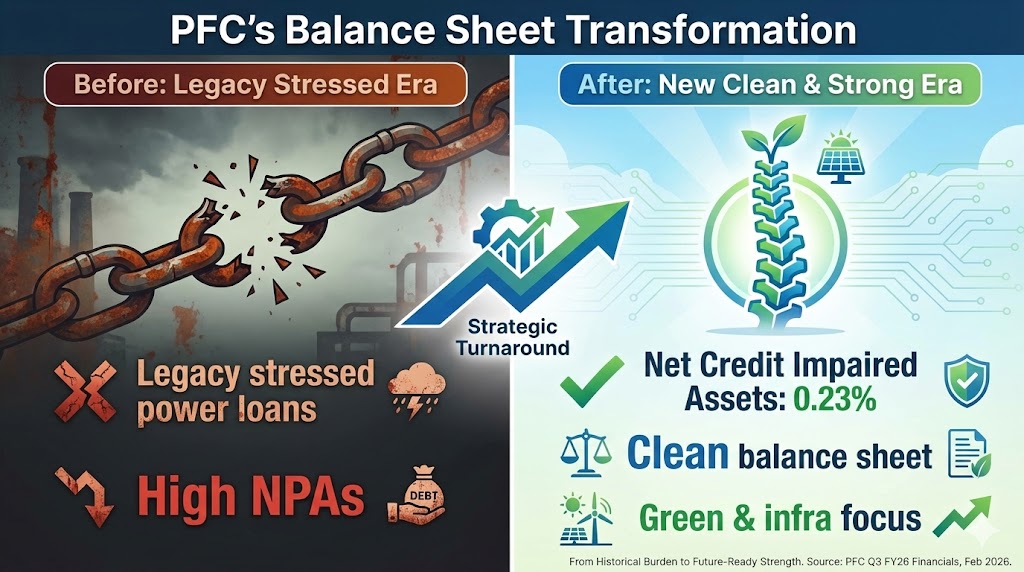
But the real story of this quarter is not just profit growth. It lies in asset quality, specifically the Net Credit Impaired Asset Ratio, which has fallen to a historic low of just 0.23%. For a lender that once carried the burden of stressed power assets and delayed state discom payments, this is a structural shift.
There is also a shareholder-friendly angle. The board announced a third interim dividend of ₹4 per share, taking the total dividend for FY26 to ₹11.35. This signals confidence not just in current earnings, but in the sustainability of cash flows going forward.
In simple words, PFC’s Q3 FY26 performance suggests that the ghosts of the old bad-loan cycle are fading, while a new chapter—focused on renewables, infrastructure, and disciplined lending—is taking shape.
Power Finance Corporation – Official Financial Results (Primary Source)
2. Financial Scorecard: Q3 FY26 at a Glance
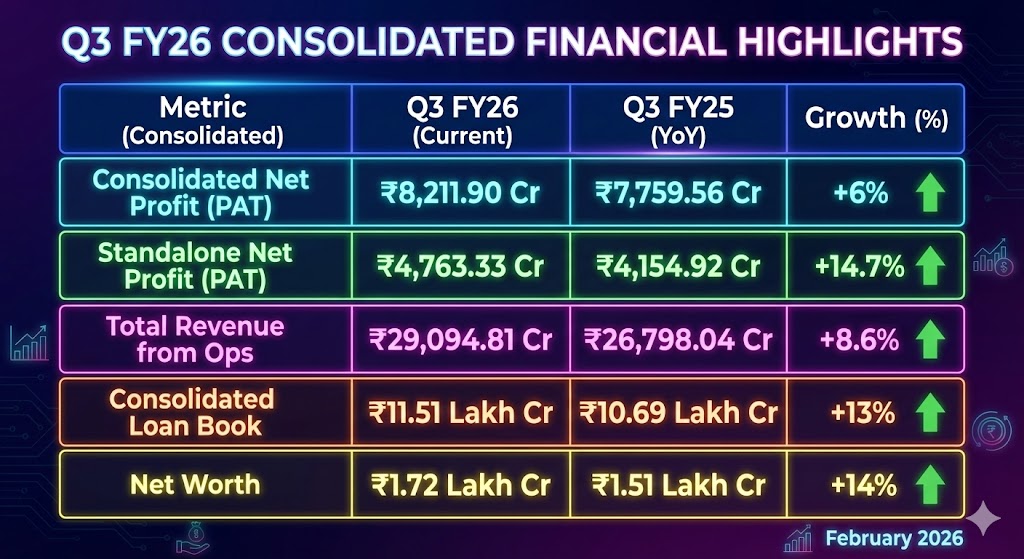
To understand the scale at which PFC operates, it helps to first look at the numbers in one place.
On a consolidated basis, PFC reported a net profit of ₹8,211.9 crore, up from ₹7,759.6 crore in Q3 FY25, reflecting 6% year-on-year growth. The standalone net profit, which better reflects PFC’s core performance, rose sharply by 14.7% to ₹4,763.3 crore, compared with ₹4,154.9 crore a year ago.
Total revenue from operations increased to ₹29,094.8 crore, up 8.6% year-on-year, driven by higher interest income from an expanding loan book. The consolidated loan book grew to ₹11.51 lakh crore, from ₹10.69 lakh crore last year, marking a 13% expansion. This alone underlines PFC’s sheer scale—it is effectively financing a large portion of India’s power and infrastructure pipeline.
Equally important is the balance sheet strength. Net worth rose to ₹1.72 lakh crore, up 14% year-on-year, providing a strong capital base to support future lending. When combined with improving asset quality, this growth in net worth makes PFC far more resilient than it was during the previous power-sector stress cycle.
3. Fundamental Breakdown: The Engine Driving 2026 Growth
A seasoned analyst does not stop at headline growth. The key question is why the numbers look the way they do and whether that momentum is sustainable. In PFC’s case, three structural pillars stand out.
Pillar 1: The Renewable Energy Lending Surge
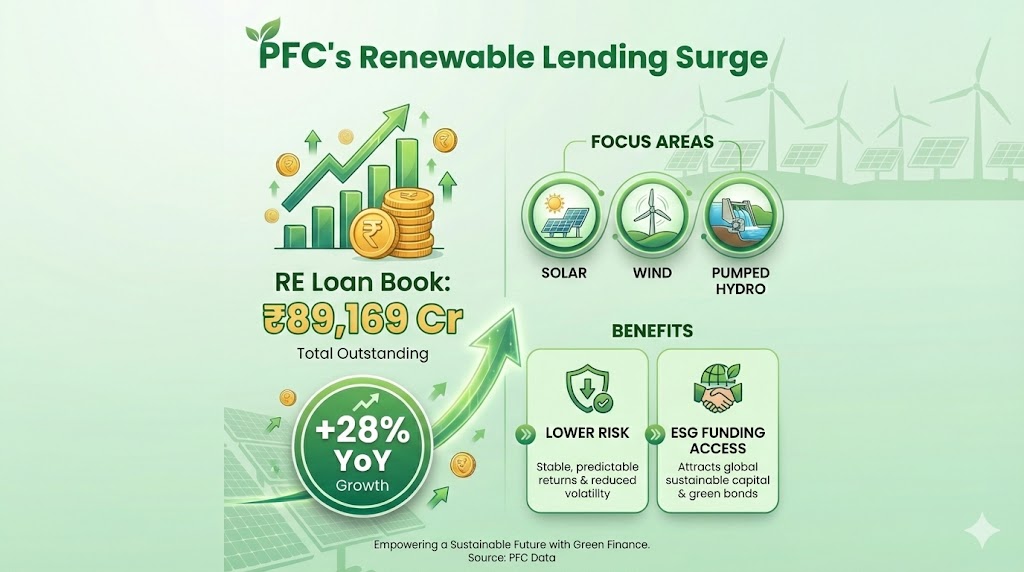
One of the most important shifts in PFC’s business model is its renewable energy (RE) pivot. As of Q3 FY26, PFC’s renewable loan book grew 28% year-on-year to ₹89,169 crore. This is not incremental change; it is a strategic rebalancing.
Historically, PFC was seen as a “coal and thermal power financier.” That perception is changing fast. Under the Union Budget 2026 policy direction, PFC has been encouraged to expand financing for solar, wind, pumped hydro, and hybrid renewable projects. These projects typically carry lower long-term risk, especially when backed by central government schemes or strong off-takers.
There is also a cost advantage. Renewable projects attract global ESG-linked funding and multilateral support, which lowers the cost of capital over time. For PFC, this means it can lend at competitive rates while still protecting margins. Over the long term, this transition improves both risk-adjusted returns and balance-sheet stability.
Ministry of New & Renewable Energy (MNRE)
Pillar 2: Asset Quality Transformation
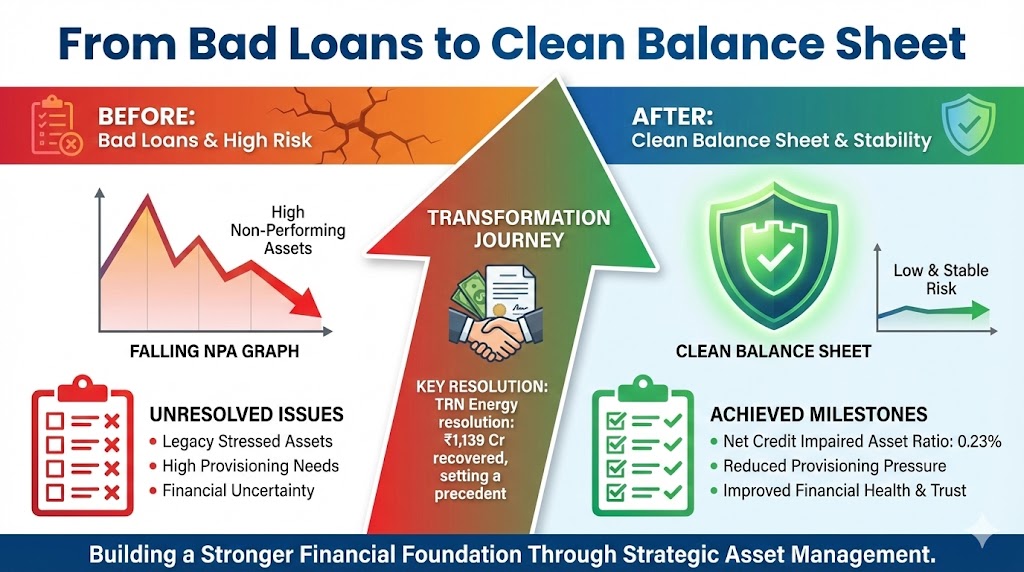
Perhaps the most reassuring aspect of PFC’s Q3 FY26 results is the near-clean balance sheet. The Net Credit Impaired Asset Ratio at 0.23% is not just low—it is exceptional for a lender with such a large and long-gestation loan book.
A key contributor to this improvement was the successful resolution of the TRN Energy loan worth ₹1,139 crore, completed outside the NCLT process. This matters because it shows that PFC is now able to resolve stressed assets proactively, rather than waiting for prolonged legal processes.
In plain terms, when a lender of PFC’s size brings net NPAs close to zero, it enters a “clean balance sheet” era. This reduces provisioning pressure, frees up capital, and allows the institution to price loans more competitively. It also improves investor confidence, which is critical for a market-borrowing-dependent NBFC.
Pillar 3: Infrastructure Lending Beyond Power
Another quiet but important shift is diversification beyond traditional power lending. While electricity generation and transmission remain core, PFC is increasingly financing logistics, metro rail, ports, and large infrastructure projects.
This diversification reduces concentration risk, especially exposure to state discom finances, which historically have been a weak link in the power value chain. By lending to a broader set of infrastructure assets—many with annuity-style cash flows—PFC is building a more balanced and resilient loan portfolio.
Ministry of Power (India) – Power Sector Policy Context
4. Geopolitics and Policy: The India–US Trade Deal Factor
Macro policy and geopolitics play a bigger role in PFC’s future than many investors realise. The India–US trade and technology framework announced in February 2026 has meaningful implications for long-term infrastructure financing.
One key area is clean technology. As India pushes into carbon capture, clean coal transition technologies, nuclear power, and grid-scale storage, access to US technology and private capital becomes increasingly important. PFC, as a government-backed Maharatna, is well positioned to act as a bridge between global capital and domestic infrastructure needs.
There is also a funding angle. PFC regularly taps international bond markets. Improved geopolitical stability and stronger India–US economic alignment help narrow Credit Default Swap (CDS) spreads for Indian sovereign-linked borrowers. Over time, this can lower PFC’s borrowing costs, directly supporting margins.
In short, geopolitics is no longer a distant backdrop. It is becoming a tangible driver of funding efficiency for large infrastructure lenders like PFC.
5. Risk vs. Reward: What Investors Should Watch
No analysis is complete without addressing risks. Despite the strong Q3 FY26 performance, there are a few areas investors should monitor closely.
Margin Pressure Risk
While interest income grew 8.5%, there was a slight dip in PAT margins. This suggests that domestic borrowing costs are rising faster than loan repricing, at least in the short term. As an NBFC, PFC does not enjoy low-cost CASA deposits. It relies on market borrowings, both domestic and overseas.
If RBI policy rates remain volatile or funding costs spike, margins could face temporary pressure. The upcoming Monetary Policy Committee (MPC) decisions will therefore be an important near-term variable.
Valuation Comfort
On the positive side, valuation provides a significant cushion. At around 5.5 times earnings and just above 1x book value, PFC remains fundamentally undervalued compared with private-sector NBFCs and infrastructure financiers. This low valuation reflects historical baggage, but as asset quality improves, the market may gradually reassess this discount.
6. Conclusion: The “Income + Growth” Play
For long-term investors and serious policy watchers, the message from PFC’s Q3 FY26 results is clear. This is no longer a stressed-sector lender struggling with legacy issues. PFC today is a defensive giant—offering the stability of a government-backed institution with the growth profile of an infrastructure fund.
With a dividend yield approaching 3.8%–4%, improving asset quality, and a rapidly expanding renewable and infrastructure loan book, PFC fits neatly into the “income plus growth” category. It may not be a flashy stock, but it is an essential one for understanding how India’s power and infrastructure ambitions are actually financed.
In an economy aiming for scale, energy security, and a green transition, PFC’s role as the financial backbone is becoming more relevant than ever. For conservative, long-term portfolios, that relevance translates into durability—and, over time, steady compounding.
❓ FAQ
FAQ 1
What are PFC’s Q3 FY26 results?
Power Finance Corporation reported standalone net profit of ₹4,763 crore in Q3 FY26, up nearly 15% year-on-year, while consolidated profit stood at ₹8,212 crore.
FAQ 2
How is PFC’s asset quality in Q3 FY26?
PFC’s net credit-impaired asset ratio fell to a historic low of 0.23%, indicating a near-clean balance sheet.
FAQ 3
How large is PFC’s loan book?
As of Q3 FY26, PFC’s consolidated loan book stood at approximately ₹11.51 lakh crore, growing 13% year-on-year.
FAQ 4
Is PFC shifting towards renewable energy financing?
Yes, PFC’s renewable energy loan book grew 28% year-on-year to ₹89,169 crore, reflecting a strategic pivot toward green energy.
FAQ 5
What dividend has PFC declared for FY26?
PFC has declared a cumulative dividend of ₹11.35 per share for FY26 so far, including a third interim dividend of ₹4 per share.